

If you're looking for mental health support, you’ve probably seen the terms therapist, psychologist, and counselor used almost interchangeably. It's a common point of confusion. So, what’s the real difference?
At its core, the main distinction comes down to education and scope. Psychologists have a doctorate (PhD or PsyD), which uniquely qualifies them to conduct psychological testing and diagnose more complex mental health conditions. Counselors and therapists, on the other hand, typically hold a master's degree and focus on providing talk therapy to help people navigate specific life challenges and get emotional support.
The right choice for you really hinges on whether you're seeking in-depth diagnostic evaluation or practical, therapeutic guidance.
Decoding the Differences in Mental Health Care
Choosing the right professional is your first real step toward feeling better, but the jargon can be a roadblock. Each of these roles—therapist, psychologist, and counselor—comes with its own unique training, a different scope of practice, and a distinct approach to care. Getting a handle on these foundations will give you the confidence to find the provider who’s the best fit for your personal needs and goals.

This guide is designed to give you a clear, straightforward comparison. We'll break down exactly what sets these professionals apart, so you can move forward feeling informed and empowered.
At-a-Glance Comparison Therapist vs Psychologist vs Counselor
Let's start with a high-level overview. This quick comparison table is designed to give you a scannable summary of the core differences between these three professional roles.
| Attribute | Therapist (General Term) | Psychologist | Counselor |
|---|---|---|---|
| Primary Focus | Providing talk therapy and emotional support for a wide range of issues. | Diagnosing and treating complex mental health conditions; psychological testing. | Offering guidance on specific life challenges like grief, career, or stress. |
| Education | Typically a master's degree (e.g., MSW, MFT). | Doctoral degree (PhD or PsyD). | Master's degree (e.g., MA, MS in Counseling). |
| Can Diagnose? | Yes, qualified to diagnose many common conditions like anxiety and depression. | Yes, qualified to diagnose all mental health conditions. | Yes, qualified to diagnose many common conditions. |
As you can see, while there's certainly some overlap, the distinct educational paths create different areas of expertise. A psychologist's extensive academic and clinical training prepares them for deep assessment, whereas counselors and therapists specialize in the hands-on, applied techniques that help you navigate life's hurdles.
What It Takes to Be a Professional: A Look at Credentials and Practice
It’s easy to use terms like psychologist, therapist, and counselor interchangeably, but behind the scenes, the paths to these professions are quite different. The specific education, training, and state licensing each person completes shapes how they can help you. Getting a handle on these credentials is the first step to finding the right expert for your situation.
The biggest difference right out of the gate is the level of education required. This single factor is what allows a psychologist to perform deep diagnostic assessments, while a counselor might focus more on practical, goal-oriented guidance.
Education and Training Pathways
The road to becoming a psychologist is the most demanding academically, always requiring a doctoral degree. This is the main thing that sets them apart from therapists and counselors.
- Psychologists must earn a doctorate—either a PhD (Doctor of Philosophy), which is very research-heavy, or a PsyD (Doctor of Psychology), which leans more into clinical practice. This isn't a quick process; it typically takes five to seven years of graduate school, plus thousands of hours of supervised hands-on experience.
- Therapists and Counselors usually need a master's degree to practice. You’ll see degrees like a Master of Social Work (MSW), a Master of Arts in Counseling (MA), or a Master of Science in Marriage and Family Therapy (MFT). This training involves about two years of graduate coursework and is also followed by a hefty period of supervised work.
That doctoral-level training is what gives psychologists the unique ability to administer and interpret a whole range of psychological tests—everything from IQ assessments to in-depth evaluations for conditions like ADHD or personality disorders.
This split in education has a real-world impact. Job postings for psychologists almost always demand a doctorate, while therapist and counselor roles typically set the bar at a master's degree. This also creates a ripple effect, influencing the number of professionals available, market demand, and even how much they earn.
State Licensure and Professional Titles
Education is just the first hurdle. To practice on their own, all three types of professionals must get a license from their state. Think of it as a seal of approval that ensures your provider has met strict ethical and professional standards, which is a critical protection for you.
Getting licensed usually involves a few key steps:
- Finishing the right degree (Master's or Doctorate).
- Putting in the clinical hours—often somewhere between 1,500 and 4,000 supervised hours after graduation.
- Passing a state or national licensing exam. For psychologists, it's often the Examination for Professional Practice in Psychology (EPPP), while counselors might take the National Counselor Examination (NCE).
Once they've checked all the boxes, they earn specific titles that tell you about their qualifications, like Licensed Psychologist (LP), Licensed Professional Counselor (LPC), Licensed Marriage and Family Therapist (LMFT), or Licensed Clinical Social Worker (LCSW). It's always a good idea to double-check a provider's license status on your state’s licensing board website.
Scope of Practice and Treatment Focus
How a professional is trained directly impacts what they can do for you. While all three often provide "talk therapy," their core strengths and expertise can be quite different.
Psychologists have the widest scope of practice. Their deep training in psychopathology, human behavior, and assessment qualifies them to:
- Diagnose the entire spectrum of mental health disorders, from common anxiety to more complex conditions.
- Use psychological tests to get diagnostic clarity (think personality tests or cognitive assessments).
- Offer psychotherapy using a wide range of proven methods.
- Conduct research, adding to our scientific understanding of the mind.
Counselors often zoom in on specific life challenges, helping clients build practical skills to navigate them. Their work tends to be solution-focused, aiming for clear goals related to things like:
- Coping with grief and loss.
- Managing career changes or workplace stress.
- Navigating relationship problems.
- Supporting substance abuse recovery.
Therapists (a term that often includes LMFTs and LCSWs) concentrate on relationships and systems. An LMFT, for example, has specialized training to help couples and families communicate better and work through conflict. An LCSW often looks at the bigger picture, considering how things like your environment and social structures affect your well-being.
It’s good to remember that even though psychologists are the ones handling formal diagnoses and testing, the actual therapy sessions can feel very similar no matter who you see. And if medication is part of the picture, collaboration is key. Many people find that working with a psychiatric mental health nurse practitioner who can manage medication, in addition to their therapist, provides truly well-rounded care.
Matching Your Needs to the Right Professional
Knowing the textbook differences between a therapist, psychologist, and counselor is one thing. Figuring out which one is right for you is another thing entirely. Let's move past the generic definitions and get into practical, real-world scenarios to help you decide who to call.
The single most important factor for success in therapy is finding a provider whose expertise actually lines up with what you want to achieve. It’s about finding the right support for your journey, not just any support.
This decision tree can give you a quick visual to start with, helping you map out your primary needs and see whether testing or therapy is your first step.
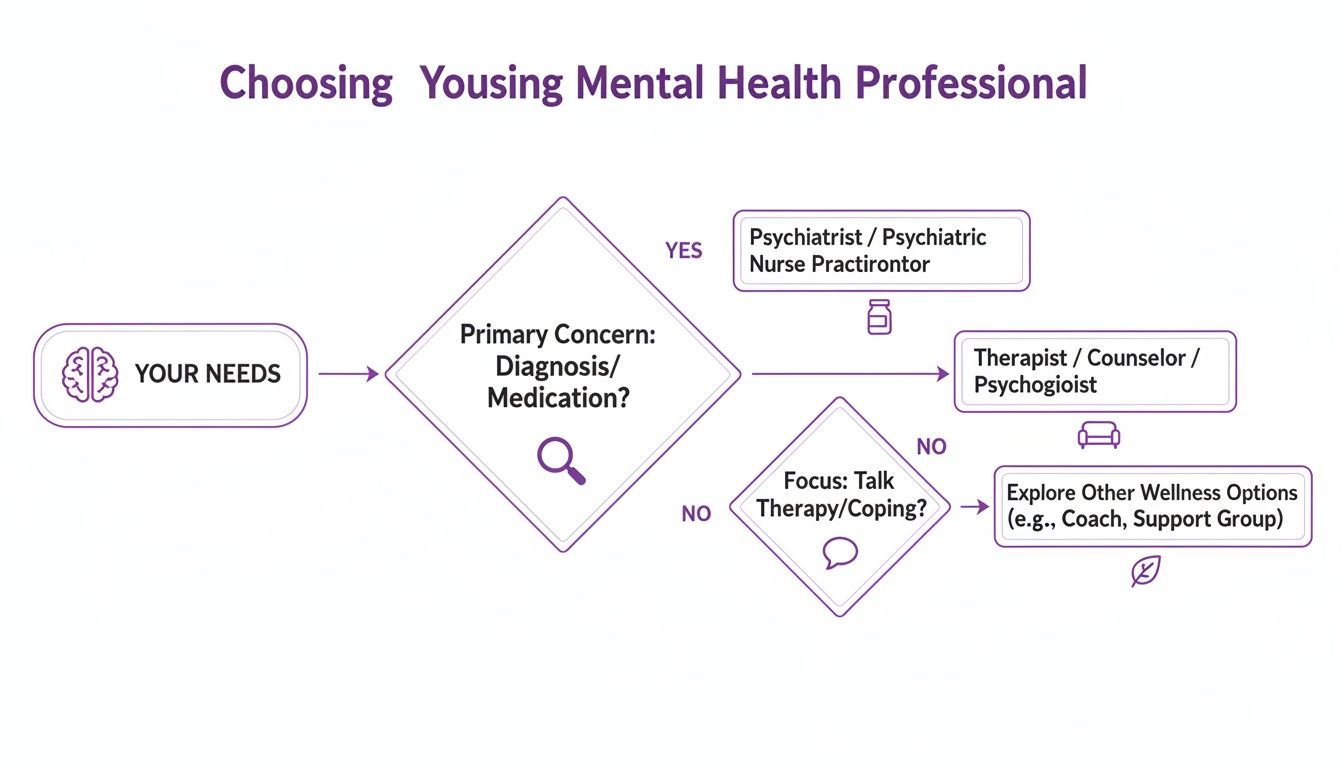
As you can see, if a formal diagnosis through testing is what you're after, a psychologist is your person. But when it comes to talk therapy, all three professionals can be great options, depending on your situation.
When to See a Counselor
Counselors, especially Licensed Professional Counselors (LPCs), are often the perfect choice for navigating specific life challenges that feel overwhelming right now. Their training is usually geared toward finding solutions and giving you practical strategies to help you move forward.
You might want to see a counselor if you’re dealing with:
- Grief and Loss: A counselor provides a safe, supportive space to work through the incredibly complex emotions that come with losing someone you love.
- Career Stress or Transitions: If work has you totally burned out, you're facing a layoff, or you’re thinking about a major career change, a counselor can help you manage the stress and get clear on your next steps.
- Mild to Moderate Anxiety: For those everyday worries or anxiety tied to a specific situation, a counselor can teach you indispensable skills like mindfulness and cognitive reframing.
Think of a counselor as a skilled guide helping you through a distinct, difficult chapter. The work is often shorter-term, focused on giving you the tools to overcome what’s in front of you and build resilience for the future.
When to Choose a Therapist
The title "therapist" is often used to describe professionals who specialize in how we relate to one another and our environment, like a Licensed Marriage and Family Therapist (LMFT) or a Licensed Clinical Social Worker (LCSW). They are true experts in understanding how our connections—or lack thereof—shape our mental health.
A therapist is an excellent choice for situations like these:
- Relationship Issues: An LMFT has specific training to help couples and families communicate better, work through conflict, and heal their connection.
- Family Dynamics: If you're struggling with parenting or stuck in old, unhealthy family patterns, a therapist can help the whole system understand and change for the better.
- Long-Term Emotional Support: For persistent struggles like low self-esteem or trouble managing your emotions, a therapist offers the consistent, in-depth support needed for lasting change.
Of course, when you're looking for any mental health professional, it's vital to ensure they take your privacy seriously. That includes a deep understanding of HIPAA compliance for patient data security to keep your information safe.
When a Psychologist Is the Right Fit
Because they have a doctoral degree, psychologists have a unique and extensive scope of practice. Their expertise really shines in two key areas: psychological assessment and the treatment of complex mental health conditions.
You should definitely seek out a psychologist when you need:
- Formal Diagnostic Testing: If you suspect you or your child might have ADHD, a learning disability, or an autism spectrum disorder, a psychologist is the only one qualified to conduct the comprehensive tests required for a formal diagnosis.
- Complex Mental Health Conditions: For severe or chronic conditions like complex PTSD (C-PTSD), bipolar disorder, or personality disorders, a psychologist can offer a deep diagnostic insight and highly specialized, evidence-based treatments like Dialectical Behavior Therapy (DBT).
- Clarity on an Unclear Diagnosis: If you’ve gotten conflicting opinions or just feel like nobody has quite figured out what's going on, a psychologist can perform a thorough evaluation to provide diagnostic clarity and create a targeted treatment plan.
Finding the right professional can also depend on where you live. The demand for mental health support is incredibly high—nearly 60 million people in the U.S. get treatment each year. But access isn't equal everywhere; for example, the rate of people receiving counseling in nonmetropolitan areas (7.8%) is noticeably lower than in urban centers (9.7%), which shows just how much geography can be a barrier.
No matter where you're starting from, taking some time to explore the different mental health services available is a great first step. It will help you see which approach—whether it’s individual therapy, family counseling, or a specialized treatment—feels like the best fit for you.
Navigating Costs, Insurance, and Finding a Good Fit
Okay, so you understand the differences between a therapist, a psychologist, and a counselor. That’s a huge first step. But the practical side of things—like paying for sessions and finding someone you actually click with—can feel just as daunting. Let's break down how to handle the financial piece and what to look for in a provider to make sure it's a good personal fit.
Getting a handle on insurance and out-of-pocket costs right from the start will save you a ton of stress down the road. And knowing the right questions to ask a potential provider is key to finding someone who isn't just qualified, but is the right partner for your unique journey.

Understanding Insurance and Out-of-Pocket Costs
Thanks to mental health parity laws, most insurance plans do offer some level of coverage for mental health services. The tricky part is that the extent of that coverage varies wildly from one plan to another.
Here are a few insurance terms you'll want to get familiar with:
- Co-pay: This is the fixed amount you'll pay for each session after hitting your deductible.
- Deductible: This is what you have to pay out-of-pocket for your healthcare before your insurance plan starts chipping in.
- In-Network: These are providers who have a contract with your insurance company. Seeing them will almost always be cheaper for you.
- Out-of-Network: These providers don't have a contract with your insurer, which means you'll likely pay more to see them.
Navigating the financial side of things also means knowing how to choose the right health insurance in the first place. The best advice? Call the number on the back of your insurance card. They can verify your benefits and give you a list of in-network professionals in your area.
When you start reaching out, be direct. Ask potential providers if they take your insurance. If they don't, ask about their out-of-pocket fees or if they can provide a "superbill." A superbill is a detailed receipt you can submit to your insurance for potential partial reimbursement.
Making Sure You Find the Right Personal Fit
Finding the right person is about so much more than their credentials. The quality of the relationship you build with your provider—what we call the therapeutic alliance—is one of the single biggest predictors of whether therapy will be successful. You have to feel safe, heard, and genuinely understood.
Many providers offer a brief, free consultation call, and you should absolutely take advantage of it. Think of it as an interview. After all, you're hiring them for a very important job.
Key Questions to Ask a Potential Provider
When you have that initial chat, come prepared with a few questions. This will help you get a feel for their style, their expertise, and whether their personality is a good match for yours.
Questions About Their Approach and Experience:
- What's your therapeutic approach (like CBT or psychodynamic therapy), and how would that apply to my specific concerns?
- Do you have experience working with clients who have dealt with issues similar to mine?
- How do you usually structure your sessions? What can I expect from our first few meetings together?
Questions About Logistics and Expectations:
- What are your session fees? Do you offer a sliding scale or payment plans if I need them?
- What's your policy on cancellations or rescheduling?
- How do you think about the length of treatment? And how will we track my progress?
This first conversation is your chance to assess not just their answers, but how you feel talking to them. Do they seem empathetic? Is the conversation easy? Trust your gut. It's often your most reliable guide to finding a provider you can build a strong, trusting relationship with, which is the foundation of any effective mental health care.
Finding a Mental Health Professional in the Phoenix Area
You’ve done the hard part of learning the differences between a therapist, psychologist, and counselor. Now comes the most important step: finding the right person to start your journey with. If you're in the Phoenix metro area, knowing that great care is right around the corner can make taking that final step feel a lot less intimidating.
At reVIBE Mental Health, we try to make this part as simple as possible. Our team is a diverse group of highly qualified professionals, which means you can find a great match for your specific needs without having to search all over town. Our goal is to connect you with someone who really gets your goals and personality, setting the stage for a strong, trusting therapeutic relationship from day one.
Your Local Partner in Mental Wellness
The need for good mental health care is growing fast. National labor statistics predict that jobs for mental health counselors will jump by 18% between 2022 and 2032—that's way faster than most other jobs. This translates to roughly 42,000 openings each year, and you can definitely feel that demand right here in a major city like Phoenix. You can dig into more of this data on the Bureau of Labor Statistics website.
With so many people seeking support, it’s more important than ever to find a practice that can see you promptly and give you the attention you deserve. At reVIBE, we’re committed to being that reliable resource for our community. Our collaborative approach means you have access to a full spectrum of care, all in one place. Take a moment to meet our team and learn more about our dedicated Phoenix-area therapists to see who might be a good fit for you.
Our mission is simple: to remove the barriers that keep people from getting help. We believe finding a therapist should feel supportive and empowering, starting with the very first phone call.
Find a reVIBE Location Near You!
We currently have five locations for your convenience. (480) 674-9220
-
reVIBE Mental Health – Chandler
3377 S Price Rd, Suite 105, Chandler, AZ -
reVIBE Mental Health – Phoenix Deer Valley
2222 W Pinnacle Peak Rd, Suite 220, Phoenix, AZ -
reVIBE Mental Health – Phoenix PV
4646 E Greenway Road, Suite 100, Phoenix, AZ -
reVIBE Mental Health – Scottsdale
8700 E Via de Ventura, Suite 280, Scottsdale, AZ -
reVIBE Mental Health – Tempe
3920 S Rural Rd, Suite 112, Tempe, AZ
Your Questions Answered: Navigating Mental Health Professionals
Choosing to get mental health support is a huge step, and it’s completely normal to have a lot of questions. Even after learning about the different credentials, what each professional does, and how much it might cost, you might still be wondering about a few things. Let’s clear up some of the most common questions people have when trying to decide between a therapist, psychologist, and counselor.
Getting these last few details ironed out can give you the confidence you need to take that next step and find the right person for you.
Can a Counselor or Therapist Diagnose Mental Illness?
Absolutely. Many licensed professionals, including Licensed Professional Counselors (LPCs) and therapists like Licensed Marriage and Family Therapists (LMFTs), are fully qualified to diagnose common mental health conditions. Their training gives them the skills to recognize and diagnose issues like major depression, generalized anxiety, and PTSD. This is a key part of their job, as a proper diagnosis helps shape an effective treatment plan just for you.
However, there are some limits. When it comes to more complex conditions or situations where formal psychological testing is needed, a psychologist is the right person to see.
A psychologist's doctoral-level training is what sets them apart here. They are the only ones qualified to perform and interpret a whole range of psychological tests. These formal assessments are critical for diagnosing things like learning disabilities, ADHD, autism spectrum disorder, or complex personality disorders that require a much deeper dive into cognitive and behavioral patterns.
Do I Need a Referral to See a Psychologist?
For the most part, no—you usually don't need a referral from your doctor to see a psychologist for therapy. You can typically just research psychologists in your area and call their office directly to set up an appointment. This direct access makes it much easier to get specialized help without jumping through extra hoops.
The big exception? Your health insurance plan. Some insurance providers, especially HMOs, often require a referral from your primary care physician before they’ll agree to cover visits with a specialist, and that includes psychologists. This is particularly true if you're seeking comprehensive psychological testing.
Your best bet is to always call the member services number on the back of your insurance card before you book anything. A quick phone call can clear up your plan’s rules on referrals for mental health care and help you avoid any surprise bills down the road.
How Do I Know Which Professional My Insurance Covers?
Trying to figure out insurance coverage can feel like a maze, but there are a few simple ways to get clear answers. The most direct route is to just contact your insurance company. They'll have the most accurate and current information about what your specific plan covers.
Here are a few practical steps to take:
- Check Your Insurer’s Website: Most insurance companies have an online portal with a search tool for finding "in-network" providers. You can usually filter your search by specialty, like "psychologist," "licensed professional counselor," or "marriage and family therapist."
- Call Member Services: That phone number on your insurance card is your best friend. Just ask the representative for a list of covered mental health providers near you.
- Ask the Provider’s Office: When you find a professional you’re interested in, their office staff is often happy to help verify your insurance benefits as part of the new patient process.
Confirming your coverage ahead of time lets you focus on what really matters: finding a professional you connect with, without having to stress about the cost.
What Is the Difference Between a PsyD and a PhD?
Both a PsyD (Doctor of Psychology) and a PhD (Doctor of Philosophy in Psychology) are doctoral degrees that allow someone to become a licensed psychologist. While professionals with either degree are highly skilled, the training philosophy behind them is a bit different, which might matter to you.
The main distinction really comes down to focus:
- A PhD program is what’s known as a "scientist-practitioner" model. It places a huge emphasis on research, statistics, and scientific methods. PhDs are trained to be both clinicians and researchers. Many go on to work in universities, conduct studies, or publish scientific papers in addition to seeing patients.
- A PsyD program follows a "practitioner-scholar" model. Its primary focus is on the hands-on, clinical practice of psychology—in other words, working directly with patients. While PsyD students learn about research, their coursework is heavily geared toward therapy techniques, clinical assessment, and applying psychological principles in real-world settings.
For anyone looking for therapy, a psychologist with either a PsyD or a PhD is an excellent choice. It really just boils down to your personal preference. You might lean toward someone with a deep background in clinical application (PsyD) or someone with extensive expertise in research and theory (PhD).
No matter where you are in your search, the most important step is the one you take to get started. At reVIBE Mental Health, our team of compassionate and skilled professionals is here to guide you, answer your questions, and connect you with the right care in the Phoenix area. We invite you to visit our website to learn more and take the first step toward feeling better.