

When you're looking for mental health support, one of the first questions you'll likely face is, "Do I need a psychiatrist or a psychologist?" It's a common point of confusion, but the answer is pretty straightforward once you understand their unique roles.
The simplest way to think about it is that psychiatrists are medical doctors (MDs) who can prescribe medication, while psychologists hold a doctorate in psychology (Ph.D. or Psy.D.) and specialize in therapy. Your decision really comes down to whether you need medical treatment, want to build coping skills through therapy, or could benefit from a bit of both.
Answering the Core Question: Psychiatry vs. Psychology

While both professionals are dedicated to helping you feel better, they come at it from different angles. Knowing the difference is the key to getting the right kind of help for your specific needs.
A psychiatrist, first and foremost, is a physician. They’ve gone through medical school and then completed a residency focused on mental health. This gives them a deep understanding of the brain's biology and how physical health can impact your mental state. Because of this medical training, they are licensed to diagnose mental health conditions and prescribe medications.
A psychologist, on the other hand, has earned a doctoral degree focused on human behavior, emotions, and thought processes. Their expertise is in psychotherapy, or "talk therapy." They use evidence-based therapeutic techniques to help you work through challenges, understand your own patterns, and develop new, healthier ways of coping without medication.
Key Professional Distinctions
The roles of psychiatrists and psychologists became more defined after World War II, as each field established its own rigorous training and certification paths. A major milestone was the publication of the DSM-III in 1980, which created a standardized system for diagnosing mental health disorders. This not only improved diagnostic accuracy but also solidified psychiatry's role within medical research. You can learn more about how diagnosis has evolved over time to get a better sense of this history.
To quickly see how they differ in practice, this table breaks it down.
Core Distinctions: Psychiatrist vs. Psychologist
| Attribute | Psychiatrist | Psychologist |
|---|---|---|
| Primary Degree | Medical Doctor (MD or DO) | Doctor of Philosophy (Ph.D.) or Psychology (Psy.D.) |
| Prescribing Ability | Yes, can prescribe medication | No (in most states) |
| Treatment Focus | Biological and neurological aspects of mental health | Cognitive, emotional, and behavioral patterns |
| Typical Approach | Medication management, diagnostic evaluations | Psychotherapy (talk therapy), psychological testing |
This table gives a good at-a-glance summary of the main differences you'll encounter when choosing a provider.
The easiest way to remember the difference is this: Psychiatry follows a medical model, focused on diagnosing and treating illness, often with medication. Psychology uses a therapeutic model, focused on changing thoughts and behaviors through therapy.
The choice isn't always an either/or situation. In fact, many people get the best results by seeing both. A psychiatrist can manage the biological side with medication, while a psychologist provides ongoing support through therapy. This kind of integrated care ensures all aspects of your mental health are being addressed.
Here at reVIBE Mental Health, our teams across Chandler, Phoenix, Scottsdale, and Tempe work together to provide exactly this type of coordinated care.
A Look at the Different Educational and Training Pathways

To really get to the heart of the psychiatry vs. psychology question, you have to look at the demanding and completely different training each professional goes through. The years they spend in school and in clinical practice fundamentally shape their perspectives, their skills, and how they approach treatment.
These distinct journeys are the reason one can prescribe medication and the other specializes in talk therapy.
The Psychiatrist's Medical Journey
First and foremost, a psychiatrist is a medical doctor. Their path starts with a bachelor's degree, just like any other aspiring physician, but then they dive into four years of medical school to earn a Doctor of Medicine (MD) or Doctor of Osteopathic Medicine (DO) degree. Their core medical training is identical to that of a cardiologist or a general surgeon.
After med school, they pivot into a four-year residency that is exclusively focused on psychiatry. This is where the real-world learning happens—in hospitals and clinics, they diagnose and treat a massive range of mental health conditions across all kinds of patient populations.
During this residency, they get their hands dirty in:
- Inpatient and Outpatient Care: Learning to manage everything from acute, severe crises to stable, long-term conditions.
- Specialty Rotations: Gaining focused experience in areas like child and adolescent psychiatry, addiction medicine, or geriatric psychiatry.
- Medical Management: Mastering the complex interplay between a person's physical health and their mental well-being.
This is the key. That extensive medical background is what gives psychiatrists the authority to prescribe medication. They have a deep, practical understanding of neurobiology, pharmacology, and how a specific drug will interact with the body and brain. Some even go on to complete fellowships in highly specialized fields like forensic psychiatry.
The Psychologist's Clinical Path
A psychologist’s education, on the other hand, is built around the science of human behavior, thought, and emotion. After getting a bachelor's degree, they jump into a doctoral program that typically takes five to seven years to complete.
They generally pursue one of two doctoral degrees:
- PhD (Doctor of Philosophy): This degree is heavily focused on research. PhDs are trained not only to provide clinical care but also to conduct scientific studies that push the field forward.
- PsyD (Doctor of Psychology): This degree is all about clinical practice. The training is designed to prepare students for hands-on work providing therapy and conducting psychological assessments.
No matter the degree, the training is incredibly intense. It involves years of coursework on psychological theory, assessment methods, and different therapeutic techniques. The most critical part is the supervised clinical work—including a full-time, year-long internship and often thousands of post-doctoral hours—where they apply everything they've learned with real patients. We're talking thousands of hours of direct patient care before they can even think about getting licensed.
At its core, a psychiatrist’s training is rooted in the biological sciences and medicine, equipping them to treat the brain as an organ. A psychologist’s training is rooted in social and behavioral sciences, equipping them to understand the mind and its patterns.
This specialized training in psychological assessment and evidence-based therapies is a psychologist’s bread and butter. While they are true experts in their field, the critical distinction in the psychiatry vs. psychology debate is that psychologists do not go to medical school and, in most states, cannot prescribe medication.
Interestingly, the field of psychiatry has always been grounded in data. As far back as the 1820s, the profession was collecting statistical data, making it one of the first medical specialties to use epidemiological analysis to improve patient care. By 1917, a precursor to the American Psychiatric Association was already pushing for uniform reporting systems across all mental hospitals to standardize data and get better results. You can learn more about how data has shaped psychiatric care.
Understanding these different paths makes it clear why both professions are so crucial for comprehensive mental healthcare. At reVIBE, our team includes licensed professionals from both backgrounds—including the vital role of a psychiatric mental health practitioner—to make sure you get the well-rounded, effective care that’s right for you.
How Psychiatrists and Psychologists Approach Treatment
When people try to explain the difference between psychiatry and psychology, they often boil it down to a simple "medication versus therapy." While there's a kernel of truth there, the reality is much more nuanced. Each professional’s path to helping you is shaped by years of distinct training, a unique philosophy, and a different set of tools. They offer complementary, not competing, ways to achieve mental wellness.
A psychiatrist’s approach is grounded in medicine. They’ve been to medical school, so they see mental health conditions through a biological and neurological lens—similar to how a cardiologist looks at heart disease. Their first step is typically to diagnose a condition using established medical criteria and then work to relieve the symptoms with targeted interventions.
The Psychiatrist's Toolkit: A Medical and Diagnostic Focus
A psychiatric evaluation feels like a deep dive into your health. It’s a thorough diagnostic process where they’ll review your complete medical history, discuss your symptoms in detail, and may even order lab tests. This is to make sure there isn’t an underlying physical issue mimicking a mental health condition, which is a key difference in the psychiatry vs. psychology comparison.
Once a diagnosis is clear, treatment often revolves around medication management. Psychiatrists are the experts in psychopharmacology—the science of how medications impact mood, thought, and behavior. Their role involves:
- Prescribing Medication: They carefully select the right medication and dosage, whether it's an antidepressant or a mood stabilizer, to help correct chemical imbalances in the brain.
- Monitoring Effects: They keep a close eye on how you're responding, helping you manage any side effects and tweaking the plan as you progress.
- Managing Complex Conditions: They are essential for managing severe conditions like schizophrenia or bipolar disorder, where medication is often the foundation for stability.
You could say that psychiatry often focuses on the 'what'—the symptoms and the diagnosed illness—by tackling the biological factors. The goal is to restore stability on a neurochemical level.
The Psychologist's Toolkit: A Therapeutic and Behavioral Focus
On the other hand, a psychologist's work is built around psychotherapy, or "talk therapy." They work from the idea that our thoughts, feelings, and behaviors are all connected, and that we can develop new skills and self-awareness to change unhelpful patterns. Their focus is less on the biology of your symptoms and more on the life patterns that cause you distress.
Psychologists use a wide range of evidence-based therapies, and many draw from the principles of positive psychology to help clients build resilience and well-being. The specific approach depends entirely on your needs.
Common Therapeutic Approaches
- Cognitive Behavioral Therapy (CBT): This is one of the most widely used and effective therapies out there. It’s a practical approach that teaches you how to spot and reframe negative thought cycles and develop healthier ways of reacting to life’s challenges.
- Dialectical Behavior Therapy (DBT): Originally designed for borderline personality disorder, DBT is now used for a variety of issues. It’s fantastic for helping people manage overwhelming emotions and improve their relationships by teaching skills like mindfulness and distress tolerance.
- Specialized Modalities: Many psychologists also get certified in highly specific techniques. A great example is Eye Movement Desensitization and Reprocessing (EMDR), a structured therapy that helps people heal from the emotional wounds of trauma. You can learn more about how EMDR therapy for anxiety can help your brain reprocess painful memories.
Working with a psychologist is a collaborative, empowering process. Through conversation, skill-building activities, and guided self-exploration, they help you uncover the 'why' behind your feelings and behaviors. You'll walk away with tools that last a lifetime, helping you manage stress and navigate challenges long after your sessions are over.
Matching Your Needs to the Right Specialist
Trying to figure out where to start on your mental health journey can feel like a lot. It’s overwhelming. But a few key questions can help you find your footing. The choice between a psychiatrist and a psychologist usually boils down to what your symptoms feel like and how severe they are. Both pros can help with common issues like anxiety and depression, but your most immediate needs will light the path to the best first step.
Getting this right matters, especially when you realize how common mental health struggles are. In fact, modern psychiatric research shows that 20-25% of adults in the United States experience a diagnosable mental disorder in any given year. That’s roughly one in every four or five people. You can learn more about the widespread nature of these conditions and see just why accessible, clear-cut care is so vital.
When to Consider a Psychiatrist First
If you’re dealing with something that feels deeply biological or neurological, a psychiatrist is often the right person to call first. Because they’re medical doctors, they can assess whether medication could help stabilize your symptoms, making it possible for other therapies to work. Think of a psychiatrist as your go-to when symptoms feel severe or debilitating.
You should probably start with a psychiatrist in these situations:
- You're in an Acute Crisis: If you're having suicidal thoughts, experiencing psychosis, or are so overwhelmed by your symptoms that you can't manage daily life.
- You're Experiencing Severe Mood Swings: For conditions like bipolar disorder or major depressive disorder, medication is often a critical first step to get the extreme highs and lows under control.
- You Have a Psychotic Disorder: Conditions like schizophrenia absolutely require a psychiatrist’s expertise to prescribe and manage antipsychotic medications.
- You're Having Debilitating Panic Attacks: When panic attacks are so frequent or intense that you can’t leave home or go to work, a psychiatrist can prescribe medication to provide more immediate relief.
This flowchart gives you a simple visual guide, showing how a psychiatrist zeroes in on symptoms while a psychologist often focuses on behavioral patterns.
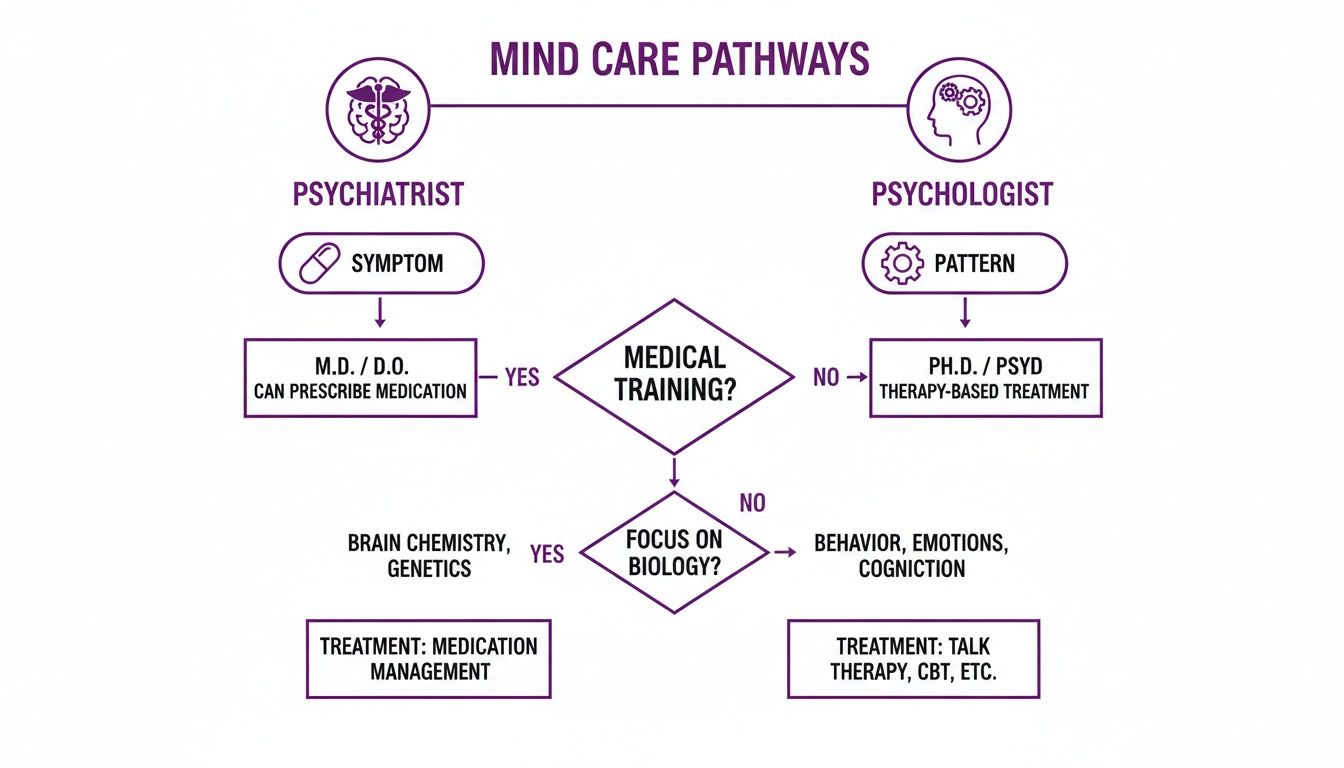
As the chart shows, when symptoms are severe and seem to have a biological root, a psychiatrist’s medical approach is usually the recommended starting point.
Here’s a good rule of thumb: If your symptoms are seriously getting in the way of your ability to work, maintain relationships, or even just take care of yourself, getting a psychiatric evaluation is a smart and effective first move.
When a Psychologist Might Be the Better Starting Point
On the other hand, if your struggles are more tied to your thoughts, specific behaviors, life stressors, or relationship troubles, a psychologist is a fantastic place to start. Their expertise is in psychotherapy, giving you the tools to build coping skills, work through tough emotions, and make lasting changes in how you live your life.
Seeing a psychologist first makes a lot of sense in cases like these:
- Navigating a Major Life Transition: Dealing with grief, a job loss, or the end of a relationship are all areas where a psychologist can offer incredible support.
- Working Through Relationship Issues: Whether it’s with a partner, family, or coworkers, therapy can teach you how to communicate better and build healthier bonds.
- Managing Work-Related Stress: A psychologist can help you come up with real-world strategies to handle burnout, set boundaries, and find a bit more balance.
- Processing Past Trauma: If past events are still affecting you today, a psychologist who specializes in therapies like EMDR can guide you toward healing.
- Developing Self-Awareness: Sometimes you just feel "stuck." If you want to understand your own patterns better, a psychologist can help you explore your inner world and grow as a person.
At the end of the day, this isn't a black-and-white choice. There's no "wrong" door to walk through. Many people start with one specialist and get a referral to the other as part of their treatment plan. The most important thing is simply to reach out. Once you do, a professional can help you figure out the exact mix of care that’s right for you.
Why Collaborative Care Is Often the Best Choice

The whole "psychiatry vs. psychology" debate can feel like you have to pick a side. But in reality, that’s a false choice. The most powerful approach to mental health isn't about choosing one or the other; it’s about understanding how they can work together for you.
An integrated or collaborative approach starts from a simple truth: mental wellness has biological roots and emotional, behavioral ones. Tackling both at the same time is often what leads to the deepest, most lasting change. This "both/and" strategy is quickly becoming the most effective way to treat many conditions, creating a comprehensive support system that addresses immediate symptoms while helping you build long-term resilience.
The Power of an Integrated Approach
Let’s look at a common scenario: someone struggling with severe depression. A psychiatrist can step in to manage the biological side of things, prescribing an antidepressant to help regulate brain chemistry and ease the most crushing symptoms. That medication can be the key that provides enough stability to even begin the deeper work of therapy.
At the same time, that person can see a psychologist or therapist every week. In those sessions, they’ll dig into the root causes of their depression, learn to spot and reframe negative thought patterns, and build a toolkit of coping skills for everyday life. It's a perfect partnership: the medication makes the therapy possible, and the therapy makes the medication more effective over the long haul.
When medication and therapy are combined, the biological and behavioral aspects of mental health are treated in tandem. This creates a powerful synergy where medical treatment provides stability, and therapy provides the skills for sustainable change.
This dual-track approach simply gives you the best of both worlds, paving the way for a more complete and well-rounded recovery.
Benefits of a Unified Treatment Strategy
The advantages really stack up when psychiatrists and psychologists are on the same team, ideally working together under one roof. When your providers are unified, they can develop a single, cohesive treatment plan that is far more powerful than two separate efforts.
Here’s what that looks like for you:
- Seamless Communication: When your providers are colleagues, they can easily share notes, discuss your progress, and make real-time adjustments to your treatment plan. This closes any gaps in care and makes sure everyone is on the same page.
- Holistic Care: An integrated team sees the complete picture. Your psychiatrist understands your therapy goals, and your therapist is aware of any medication changes. The result is a care plan that is truly built around you.
- Less Hassle, Less Stress: Juggling appointments, messages, and records between different offices adds a layer of stress no one needs. Having everyone in one place simplifies the logistics so you can focus on what matters—feeling better.
Collaborative Care in Phoenix and the Valley
At reVIBE Mental Health, this collaborative model is the heart of what we do. Our teams across Chandler, Tempe, Scotscale, and Phoenix include both psychiatric professionals and therapists who work side-by-side every single day. This structure means we can match you with the right combination of care from your very first appointment.
Whether you start with a psychiatric evaluation or a therapy intake, our providers can easily consult one another to ensure your treatment plan is dialed in perfectly to your needs. This seamless teamwork is central to our mission of providing accessible, effective mental health support that helps you get better and stay better.
Find Your Path to Wellness with reVIBE Mental Health
Knowing the difference between psychiatry and psychology is a great first step, but the most important one is actually reaching out for help. At reVIBE Mental Health, our entire mission is to connect you with the right support for you. We have an integrated team of psychiatrists, psychologists, and therapists who all work together, designing a treatment plan that fits your specific needs and personal goals.
We’ve made getting started as simple and stress-free as possible. Our goal is to create a welcoming, non-judgmental space where you feel heard and empowered from the very first conversation. Whether you’re looking for talk therapy, need help managing medication, or are interested in specialized treatments, we’re here to guide you on your journey to feeling better.
Your Journey Starts Here
From the moment you call, we focus on matching you with the ideal provider. We'll even verify your insurance right away so you have total clarity from the start. We firmly believe that excellent care should be accessible. Beyond just the professional distinctions, understanding core principles like supporting emotional well-being and managing anxiety is key, and our team is ready to help you explore these concepts in a safe, therapeutic setting.
We offer a full spectrum of care to ensure you get what you need:
- Psychiatric Evaluations for a clear diagnosis and expert medication management.
- Individual Therapy to help you build coping skills and navigate life's challenges.
- Specialized Treatments like EMDR to effectively process and heal from trauma.
At reVIBE, you’re not just a patient; you are an active partner in your own wellness journey. We are committed to providing care that is both compassionate and effective, tailored specifically to you.
Find a reVIBE Location Near You!
We currently have five locations for your convenience. (480) 674-9220
reVIBE Mental Health – Chandler
3377 S Price Rd, Suite 105, Chandler, AZ
reVIBE Mental Health – Phoenix Deer Valley
2222 W Pinnacle Peak Rd, Suite 220, Phoenix, AZ
reVIBE Mental Health – Phoenix PV
4646 E Greenway Road, Suite 100, Phoenix, AZ
reVIBE Mental Health – Scottsdale
8700 E Via de Ventura, Suite 280, Scottsdale, AZ
reVIBE Mental Health – Tempe
3920 S Rural Rd, Suite 112, Tempe, AZ
No matter where you are on your path, our team is ready to help you find your strength and get back on track. You can explore our complete list of mental health services to see exactly how our collaborative approach can support you.
We Get These Questions A Lot
Let's be honest, figuring out mental healthcare can feel like a puzzle. You've got questions about referrals, who does what, and of course, the cost. Getting these practical details sorted out can make the whole process feel less overwhelming. Here are some of the most common questions we hear when people are weighing psychiatry against psychology.
Do I Need a Referral to See a Psychiatrist?
This really boils down to your health insurance plan. If you have a PPO (Preferred Provider Organization) plan, you can usually just call and book an appointment with a psychiatrist directly—no referral needed. On the other hand, HMO (Health Maintenance Organization) plans almost always require you to get a referral from your primary care doctor first.
The best first step is always to call your insurance provider. A quick check on your specific policy can save you a ton of time and prevent any surprise bills later on.
Can a Psychologist Tell Me If I Need Medication?
A psychologist can't write a prescription, but they are absolutely qualified to recognize when medication might be a helpful part of your treatment. They spend a lot of time with you in therapy, assessing your symptoms and tracking how you're doing.
If your psychologist notices that therapy alone isn't getting you where you need to be, or if your symptoms are particularly severe, they’ll recommend that you see a psychiatrist for a medication evaluation.
Think of it as a professional hand-off. Your psychologist can suggest a medication consult, but only a medical doctor—like a psychiatrist—can actually perform the evaluation and prescribe. It's all about getting you the most complete care.
This kind of collaboration is incredibly common and effective. Your therapist can even share important insights with the psychiatrist (with your permission, of course), which helps the doctor make a much more informed decision about your care.
How Do the Costs Compare?
The cost difference between a psychiatrist and a psychologist often comes down to your insurance and the type of appointments you need. Your first visit with a psychiatrist—the initial evaluation—is typically the most expensive single appointment. That's because it's a deep-dive medical assessment that can take up to 90 minutes.
After that, however, follow-up appointments for medication management are much shorter, usually just 15-30 minutes, and might only happen once a month or every few months. Therapy with a psychologist, in contrast, involves more regular sessions, typically 50 minutes long, scheduled every week or two.
So, while a single therapy session costs less than that initial psychiatric evaluation, the total cost over time might be similar depending on how often you go. The biggest factor, without a doubt, will be how your specific insurance plan covers mental health services for each specialist.
At reVIBE Mental Health, our team is here to help you get answers and find the right fit. We take most major insurance plans and can help you verify your coverage to make everything as clear as possible. Find your path to wellness by connecting with our compassionate team today at https://revibementalhealth.com.