
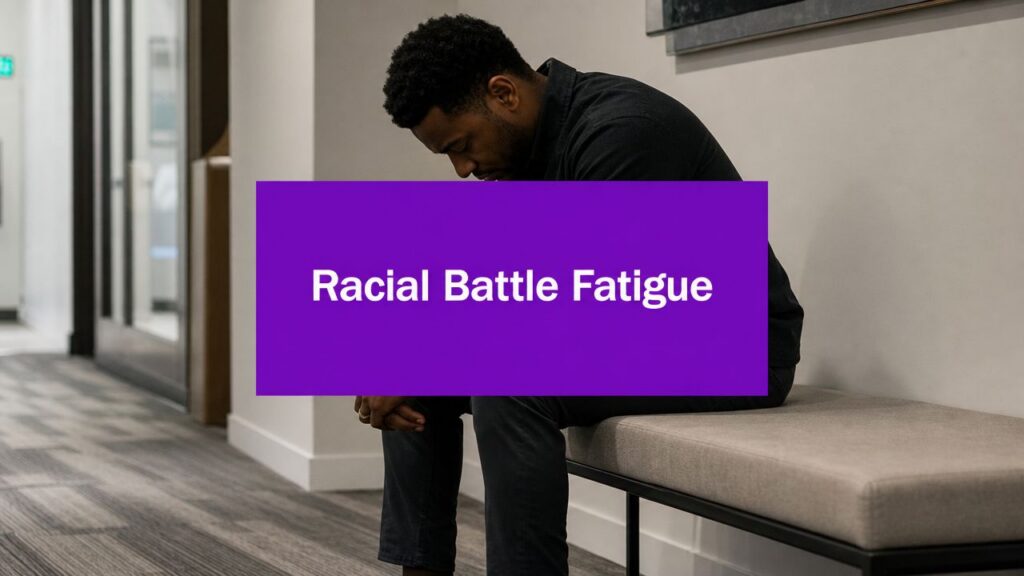
You may be carrying a kind of exhaustion that doesn't fully make sense on paper.
You got through the meeting. You answered the email carefully. You replayed the comment afterward and wondered whether it was biased, dismissive, or “not worth making a big deal about.” You adjusted your tone, your clothes, your hair, your words, and maybe even your face just to get through the day with less friction. Then you got home feeling depleted, tense, and oddly guilty for being so tired.
That kind of weariness can be hard to explain to people who haven't lived it. It's not just stress. It's not just work. For many people of color, it's the strain of moving through environments where racism, exclusion, and constant self-monitoring are part of daily life. Mental health professionals and educators use a specific term for that experience: Racial Battle Fatigue.
Are You Feeling Drained by More Than Just Work
A lot of people arrive at this topic before they arrive at the language for it.
They know they're tired, but “burned out” feels incomplete. Burnout doesn't fully capture the pressure of being the only person of your race in a room, the way your shoulders tighten before speaking up, or the mental math of deciding whether correcting a stereotype is worth the cost today. By the end of the week, you may feel snappy, numb, watchful, or completely spent.
Sometimes it looks ordinary from the outside. You laugh off a joke that landed wrong. You rewrite an email so you won't sound “too emotional.” You stay polished in a meeting where someone questions your competence in a way that feels familiar. You tell yourself it was minor. Your body doesn't agree.
You can be high-functioning and still be carrying racial stress that is wearing you down.
This kind of strain often includes hypervigilance, code-switching, second-guessing, and the pressure to stay composed while navigating subtle and overt bias. People often blame themselves for the fatigue. They think they need more discipline, more sleep, or a better routine. Sometimes those things help. But sometimes the underlying issue is that your nervous system is reacting to repeated racial stress.
If you've also been wondering whether this overlaps with workplace exhaustion, resources on coping with burnout can help you sort out what's general overload and what feels specifically tied to race, belonging, and safety.
Racial battle fatigue gives a name to something many people have felt for years. Naming it doesn't erase the pain. It does reduce the confusion. And that matters, because clarity is often the first step toward relief.
Understanding Racial Battle Fatigue
Racial battle fatigue is a framework for understanding what happens when repeated racism and racial microaggressions place the mind and body under chronic stress.
The term was coined by William A. Smith in 2004 to describe the cumulative physiological, psychological, and behavioral stress responses experienced by People of Color due to chronic exposure to racism and microaggressions. His work also emphasized that navigating racially hostile environments can function in ways similar to combat stress for soldiers, which is part of why the exhaustion can feel so deep and persistent, as described in this overview of the concept's origins and definition.

What the term actually means
This isn't about a single bad interaction.
It's about accumulation. One dismissive comment. One assumption that you're less qualified. One moment of being watched more closely than everyone else. One meeting where you're mistaken for another person of your race. Each incident may seem small to outsiders. Repeated over time, they can create a stress injury that affects concentration, sleep, mood, and a person's sense of safety.
Core idea: Racial battle fatigue is not overreacting. It's a human response to repeated racial stress.
The “battle” part of the phrase can confuse readers. It doesn't mean a person is fighting all day in an obvious way. It points to the constant readiness many people develop in environments where they expect bias, exclusion, or scrutiny. That readiness can become exhausting even on days when nothing dramatic happens.
Why it feels different from ordinary stress
General life stress can come from deadlines, parenting, money, or health concerns. Racial battle fatigue adds another layer. The person isn't just managing tasks. They're also managing exposure to racism and its aftereffects.
That often includes:
- Monitoring safety: deciding when it's safe to speak, correct, challenge, or disengage
- Interpreting ambiguity: asking yourself whether a comment was biased or whether you'll be punished for naming it
- Managing presentation: changing speech, expression, posture, or behavior to reduce harm
- Carrying cumulative memory: remembering past incidents and anticipating new ones
Racial battle fatigue helps explain why someone can leave a room physically tense after a “minor” exchange. The body often recognizes a pattern before the mind feels ready to name it.
The Toll of Racial Battle Fatigue Symptoms and Impacts
The effects of racial battle fatigue often show up across the whole person. Thoughts, emotions, body symptoms, and behavior can all shift at once.
Research covered by Penn State reports that over 40% of African Americans reported experiencing some form of racial discrimination, and that chronic exposure significantly increases the likelihood of generalized anxiety disorder and related manifestations of racial battle fatigue, as summarized in this Penn State report on discrimination and racial battle fatigue.

Psychological and emotional effects
Many people first notice the emotional layer. They feel anxious before work, frustrated in settings that require constant self-editing, or discouraged by how often they have to prove themselves. Some describe dread that starts on Sunday night and doesn't fully lift.
Common emotional effects can include:
- Anxiety: especially in spaces where bias feels likely
- Irritability or anger: often after repeated invalidation
- Sadness or hopelessness: when exclusion feels chronic
- Mental burnout: the drained feeling that follows constant self-protection
Physical and behavioral effects
The body keeps score. Racial battle fatigue has been associated with symptoms such as headaches, high blood pressure, insomnia, and chronic fatigue in the broader framework described in the earlier research on the concept.
Behavior can change too, often in ways that look confusing from the outside:
- Social withdrawal: skipping gatherings because you don't want to explain yourself again
- Overpreparing: spending extra energy trying to avoid criticism
- Hypervigilance: scanning for tone, danger, or disrespect
- Reduced performance: not because you care less, but because stress narrows attention and drains capacity
Some people think, “I must be getting weaker.” Often the opposite is true. They've been enduring too much for too long.
Racial Battle Fatigue vs General Burnout
| Symptom Area | Racial Battle Fatigue (RBF) | General Burnout |
|---|---|---|
| Primary trigger | Repeated racism, microaggressions, exclusion, and racialized stress | Chronic workload, overload, lack of rest, role strain |
| Emotional pattern | Anxiety, frustration, vigilance, sadness tied to racial experiences | Detachment, exhaustion, cynicism tied to work demands |
| Body response | Tension, headaches, sleep disruption, fatigue that can follow racial stress | Fatigue, low motivation, sleep problems from overwork |
| Thought pattern | “Am I safe here?” “Was that racist?” “Do I have to prove myself again?” | “I can't keep up.” “I'm depleted.” “I need a break.” |
| Social impact | Isolation, code-switching, guardedness, mistrust | Withdrawal, irritability, lower engagement |
| What often helps | Validation, culturally responsive support, safer community, boundaries, therapy | Rest, workload changes, recovery time, support, therapy |
The two can overlap. A person can be burned out from work and also carrying racial battle fatigue. When both are present, recovery usually requires more than rest alone.
How Racial Battle Fatigue Manifests in Daily Life
At work, racial battle fatigue often hides inside “small” moments.
A professional of color may enter a meeting already preparing to be interrupted, dismissed, or mistaken for someone more junior. If that person gets through the meeting without any obvious incident, they may still leave exhausted because they spent the entire hour monitoring tone, wording, posture, and risk. That effort is real labor.
In the workplace
One person may get asked, again, if they're “really from here.” Another becomes the unofficial translator for every diversity issue in the office. Someone else notices that when they show confidence, they're described as intimidating, but a colleague showing the same confidence is called leadership.
In healthcare settings, the link between race-related stress and professional exhaustion is especially visible. A 2022 survey found that 61% of Black physicians attributed their burnout directly to racial microaggressions from patients or colleagues, as noted by reVIBE Mental Health's discussion of racial battle fatigue in practice. That helps put words to a pattern many professionals already know in their bodies.
In social and academic spaces
Racial battle fatigue doesn't stop when work ends.
It can show up at dinner with friends when someone makes a comment and waits for you to teach them why it was offensive. It can appear in classrooms where a student feels pressure to represent an entire race, or in graduate programs where people act as if belonging must be earned over and over. Even casual spaces can require constant interpretation: Was that curiosity, stereotyping, or hostility dressed up as a joke?
A few daily-life signs often look like this:
- Code-switching until you feel far from yourself
- Replaying conversations long after they end
- Avoiding spaces where you expect to be the “only one”
- Feeling guilty for being tired because nothing “big” happened
The daily burden often comes from repetition, not drama. A person can be wounded by pattern as much as by event.
That's why racial battle fatigue can be hard to explain. The harm isn't always loud. But it is cumulative, and it is intensely felt.
Building Resilience Practical Coping Strategies
No self-care routine can erase racism. But some strategies can reduce the toll it takes on your nervous system, your relationships, and your sense of self.
Evidence-based approaches discussed by a school psychologist in The Conversation's overview of racial battle fatigue include cultivating community, practicing mindfulness, and engaging in regular physical activity. Those aren't quick fixes. They are stabilizers. They help restore capacity in a body and mind that have been asked to carry too much.
Protect what restores you
Community matters because isolation intensifies stress. People heal better when they have places where they don't have to explain basic realities.
That might mean:
- Choosing affirming spaces: spending more time with people who don't minimize racial stress
- Using support intentionally: group chats, peer circles, faith communities, affinity spaces, or trusted friends
- Letting yourself be known: saying “that interaction really got to me” instead of forcing yourself to act fine
Mindfulness can help when your nervous system stays activated long after a difficult interaction. The goal isn't to become detached from injustice. The goal is to help your body come down from constant alert.
If grounding through the body feels useful, somatic healing exercises can offer practical ways to release tension, notice activation early, and reconnect with a sense of steadiness.
Choose your boundaries on purpose
Not every moment requires a response. That isn't avoidance. Sometimes it's conservation.
Here are a few ways people protect their energy:
- Pre-decide your limits. Know which comments you'll address, which settings you'll leave, and which conversations you won't take on.
- Shorten the recovery loop. After a racialized interaction, move your body, call someone safe, journal, pray, or sit quietly before jumping back into productivity.
- Use self-affirmation. Remind yourself what is true about you before someone else's bias becomes your inner voice.
Practical rule: Ask, “What would help me feel more resourced in the next hour?” Not what would make the whole problem disappear. Just the next honest step.
Physical activity can also help discharge stress that gets trapped in the body. That doesn't have to mean a hard workout. A walk, stretching, dancing, or anything that interrupts freeze and tension can be meaningful.
Resilience isn't pretending you're unaffected. It's learning how to stay connected to yourself while moving through what hurts.
Seeking Professional Support for Racial Battle Fatigue
Professional support can make a major difference when racial stress starts shaping sleep, concentration, relationships, work performance, or your basic sense of safety.
Therapy is useful here not because the problem is “all in your head,” but because repeated racial stress affects the mind and body in ways that deserve care. A skilled clinician can help you identify patterns, process anger and grief, reduce hypervigilance, and build strategies that fit your life rather than generic advice that ignores race.
What good therapy can look like
A culturally competent therapist won't ask you to prove that racism happened. They'll understand that ambiguity itself can be stressful, and they'll help you work with the aftereffects.
Depending on your needs, support may include:
- Trauma-informed talk therapy: to process repeated racial injury without minimizing it
- CBT approaches: to work with anxiety, self-doubt, and exhausting thought loops
- EMDR: when specific experiences feel stuck and keep activating the nervous system
- Psychiatry and medication support: when symptoms such as anxiety, depression, or insomnia feel intense and persistent
Research also shows that racial battle fatigue can look different across groups. A study on Black women graduate students found that gendered racism and academic isolation were linked with physical pain and sleep disturbances, highlighting the need for care that understands intersecting stressors, as discussed in this research on Black women graduate students and racial battle fatigue.
How to find support that fits
When you're looking for care, it helps to ask direct questions. Does this provider talk openly about racial trauma? Do they understand microaggressions? Can they explain how they adapt therapy for clients dealing with chronic racism rather than only individual stress?
A broader support network can help too. If you want a place to explore mental health tools and supportive resources outside the therapy room, Kindness Community Foundation offers a community wellness platform designed to help people connect with practical wellbeing support.
For readers who want therapy that explicitly centers identity, safety, and lived experience, learning more about culturally sensitive therapy can make the search feel less overwhelming.
Getting help is not a sign that you've failed to cope. It's often the moment you stop carrying an unfair burden alone.
Your Path to Healing in Phoenix Starts Here
Healing from racial battle fatigue usually begins with one important shift. You stop treating your exhaustion like a personal weakness and start seeing it as a response to chronic strain.
That shift matters in Phoenix just as much as anywhere else. People are juggling work, school, caregiving, money stress, and relationship stress already. When racial stress gets layered on top, fatigue can intensify quickly. In academic and professional settings, the load can be heavier still. Black faculty at White universities often spend 20% to 30% more time on student mentoring and diversity work than their White counterparts, which directly contributes to exhaustion, as noted by reVIBE Mental Health's overview of these added professional burdens.
What healing often includes
For many, recovery doesn't come from one insight. It comes from support, repetition, and a place where your experience is taken seriously.
That may include:
- Naming the pattern clearly: recognizing when your stress is connected to racialized experiences
- Reducing isolation: building contact with people and spaces that feel safe enough to exhale
- Getting skilled care: working with clinicians who understand trauma, anxiety, depression, and the impact of bias
- Creating a sustainable plan: one that fits your schedule, your symptoms, and your level of capacity right now
You don't need to wait until you're falling apart to reach for support. You also don't need a perfect explanation for why you feel so tired. If your mind and body have been signaling that something is off, that is enough reason to listen.
Find a reVIBE location near you
If you're looking for care in the Phoenix area, local support is available close to home.
Find a reVIBE Location Near You!
We currently have five locations for your convenience. (480) 674-9220
reVIBE Mental Health – Chandler
3377 S Price Rd, Suite 105, Chandler, AZ
reVIBE Mental Health – Phoenix Deer Valley
2222 W Pinnacle Peak Rd, Suite 220, Phoenix, AZ
reVIBE Mental Health – Phoenix PV
4646 E Greenway Road, Suite 100, Phoenix, AZ
reVIBE Mental Health – Scottsdale
8700 E Via de Ventura, Suite 280, Scottsdale, AZ
reVIBE Mental Health – Tempe
3920 S Rural Rd, Suite 112, Tempe, AZ
Healing is possible. It often starts with being believed, understood, and supported in a way that matches what you're carrying.
If you're ready to take the next step, reVIBE Mental Health offers compassionate therapy, EMDR, and psychiatry with medication management for people across the Phoenix metro area. With in-person and online options, a welcoming environment, and locations in Chandler, Phoenix, Scottsdale, and Tempe, reVIBE makes it easier to find care that fits your needs and helps you feel like yourself again.