You rehearse a question in your head, then decide it's safer to stay quiet. You want to ask for help, set a boundary, apply for something, speak up in a room, or tell the truth about how you feel, but the possibility of hearing no stops you before the moment even starts. That pattern is common, and it can subtly shrink a person's life.
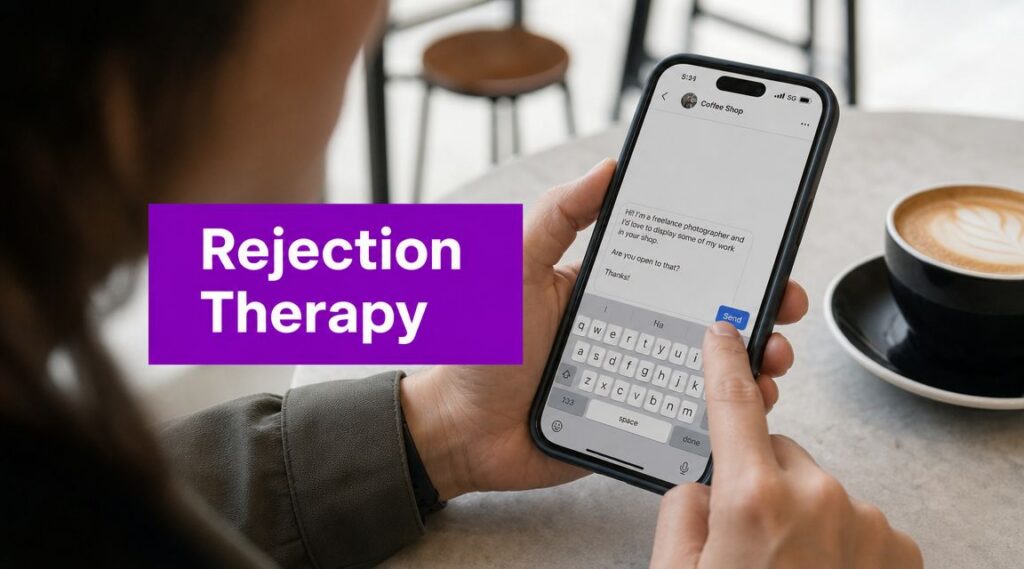
Rejection therapy offers a practical way to interrupt that cycle. It's a relatively modern self-help concept, and one of the milestones that pushed it into the mainstream was Jason Comely's 100 Days of Rejection Therapy, a structured challenge built around deliberately seeking situations where rejection might happen. That framework matters because it turned fear of refusal into a repeatable exercise instead of a vague personal weakness.
Done well, rejection therapy isn't about collecting humiliations or forcing yourself into unsafe situations. It works best when it's gradual, respectful, and tied to a therapeutic purpose. Many guides describe it as one ask per day, often sustained for at least 30 days so the nervous system has time to adapt and the pattern becomes trackable, as described in this dating-focused guide to rejection therapy.
Below are seven rejection therapy ideas that move from lighter exposures to deeper vulnerability. Each one can build resilience, but each one also comes with trade-offs. Some work because they lower the emotional stakes. Others work because they reveal how often your predictions are harsher than reality.
1. Low-Stakes and Absurd Requests
A strong starting point is asking for something that's mildly uncomfortable but not overly personal. Retail and food settings are useful here because the interaction is brief, the stakes are low, and a no usually isn't about you. Ask a coffee shop if they ever give out a free pastry with an order. Ask a clothing store whether there's any discount available. Ask a bakery whether they can make a donut with a silly design that probably isn't on the standard menu.

Absurd requests can help because they reduce overidentification. If you ask for a sandwich with every vegetable on the menu, you're not exposing your deepest insecurity. You're practicing tolerating a response you can't control. That's often exactly where beginners need to start.
How to keep it useful
What works is brief, polite, consent-safe discomfort. What doesn't work is turning the exercise into a prank, a power move, or a test of whether strangers will rescue your self-esteem.
- Choose low-impact settings: Busy chain-style retail or casual food spots usually feel easier than highly intimate businesses where staff may know you well.
- Use a simple script: “I know this may not be possible, but I wanted to ask.” That keeps you direct without sounding demanding.
- Thank the person either way: The point is exposure, not getting a yes.
- Write down the result: Note what you predicted, what happened, and how long the discomfort lasted.
Practical rule: If the ask would make another person feel trapped, manipulated, or mocked, skip it.
A lot of rejection therapy ideas fail because people start too big. They jump to asking for something loaded, like a major raise or an emotionally risky confession, before they've learned how to regulate the body response to a simple no. Start smaller than your ego wants. That usually leads to better progress.
2. Public Speaking or Group Participation
For many people, the hardest part isn't one person saying no. It's being seen by a group. Raising your hand at a workshop, town hall, lecture, networking event, or community seminar can be a potent exposure because the fear often centers on visibility, not just rejection.

Prepare one genuine question before you go. Keep it short. Ask for clarification, a practical example, or one next step. In a community mental health seminar, for example, you might ask how someone can tell the difference between ordinary stress and a level of anxiety that deserves support.
Why this one hits differently
This exercise targets several fears at once. You're tolerating attention, the possibility of sounding imperfect, and the uncertainty of how others will respond. That makes it more emotionally demanding than asking for a discount, but it also makes the gains more transferable to work meetings, interviews, classes, and social events.
If social anxiety is already shaping your daily life, getting extra support can make this kind of exposure much safer and more effective. reVIBE has a helpful guide on how to overcome social anxiety that fits well with this kind of gradual practice.
Most people in the room aren't grading you. They're relieved someone asked the question they were too nervous to ask.
One caution matters here. Don't measure success by whether your voice shakes or whether the room responds warmly. Measure it by whether you stayed in the moment and followed through. That shift matters. Exposure works best when the win is participation, not perfect performance.
3. The Authentic Request
Some rejection therapy ideas are playful. This one isn't. Asking for genuine help can stir up much more vulnerability because it touches beliefs like “I'm a burden,” “I should handle this alone,” or “If I need something, people will pull away.”
That's why this exercise can be so powerful. Ask a neighbor if you can borrow a tool. Ask a coworker for feedback on a project. Ask a friend if they have the emotional bandwidth to listen for a few minutes. Ask someone for directions instead of immediately using your phone. If you need a reasonable accommodation at school or work, naming that need can also be a meaningful exposure.
What makes it therapeutic
This kind of ask reveals the gap between predicted rejection and actual human response. Many people discover that others are more willing to help than expected, or that a respectful no doesn't equal abandonment. Even when someone declines, the experience often carries less shame than the mind predicted.
A useful way to structure it is:
- Be specific: Ask for one concrete thing rather than hinting.
- Pick the right person: Start with someone reasonably safe, not the most emotionally complicated relationship in your life.
- Respect the answer: Help that's freely given builds trust. Help extracted through guilt doesn't.
- Review the story you told yourself: Did you assume rejection before the ask even happened?
If asking for support feels almost impossible, that may be a sign the struggle runs deeper than ordinary discomfort. reVIBE's article on signs you need therapy can help people recognize when self-help tools should be paired with professional care.
In this context, I often see the biggest shift in therapy. Not because every request goes well, but because clients begin to learn that need is not the same thing as weakness.
4. The Compliment or Genuine Appreciation
Not every useful exposure involves asking for something. Many anxious people are just as afraid to express warmth as they are to ask for help. Giving a sincere compliment or offering appreciation can trigger fears about being awkward, intrusive, or “too much.”
That makes this a surprisingly effective exercise. Tell a coworker you appreciated how they handled a meeting. Thank a store employee for being patient and helpful. Compliment someone's jacket, glasses, or shoes in a brief, respectful way. Leave a thoughtful positive review for a service provider when you mean it.
Keep it brief and grounded
The mistake here is making the interaction intense. You're not trying to force closeness. You're practicing visible goodwill without overmanaging how it lands.
- Be specific: “You explained that clearly” works better than a vague “You're amazing.”
- Stick to safe topics with strangers: Clothing, style, or service are usually better choices than comments about someone's body.
- Don't chase reassurance: Say it, mean it, and let the moment end naturally.
There's a quiet strength in this exercise. You're tolerating exposure while giving something positive. That can loosen the belief that every social risk has to involve loss, embarrassment, or defense. It also helps people who are so focused on self-protection that they rarely practice open, prosocial contact.
Many people notice something important here. The discomfort often passes quickly when attention moves off self-monitoring and toward genuine connection. That doesn't mean every compliment lands smoothly. It means imperfect social moments are survivable, and often softer than expected.
5. The Boundary-Setting Request
Some people fear rejection most when they're on the receiving end. Others fear causing it. If you people-please, overexplain, or agree to things you resent, one of the best rejection therapy ideas is learning to be the person who says no.

Decline an invitation you don't want to accept. Tell a coworker you can't take on their extra task. Put a time limit on a phone call. Ask someone not to bring up a topic that leaves you dysregulated. This is still rejection exposure because you're tolerating the fear that someone may be disappointed, annoyed, or less approving of you.
Why this can be harder than asking strangers for odd favors
Boundary setting challenges identity-level fears. If you've built safety through accommodation, saying no can feel dangerous even when the relationship is healthy. The body may respond as if you're risking connection itself.
A few guidelines make this more effective:
- Use plain language: “I can't do that” is enough.
- Avoid long defenses: Overexplaining often invites negotiation.
- Start with lower-stakes relationships: Practice before using this with the most reactive person in your life.
- Track outcomes: Compare what you feared with what happened.
reVIBE offers a practical resource on setting healthy boundaries with family, which is especially useful when guilt and obligation are tangled together.
A boundary is not a punishment. It's information about what you can and cannot do with integrity.
This is one place where rejection therapy can expose deeper wounds. If setting even a small limit triggers panic, shutdown, or intense shame, slow down and work with a therapist. Pushing harder isn't always the answer.
6. The Professional or Authority Request
Many adults can ask peers for things but freeze around authority. Doctors, supervisors, teachers, contractors, and even experienced service providers can trigger old fears of being dismissed, judged, or punished for speaking up.
A useful exposure is respectfully challenging the power imbalance. Ask a doctor to explain why they're recommending a treatment. Ask a professor or teacher to clarify grading logic. Ask a contractor to walk you through an estimate. Ask a therapist why a certain approach makes sense for your goals. None of this is rude. It's self-advocacy.
Use curiosity, not combat
This exercise works best when the tone is calm and direct. The phrase “Can you help me understand…” lowers defensiveness while still protecting your right to ask questions.
A neuroscience explainer notes that rejection therapy is grounded in cognitive behavioral therapy and exposure therapy, with the aim of reducing anxiety through systematic exposure to feared social outcomes, in this introduction to rejection therapy. That same source discusses research suggesting intensity matters. Medium-intensity rejection appears more adaptive than severe rejection, which is a useful reminder not to turn this into a showdown.
So skip the dramatic confrontation. Try measured, reality-based moments of self-advocacy instead.
- Prepare one or two key questions: Don't flood the interaction when you're anxious.
- Notice the body response: Shame, anger, and fear often show up together here.
- Score the exercise by follow-through: Not by whether the authority figure was perfectly warm.
This exercise often changes more than confidence. It helps people remember that expertise doesn't erase their right to understand, consent, question, and participate.
7. Social Vulnerability and Creative Expression
The highest-yield exposures are often the ones that involve being seen as you are. That might mean admitting you're struggling in real time, asking for emotional support, sharing a piece of writing, posting artwork, offering an original idea in a meeting, or publishing a personal reflection that matters to you.
These experiences can sting more because the “product” is closer to the self. If someone dismisses your feeling, ignores your post, or critiques your idea, it's easy to interpret that as global rejection. That's why pacing matters.
Start where support is possible
Begin with trusted people or smaller audiences. Let a friend know you're having a hard day and ask whether they can stay present with you for a few minutes. Share writing with one safe person before posting publicly. Offer a thoughtful dissenting opinion in a meeting rather than leading with your most exposed material.
Independent guidance on rejection therapy emphasizes starting with small, low-stakes asks, avoiding manipulative or inappropriate requests, and accepting no gracefully in this therapist-written overview of rejection therapy. That applies here too. Vulnerability should be intentional, not flooding.
For some people, reflective work helps before or after an exposure. These shadow journal prompts can be useful if you want to explore what rejection tends to activate in you, such as shame, anger, perfectionism, or old attachment fears.
Share enough to stretch yourself, not so much that you abandon yourself.
One more caution deserves to be said clearly. Rejection therapy is not a substitute for trauma treatment, and it isn't a contest in bravery. If creative exposure or emotional openness routinely leaves you overwhelmed for days, scale back. A smaller exposure done with care is usually more therapeutic than a dramatic leap you can't metabolize.
7 Rejection Therapy Ideas Comparison
| Exercise | Implementation Complexity 🔄 | Resource Requirements ⚡ | Expected Outcomes 📊 ⭐ | Ideal Use Cases 💡 | Key Advantages ⭐ |
|---|---|---|---|---|---|
| Low-Stakes & Absurd Requests (Discounts & Unusual Requests) | Low, brief, repeatable interactions | Minimal, minutes, public retail settings | Increased rejection tolerance; quick confidence boosts 📊 | Introductory exposure for rejection-averse beginners | Accessible, low-risk practice with immediate feedback ⭐ |
| Public Speaking / Group Participation (Ask a Question) | Moderate–High, preparation + visible exposure | Moderate, events, prep time, opportunity to speak | Durable public-speaking skills and genuine confidence 📊 ⭐ | Performance-anxiety, career skill-building, social presence work | High-transfer value to professional and social contexts ⭐ |
| The Authentic Request (Asking for Help) | Moderate, requires genuine vulnerability | Low–Moderate, real relationships, occasional therapist support | Better help-seeking, stronger support networks, trust-building 📊 ⭐ | Rebuilding help-seeking in therapy; interpersonal trust work | Produces real connection and practical support outcomes ⭐ |
| Compliment / Genuine Appreciation | Low, brief giving of positive regard | Minimal, attention and sincerity, seconds per interaction | Improved mood, expression practice, usually positive feedback 📊 | Anhedonia, emotional expression practice, low-risk vulnerability | High positive reception; safe way to practice authenticity ⭐ |
| Boundary-Setting Request (Saying No) | Moderate, direct, requires assertiveness practice | Low–Moderate, conversations, therapeutic processing | Stronger boundaries, reduced chronic anxiety, improved esteem 📊 ⭐ | People-pleasing, codependency, family-trauma related work | Promotes long-term self-care and healthier relationships ⭐ |
| Professional / Authority Request (Challenge Experts Respectfully) | Moderate, involves power dynamics and calibration | Moderate, research, communication skills, therapy prep | Improved advocacy, clearer information, better service outcomes 📊 ⭐ | Medical, educational, workplace self-advocacy; institutional trauma work | Enhances autonomy and access to appropriate care/services ⭐ |
| Social Vulnerability & Creative Expression | High, intense emotional exposure and potential critique | High, safe audience/platforms, therapeutic support recommended | Deep interpersonal bonds, resilience to criticism, creative opportunities 📊 ⭐ | Perfectionism, identity work, trauma-informed expressive work | Deepest therapeutic payoff; fosters authenticity and community ⭐ |
Your Next Steps Rejection Therapy and Professional Care
You rehearse a simple ask in the parking lot, walk in, and feel your chest tighten before you speak. That moment is where rejection therapy either becomes useful or becomes too much. The difference is pacing, purpose, and support.
These exercises work best as graded exposure, not as random dares. A low-stakes request can help you notice anticipatory anxiety and stay present long enough for it to pass. A harder exercise, such as setting a boundary or making an authentic request, can show you which beliefs drive the fear. In therapy, I want those exercises tied to a clear target. Social anxiety, people-pleasing, shame, trauma history, and low self-worth do not all need the same assignment.
Structure matters more than intensity. The nervous system learns from repetition at a tolerable level of discomfort. If an exercise leaves you flooded, shut down, or ashamed for hours, the dose was probably too high. If it feels only mildly uncomfortable and you can reflect on it afterward, that is often the better training zone.
Digital tools can support that process when they are used well. A summary from Market.us Media suggests strong public interest in digital therapeutics and continued growth in use. That can make rejection practice easier to track through notes, prompts, or mood logs. It does not replace clinical judgment about timing, difficulty, or readiness.
At reVIBE Mental Health, rejection therapy can be built into a treatment plan instead of treated like a challenge to complete. A clinician can help you choose the right starting point, predict common triggers, and review what happened versus what anxiety predicted. That kind of debrief is often where change happens. Clients start to see that discomfort is survivable, rejection is often less catastrophic than expected, and avoidance has been costing them more than a brief moment of embarrassment.
Professional support also helps with trade-offs. Some exposure builds confidence. Too much exposure, too fast, can reinforce fear or activate old wounds. That is especially important for people working through trauma, panic, depression, or long-standing relational patterns.
reVIBE Mental Health serves the Phoenix metro area with locations in Chandler, Phoenix Deer Valley, Phoenix PV, Scottsdale, and Tempe. If you want a plan that is challenging, safe, and realistic, reVIBE Mental Health can help. Stories of change often begin with small, repeatable acts, and these inspiring personal success stories can remind you that progress usually starts before confidence does.