

Setting healthy boundaries with family means getting clear about your own needs and limits. It's about learning how to communicate those limits so you can build relationships based on respect, not resentment. This isn't about pushing people away; it's about creating a sustainable way to stay connected.
Why Setting Boundaries With Family Is So Challenging
Does the thought of telling your mom "no" or asking your brother for space make your stomach twist into a knot? If so, you're definitely not alone. Trying to set boundaries with the people who raised you or grew up beside you can feel like navigating a minefield of guilt, obligation, and fear.
These relationships are our first blueprint for the world. They're tangled up in our identities, full of unwritten rules and roles we've been playing since childhood.
For many of us, drawing a line feels less like self-care and more like betrayal. Families often run on an unspoken currency of loyalty and sacrifice. A simple request for an evening to yourself or a "no" to a last-minute demand can easily be taken as a personal rejection, sparking a lot of hurt feelings.
The Weight of Guilt and Obligation
Guilt is probably the heaviest weight we carry. It’s that nagging little voice that whispers, “After everything they’ve done for you, how can you possibly say no to this?” This feeling is almost always tied to a powerful sense of obligation—a deep-seated belief that you owe your family your time, energy, and money, no matter what it costs you personally.
If this sounds familiar, know that it's not a personal failing. It’s often the result of a family dynamic where love felt conditional. When you learn early on that your value is based on what you do for others, taking care of your own needs can feel incredibly selfish.
"Accepting someone's emotional limitations doesn't mean you approve of their behavior—it means you're choosing peace over repeated disappointment. You are not responsible for managing other people's feelings."
This internal battle is completely draining. It puts your own well-being in direct opposition to your desire to be a "good" daughter, son, or sibling. The fear of being labeled difficult or ungrateful is often enough to make us sacrifice our own peace just to keep things smooth.
Unspoken Rules and Ingrained Family Roles
Every family has its own culture, complete with unspoken expectations and assigned jobs. Maybe you’re the "peacemaker" who defuses every argument. Or perhaps you're the "responsible one" who organizes every holiday, or the "helper" who's always just a phone call away.
These roles are often handed out in childhood, and they can become incredibly rigid over the years.
When you finally decide to set a boundary, you’re doing more than just turning down a request—you’re stepping out of character. This shakes up the entire family system, and the pushback you get is usually an attempt to pull you back into that familiar (and often unhealthy) role. They might not even be doing it on purpose. Their reaction often comes from a place of fear—fear of change and discomfort with the new dynamic.
Recognizing that these patterns can be passed down through generations is a huge step. For those who want to dig deeper into these family dynamics, learning more about trauma-informed therapy can be incredibly eye-opening.
Ultimately, setting a boundary is an act of self-preservation. It’s not about shutting people out. It’s about creating the space needed for healthier, more honest relationships to actually grow.
What Healthy Family Boundaries Actually Look Like
Before you can start talking about boundaries with your family, you have to get crystal clear on what a healthy boundary actually is. It's easy to think of them as these big, scary walls we put up, but that's not it at all.
Think of them less like walls and more like fences with a gate. They define your property—your emotional space, your time, your money, your physical self—and you get to decide who you let in and when. Without these "fences," it's incredibly easy to end up feeling resentful, taken for granted, and completely burned out.
The Different Kinds of Boundaries You Might Need
Boundaries aren't a one-size-fits-all thing. They show up in different areas of our lives, and figuring out which type of boundary you need can be a huge lightbulb moment. It helps you pinpoint exactly where things feel off in your family relationships.
Let’s break down the most common types:
- Emotional Boundaries: This is all about protecting your own emotional well-being. A healthy emotional boundary means you don't have to take on your mom's anxiety as your own or feel responsible for fixing your sibling's bad mood. You can be supportive without letting their emotional state dictate yours.
- Time Boundaries: Your time is one of your most precious, non-renewable resources. A solid time boundary might be telling your family you're not available for drop-in visits or last-minute requests during the week. It’s about reclaiming the right to decide how your own time is spent, guilt-free.
- Financial Boundaries: Money can get messy with family, and clear lines here are essential to avoid resentment. This could be as simple as saying, "I'd rather not talk about my salary," or as firm as declining a loan request that you know would create financial stress for you.
- Physical Boundaries: This one is about your personal space and your body. It might look like asking your dad to call before he shows up at your door, or telling an aunt you're not a big hugger. It's your fundamental right to feel comfortable and in control of your own body.
Of course, knowing you need a boundary and actually setting one are two different things. Often, the biggest hurdles are the ones inside our own heads.
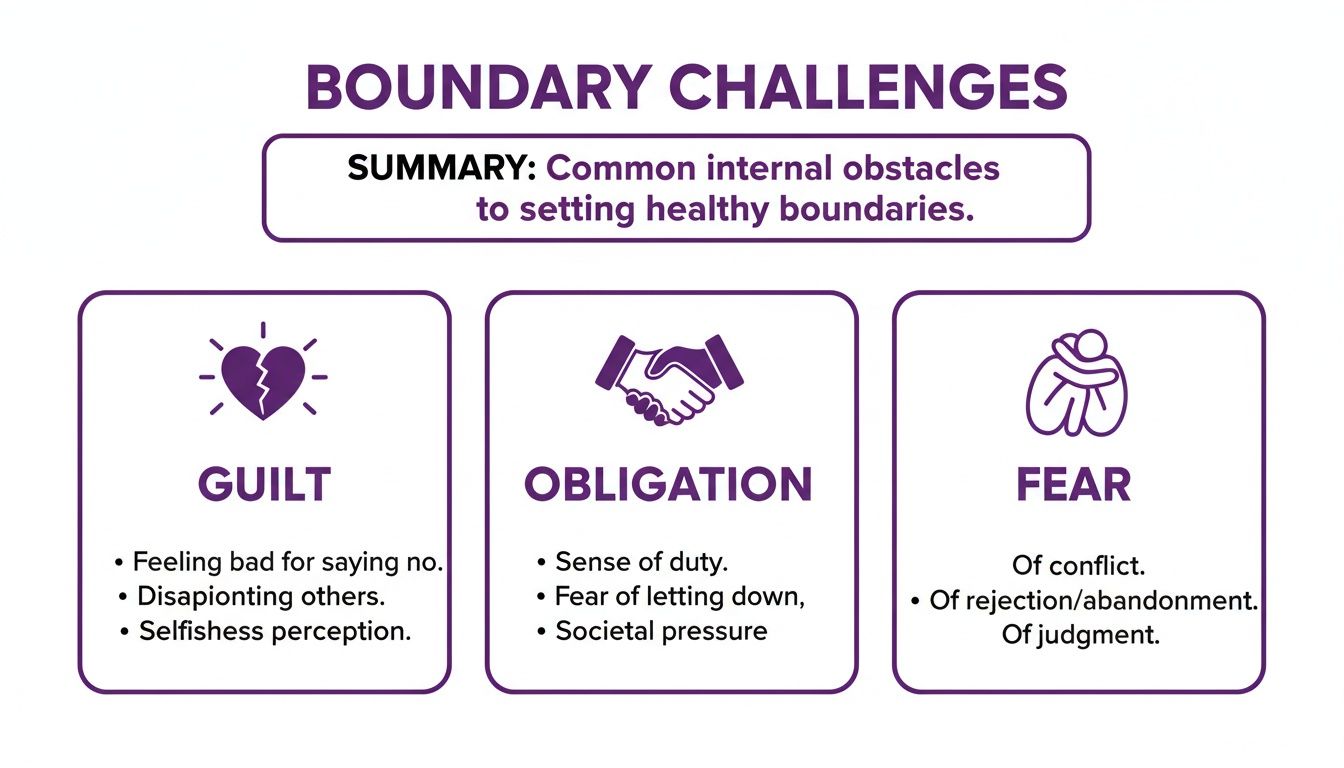
As you can see, those feelings of guilt, a deep-seated sense of obligation, and the fear of a negative reaction are powerful forces that can keep us stuck.
Types of Family Boundaries and Practical Examples
It's one thing to understand these concepts, but it's another to see what they look like in the real world. The difference between a weak boundary (what some therapists call a "porous" boundary) and a healthy one often comes down to who is in the driver's seat of your life.
This table gives a side-by-side look at how these scenarios play out.
| Boundary Type | Example of a Weak Boundary | Example of a Healthy Boundary |
|---|---|---|
| Emotional | Feeling you have to listen to a parent's negativity for hours, leaving you completely drained. | "Mom, I can hear how upset you are, and I want to listen. I have about 15 minutes to talk right now before I have to get back to my work." |
| Time | Immediately dropping your own plans to run an errand for a sibling who always has a last-minute "emergency." | "I can't help with that today, but I'm free on Saturday morning if you still need a hand then. Let me know." |
| Financial | Loaning money you can't afford to a cousin, knowing you'll never see it again, just to avoid a potential argument. | "I'm not in a position to lend money right now. I'm happy to help you think through some other options if you like." |
| Physical | Tolerating unwanted hugs or kisses from a relative because it feels easier than making a fuss. | "I'm not much of a hugger, but it's so great to see you!" |
Seeing the direct comparison makes it clear, doesn't it? One path leads to resentment, while the other leads to respect—both for yourself and from others.
A healthy boundary isn't about controlling someone else's behavior. It's about choosing how you will behave to protect your own well-being and self-respect.
This is a game-changing shift in perspective. You're not telling them what to do; you're just being clear about what you will do. It’s an act of self-preservation and a cornerstone for building healthier, more honest relationships with the people you love.
Communicating Your Needs with Clarity and Kindness
Knowing your boundaries is a huge first step. But the real test comes when you have to actually talk about them. This is where the rubber meets the road—moving from an idea in your head to a conversation that can reshape your relationships for the better. The goal isn't to pick a fight; it's to build a healthier, more respectful dynamic.
Let's be honest, this part can be nerve-wracking, especially if you're the family peacekeeper. But clear communication is the only bridge that gets you from resentment to respect. The trick is to shift your entire approach from blaming to explaining. Your best tool for the job? The "I" statement.

The Power of "I Feel" Over "You Always"
How you frame the conversation is everything. If you start with "You always…" or "You need to stop…," you've already lost. The other person immediately goes on the defensive. It feels like an attack, and their instinct will be to protect themselves, not to listen to you.
"I" statements completely change the game. They anchor the conversation in your experience and your feelings. And here’s the thing—no one can argue with how you feel. It's your truth. This simple switch de-escalates tension right away and opens the door for a real conversation.
Just look at the difference:
- The Blaming Statement: "You always bring up my finances and it makes me so angry. You need to stop asking me about money."
- The "I" Statement: "I feel stressed and uncomfortable when we discuss my finances. I'd appreciate it if we could keep that topic off the table going forward."
The first one is an accusation. The second is a simple statement of need. This method is a cornerstone for anyone trying to figure out how to fix relationship problems without making things worse.
Actionable Scripts for Common Scenarios
It helps to have a few phrases in your back pocket. Think of these as conversation starters you can tweak to fit your own life. Having a starting point makes the whole process feel much less intimidating.
Scenario 1: Handling Intrusive Personal Questions
You’re at a family get-together, and your aunt starts drilling you about why you're still single.
Instead of: "That's none of your business."
Try: "I appreciate you caring about me, but I'm not comfortable talking about my love life. I'd love to hear about your trip to the coast, though!"
This response is polite, firm, and skillfully redirects the conversation. You’ve set a clear boundary without causing a scene.
Scenario 2: Declining a Last-Minute Request
Your brother calls on a Tuesday night asking you to babysit at the last minute—a habit of his.
Instead of: "You're so inconsiderate, you always assume I'm free."
Try: "I can't tonight, I need this time to recharge for the week. I need at least a couple of days' notice for babysitting requests, so please ask me by Friday for weekend help."
Here, you’ve communicated your limit (your time), stated your need (downtime), and given him a clear, positive way to ask in the future.
Finding the Right Time and Tone
The "when" and "how" are just as important as the "what." Trying to establish a new boundary in the middle of a heated argument is a recipe for failure. The other person is already fired up and won't be in a place to truly hear you.
Instead, pick a calm, neutral moment. This could be during a quiet phone call, over a cup of coffee, or on a walk—any setting where you both feel relaxed enough to talk without interruption.
Your tone should be calm and assertive, not aggressive or apologetic. Remember these key points:
- Be direct and specific. Vague boundaries are confusing and easy to ignore.
- Keep it simple. You don’t need to write a dissertation justifying your feelings. A few clear sentences are enough.
- Stay firm but kind. Your delivery truly matters. A compassionate tone reminds them you’re doing this for the relationship, not to push them away.
This is especially vital for parents navigating a separation. Exploring dedicated co-parenting communication tools can be a lifesaver for simplifying schedules and keeping discussions focused on the kids.
Ultimately, setting boundaries is a skill. Like anything new, it gets easier and more natural with practice. Start with a small, manageable boundary, stay consistent, and remember to focus on progress, not perfection.
How to Handle Pushback and Emotional Reactions
Let's be real: once you start setting boundaries, you're almost guaranteed to get some pushback. This is completely normal, so don't panic. When you change the unwritten rules of a family relationship, it can feel jarring to everyone else.
This resistance isn't a sign you're doing something wrong. It's actually proof that the system is reacting to a change you’ve initiated. When a family member gets angry, tries to guilt-trip you, or just dismisses your feelings, it usually comes from their own discomfort—a feeling of lost control, rejection, or just plain confusion. Your job isn't to manage their emotions, but to stay in control of your own response.

Staying Calm When Emotions Run High
Honestly, one of the hardest parts of this whole process is learning to sit with the discomfort of a loved one's negative reaction. Your gut instinct might scream at you to backtrack, apologize, or just give in to make the tension go away. This is where learning to self-soothe becomes your superpower.
Before or even during a tough conversation, try one of these simple grounding techniques:
- Breathe Deeply: Inhale slowly for a count of four, hold it for four, and then exhale for a count of six. This little trick activates your body's natural calming response.
- Use Your Senses: Look around and name five things you can see. Notice four things you can physically feel (like your feet on the floor or the texture of your chair). Listen for three sounds. Identify two things you can smell, and one thing you can taste. This pulls you out of your head and into the present moment.
- Repeat a Mantra: Silently tell yourself something reassuring. It could be, "I am allowed to have my own needs," or "Their reaction is not my responsibility."
These aren't just fluffy wellness tips; they are practical tools that help you stay centered. They create the inner space you need to respond thoughtfully instead of just reacting.
Differentiating Boundaries from Ultimatums
It’s so important to understand the difference between setting a boundary and issuing an ultimatum. They come from completely different places and have drastically different results. Mixing them up is a surefire way to escalate conflict.
A boundary is a statement about what you will do to protect yourself. It's focused on your actions and limits.
An ultimatum is a threat designed to control someone else's behavior. It's focused on punishment.
Let’s put this into a real-world scenario. Imagine your parent constantly criticizes your parenting style.
- Boundary: "I feel really hurt when you criticize my parenting. If it continues, I'm going to have to end our conversation and leave the room."
- Ultimatum: "If you criticize my parenting one more time, you won't see your grandkids for a month."
See the difference? The boundary protects your emotional well-being. The ultimatum tries to force the other person to change with a threat. Boundaries build respect over time; ultimatums almost always create resentment.
What to Do When Your Boundary Is Tested
And they will be tested. Family members will likely push against your new boundaries, sometimes without even realizing it, just to see if you’re serious. Your consistency is everything here.
When a boundary is crossed, your only job is to calmly and firmly restate it. No big emotional speech. No lengthy re-explanation.
For example, if you’ve asked your sibling not to drop by unannounced and they show up at your door, you can say: “It’s so good to see you, but like I mentioned, I really need you to call before coming over. I can’t visit right now, but let’s set up a time to get together later this week.”
You don't need to justify the boundary all over again. Just repeat it. Each time you do, you're reinforcing the new, healthier dynamic. This isn't just you; it's a massive challenge for many. A staggering 81% of women and 75% of men report having a hard time setting boundaries with family. The pressure is especially high during the holidays, when 40% of people feel more anxious due to family expectations.
When you communicate your needs, it's possible family members may react strongly and even handle feelings of betrayal. Learning how to navigate those emotions is a key part of the process. Remember, managing pushback is a skill that takes practice, patience, and a deep commitment to your own well-being.
When It’s Time to Call in a Professional
Let’s be honest, you can do a lot of this work on your own. But sometimes, family dynamics are just too tangled and deep-seated to unravel by yourself. Recognizing when you need backup isn't a failure—it's actually a huge sign of strength.
If you’ve tried to set boundaries and are still hitting a wall of resistance or emotional blowback, getting a professional involved can change everything. Think of a therapist as a neutral referee, someone who isn't tangled up in decades of family history and unwritten rules. They create a safe space where you can finally say what you need to say without the conversation immediately derailing.
Telltale Signs You Need More Support
So, how do you know when you’ve moved past a "tricky" family situation into territory that really requires an expert? Look out for these patterns. If any of this sounds familiar, it's a strong signal that self-help strategies just aren't going to cut it.
- You're always on edge. Do you consistently feel anxious, drained, or even depressed after family interactions? If it’s bleeding into the rest of your life, that’s a major red flag.
- It’s the same fight, different day. You have the same arguments over and over again. Nothing ever gets resolved, and everyone walks away feeling hurt and completely misunderstood.
- There’s emotional or verbal abuse. This isn't just about disagreements. It's about patterns of name-calling, constant criticism, guilt-tripping, the silent treatment, or any behavior that makes you feel psychologically unsafe.
- You feel physically unsafe. If there are any threats or actions that make you fear for your physical safety, getting help immediately is non-negotiable.
- Addiction or mental illness is in the mix. When a family member's substance use or untreated mental health condition is driving the boundary-crossing, a therapist can give you the specialized guidance you need to protect your own well-being.
A key takeaway here: If your attempts to set boundaries are consistently ignored, punished, or mocked, you're likely dealing with a level of dysfunction you can't fix alone. A therapist can help you come to terms with that reality and build strategies to cope.
How Therapy Can Actually Help
Therapy provides a practical roadmap for these tough spots. At reVIBE, our therapists use proven approaches to get to the root of what makes setting boundaries so incredibly hard in your specific family.
For instance, with something like family counseling, a therapist can work with the whole family to learn healthier ways to talk to each other and interact. It’s about building new patterns together.
In individual therapy, you get to work one-on-one with a counselor to build your confidence, process all the complicated emotions that come up, and even role-play conversations for your specific challenges. This isn't about blaming anyone. It’s about giving you the tools you need to build healthier, more respectful relationships from your side of the street.
Making that first call can feel intimidating, but it’s often the most powerful step you can take toward finding peace. If you're in the Phoenix metro area and you’re ready, support is right around the corner.
Find a reVIBE Location Near You!
We currently have five locations for your convenience. (480) 674-9220
reVIBE Mental Health – Chandler
3377 S Price Rd, Suite 105, Chandler, AZ
reVIBE Mental Health – Phoenix Deer Valley
2222 W Pinnacle Peak Rd, Suite 220, Phoenix, AZ
reVIBE Mental Health – Phoenix PV
4646 E Greenway Road, Suite 100, Phoenix, AZ
reVIBE Mental Health – Scottsdale
8700 E Via de Ventura, Suite 280, Scottsdale, AZ
reVIBE Mental Health – Tempe
3920 S Rural Rd, Suite 112, Tempe, AZ
Your Top Questions About Family Boundaries, Answered
Even with a solid plan, stepping into the world of setting boundaries with family can feel like navigating a minefield of "what-ifs." It’s completely normal to have lingering questions and a bit of anxiety. Let's tackle some of the most common concerns I hear from clients, so you can move forward with more confidence.
What if My Family Says I’m Being Selfish?
This is probably the single most common fear—and the most frequent form of pushback. Hearing that you're "selfish" for taking care of yourself can be incredibly painful, mostly because it's designed to be. It's often a tactic, conscious or not, to get you to drop the boundary and return to the old way of doing things.
The best thing you can do? Reframe it for yourself. You're not being selfish; you're being self-respecting.
Healthy relationships are built by healthy people. If you're running on empty, you can't show up for your loved ones in a meaningful way. You're just showing up out of obligation or, worse, resentment. Try explaining it from your perspective: "I need a little quiet time to decompress after work. It helps me recharge so I can be more present and engaged with everyone later." It’s not about pushing them away; it’s about taking care of yourself so you can be a better part of the relationship.
How Long Does This Adjustment Period Last?
This is the hard part: there's no set timeline. It really depends on your family's unique dynamics, how entrenched these old patterns are, and how open everyone is to change. It's almost never an overnight fix.
You should fully expect your new boundaries to be tested, especially at first. People will naturally fall back on what’s familiar.
Your superpower here is consistency. Every single time you calmly hold your ground and restate your boundary, you’re teaching a new rule. It’s like muscle memory—it takes repetition to stick.
This phase could last a few weeks, or it could be a months-long process. Be patient with them, but just as importantly, be patient with yourself. And don't forget to celebrate the small victories along the way, like successfully changing the subject when a topic is off-limits. Those little wins will keep you going.
Is It Ever Too Late to Start Setting Boundaries?
Absolutely, unequivocally not. It is never too late to start putting your well-being first and shifting your relationships toward a healthier place. I know it can feel monumental to try and change dynamics that have been in place for decades, but it is always possible.
Starting now is an act of empowerment. You don't have to tackle the biggest, most explosive issue right out of the gate. In fact, I usually advise against it.
Instead, start building your "boundary muscle" on smaller, lower-stakes issues. For example, maybe you ask your sibling to text before they call, or you set a clear end time for your weekly phone call with a parent. Every time you succeed with a small boundary, you build the confidence you need to handle the bigger stuff down the road. The only thing that matters is that you start.
What’s the Difference Between a Boundary and an Ultimatum?
This is such an important distinction. Getting this right is what keeps your efforts grounded in self-respect, not in trying to control or punish someone else.
- A boundary is about your actions. It's a statement about what you will do to protect your peace. It's all about your own limits.
- An ultimatum is about their actions. It’s an attempt to control what the other person does, usually by threatening a consequence.
Let’s use a real-world example. Say you have a family member who frequently raises their voice during disagreements.
- Boundary: "I love you, but I can't be part of a conversation when there's yelling. If it gets to that point, I'm going to step away until we can both speak calmly."
- Ultimatum: "If you yell at me one more time, you'll never see me again!"
See the difference? The boundary is about you taking care of yourself—you control your own feet. The ultimatum is an attempt to force their behavior with a threat. Boundaries invite respect; ultimatums invite conflict and resentment.
Remember, setting boundaries isn't a one-and-done task; it's an ongoing practice. If you're finding these conversations consistently challenging or feel you need more support with complicated family dynamics, the team at reVIBE Mental Health is here. Our therapists are experts in family and relationship issues, offering a safe space to build the skills you need to feel confident and secure. You don't have to figure this out on your own. Find your strength and feel better with care that meets you where you are.