
When someone struggles with the fear of abandonment, it often shows up as an intense, gut-wrenching anxiety at the mere thought of being left. You might notice a tendency to become clingy in relationships or feel crushed by the smallest signs of perceived rejection. These aren't just quirks; they are deep emotional and behavioral patterns that, ironically, can end up pushing people away. Simply recognizing this cycle is a huge first step toward building healthier, more secure connections.
What Does Fear of Abandonment Actually Mean?
Think of your emotional system as having a smoke detector. For most of us, this alarm goes off when there's a real fire—a genuine threat to a meaningful relationship. But if you have a deep-seated fear of abandonment, that smoke detector is dialed up to its most sensitive setting. It can be set off by the tiniest puff of smoke, like a text message that takes too long to arrive or a subtle shift in your partner's tone. This isn't a character flaw; it's an internal alarm system stuck on high alert.
This powerful anxiety keeps you constantly scanning for signs of rejection or separation, which inevitably colors how you see your relationships and even your own self-worth. It often grows out of early experiences where connection and safety felt unpredictable, leaving a lasting mark.

Unpacking the Roots of This Fear
Fear of abandonment is much more than just a simple worry about being alone. It’s a profound, often subconscious belief that you aren’t worthy of lasting love and that, sooner or later, everyone you depend on will leave. This core belief can be traced back to formative events that shattered a child's fundamental sense of safety and belonging.
These early experiences could include:
- The death or sudden loss of a parent or primary caregiver.
- Emotional or physical neglect where your needs were not consistently met.
- Caregiving that was unpredictable, creating deep uncertainty about love and support.
- Witnessing frequent, intense conflict or the separation of your parents.
Essentially, these events can wire the brain to expect loss, creating a state of hypervigilance that makes it incredibly difficult to trust that any connection will last. This fear is a major component of separation anxiety, which is by no means just a childhood issue.
While approximately 4% of children experience separation anxiety, its lifetime prevalence among adults is 6.6%, with a significant 77.5% of cases first appearing in adulthood. This issue is also a core symptom of conditions like borderline personality disorder (BPD), which affects about 5.9% of the population. You can learn more about the prevalence of separation anxiety and related conditions from these statistics.
Understanding Its Impact on Your Life
Living in this constant state of high alert is mentally and emotionally exhausting, and it affects nearly every corner of your life. It can lead you to constantly second-guess your own value, creating a painful cycle where you desperately seek validation from others while simultaneously distrusting their sincerity. Recognizing this pattern isn't about assigning blame; it’s about understanding the emotional logic driving your reactions.
To help you see how these feelings might be playing out, we've broken them down into four key dimensions.
Four Key Dimensions of Abandonment Fear
This table breaks down the fear of abandonment into four core components, helping you quickly identify how it might be showing up in your life.
| Dimension | Description |
|---|---|
| Emotional | An intense storm of feelings—anxiety, panic, jealousy, or even despair—at the thought of a loved one leaving. |
| Cognitive | Persistent, looping thoughts focused on worst-case scenarios, overanalyzing others' behavior for signs of rejection. |
| Behavioral | Actions driven by fear, like seeking constant reassurance, avoiding intimacy, or pushing people away to avoid getting hurt. |
| Relational | A pattern of unstable relationships, often swinging between idealizing a person and devaluing them when fears are triggered. |
Seeing the fear through these dimensions can make it feel less like a single, overwhelming monster and more like a set of patterns you can begin to understand and change.
Accepting that this fear started as a protective mechanism—even if it's now working overtime—is the first real step toward healing. It allows you to approach yourself with compassion as you start building the inner security needed for healthier, more fulfilling connections. Help is available to guide you through this process. With five convenient locations in Chandler, Phoenix, Scottsdale, and Tempe, reVIBE Mental Health makes it easier to find professional support close to home.
Recognizing the Internal Signs and Symptoms
Fear of abandonment isn't just a simple worry that comes and goes. It's more like an internal storm, a constant mix of powerful emotions and racing thoughts that can feel incredibly overwhelming. It tends to operate just beneath the surface, coloring how you see the world and react to it in ways that might not make sense until you pinpoint the source. Learning to spot these internal signs is the first real step toward finding calmer waters.
Think of your emotional security like a house of cards. For most people, a little shake—a friend canceling plans, a partner needing some space—is no big deal. The structure holds. But when you’re dealing with a deep fear of abandonment, that same little shake feels like an earthquake threatening to bring everything crashing down. This is why a delayed text message or a change in someone’s tone of voice can set off such a powerful, painful internal alarm.
The Emotional Undercurrent of Abandonment Fear
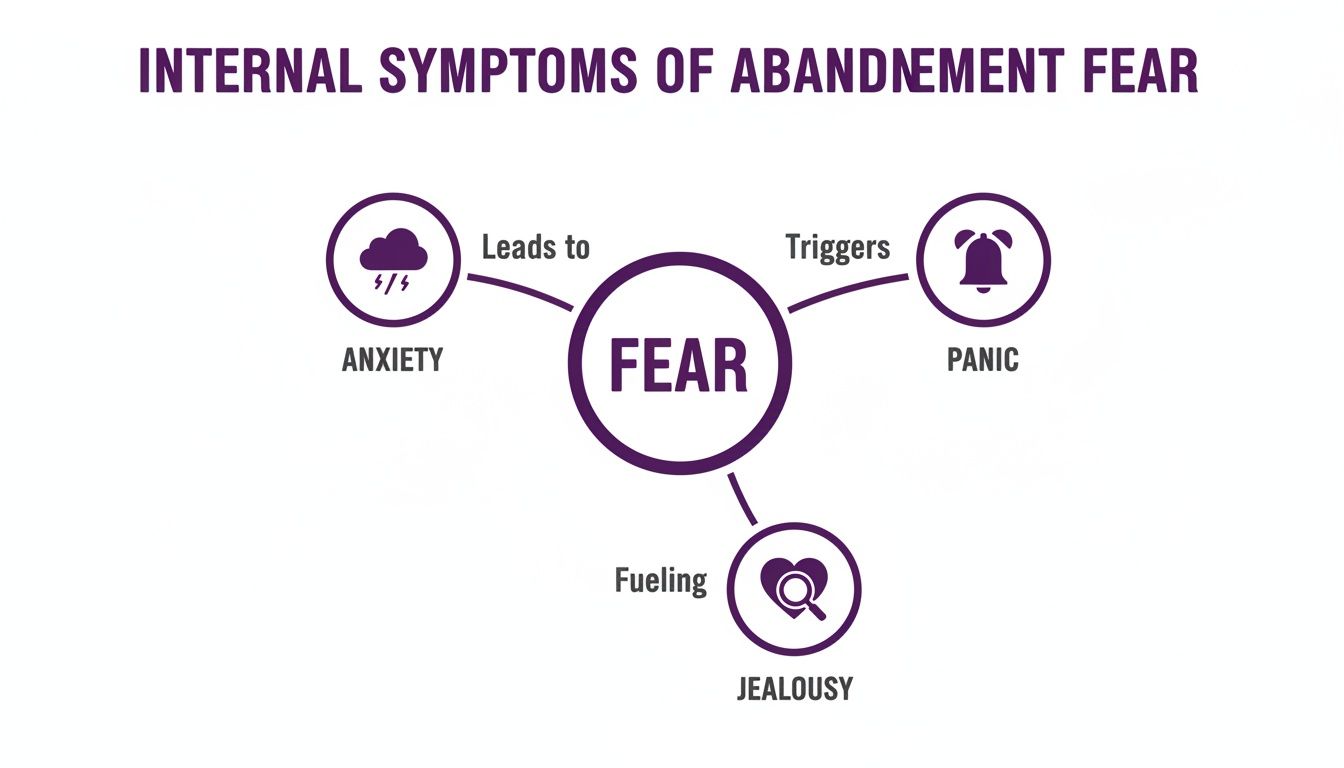
The emotional side of this fear is often what you notice first. It can feel like a persistent hum of distress that follows you through your day, ready to spike at a moment's notice. When these feelings get triggered, they're intense, immediate, and can feel all-consuming.
It's important to know these feelings aren't random. They're your nervous system's way of trying to protect you from getting hurt again. They're raw signals that an old wound has been touched.
Some of the most common emotional symptoms include:
- Pervasive Anxiety: This isn’t about getting nervous before a big meeting. It's a chronic, low-grade anxiety that hangs around, especially in your relationships. You might always feel on edge, just waiting for the other shoe to drop.
- Sudden Panic: A wave of intense, heart-pounding fear can hit you out of nowhere when a loved one is out of reach or doesn't respond right away. This is your internal alarm system screaming that you're about to be left, even when there's no real evidence for it.
- Intense Jealousy: You might find yourself feeling a jealousy that seems way out of proportion to what's actually happening. A partner chatting with someone new or a friend making other plans can feel like a direct threat, sparking possessiveness and fear.
- Chronic Loneliness: It's possible to feel profoundly alone even when you're in a room full of people. This feeling often comes from a core belief that you can't truly connect with anyone because, sooner or later, they'll leave.
These powerful emotions can sometimes get tangled up with other conditions. If you're also dealing with persistent sadness or have lost interest in things you used to love, it could be helpful to learn about the common signs of depression in adults to get a clearer picture of what's going on.
Cognitive Patterns That Fuel the Fear
Behind every emotional storm, there are thoughts that act as the wind and rain. The cognitive symptoms are the repeating, often automatic, thought patterns that reinforce the belief that you’re not safe in your relationships. Over time, these thoughts can become so ingrained that they start to feel like undeniable facts.
It’s like having a biased narrator in your head, one who interprets everything through the lens of rejection. This narrator is constantly on the lookout for evidence to confirm your deepest fears, while conveniently ignoring anything that proves them wrong.
The core cognitive distortion is often a deep-seated belief that you are fundamentally unlovable or unworthy of lasting care. This negative self-perception becomes a self-fulfilling prophecy, as it shapes how you interpret every interaction and can lead you to act in ways that inadvertently push others away.
Common thought patterns include:
- Catastrophizing Minor Events: A small disagreement isn't just a bump in the road; in your mind, it’s a sign the entire relationship is about to collapse. A partner saying they need a little space is heard as, "This is the beginning of the end."
- Hypervigilance: You're constantly on high alert, scanning for the tiniest shifts in mood, tone, or behavior. You might over-analyze texts and conversations, replaying them for hours to find hidden meanings or signs of rejection.
- Personalization: You tend to take everything personally. If a friend cancels, your first thought isn't that they might be busy or tired—it's, "What did I do wrong?"
- Black-and-White Thinking: Relationships are all or nothing. People are either completely devoted and perfect, or they're on the verge of abandoning you. There’s no room for the normal, messy middle ground of human connection.
Making the connection between these internal experiences—the gut-wrenching panic, the obsessive thoughts, the intense jealousy—and the underlying fear of abandonment can be a game-changer. It allows you to see them not as character flaws, but as perfectly understandable symptoms of a deeper wound that is ready to be healed.
How Abandonment Fear Influences Your Behavior
That internal storm of anxiety and intense emotion has to go somewhere, and it often spills out into our actions. The behavioral symptoms of a fear of abandonment can seem confusing and even contradictory, but they’re all driven by the same core goal: to prevent the very rejection you’re so terrified of. These actions can feel instinctual, pushing you to behave in ways that, ironically, end up damaging the very connections you're fighting to keep.
Think of it like trying to hold a handful of sand. If you squeeze too hard, terrified of losing it, the grains just slip through your fingers faster. But if you hold your hand too loose, a gust of wind could blow it all away. This is the classic dilemma of abandonment fear—our reactions tend to swing to one of two extremes.
The Clinging Response: Pleading to Stay
One of the most common patterns is clinging. This is when you try to pull people in so tightly through constant contact and appeasement that they couldn’t possibly leave. It’s more than just being affectionate; it's a fear-based drive to make yourself so essential or agreeable that leaving you would seem unthinkable. When this instinct takes over, your own needs and wants get shoved to the back burner to keep the peace at all costs.
Some classic clinging behaviors look like this:
- Relentless People-Pleasing: You find yourself saying "yes" to almost anything asked of you, even when it’s a major inconvenience or goes against what you truly want. The unconscious goal is to avoid any hint of conflict or disapproval, based on the belief that being “easy” makes you more lovable.
- Needing Constant Reassurance: This isn’t just fishing for a compliment. It's a deep, compulsive need to hear things like "we're okay" or "I still love you" again and again. Without that external confirmation, the anxiety can become overwhelming very quickly.
- Staying in Unhealthy Relationships: For some, the terror of being alone feels far worse than the ongoing pain of a toxic relationship. This can lead you to tolerate mistreatment or stay with a partner who is a bad fit, all because the alternative—being abandoned—feels absolutely unbearable.
The Pushing-Away Response: Leaving Before You Can Be Left
Then there's the other side of the coin: the pushing away response. This is essentially a preemptive strike against the pain you’re sure is coming. If you’re convinced someone will eventually leave you, sabotaging the relationship first creates a painful illusion of control. Yes, it still hurts, but it's a hurt you caused, which can feel less shattering than being blindsided by rejection.
This defensive maneuver is all about the "I'll leave you before you can leave me" mindset. It's a self-preservation tactic that creates a false sense of power in a situation where you feel utterly powerless.
Common pushing-away behaviors include:
- Sabotaging Intimacy: Just as a relationship starts getting close and feeling really good, you might suddenly pick a fight, become emotionally distant, or start finding fault with your partner over small things. This creates an immediate buffer, protecting you from getting too attached and becoming too vulnerable.
- Testing a Partner's Commitment: This can involve provoking arguments or creating drama just to see how much they’ll put up with. The subconscious hope is to prove their loyalty, but more often than not, this behavior backfires and pushes them away, which only confirms your original fear.
- Avoiding Emotional Depth: You might keep conversations light and superficial, dodge any talk about the future, or flat-out refuse to be vulnerable. The logic here is that if they never get to know the real you, it won't sting as much when they inevitably walk away.
Whether you tend to cling or push people away, it’s crucial to see that these are two sides of the same coin. They are powerful, learned survival strategies that, at some point, probably helped you cope with an unbearable fear. Understanding these behaviors as symptoms—not as character flaws—is the first real step toward learning healthier, more secure ways to connect with others and, most importantly, with yourself.
Building Inner Security with Practical Coping Skills
Recognizing how the fear of abandonment is showing up in your life is a huge first step. The next is to start building a toolkit of practical strategies that create a deep sense of inner security. The goal here isn't to never feel fear again, but to learn how to be your own anchor in a storm.
Think of it this way: instead of constantly scanning the horizon for someone else to hold you steady, you start developing the skills to ground yourself. No matter how turbulent the emotional waters get, you'll have what you need to find your center. These techniques empower you to manage that rush of anxiety in the moment, question those catastrophic thoughts, and feel more confident in who you are.

Mindfulness and Grounding to Calm Anxiety
When the fear of abandonment gets triggered, it can feel like your nervous system hits the panic button, making it almost impossible to think clearly. This is where mindfulness and grounding exercises become your first-aid kit. They are designed to pull you out of the terrifying spiral of "what ifs" and bring you back to the safety of right here, right now.
When those overwhelming feelings hit, using powerful grounding techniques for anxiety can be a game-changer. One of the most effective and simple methods is the 5-4-3-2-1 technique:
- 5 Things You See: Look around the room and name five objects. Really notice their color, shape, and even the way light hits them.
- 4 Things You Feel: Bring your awareness to four physical sensations. It could be the solidness of the floor under your feet, the texture of your jeans, or the air on your skin.
- 3 Things You Hear: Tune your ears into three distinct sounds. Maybe it's the hum of your computer, birds outside, or distant traffic.
- 2 Things You Smell: What are two scents in your environment? Maybe it’s the faint smell of coffee or the fresh scent from an open window.
- 1 Thing You Taste: Focus on one thing you can taste. You could take a sip of water or just notice the current sensation in your mouth.
This exercise works by interrupting panic. It forces your brain to focus on your immediate sensory experience, which sends a powerful signal that you are safe in this present moment. Another incredible approach is to explore different somatic healing exercises which use body-based techniques to help release trapped stress and regulate your nervous system. You can learn more about them here: https://revibementalhealth.com/somatic-healing-exercises/.
Challenging Fearful Thoughts Through Journaling
Just because you think something doesn't make it true, especially when old fears are running the show. Journaling is a fantastic way to create some space between you and your anxious thoughts, allowing you to examine them with curiosity instead of automatically believing them.
Start by just getting it all out on paper—no filter, no judgment. Once the feelings are on the page, you can begin to see the specific thoughts that are fueling the fire.
The core of this practice is to interrupt the automatic storyline your fear tells you. By asking gentle, reality-testing questions, you can slowly begin to create a new, more balanced narrative based on what is actually true in the present moment.
Try using these prompts to guide you:
- What just happened that triggered my fear? Be specific. (e.g., "My friend canceled our plans last minute.")
- What's the story my fear is telling me right now? Write down the worst-case scenario that pops into your head. (e.g., "They're tired of me and don't want to be my friend anymore.")
- What evidence do I have that this story is 100% true? Look for cold, hard facts—not feelings.
- What are some other, more likely explanations? (e.g., "They had a long day at work," "Something unexpected came up," "They just need a night to themselves.")
- What would I tell a friend if they were having this exact fear? This little trick helps you tap into your own inner wisdom and compassion.
This process isn't about shaming yourself for feeling scared. It's about acknowledging the fear, giving it a voice, and then consciously choosing to engage with a more rational and kind perspective. Every time you do this, you take one more powerful step toward building that unshakeable inner security.
Finding Lasting Relief with Professional Support
While self-help strategies are fantastic for building self-reliance, sometimes the roots of abandonment fear run too deep for us to manage alone. That’s where professional support comes in.
Making the choice to see a therapist isn’t a sign of weakness—far from it. It’s a brave and powerful step toward reclaiming your life from anxiety and finally building the secure, happy relationships you deserve. A therapist offers a safe, non-judgmental space to explore painful experiences and learn proven skills that create real, lasting change.
Think of it this way: self-help is like learning basic first aid for a recurring injury. You can patch yourself up and get by. Therapy, on the other hand, is like working with a specialist who can diagnose the underlying cause of the injury, heal it properly, and teach you how to prevent it from happening again.
Evidence-Based Therapies for Healing
So, what does that healing process actually look like? Fortunately, several therapeutic approaches are incredibly effective at getting to the heart of abandonment fears. If you're exploring options, understanding the different effective therapeutic interventions for anxiety can help you find a path that feels right for you.
Here are a few of the most successful methods we see in our practice:
- Cognitive Behavioral Therapy (CBT): This is all about tackling the thought patterns that keep you stuck. A CBT therapist helps you catch those automatic, negative thoughts—like "They're definitely going to leave me"—and challenge them until they lose their power.
- Dialectical Behavior Therapy (DBT): If your emotions feel overwhelming and chaotic, DBT can be a game-changer. It gives you practical, real-world skills to manage intense feelings without letting them take over, helping you tolerate distress and regulate your reactions.
- Eye Movement Desensitization and Reprocessing (EMDR): When abandonment fear is directly linked to past trauma, EMDR can be profoundly healing. It’s a unique therapy that helps your brain reprocess painful memories, so they no longer trigger that knee-jerk fear and panic in the present.
Since these fears often begin with difficult early-life experiences, working with a therapist who understands trauma is key. To get a better sense of what this involves, read our guide on what is trauma-informed therapy.
Comparing Therapeutic Approaches for Abandonment Fear
To help you visualize how these different therapies work, here’s a quick breakdown of their focus and how they specifically help with the fear of abandonment.
| Therapy Type | Primary Focus | How It Helps |
|---|---|---|
| Cognitive Behavioral Therapy (CBT) | Identifying and restructuring negative thought patterns. | Helps you challenge the catastrophic thinking and core beliefs that fuel abandonment anxiety. |
| Dialectical Behavior Therapy (DBT) | Building skills in mindfulness, distress tolerance, and emotional regulation. | Gives you concrete tools to manage overwhelming fear and prevent impulsive, fear-driven behaviors. |
| Eye Movement Desensitization and Reprocessing (EMDR) | Reprocessing traumatic memories that are "stuck" in the brain. | Reduces the emotional charge of past abandonment experiences, so they no longer control your present. |
Each of these paths offers a unique way to approach healing, and the best one for you depends entirely on your personal history and what you need most right now.
The Role of Psychiatry and Medication
For some people, the anxiety, panic, or depression tied to abandonment fear can be so intense that it gets in the way of daily life—and even therapy itself. When that’s the case, psychiatry and medication can be an incredibly helpful part of the healing journey.
Medication isn't a magic wand that "cures" the fear of abandonment. Instead, think of it as turning down the volume on your symptoms. By quieting the constant noise of anxiety or depression, it creates the headspace you need to do the deep, meaningful work in therapy.
Medications like SSRIs (a type of antidepressant) can help stabilize your mood and calm that persistent background anxiety. This makes it so much easier to engage with your therapist and practice the new skills you’re learning.
This integrated approach—therapy and medication working together—often produces the best outcomes. It addresses both the root causes and the immediate symptoms, creating a more stable and supportive path toward genuine, long-term healing.
Let's Start Your Healing Journey Together at reVIBE Mental Health
Realizing that fear of abandonment is shaping your life is a huge, courageous first step. The next one—the one where real change begins—is taking action. You don’t have to walk that path alone.
Here at reVIBE Mental Health, our team is genuinely committed to helping you build the secure, stable, and deeply fulfilling relationships you’ve always wanted. We’re ready to guide you every step of the way.
We get it. Reaching out for help is a big deal, and it can feel incredibly vulnerable. That’s why we’ve worked hard to create a space that feels warm, safe, and completely free of judgment. Our offices are designed to feel more like a comfortable home than a cold, clinical setting, so you feel seen and heard from the moment you walk through our doors.
How We Make Care Work for You
Our entire philosophy is built on an integrated care model. What does that actually mean? It means our skilled therapists and licensed psychiatric professionals are on the same team—your team. They collaborate on your care, ensuring that whether you need talk therapy, a specialized approach like EMDR, or medication management, everything works together seamlessly.
We also know that life is busy. Finding time for yourself can feel impossible, so we make it a priority to fit into your world, not the other way around.
- Five Convenient Locations: With offices all over the Valley, great care is never far from home or work.
- Telehealth That Fits Your Life: Meet with our providers from the privacy of your own space through secure online sessions.
- Scheduling for Real People: We offer appointments seven days a week because we know life doesn’t just happen Monday through Friday, 9 to 5.
This flexibility is key. It ensures you can get the consistent, reliable support you need to make real, lasting progress.
Deciding to seek professional help is one of the greatest acts of self-compassion you can perform. It’s you telling yourself that you are worthy of feeling safe and loved, and that you’re ready to build a future that isn’t defined by anxiety.
Getting Started Is Easier Than You Think
We believe the process of starting therapy should be simple and supportive, not another source of stress. Our team is here to handle the details so you can focus on your well-being.
When you call, we’ll take the time to listen, understand what you’re going through, and help you find a provider who is the right fit for your personality, goals, and insurance plan. We accept most major insurance and are happy to help you figure out your benefits.
You don't have to let the symptoms of fear of abandonment run your life for one more day. A future built on solid self-worth and healthy, trusting connections is absolutely possible.
Take that next step. Call us at reVIBE Mental Health at (480) 674-9220 to get started.
Find a reVIBE Location Near You!
We currently have five locations for your convenience. (480) 674-9220
-
reVIBE Mental Health – Chandler
3377 S Price Rd, Suite 105, Chandler, AZ -
reVIBE Mental Health – Phoenix Deer Valley
2222 W Pinnacle Peak Rd, Suite 220, Phoenix, AZ -
reVIBE Mental Health – Phoenix PV
4646 E Greenway Road, Suite 100, Phoenix, AZ -
reVIBE Mental Health – Scottsdale
8700 E Via de Ventura, Suite 280, Scottsdale, AZ -
reVIBE Mental Health – Tempe
3920 S Rural Rd, Suite 112, Tempe, AZ
Your Questions, Answered
It's only natural to have questions as you start to unpack something as complex as the fear of abandonment. We've gathered some of the most common ones we hear to give you a bit more clarity on what this experience is all about and what healing can look like.
Can Fear of Abandonment Be Cured Completely?
While we can't erase the past, you can absolutely heal to the point where this fear no longer runs the show. The goal of therapy isn't to forget what happened, but to learn how to manage the anxiety and build a strong sense of self that doesn't depend on anyone else's approval.
Think of it like turning down the volume on that constant, nagging fear. Healing allows you to finally build the healthy, trusting relationships you've always wanted, without that background noise of anxiety drowning everything out.
Is Fear of Abandonment the Same as an Insecure Attachment Style?
They're incredibly close, but not quite the same thing. It helps to think of the fear of abandonment as the core emotional wound—that deep-seated, painful belief that you’re going to be left behind.
An insecure attachment style, on the other hand, is the set of behaviors you developed to cope with that wound. For instance, someone with an anxious attachment style might constantly seek reassurance, but why? It’s because that powerful, underlying fear of being abandoned is driving them to do it.
In short, the attachment style is how the fear of abandonment plays out in your relationships. To truly build a more secure way of connecting with others, you have to get to the root of that fear.
How Can I Tell if My Jealousy Is a Symptom?
A little jealousy here and there is normal. It’s usually a fleeting feeling tied to a specific situation that would make most people a little uneasy. But when jealousy is fueled by a fear of abandonment, it feels completely different.
It becomes intense, persistent, and can be set off by the smallest things—like a partner taking too long to text back. This kind of jealousy is wrapped up in catastrophic thinking ("They're not answering, which means they're losing interest and are going to leave me"). It can also lead to behaviors like checking their phone or needing constant updates on where they are.
If your jealousy feels overwhelming and totally out of proportion to what’s actually happening, there’s a good chance it’s one of the major symptoms of fear of abandonment.
You don't have to figure this out on your own. At reVIBE Mental Health, our compassionate team is here to help you understand what triggers these feelings and build a solid foundation of security from within.
Ready to take the first step toward healthier, happier relationships? Visit us online to learn more or schedule an appointment.
Find your path to healing with us at https://revibementalhealth.com.