You read a short message from your partner and immediately sense distance. They haven't said anything is wrong, but you replay the wording, check when they were last online, and wonder whether their feelings have changed. You ask for reassurance, feel calmer for a while, and then notice the same fear returning.
That pattern can feel confusing and embarrassing, especially when the relationship is loving and the worry seems out of proportion. Therapy for relationship anxiety can help you understand whether the distress comes mainly from personal anxiety patterns, current relationship dynamics, or both. The sections below define relationship anxiety, explain common causes and symptoms, compare therapy approaches, describe what treatment feels like, and offer practical ways to start. You'll also find guidance for choosing support in the Phoenix metropolitan area.
Introduction to Relationship Anxiety Therapy
Relationship anxiety often appears in ordinary moments. You might be having dinner with someone you love while mentally comparing your relationship with an imagined “better” one. You might hear a tired tone and conclude that your partner is preparing to leave. Or you might pull away first, hoping that ending the conversation on your terms will protect you from rejection.
These reactions don't make you manipulative or incapable of intimacy. They often reflect a nervous system trying to prevent emotional pain. The difficulty begins when checking, questioning, withdrawing, or seeking certainty becomes the main way you manage fear.
Therapy helps by slowing that process down. A clinician can help you identify the thought that starts the alarm, examine the behavior that temporarily reduces distress, and practice a different response. Sometimes individual treatment is the right starting point. In other situations, the relationship itself maintains the anxiety, so carefully selected couples work may be more appropriate.
The right path depends on the pattern. Anxiety that appears across relationships and situations may call for individual therapy, while distress tied to inconsistency, criticism, emotional unavailability, or conflict with a current partner requires a broader assessment. Safety and power dynamics must also be considered before partners attend therapy together.
Understanding Relationship Anxiety
Relationship anxiety is persistent fear, doubt, or threat monitoring focused on closeness, commitment, compatibility, or a partner's feelings. It isn't limited to jealousy. It may involve repetitive questions, mental comparisons, repeated checking, or avoidance of emotional vulnerability.
A useful analogy is a radio with too much static. The signal is your partner's actual behavior. The static consists of predictions such as, “They're quiet because they're losing interest,” or, “If I don't feel completely certain, this relationship must be wrong.” When static gets loud, neutral information can sound threatening.
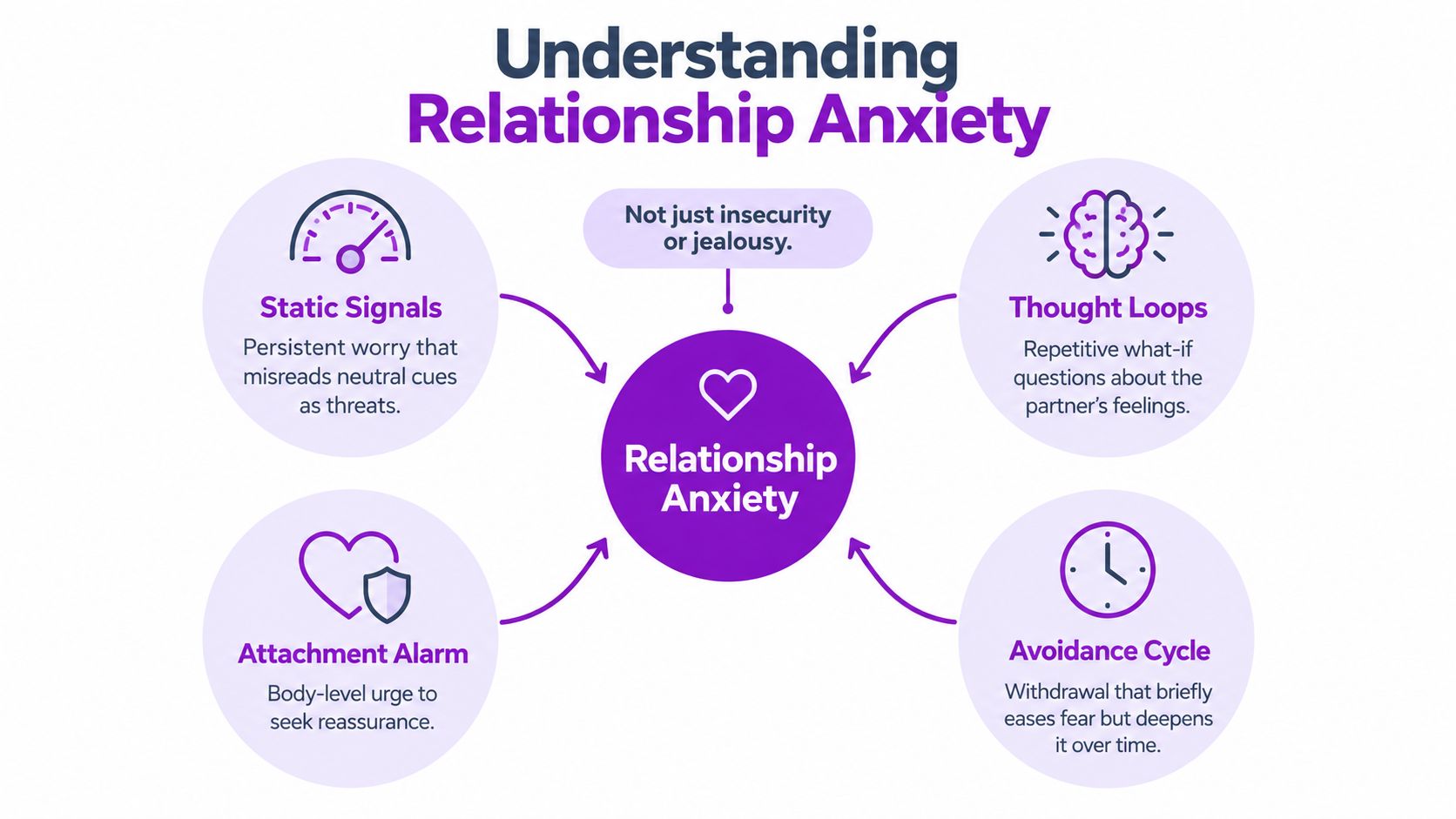
Two sources of the alarm
A personal pattern may come from fear of abandonment, sensitivity to rejection, earlier relationship experiences, or anxiety that appears in other areas of life. If the same doubts arise with different partners, or if worry extends into work, health, family, and social situations, individual therapy deserves serious consideration.
A couple-system pattern looks different. The partner may be inconsistent, critical, coercive, emotionally unavailable, or involved in ongoing trust violations. In that context, anxiety may be an accurate response to instability rather than a distorted interpretation. Evidence supports both individual CBT and couple-based interventions, depending on whether symptoms persist across relationships or are mainly triggered by current partner dynamics (research on individual and couple-level treatment considerations).
The cycle often looks like this:
- A cue appears, such as a delayed reply.
- The mind assigns a threatening meaning.
- The body reacts with urgency.
- You check, ask, compare, or withdraw.
- Relief arrives briefly.
- Your brain learns that the ritual was necessary.
Practical rule: Support can acknowledge distress without promising impossible certainty.
Some people also notice that mood changes or broader emotional symptoms affect how they interpret closeness. A general resource on Lila on easing mood symptoms may help readers consider whether relationship distress is occurring alongside other changes. For more on patterns involving closeness and dependence, see attachment issues in relationships.
Recognizing Causes and Symptoms
The same outward behavior can have different causes. Repeated questions may reflect an obsessive-compulsive reassurance ritual, a response to a partner's real inconsistency, or a learned response to earlier abandonment. A careful assessment asks what happens before the anxiety, what behavior follows it, and whether the behavior actually solves the underlying problem.
Common emotional and behavioral signals
- Reassurance seeking: You repeatedly ask whether your partner loves you, whether the relationship is safe, or whether they're sure about you.
- Mental comparison: You compare your partner's appearance, personality, or feelings with alternatives, then search for a perfect level of certainty.
- Checking: You monitor messages, tone, social activity, facial expressions, or signs of attraction.
- Avoidance: You delay commitment, suppress needs, avoid difficult conversations, or emotionally withdraw before rejection can occur.
- Abandonment fear: Ordinary distance feels like evidence that the relationship is ending.
- Intrusive doubt: Questions about compatibility or attraction return despite previous answers.
Consider two examples. Maya receives a kind but brief text while her partner is working. She asks several questions, receives reassurance, and feels better briefly before checking again. Her pattern may be maintained by the relief that follows reassurance. Jordan, by contrast, feels anxious because their partner repeatedly cancels plans, refuses honest conversations, and becomes intimidating when concerns are raised. Jordan's distress needs to be understood in the context of the relationship, not automatically labeled insecurity.
Attachment-related mechanisms can become measurable treatment targets when anxiety involves fear of abandonment, rejection sensitivity, avoidance of dependence, or difficulty trusting closeness. In a randomized study of psychotherapy for social anxiety involving 495 patients, CBT produced significant reductions in partner-related attachment anxiety and attachment avoidance compared with a waiting-list condition, with standardized effect sizes of approximately -0.30 and -0.23, respectively (the study of CBT and attachment-related outcomes).
Questions that clarify the pattern
Ask yourself whether the anxiety follows a specific present problem or shifts from one doubt to another. Notice whether reassurance settles the concern for a meaningful period or only for a short time. Also ask whether you can discuss concerns safely with your partner. If intimidation, coercive control, or fear of retaliation is present, individual support and safety planning should come before conjoint treatment.
Therapy Approaches for Relationship Anxiety
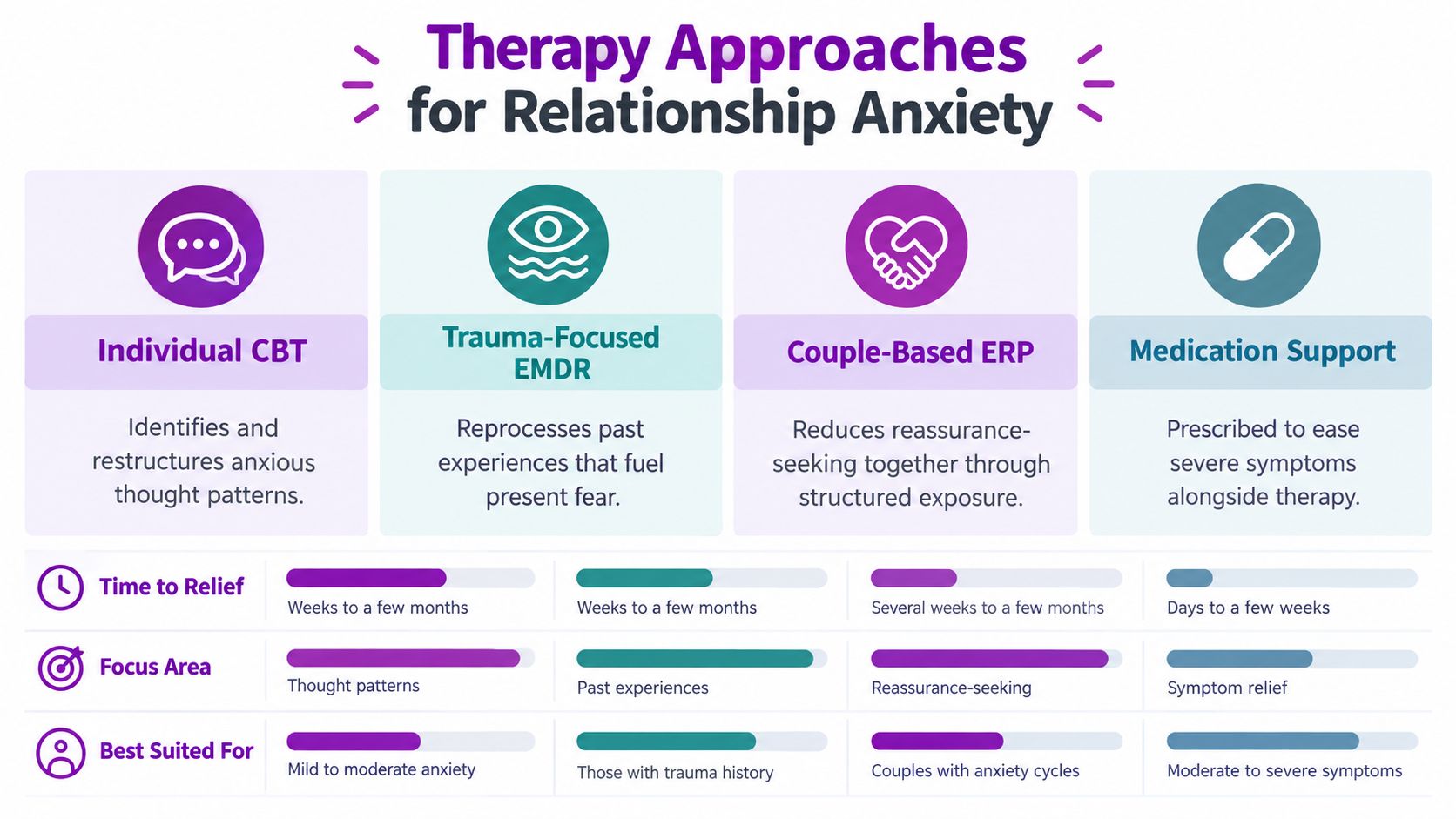
No single treatment fits every form of relationship anxiety. The best choice depends on the main mechanism, the level of distress, safety in the relationship, and whether the partner can participate without reinforcing harmful patterns.
Individual CBT
Cognitive behavioral therapy works well when anxious predictions and avoidance drive the problem. You and the therapist identify thoughts such as, “If my partner doesn't respond quickly, the relationship is failing,” then test those predictions through cognitive restructuring and behavioral experiments.
The work usually includes noticing triggers, separating facts from interpretations, reducing safety behaviors, and practicing approach behaviors. A benefit is its practical structure. You'll often leave sessions with a specific exercise, such as delaying a checking behavior or having a direct conversation instead of silently collecting evidence.
CBT may be a strong starting point when anxiety appears across relationships or overlaps with broader anxiety. It may be less suitable as the only intervention when current partner behavior creates genuine instability or when unresolved trauma remains highly activating.
Trauma-focused EMDR
Eye Movement Desensitization and Reprocessing, or EMDR, may be considered when present fear connects to traumatic experiences, betrayal, abuse, or earlier relational wounds. Rather than focusing only on whether today's fear is rational, treatment helps process memories and meanings that continue to trigger the nervous system.
A therapist may begin with history-taking, stabilization, and coping preparation before reprocessing selected memories. EMDR isn't a tool for proving that a relationship is safe, and it shouldn't be used to make someone tolerate ongoing mistreatment. It can be useful when the emotional intensity of present events seems linked to experiences that occurred earlier.
Readers managing anxiety in another major life transition may also find practical ideas in this resource on coping skills for postpartum anxiety, while recognizing that relationship-focused treatment requires an individualized assessment.
Couple-based ERP
When relationship doubts include repetitive checking, reassurance seeking, mental comparison, or certainty rituals, symptoms may overlap with relationship-focused obsessive-compulsive symptoms. Exposure and response prevention, or ERP, helps a person face uncertainty without performing the behavior that provides short-term relief.
A pilot study used a 16-session couple-based protocol combining partner-assisted ERP, reduced partner accommodation, and work on relationship stressors. Participants showed substantial improvements in obsessive-compulsive symptoms, relationship functioning, and depression, and symptom improvement was maintained through 12-month follow-up (the pilot study of couple-based CBT with ERP).
The study was a pilot, not a definitive large randomized trial. Its findings support a specialized treatment rationale, not a universal protocol. In practice, a partner might validate distress without repeatedly answering the same certainty question, while the person with anxiety practices tolerating uncertainty. Exposure should be collaborative, graded, and repeated.
Medication support
Medication can be considered when anxiety is severe, persistent, or part of a broader psychiatric condition. A psychiatric professional evaluates symptoms, medical history, possible diagnoses, side effects, and whether medication should accompany psychotherapy.
Medication doesn't replace work on reassurance rituals, communication, trauma, or relationship safety. It may reduce symptom intensity enough for someone to participate more fully in CBT, EMDR, or couples therapy. Decisions should be made with a qualified prescriber rather than based on another person's experience.
For an overview of relationship-focused services and formats, explore types of relationship therapy.
What to Expect in Relationship Anxiety Therapy
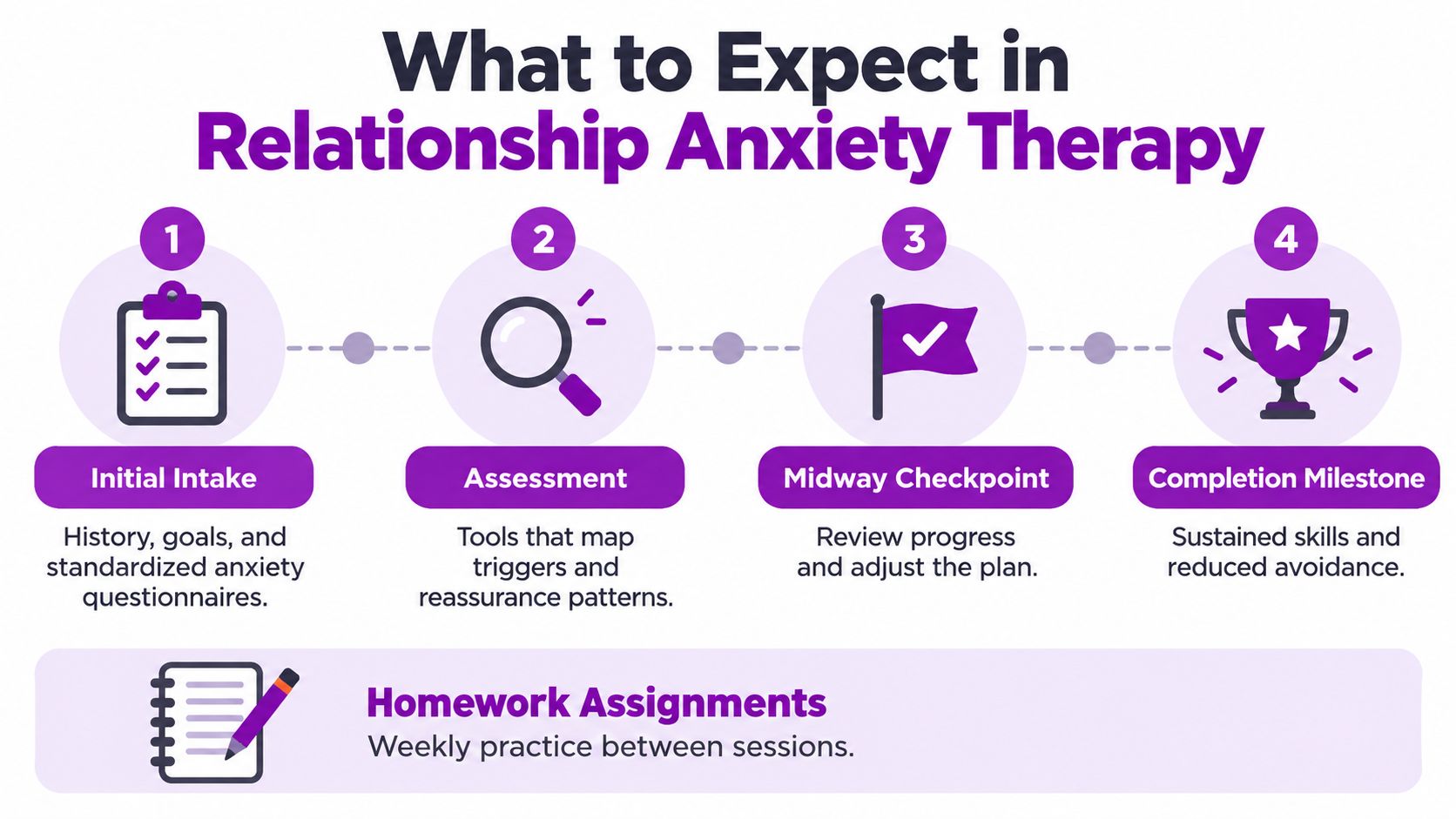
Starting therapy can feel exposing because the symptoms often involve thoughts you've tried to hide. A good clinician won't require you to present a polished explanation. The first appointment usually creates a shared map of what happens, when it happens, and what you want to change.
The early phase
During intake, the therapist may ask about current symptoms, relationship history, previous treatment, trauma exposure, sleep, mood, substance use, and safety. Standardized anxiety questionnaires can provide a consistent way to track change, but they're only one part of the assessment.
You'll also clarify goals. “I want to stop feeling anxious” can become more practical as “I want to reduce checking,” “I want to discuss concerns without accusing my partner,” or “I want to tolerate uncertainty without asking for repeated confirmation.”
The working phase
Treatment then targets the maintaining pattern. CBT may involve thought records and behavioral experiments. EMDR may begin with stabilization before processing selected memories. ERP may involve planned exposure to uncertainty, followed by response prevention rather than immediate checking or reassurance.
Homework should be specific enough to complete. You might record a trigger, prediction, action, and outcome. You might practice waiting before sending a second message, notice the urge without acting on it, or ask for one supportive response instead of an open-ended certainty ritual.
Reviewing progress
Progress isn't measured only by whether anxiety disappears. You and the therapist can track distress, reassurance seeking, avoidance, communication, relationship functioning, and your ability to remain present during uncertainty.
Therapy should help you make choices while anxious, not force you to wait until you feel perfectly certain.
At a midway checkpoint, you can ask whether the treatment target is correct. If symptoms remain unchanged, the clinician may revise the formulation, address a missed trauma or diagnosis, involve a partner, or recommend coordinated psychiatric care. Completion means you've developed skills that remain usable outside the therapy room, not that life will contain no difficult feelings.
Self Help Strategies and Conversation Starters
Self-help works best as practice, not as a demand to solve everything alone. The aim is to create a small pause between the alarm and the behavior that usually follows it.
Start with observation
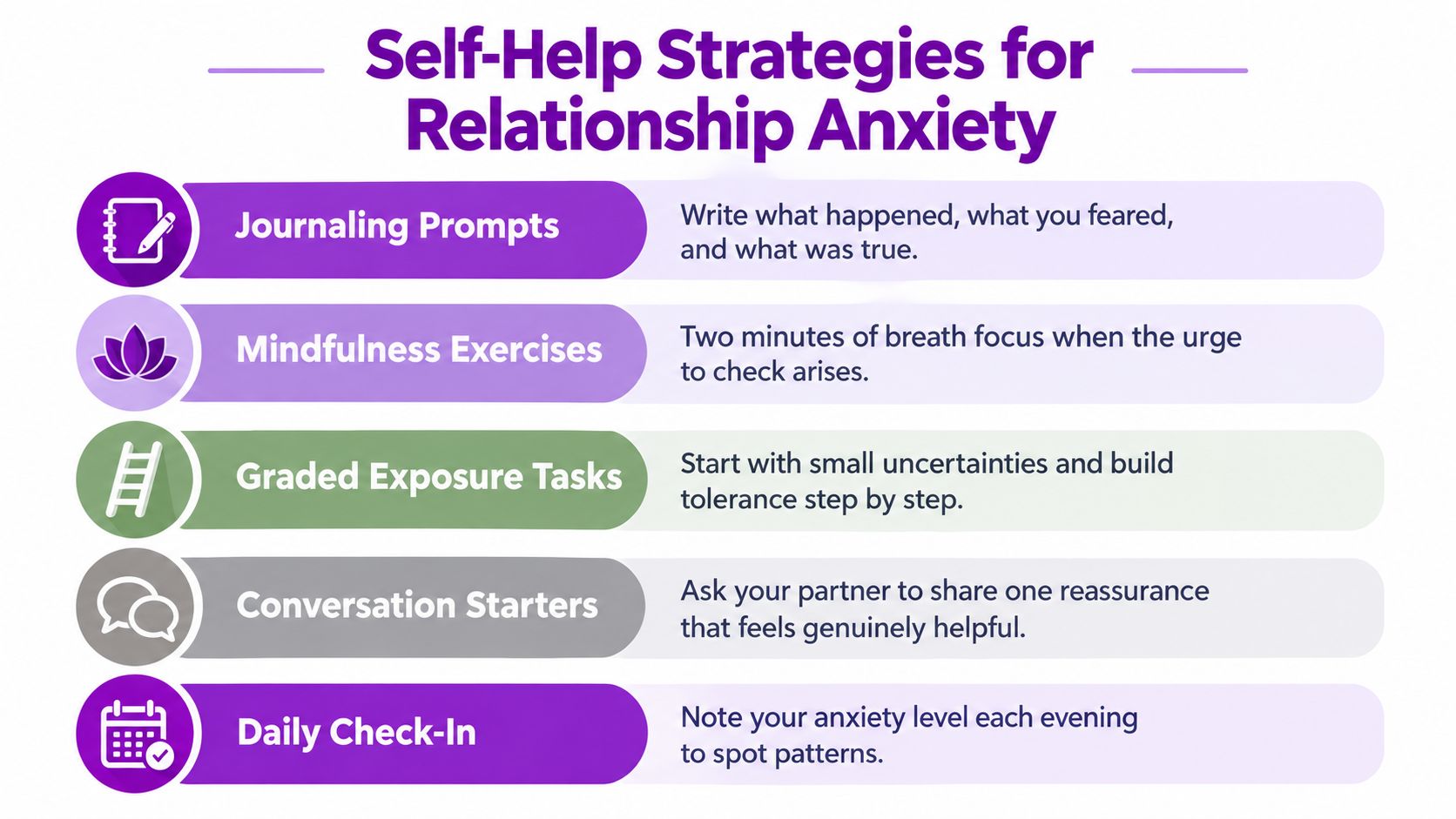
Use a notebook to write three lines after a trigger:
- What happened: “My partner replied with one sentence.”
- What I feared: “They're losing interest.”
- What I know: “They replied, and I don't know why the message was brief.”
This exercise doesn't argue that your fear is impossible. It separates observation from prediction, which gives you more room to choose your next action.
When the urge to check arises, try two minutes of steady breathing. Keep attention on the physical sensation of breathing, notice the urge, and return to the breath when your mind produces another question. The goal isn't instant calm. The goal is learning that an urge can rise and fall without controlling your behavior.
Practice uncertainty gradually
Create a ladder from easier to harder situations. You might begin by waiting before rereading a message, then later practice leaving a minor question unanswered until your scheduled check-in. Don't turn exposure into a private test of endurance. A therapist can help you grade tasks and prevent accidental reinforcement of compulsive patterns.
Conversation also needs structure. Try:
- “I noticed I felt anxious when we didn't connect today. I'm working on the feeling, and I'd like to talk about a time that works for both of us.”
- “I'm having the urge to ask for certainty again. Could you acknowledge that I'm distressed without answering the same question repeatedly?”
- “When plans change, I need clear information. Can we agree on how we'll update each other?”
- “I want to tell you what I'm experiencing without making you responsible for removing every uncomfortable feeling.”
A daily check-in can help you notice patterns, but avoid turning it into another monitoring ritual. Record how anxiety affected your actions and functioning, then bring recurring patterns to therapy. If a partner refuses reasonable communication, responds with intimidation, or uses your anxiety to control you, the solution may involve individual support and safety assessment rather than more reassurance practice.
Choosing the Right Therapist in Phoenix Metro Area
Look for a therapist whose training matches the pattern you're experiencing. Ask whether they work with CBT, ERP, EMDR, attachment-related concerns, trauma, or couples therapy. You can also ask how they distinguish reassurance from reassurance rituals, how they assess relationship safety, and how they measure progress.
Practical fit matters too. Check insurance participation, appointment availability, session format, and whether you prefer individual, couples, in-person, or secure online care. The first consultation should leave you feeling able to discuss difficult thoughts without being judged. If the therapist treats every concern as personal insecurity, even when your partner's behavior is unstable or unsafe, ask how they account for relationship context.
What to look for in a therapist can help you prepare questions before contacting a practice.
reVIBE Mental Health reports five Arizona locations serving the Phoenix metropolitan area, with the listed contact number (480) 674-9220 (reVIBE's location information). The sites are:
- Chandler: 3377 S Price Rd, Suite 105, Chandler, AZ
- Phoenix Deer Valley: 2222 W Pinnacle Peak Rd, Suite 220, Phoenix, AZ
- Phoenix PV: 4646 E Greenway Road, Suite 100, Phoenix, AZ
- Scottsdale: 8700 E Via de Ventura, Suite 280, Scottsdale, AZ
- Tempe: 3920 S Rural Rd, Suite 112, Tempe, AZ
The practice offers talk therapy, EMDR, couples and relationship support, and psychiatry with medication management, with in-person and secure online options described by the provider. Confirm current availability, insurance participation, and the clinician's experience with your specific concerns when you call.
Conclusion and Next Steps
Relationship anxiety becomes easier to address when you identify the pattern instead of arguing with every individual thought. Track the trigger, the prediction, and the behavior that follows. Then ask the central treatment question: does this anxiety travel with you across relationships and situations, or does it mainly arise from what is happening with your current partner?
Individual CBT, attachment-focused work, trauma treatment, ERP, couples therapy, and psychiatric care each have different roles. Couple-based work may help when both partners can participate safely and the relationship maintains the cycle. Individual therapy should come first when symptoms are broad, trauma is prominent, coercion is present, or the relationship environment makes open conversation unsafe.
Small practices can support treatment. Write down predictions, pause before checking, communicate needs without demanding certainty, and measure progress by your choices and functioning rather than by the complete absence of anxiety. The Phoenix network includes locations serving Phoenix, Chandler, Scottsdale, Tempe, and Paradise Valley service areas, giving people multiple in-person access points (reVIBE's locations across the area).
reVIBE Mental Health offers individual therapy, couples support, EMDR, and psychiatry with medication management for concerns that can affect relationships, including anxiety, trauma, and emotional distress. Visit reVIBE Mental Health to explore in-person or secure online care and contact the practice at (480) 674-9220 to discuss a personalized next step.