Which relationship problem are you trying to change: the argument itself, the fear underneath it, the beliefs that intensify it, or the decision about whether to stay? Relationship therapy isn't one standardized method. Some approaches focus on emotional bonds, while others target thoughts and behaviors, family history, personal values, relationship narratives, or separation decisions.
Couples therapy usually works with the relationship as the client, although individual sessions may support the process. Individual therapy focuses primarily on one person's mental health and patterns, while family-focused work examines the wider system surrounding a couple. The best comparison asks about each model's primary goal, session style, ideal fit, strengths, limitations, and between-session practice.
A qualified therapist can also adapt methods to the couple's needs instead of forcing every concern into one framework. In Arizona, reVIBE Mental Health offers relationship and family support through in-person and secure online sessions, provider matching, and locations serving Scottsdale, Tempe, Chandler, Phoenix, and Paradise Valley. The practice may be one care option for adults and couples looking for a therapist who fits their goals.
1. Emotionally Focused Therapy
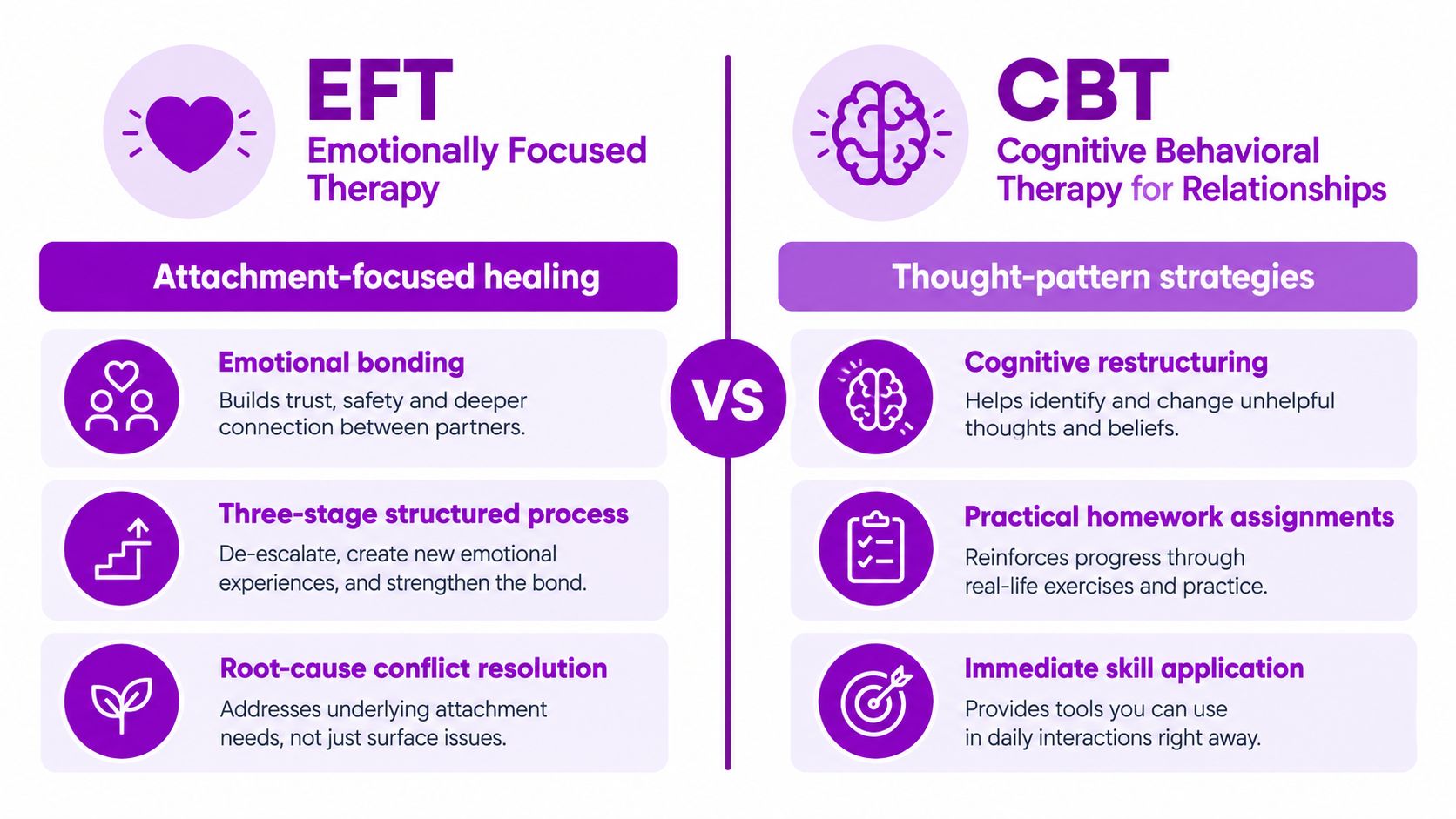
Emotionally Focused Therapy, often called EFT, starts with a simple idea: recurring arguments often express unmet attachment needs. A partner who complains about dishes may also be asking, “Can I rely on you?” A partner who withdraws may be protecting against rejection rather than showing indifference.
EFT helps couples identify the cycle that keeps repeating, recognize the vulnerable emotions beneath surface frustration, and respond to one another with greater emotional availability. Sessions often move from de-escalating the negative cycle to changing the interaction pattern and consolidating new ways of connecting. The approach is especially useful when partners feel emotionally distant, stuck in protest and withdrawal, or unable to rebuild trust after an injury.
A couple recovering from infidelity might need more than rules about phone access. They may need to express fear, grief, shame, and longing while learning whether the injured partner can risk trust again and whether the other partner can respond without defensiveness. Long-term partners may use EFT to understand why one pursues conversation while the other shuts down.
Practical rule: Talk about the need beneath the complaint, not only the complaint itself.
EFT asks for emotional courage. You'll need to discuss vulnerable feelings rather than only surface frustrations, attend consistently, and practice new communication patterns between sessions. It can feel slow for couples who want immediate problem-solving, and it may need modification when safety concerns, untreated addiction, or severe individual symptoms dominate the relationship.
Learn more about how attachment issues can affect relationships before deciding whether an attachment-focused approach fits your situation.

2. Cognitive Behavioral Therapy for Relationships
Cognitive Behavioral Therapy for relationships examines the connection between thoughts, emotions, and actions. A partner may think, “They didn't text because they don't care,” feel rejected, and respond with an accusation. The other partner may interpret that accusation as proof that nothing they do will be enough, then withdraw. CBT makes that sequence visible so the couple can interrupt it.
The therapist may help partners identify mind-reading, catastrophizing, all-or-nothing thinking, or assumptions presented as facts. The couple then tests those interpretations against evidence and practices a different response. A long-distance couple, for example, might create dependable contact routines while challenging the belief that a missed call automatically signals emotional abandonment.
CBT tends to be structured and practical. Sessions may include thought records, communication exercises, behavioral experiments, and agreed homework. That structure can suit couples who want clear tools for high conflict, anxiety, jealousy, or repeated misunderstandings.
What practice looks like
A partner who thinks, “If we disagree, this relationship is failing,” might record the situation, identify the emotion, examine evidence, and write a more balanced interpretation. The couple could then practice making one specific request instead of starting a broader attack.
The main limitation is that changing thoughts and behaviors may not fully address grief, attachment injuries, trauma, or deeply rooted family patterns. Some couples also resist homework or expect new behaviors to feel natural immediately. Repetition matters because a skill can be intellectually understood before it becomes emotionally familiar.
You can explore online cognitive behavioral therapy treatment if structured exercises and secure remote sessions match your needs.
3. The Gottman Method
The Gottman Method gives couples a detailed map of relationship strengths, conflict habits, friendship, intimacy, and shared meaning. Developed by Drs. John and Julie Gottman and grounded in more than four decades of research, the approach pays close attention to interaction patterns that predict escalation. Its familiar “Four Horsemen” are criticism, contempt, defensiveness, and stonewalling.
Consider a disagreement about parenting. Criticism attacks character, contempt communicates disrespect, defensiveness shifts blame, and stonewalling ends engagement. The method teaches alternatives, such as a softened startup, a specific complaint about behavior, validation, and a repair attempt that lowers the temperature before the argument becomes destructive.
A therapist may begin with assessment rather than immediately asking a couple to discuss its biggest wound. Partners might examine friendship, conflict management, rituals of connection, and their shared future. That breadth can help couples who want a practical relationship skills program, particularly when they still have goodwill but lack reliable tools during disagreements.
A repair attempt doesn't erase the conflict. It helps partners stop adding damage while they work through it.
A couple might replace “You never listen” with “I felt alone when I handled bedtime without checking in. Can we plan that differently tonight?” Partners can also create daily connection rituals, practice gentle openings, and agree on timeouts when either person becomes overwhelmed.
The method's specificity is a strength, but some couples may experience it as highly structured or skills-heavy. It can also miss deeper emotional or historical material unless the therapist integrates other approaches. The right question isn't whether every technique feels natural. It's whether the couple can practice it consistently enough to create safer exchanges.
4. Imago Relationship Therapy
Imago Relationship Therapy helps partners explore how early caregiving experiences can shape attraction, expectations, and conflict. Its central premise is that people may be drawn to partners who reflect familiar qualities from formative relationships, including qualities they found comforting and qualities that hurt them.
That doesn't mean childhood determines a relationship or that partners are just repeating their parents' marriages. The approach uses this history to make recurring arguments more understandable. A disagreement about household responsibilities may carry an older fear of being ignored, controlled, or left alone.
The signature Imago Dialogue gives partners a structured way to speak and listen. One person communicates, the other mirrors what they heard, validates the possible logic of that perspective, and responds with empathy. Agreement isn't the immediate target. Understanding comes first.
A useful scenario
Suppose one partner asks for more affection and the other responds with jokes. The first partner experiences rejection, while the second feels pressured and criticized. Imago work may slow the exchange down enough for each person to explain what affection and pressure mean in their personal history.
This approach can suit couples who argue about the same issue repeatedly and want to understand the emotional meaning behind the pattern. It may also help second-marriage partners notice how earlier relationships influence current expectations.
The trade-off is pace. Mirroring can feel artificial at first, particularly for partners who want to defend their position or solve the practical issue immediately. Exploring childhood connections can also become distracting if the couple uses history to explain behavior without taking responsibility for changing it. Between sessions, partners need patience and practice, especially with listening before correcting.
5. Narrative Therapy for Relationships
Narrative Therapy focuses on the stories couples tell about themselves. “We're a failing relationship,” “She's selfish,” or “He never changes” can become fixed identities that filter out evidence of effort, care, and resilience. Narrative work separates people from problems and examines how a problem has influenced the relationship.
A couple might shift from “We're terrible at communication” to “The criticism-withdrawal cycle takes over when we feel unheard.” That change doesn't pretend the conflict is minor. It gives the partners a shared problem to address instead of assigning one person the role of the problem.
The therapist may ask when the negative pattern didn't succeed, what values were present during those moments, and how each partner contributed to a different outcome. A long-term couple could explore moments when they protected one another during hardship, then use those memories to build a more complete story about their relationship legacy.
The story should become more accurate, not merely more positive.
Narrative Therapy can be a strong fit for couples burdened by shame, labels, cultural expectations, or a history of being defined by one crisis. It also supports partners who want to reconnect with shared values that conflict has obscured.
Its limitation is that reframing alone won't resolve every practical or clinical problem. A couple facing aggression, untreated depression, or severe communication breakdown may need direct safety planning, behavioral work, or individual treatment alongside narrative conversations. Between sessions, partners can document exceptions to the problem pattern and notice language that turns a temporary struggle into a permanent identity.
6. Acceptance and Commitment Therapy for Relationships
Acceptance and Commitment Therapy, or ACT, helps partners stop treating uncomfortable thoughts and feelings as commands. Anxiety, jealousy, sadness, and uncertainty may remain present while a person chooses behavior aligned with values such as honesty, loyalty, patience, or compassion.
An anxious partner might repeatedly seek reassurance, check messages, or demand certainty about the future. ACT doesn't require that person to eliminate anxiety before engaging lovingly. Instead, the partner learns to observe the thought, allow the feeling, and choose a values-based action rather than automatically following fear.
Couples may clarify what kind of relationship they want to build, then identify actions within their control. One partner can't control whether the other feels cheerful or responds perfectly. They can control whether they speak respectfully, keep a commitment, pause before reacting, or return to a difficult conversation.
Where ACT fits best
ACT can help couples navigating ongoing challenges, uncertainty, anxiety, depression, obsessive relationship thoughts, or decisions that require commitment despite emotional discomfort. It can also complement other approaches when the couple understands its pattern but struggles to act differently in the moment.
The approach isn't passive acceptance of harmful conduct. Accepting that a feeling exists doesn't mean accepting abuse, betrayal, or unsafe conditions. A therapist should distinguish acceptance of internal experience from approval of damaging behavior.
Between sessions, partners might practice mindfulness, name the thought they're having instead of treating it as fact, and choose one small action connected to their shared values. ACT may feel frustrating to someone seeking certainty or a technique that removes distress immediately. Its value lies in building flexibility, not promising a permanently calm relationship.
7. Discernment Counseling
Discernment Counseling is for couples facing a serious decision about the future, especially when one partner is leaning toward separation and the other wants to continue. Unlike traditional couples therapy, it doesn't begin by assuming that reconciliation is the shared objective. The immediate task is to gain clarity about the available paths.
The model developed by William Doherty uses a structured nine-session format to help partners consider whether to pursue relationship repair, separate with dignity, or remain together without meaningful change. The process is decision-focused, not a substitute for longer-term couples therapy.
A couple on the brink of divorce may be too polarized for ordinary communication exercises. One partner may feel hopeless, while the other feels panicked and pushes for immediate repair. Discernment gives each person space to examine the relationship history, personal contribution, values, and possible consequences of each path.
What makes it different
Partners should enter with openness to more than one outcome. They'll need to discuss conflicted feelings openly and resist using sessions to persuade the other person. Clarity can lead to intensive couples therapy, separation, or a more deliberate decision to stay.
The model isn't designed to improve the relationship directly, so couples seeking reconciliation should understand the transition into a suitable couples therapy approach. It may also be inappropriate when coercion or safety risks prevent genuine choice. Ask a qualified provider how confidentiality, individual conversations, safety, and the transition after discernment will be handled.

8. Family Systems Therapy
Family Systems Therapy, particularly the Bowen Method developed by Murray Bowen, views relationship distress within a broader emotional system. A couple may be reacting not only to one another but also to expectations, loyalties, roles, and patterns learned in their families of origin.
A partner who becomes intensely reactive to criticism may have learned that disagreement threatens belonging. Another may manage tension by becoming overly responsible, emotionally distant, or drawn into conflicts between relatives. Systems work helps people notice these patterns without reducing them to blame.
A therapist may use a genogram, a visual map of family relationships, significant events, roles, alliances, and repeated patterns. The aim is to help each person develop differentiation, which means staying connected while thinking and acting with greater emotional independence.
You can honor your family without repeating every pattern it handed you.
This model may fit couples who repeatedly recreate parental dynamics, struggle with in-law boundaries, or feel pulled into intergenerational conflict. It can also help families address patterns that affect several relationships at once.
The work often asks individuals to change their own reactivity rather than waiting for every relative to participate. That's a strength, but it can feel indirect when partners want immediate conflict-resolution scripts. Family history can also become an explanation that avoids accountability. Between sessions, partners may track triggers, practice calm communication, and notice when they're responding from an old family role rather than the present situation.
Read about family systems theory to understand how wider family dynamics can influence a couple's relationship.
9. Psychodynamic Couples Therapy
Psychodynamic Couples Therapy looks beneath repeated interactions to explore unconscious conflicts, defenses, projections, and past experiences that shape present intimacy. Partners may know exactly what they argue about while missing why the same emotional sequence feels so urgent each time.
A partner who demands constant reassurance may fear dependence and rejection at the same time. Another who appears detached may use distance to protect against shame. Psychodynamic work helps each person examine these defenses and understand how the relationship activates older expectations.
A couple might discover that one partner experiences ordinary feedback as humiliation, while the other interprets emotional withdrawal as proof of abandonment. Those reactions can create a cycle in which each person's defense confirms the other's fear. The therapist pays attention to emotional shifts in the room, including how partners respond to the therapist and to one another.
Insight must become behavior
Psychodynamic therapy suits couples willing to explore uncomfortable material and tolerate a less scripted process. It can be valuable when the same patterns persist despite learning communication skills, or when partners sense that their reactions exceed the immediate situation.
The limitation is that insight takes time and doesn't automatically produce change. A couple may understand the origin of a defense yet still need behavioral rehearsal, emotion regulation, or concrete agreements. Some partners also find the focus on unconscious processes abstract. Between sessions, they can note strong reactions, slips, recurring dreams, and moments when they blame the other person for feelings they may partly be projecting.
10. Positive Psychology in Relationships
Positive Psychology in relationships shifts attention toward strengths, resilience, appreciation, shared meaning, and the experiences that help a couple flourish. It doesn't deny conflict. Instead, it makes sure the relationship isn't defined only by what's wrong.
A couple recovering from job loss or illness might identify how they supported one another, what values kept them connected, and which rituals helped them endure uncertainty. Partners with manageable conflict may use gratitude, shared purpose, and positive experiences to strengthen the relationship before resentment becomes the central story.
The therapist may ask each person to identify qualities they appreciate, describe moments of effective teamwork, and build rituals that reflect the couple's values. A partner who feels taken for granted could receive specific recognition for emotional labor, reliability, humor, or care rather than a generic compliment.
Positive Psychology works well as a complement to problem-focused therapy. Its main limitation is timing. Gratitude exercises can feel dismissive if a partner is experiencing betrayal, grief, abuse, or severe unresolved conflict. A therapist should not use positivity to pressure someone into forgiveness or silence.
Between sessions, couples can express specific appreciation, discuss shared purpose, create regular connection rituals, and celebrate progress that might otherwise go unnoticed. The most useful practice is concrete. “Thank you for taking over dinner while I was overwhelmed” carries more meaning than “You're great.”
10 Types of Relationship Therapy Compared
| Approach | 🔄 Implementation complexity | ⚡ Resource requirements & timeframe | 📊 Expected outcomes | 💡 Ideal use cases | ⭐ Key advantages |
|---|---|---|---|---|---|
| Emotionally Focused Therapy (EFT) | Structured 3-stage model; requires trained EFT therapist and both partners' engagement | Moderate, typically 8–20 sessions; therapist expertise important | ⭐⭐⭐⭐, ~75% of couples report significant improvement; stronger emotional bonding | Rebuilding trust/attachment, emotional distance, intimacy issues | Targets root causes via attachment lens; clear roadmap and strong evidence |
| Cognitive Behavioral Therapy for Relationships (CBT) | Structured, skills- and homework-focused; therapist-led exercises | Moderate, short-to-mid term with regular homework; works even if one partner less engaged | ⭐⭐⭐⭐, improved communication, reduced anxiety/conflict; measurable progress | Thought-patterns, anxiety comorbidity, goal-oriented couples | Practical, data-driven skills with immediate application |
| The Gottman Method | Assessment-heavy; directive techniques and skill training; requires certification for fidelity | Moderate-to-extensive initial assessment; ongoing exercises and practice | ⭐⭐⭐⭐, research-backed predictions; reduced harmful interaction patterns | Couples wanting prevention, conflict reduction, or measurable change | Highly practical techniques (e.g., softened startup) backed by longitudinal research |
| Imago Relationship Therapy | Moderately structured (Imago Dialogue); focuses on childhood influences, emotionally intense | Moderate, regular practice of dialogue outside sessions; therapist familiar with Imago process | ⭐⭐⭐, deeper empathy and understanding; helps heal relational wounds | Recurrent arguments, healing childhood-derived patterns, rebuilding empathy | Teaches concrete dialogue skills that foster compassion and insight |
| Narrative Therapy for Relationships | Exploratory, collaborative; therapist adopts non-expert stance; flexible process | Variable, can be time-intensive; dependent on therapist's narrative skills | ⭐⭐⭐, increased agency, reframed stories, less blame and shame | Couples stuck in negative narratives or blame cycles | Externalizes problems and empowers couples to reauthor their story |
| Acceptance and Commitment Therapy (ACT) for Relationships | Teaches mindfulness, acceptance, and values-driven action; requires ACT-trained clinician | Moderate, ongoing practice of mindfulness and values exercises; timeframe varies | ⭐⭐⭐, greater psychological flexibility and values-aligned behavior | Anxiety-related issues, commitment despite discomfort, values-driven change | Reduces struggle with emotions and promotes committed, value-based actions |
| Discernment Counseling | Highly structured nine-session decision-focused model; neutral stance | Low-to-moderate, short-term (≈9 sessions); needs specially trained discernment counselor | ⭐⭐⭐, clarity about stay/separate decisions; reduces impulsive choices | Couples in crisis considering separation or ambivalent about leaving | Fast, focused clarity to inform major relationship decisions |
| Family Systems Therapy (Bowen Method) | High complexity, multigenerational genogram, differentiation work; systemic lens | High, longer-term work; deep family-history exploration required | ⭐⭐⭐, durable system-level change over time; reduced reactivity | Intergenerational patterns, family-wide dynamics affecting couple | Addresses roots of patterns across generations; reduces blame |
| Psychodynamic Couples Therapy | High complexity, explores unconscious conflicts, transference, defenses | High, long-term commitment; skilled psychodynamic clinician needed | ⭐⭐⭐, profound insight into motivations; slower behavioral change | Couples with trauma histories or deep unconscious enactments | Deep psychological understanding of repetitive relationship dynamics |
| Positive Psychology in Relationships | Low-to-moderate, strength-based exercises and rituals; complements other approaches | Moderate, regular practices (gratitude, rituals); adaptable to brief formats | ⭐⭐⭐, increased relationship well-being, resilience, sustained positivity | Couples wanting flourishing beyond problem-solving; resilience-building | Shifts focus to strengths and flourishing; boosts hope and sustained connection |
Final Thoughts
Wrapping up the types of relationship therapy starts with abandoning the idea that one model is automatically best. EFT may fit partners who feel trapped in pursue-withdraw cycles and need a more secure emotional bond. CBT may suit couples who want structured tools for interpretations, anxiety, and behavior change. The Gottman Method offers specific communication and repair practices, while Imago gives partners a disciplined dialogue for understanding how early experiences shape present conflict.
Narrative Therapy can loosen damaging identities and help couples build a fuller account of their relationship. ACT supports values-based action when difficult emotions won't disappear on command. Discernment Counseling serves a different purpose entirely, helping couples in serious crisis make a clearer decision before committing to repair or separation. Family Systems Therapy looks across generations, Psychodynamic Couples Therapy explores unconscious patterns, and Positive Psychology strengthens appreciation, resilience, and shared meaning.
Research supports a nuanced view rather than a simple winner. A 2019 meta-analysis reported a medium overall post-treatment effect of g = 0.60, with emotionally focused couple therapy at g = 0.73 and behavioral couple therapy at g = 0.53. Benefits remained present at six months overall, with g = 0.44, according to the meta-analysis of couple therapy approaches. Another analysis found a large pre-to-post improvement in relationship satisfaction, Hedges g = 1.12, while waitlist couples showed little change, g = 0.12, as reported in this meta-analysis of couple therapy effects.
Those findings don't mean a branded method can replace therapist skill, safety assessment, cultural responsiveness, or a couple's willingness to participate. A review across 48 non-randomized clinical studies found moderate improvements in relational and individual outcomes, with context and population affecting results. The clinical review indexed by PubMed also found better relationship outcomes among older couples and couples with longer relationship duration, while outcomes were lower in some settings and populations. That's a reminder to ask how a therapist adapts care, not only which label appears on a website.
Your selection conversation can be direct. Ask what problem the therapist thinks is maintaining the distress, whether sessions are structured or exploratory, what happens between sessions, how individual concerns are handled, and how progress will be evaluated. If trauma is part of the picture, ask whether the provider has experience with trauma-informed couples work. A 2025 meta-analysis of eighteen studies found that couples' therapies for PTSD improved symptoms, relationship functioning, and depression, with an overall adherence rate of 69%, as described in this review of couples' therapies for PTSD.
Start with your pattern and your decision, then find the model and therapist that can address them. For Arizona couples and families, reVIBE Mental Health offers in-person and secure online care, provider matching, and support for relationship and family concerns across its Phoenix metro locations.
reVIBE Mental Health offers couples and family therapy through in-person and secure online sessions, with provider matching to help align care with your goals, preferences, and insurance. Visit reVIBE Mental Health to explore relationship support in Scottsdale, Tempe, Chandler, Phoenix, and Paradise Valley.