
Trauma bonding is one of the most confusing and powerful things a person can experience. It’s an incredibly strong emotional attachment that forms in the middle of a toxic, abusive relationship. It isn't love—it's a survival mechanism hardwired into our brains, born from a vicious cycle of abuse followed by sudden kindness. This pattern hijacks your brain's reward system, making it feel almost impossible to walk away, even when you know you're being hurt.
Unpacking The Trauma Bond Connection
If you've experienced a trauma bond, it's critical to know this: it is not a sign of weakness. It’s a completely understandable human response to a dangerous and deeply confusing situation.
Think of it this way: Imagine you're lost in a desert. The very same person who pushed you down into the scorching sand is also the only one who occasionally offers you a sip of water. You would naturally become intensely attached to them for those brief moments of relief, even though they are the source of your suffering. That, in a nutshell, is the dynamic of a trauma bond—a profound attachment to the person causing your pain.
This connection is cemented by a predictable cycle of abuse followed by what feels like a reward. The abuser creates a world of fear, neglect, or constant criticism, and then suddenly switches to intense kindness, tearful apologies, or "love bombing." Those good moments flood your brain with relief chemicals, creating a pattern that feels a lot like an addiction. You get hooked on the hope that the "good" version of them will finally stick around.
The Key Ingredients Of A Trauma Bond
Several key factors work together to forge and reinforce this harmful attachment. Recognizing them is the first step toward seeing the dynamic for what it is.
- Power Imbalance: The abusive partner almost always holds a significant amount of power—be it financial, emotional, or physical. This dynamic makes you feel dependent on them and less able to leave on your own terms.
- Intermittent Reinforcement: The unpredictable switch between cruelty and affection is a powerful psychological hook. It works just like a slot machine; you keep playing, hoping the next pull will be a jackpot—that next moment of kindness.
- Isolation: Abusers actively work to cut their partners off from friends, family, and other sources of support. This tactic deepens your dependence on them for any sense of connection or validation.
Here's a quick breakdown of what makes up a trauma bond. Seeing these elements laid out can help you identify if this dynamic is at play in your own life.
Core Components Of A Trauma Bond
| Element | What It Means | How It Looks In A Relationship |
|---|---|---|
| Power Imbalance | One person consistently holds control over the other (financially, emotionally, etc.). | You feel like you can't make decisions without their approval or that you need them to survive. |
| Intermittent Reinforcement | A cycle of good and bad treatment that is unpredictable and inconsistent. | Days of silent treatment are followed by a surprise gift; a huge fight is followed by intense affection. |
| Isolation | The abuser cuts you off from your support network (friends, family, colleagues). | They make you feel guilty for seeing friends, criticize your family, or move you away from your support system. |
| Cycle of Abuse | A repeated pattern of tension-building, an abusive incident, reconciliation, and calm. | Things feel tense, an explosion happens (verbal or physical), they apologize profusely, and things are "good" for a while. |
| Dependence | You feel emotionally or physically dependent on the abuser for survival or validation. | You believe you can't make it on your own or that no one else could ever love you. |
Recognizing these components isn't about blaming yourself; it's about gaining the clarity you need to protect yourself.
A trauma bond develops when repeated cycles of abuse and reconciliation create a powerful emotional attachment between the victim and abuser, making it difficult to break free. This process creates conflicting emotions, such as love, fear, dependence, and confusion, as the victim struggles with the complex interplay of attachment and manipulation.
Ultimately, being in a trauma-bonded relationship feels like you're strapped into an emotional rollercoaster you can't get off of. The dizzying highs make the terrifying lows seem almost worth it, creating a powerful illusion that your connection is uniquely special or passionate. The first step toward healing is recognizing that this isn't love—it's a cycle designed to keep you trapped.
The Psychological Hooks That Keep You Stuck
Have you ever found yourself in a relationship you knew was bad for you, yet the thought of leaving felt completely impossible? It’s a gut-wrenching, confusing place to be. This isn't a sign of weakness or a lack of willpower; it’s the result of powerful psychological hooks designed to keep you emotionally tangled and unable to break free.
One of the most potent of these hooks is called intermittent reinforcement. It’s an unpredictable, maddening cycle of reward and punishment. The best analogy is a slot machine. You keep pulling the lever, putting in coin after coin, enduring the losses because you've experienced the occasional win. The sheer unpredictability of that jackpot is precisely what keeps you glued to the machine.
In a relationship, this translates to a destructive pattern: periods of cruelty, neglect, or outright abuse are suddenly followed by intense affection, remorseful apologies, or overwhelming "love bombing." You're left constantly hoping for that next moment of kindness, that emotional "win." This keeps your nervous system on a knife's edge, caught between dread and desperate hope.
The Brain Chemistry Behind The Bond
It's not just behavioral—there's some serious chemistry at play inside your brain. The "bad times" flood your system with stress hormones like cortisol and adrenaline. Your body is essentially stuck in a state of high alert, a fight-or-flight response that is both physically and emotionally draining.
Then, when the brief "good times" roll around, your brain gets a rush of powerful reward chemicals. You get a hit of dopamine, the same chemical tied to pleasure and addiction, and oxytocin, often called the "bonding hormone." This intense cocktail creates a dizzying sense of relief and a powerful attachment to the very person who is the source of all your stress.
Your brain can literally become addicted to this high-low cycle. The profound relief you feel when the pain stops is easily mistaken for genuine love or a deep connection, forging a biochemical chain that is incredibly difficult to snap.
This conceptual map helps visualize how these different pieces—the power imbalance, the cyclical nature of the abuse, and the resulting chemical addiction—all lock together to form the trauma bond.
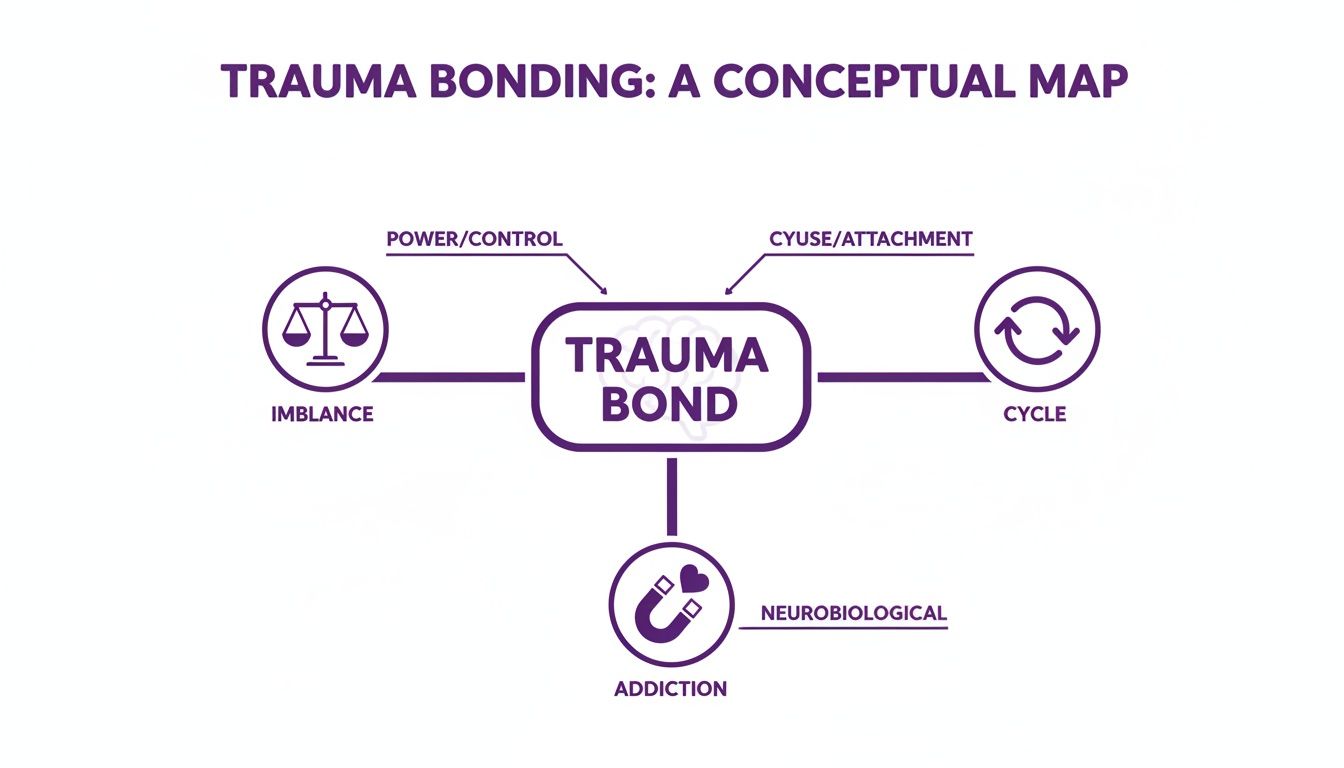
As you can see, a trauma bond isn't a single issue. It's a complex, self-reinforcing system where psychological manipulation and your own neurobiology conspire to keep you trapped.
How Your Past Shapes Your Present
Our earliest relationships with caregivers form a kind of blueprint for what we expect love to feel like as adults. If your childhood was marked by chaos, emotional neglect, or abuse, your brain may have learned to associate that kind of intensity and unpredictability with connection. It was a survival mechanism then, but it can leave you vulnerable now.
This isn't your fault. It simply means you were primed to find familiarity—and even a strange sense of comfort—in unstable dynamics.
Research consistently shows that childhood maltreatment and insecure attachment styles are major risk factors for trauma bonding in adulthood. In one study involving 354 individuals with abusive partners, the link was especially strong for those with insecure attachment histories, demonstrating how early life experiences can make someone more susceptible to these toxic relationships. If you're interested in the details, you can explore the full research on childhood risk factors.
Pulling back the curtain on these psychological hooks is a crucial first step. It helps you reframe what you're going through—not as a personal failing, but as a predictable, human response to a deeply unhealthy situation. Seeing the mechanics at work can be incredibly empowering. It's the clarity you need to recognize that these powerful feelings aren't about your worth, but are a direct product of the cycle itself. And that clarity is where the path to breaking free begins.
Seven Signs You Are In A Trauma Bond

Spotting a trauma bond from the inside is notoriously difficult. When you’re caught in such an intense whirlwind of emotions, your own judgment gets cloudy, and seeing the relationship for what it is can feel impossible. But learning to recognize the signs is the first, most critical step toward finding your way out.
This isn’t about blame or shame. It's about seeing a pattern for what it is. A trauma bond is a powerful, very real psychological response to a toxic cycle, and identifying these signs can be the key that empowers you to get help. Here are seven common indicators that you might be in a trauma-bonded relationship.
1. You Constantly Defend Their Behavior
Do you hear yourself making excuses for their hurtful actions? Maybe you tell friends, family, or even yourself things like, "They're just under a lot of stress," or "They didn't really mean what they said."
This is a classic sign. This kind of rationalizing is a way to cope, an attempt to make the kind, loving person you believe in fit with the one who causes you so much pain. It’s a story you tell yourself to keep the relationship afloat.
2. You’ve Become Isolated from Friends and Family
Abusive partners often work, subtly or overtly, to cut you off from your support system. Think about it: have you started pulling away from friends or family, especially those who show concern about your relationship?
This isolation serves a dual purpose for an abuser. It makes you far more dependent on them for everything, and it silences any outside voices that might help you see the truth. If you find yourself dreading conversations with loved ones about your partner, it's worth asking yourself why.
A core feature of a trauma bond is the powerful feeling of loyalty to the person causing harm. This isn't a flaw in your character; it's a survival instinct intertwined with the hope that their kindness will become permanent.
3. Your Self-Worth Is Entirely Tied to Them
A healthy relationship should make you feel more like yourself—secure, confident, and supported. In a trauma bond, your self-esteem is often on a puppet string, controlled completely by the other person's mood.
You might feel worthless when they’re critical or distant, only to feel a rush of validation when they finally show you affection. This emotional rollercoaster grinds down your sense of self until you feel like you're nothing without their approval.
4. You’re Addicted to the Emotional Rollercoaster
Does the relationship feel like an addiction? The constant cycle of conflict followed by intense "love-bombing" and apologies creates a powerful, chaotic experience.
You might find yourself desperately craving the "highs"—those moments of intense connection and relief—just to get away from the crushing pain of the "lows." This isn't just in your head; it creates a very real chemical bond in your brain that is incredibly hard to break.
5. You Believe You’re the Only One Who Can "Fix" Them
It’s common to feel that your partner’s harmful behavior is just a cry for help, and that you are the only one who can save them. You take on this immense responsibility, believing that if you just love them a little more or do things a little differently, they’ll finally change for good.
This mindset keeps you stuck, chasing their potential while ignoring the reality of their actions. Often, these dynamics are rooted in relationships with narcissistic individuals. To learn more, check out this guide on Surviving a Relationship With a Narcissist.
6. You Feel Indebted to Them
Abusers are masters at creating a sense of obligation. They might constantly bring up that one time they helped you with money or supported you through a tough time, using it as a weapon to keep you from leaving. This isn't love; it’s control disguised as loyalty.
7. Leaving Feels Utterly Impossible
Even when you know you’re miserable, the thought of actually ending it can trigger overwhelming panic, anxiety, and a profound sense of loss. People often call this trauma bond withdrawal, and the symptoms can be both emotional and physical.
This intense distress makes leaving feel impossible, and it's why so many people return to the toxic relationship—simply to make the pain stop.
The Hidden Costs Of A Trauma Bond
The impact of a trauma bond goes far deeper than the immediate pain of a toxic relationship. Think of its effects like invisible fault lines running through your life, creating lasting damage to your mental, emotional, and even physical well-being long after the connection ends. Seeing these hidden costs for what they are is crucial—it helps you understand why breaking free is not just a choice, but an absolute necessity for your health and survival.
The emotional toll is often the most obvious. Being trapped in a constant state of high alert, riding the rollercoaster of abuse and affection, is completely exhausting. It’s a process that systematically chips away at your self-esteem, slowly replacing your confidence with a relentless inner critic that sounds suspiciously like your abuser. Over time, you can be left struggling with a profound sense of worthlessness, internalizing the idea that you are somehow flawed or unlovable.
The Escalating Mental Health Risks
This slow emotional erosion often opens the door to serious mental health conditions. People caught in a trauma bond are at a much higher risk of developing chronic anxiety, deep-seated depression, and Complex PTSD (C-PTSD). The relentless stress and emotional whiplash keep your nervous system locked in a fight-or-flight mode, making it nearly impossible to ever feel truly safe or relaxed.
The psychological impact is stark. Research shows that people in trauma-bonded relationships are three times more likely to suffer from depression, anxiety, and post-traumatic stress disorder (PTSD). In fact, studies reveal that roughly 18% of women in domestically violent relationships report significant symptoms of trauma bonding, which just goes to show how widespread this devastating dynamic really is. If you're interested in the specifics, you can learn more about these trauma bonding statistics.
The Damage To Your Ability To Trust
One of the most corrosive effects of a trauma bond is the way it shatters your ability to trust—not just other people, but yourself. After being systematically manipulated and gaslit, your own judgment starts to feel unreliable. You begin to question your own perceptions of reality, second-guess every decision, and struggle to believe that your feelings are even valid.
This erosion of self-trust can make forming healthy relationships in the future feel like a monumental, if not impossible, task. Your internal blueprint for what connection looks like has been warped by abuse, leaving you with a few damaging patterns:
- Difficulty with Intimacy: You might either avoid closeness altogether as a form of self-protection or find yourself rushing into intense, chaotic connections that feel uncomfortably familiar.
- Hypervigilance: It's common to constantly be on the lookout for signs of danger or betrayal in new relationships, making it incredibly hard to accept kindness at face value.
- Inability to Set Boundaries: The bond conditions you to believe your needs don't matter, which makes establishing and holding firm on healthy boundaries feel foreign and wrong.
This kind of damage can be profound, creating long-term effects that shape how you move through the world for years. For a closer look at how these experiences can linger, you can read our guide on the long-term effects of post-traumatic stress disorder.
A trauma bond doesn’t just break your heart; it breaks your sense of self and your perception of the world. It rewires your brain to associate love with pain, safety with anxiety, and connection with control, leaving deep scars that require intentional healing.
At the end of the day, acknowledging these hidden costs can be a powerful catalyst for change. It helps shift the internal question from, "Why can't I leave?" to "What more will I lose if I stay?" Breaking that bond is the first, most essential step toward reclaiming your identity, rebuilding your self-worth, and finally learning what a genuinely safe and supportive connection can feel like.
Your Roadmap To Healing And Recovery
The leap from understanding a trauma bond to actually breaking free is the most empowering part of this journey. It’s not about one huge, dramatic exit. Instead, it’s a series of courageous small steps, starting with simply admitting what’s happening and putting your own safety first.
The truth is, healing is absolutely possible. With the right support, you can reclaim your sense of self and build a life that isn't defined by this painful cycle.
The first step is often the hardest: accepting the reality of the relationship without piling on blame or shame. It's about seeing the pattern for what it is and acknowledging the toll it's taken. That awareness is the solid ground you'll build your recovery on.
From there, it’s critical to create a safety plan. This isn't just about leaving; it’s about having a plan. This might mean finding a safe place to stay, gathering your important documents, and letting trusted friends or family know you might need them.
Therapeutic Pathways To Reclaim Your Life
Therapy is really the cornerstone of recovering from a trauma bond. It provides a safe, confidential space where you can sort through the tangled emotions and start learning new ways to cope. The key is finding a therapist who gets it—someone who is trained in trauma-informed care and understands the deep psychological hooks of these bonds.
Two of the most effective approaches are:
- Eye Movement Desensitization and Reprocessing (EMDR): This therapy is a game-changer for many. It helps your brain reprocess traumatic memories so they lose their emotional intensity, all without you having to talk through the event in exhaustive detail.
- Cognitive Behavioral Therapy (CBT): Think of CBT as a toolkit. It gives you practical ways to spot and challenge the distorted thought patterns that keep you feeling stuck. You learn to rebuild healthier ways of thinking about yourself and the world.
Finding a good therapeutic match is everything. The whole point is to rebuild your life on a foundation of safety and self-worth. For specialized guidance, a victim counselling service can offer tailored support for navigating the unique challenges of post-traumatic recovery.
The Role of Professional Support in Your Journey
A skilled and compassionate therapist acts as your guide through the incredibly difficult process of untangling your identity from the abuser's. They offer a judgment-free zone to grieve, process, and start rebuilding your self-esteem from the ground up.
Healing from a trauma bond involves more than just leaving the relationship; it requires a conscious effort to rediscover who you are, what you value, and how you want to be treated. It’s about learning to trust your own judgment again.
This is also where you'll learn to set firm boundaries—a critical skill for preventing future unhealthy relationships. A professional can also support you through the intense "withdrawal" symptoms that often come with leaving, like overwhelming loneliness, anxiety, and the powerful urge to go back.
Therapy can also shine a light on past experiences that may have made you more vulnerable to this kind of dynamic in the first place. To understand how therapists approach this, you can learn more from our guide on what is trauma-informed therapy. This approach ensures your treatment recognizes and respects the full scope of what you've been through.
Taking The First Step With reVIBE Mental Health
At reVIBE Mental Health, we know how much courage it takes to even consider asking for help. Our team provides specialized, compassionate care to help you finally break free from the cycle of a trauma bond and start your healing journey. With five convenient locations across the Phoenix metro area, expert support is close by.
Find a reVIBE Location Near You!
We currently have five locations for your convenience. (480) 674-9220
reVIBE Mental Health – Chandler
3377 S Price Rd, Suite 105, Chandler, AZ
reVIBE Mental Health – Phoenix Deer Valley
2222 W Pinnacle Peak Rd, Suite 220, Phoenix, AZ
reVIBE Mental Health – Phoenix PV
4646 E Greenway Road, Suite 100, Phoenix, AZ
reVIBE Mental Health – Scottsdale
8700 E Via de Ventura, Suite 280, Scottsdale, AZ
reVIBE Mental Health – Tempe
3920 S Rural Rd, Suite 112, Tempe, AZ
Find A reVIBE Location Near You
Deciding to seek help is a massive step, and it’s often the hardest one to take. But you don’t have to go through this alone. Breaking free from a trauma bond requires a safe, supportive space where you can rediscover your own strength and rebuild the sense of self that was chipped away. At reVIBE Mental Health, our entire mission is to be that space for you.
Our team of therapists and psychiatric professionals work together, specializing in what’s known as trauma-informed care. We get it—we understand the deep psychological and neurological hooks that make you feel so stuck. We use proven, compassionate methods like EMDR to help you finally process what happened without forcing you to relive it over and over. Everyone’s path to healing looks different, so we offer both in-person and secure online sessions to meet you wherever you feel most comfortable.
Accessible, Compassionate Care In Your Community
The need for accessible mental health care has never been more clear, especially when you look at the statistics on intimate partner violence (IPV)—a primary breeding ground for trauma bonds. Research shows that about one in four women (27.4%) and one in nine men (11.1%) experience IPV in their lifetime. Think about that in a place like the Phoenix metro area. That translates to hundreds of thousands of our neighbors who may have been in a relationship where a trauma bond could form, underscoring just how urgent the need for real support is. You can read more about the connection between IPV and trauma bonding in this detailed research.
We want to remove as many barriers as possible, which is why reVIBE Mental Health accepts most major insurance plans. With five convenient locations scattered across the Phoenix valley, professional and compassionate support is right in your own backyard.
Breaking free from a trauma bond isn't just about ending a relationship—it's about taking your life back. Reaching out for professional help is a profound act of self-preservation and the first real step toward a future built on safety, respect, and your own self-worth.
You can explore our reVIBE Mental Health locations to find the clinic nearest you in Chandler, Phoenix Deer Valley, Phoenix PV, Scottsdale, or Tempe. Help is much closer than you might think.
-
reVIBE Mental Health – Chandler
3377 S Price Rd, Suite 105, Chandler, AZ -
reVIBE Mental Health – Phoenix Deer Valley
2222 W Pinnacle Peak Rd, Suite 220, Phoenix, AZ -
reVIBE Mental Health – Phoenix PV
4646 E Greenway Road, Suite 100, Phoenix, AZ -
reVIBE Mental Health – Scottsdale
8700 E Via de Ventura, Suite 280, Scottsdale, AZ -
reVIBE Mental Health – Tempe
3920 S Rural Rd, Suite 112, Tempe, AZ
When you feel ready to start healing, give us a call at (480) 674-9220.
Answering Your Questions About Trauma Bonding
When you're trying to make sense of a trauma bond, it’s normal to feel lost in a storm of confusing and painful questions. The emotions are so intense and contradictory, it can feel impossible to get a clear view of what’s really happening. Let's walk through some of the most common questions people have—these answers are here to bring some clarity and let you know you’re not alone in feeling this way.
Is This Really Love, Or Something Else?
This is probably the most gut-wrenching question of all, and the answer is no, a trauma bond isn't the same as love. It’s an easy mistake to make because the feelings are so powerful, but they come from a very different place.
Healthy love is built on a foundation of safety, trust, and mutual respect. It makes you feel secure and valued, consistently. A trauma bond, on the other hand, is forged in a chaotic cycle of abuse and reward. The intense rush of relief you feel when the abuser is kind again can easily be mistaken for deep love. In reality, it's a powerful biological reaction to the temporary end of mistreatment.
Think of it this way: genuine love helps you grow and feel good about yourself. A trauma bond systematically chips away at your well-being.
Why Does It Feel Impossible To Leave?
If you've ever asked yourself this, know that it has nothing to do with being weak. A trauma bond literally hijacks your brain's survival wiring. The unpredictable cycle of good and bad times creates a powerful, addiction-like pattern. You find yourself craving the "highs" of affection just to escape the crushing "lows" of abuse, creating a biochemical chain that feels unbreakable.
On top of that, an abuser often works to dismantle your self-esteem, isolate you from friends and family, and create financial or emotional dependency. Leaving isn't just a simple choice. It is never a failure of willpower. It's about breaking a deeply ingrained psychological and biological bond, which is why professional support is so often needed to create a safe path out.
Can I Heal If I Stay In The Relationship?
Unfortunately, trying to heal from a trauma bond while still in the abusive environment is like trying to dry off in the middle of a rainstorm. It's virtually impossible.
True recovery requires a sense of safety, rebuilding your self-worth, and learning to enforce strong boundaries. An active abuser will constantly undermine any progress you make in these areas because the cycle of abuse is what gives them control. To truly heal, the pattern that created the bond has to be broken for good.
The first, non-negotiable step toward recovery is creating physical and emotional distance from the abuser. This separation is what finally gives you the space and safety you need to think clearly, process the trauma, and start reconnecting with your own identity.
Breaking free is an act of profound courage and self-preservation. It’s the first step on the journey back to yourself, where you can finally find the genuine safety and respect you have always deserved.
Taking that first step is often the hardest part, but you don’t have to do it alone. The compassionate team at reVIBE Mental Health is here to guide you with specialized, trauma-informed care. To learn more about our approach and find a location in the Phoenix area, please visit our website at https://revibementalhealth.com.