
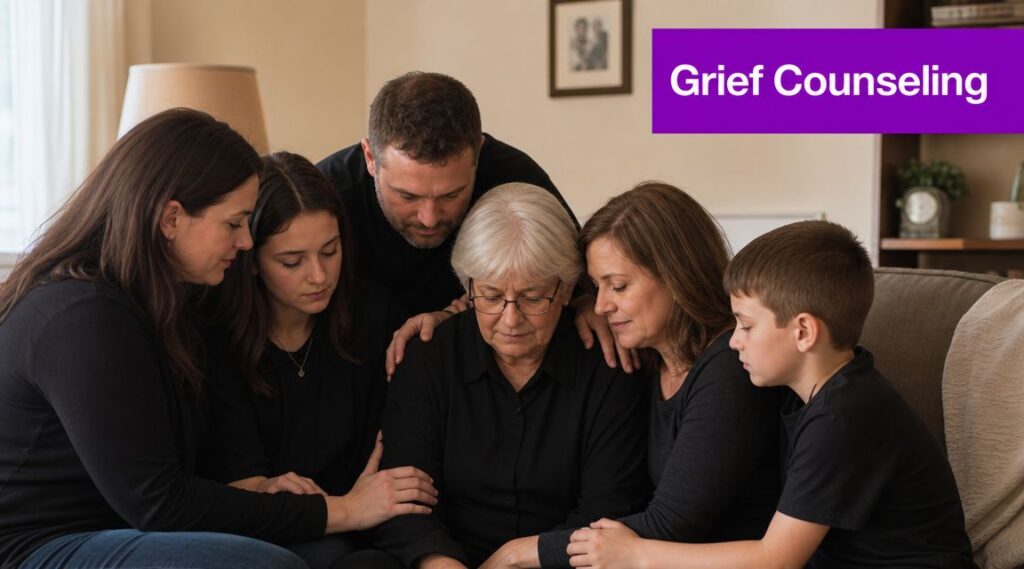
The house is quieter after a death, but not always in the way people expect. One child starts waking up at night. A teenager stops coming to dinner. The surviving parent becomes all logistics and no words. Everyone is hurting, and everyone can feel that the family has changed, yet nobody knows how to talk about it without making things worse.
That's often the hardest part of early grief. You're together, but it can feel as if each person is grieving in a separate room.
Navigating Loss Together as a Family
Families rarely fall apart in one dramatic moment after a loss. More often, strain shows up in small shifts. The person who used to keep everyone connected is gone. Routines loosen. One family member wants to talk constantly, another avoids the topic, and a child watches both reactions and learns that grief is confusing territory.
This is why grief counseling for families matters. It doesn't treat grief as one person's private problem. It looks at what the loss has done to the whole system, including communication, caregiving, conflict, and the family's sense of safety.
When grief changes daily life
A family might look functional from the outside and still feel disoriented inside. School gets harder to manage. Bedtime becomes a battle. Basic decisions take more effort. Even practical matters after a death can overwhelm people who are already emotionally taxed. If a family is dealing with the aftermath of a traumatic death scene, a resource like this homeowner's guide to biological clean up can help reduce one layer of crisis while the family focuses on emotional care.
Children are often at the center of this disruption. About 1 in 11 children in the U.S. will experience the death of a parent or sibling by age 18, which is why family-wide support is so important, not just support for one grieving person (childhood bereavement data).
Grief doesn't only remove a person. It reshapes roles, routines, and the emotional climate of a home.
A family problem needs a family lens
Parents often wonder whether they should protect children from their own grief, or whether they should hold things together until everyone else stabilizes. In practice, families do better when they understand loss through a developmental lens and a systems lens at the same time. That's part of what family therapists mean when they talk about patterns, roles, and adaptation. If you want a plain-language foundation for that idea, family development theory offers a useful starting point.
Support isn't a sign that your family is failing. It's often the first clear step toward reducing silence, restoring structure, and helping each person grieve without losing connection to the others.
What Family Grief Counseling Actually Is
Family grief counseling treats the family as the client. That doesn't mean individual pain gets ignored. It means the therapist pays attention to how each person's grief affects everyone else, and how the family can become a more workable place to heal.
A simple analogy helps. Think of a family like a mobile hanging from the ceiling. When one piece is removed, every other piece shifts. Some move sharply. Others tilt slowly. The whole structure has to find a new balance.

The family is the focus
In individual grief therapy, the therapist helps one person process their own loss. In family grief counseling, the therapist also tracks questions like these:
- Who has taken on extra responsibility after the death, and is that role healthy or too heavy?
- Which conversations are being avoided because people are trying not to upset each other?
- How are children interpreting the loss when adults stay silent or use vague language?
- What story is the family telling itself about the death, about guilt, and about what happens next?
A teen who starts acting like a second parent may look mature on the surface. In therapy, that role shift often needs careful attention. The goal isn't to strip away responsibility. It's to make sure grief hasn't pushed a child into carrying adult emotional burdens.
What therapy tries to repair
The work is practical. Therapists help families speak more directly, respond to different grief styles without judgment, and rebuild a rhythm for home life. That can include shared sessions, separate sessions for certain members, child-focused work, and coordination around school stress, anniversaries, or traumatic reminders.
Practical rule: If every family member is grieving in a different way, the answer usually isn't to force everyone into the same style. It's to build enough safety that different styles can coexist.
Many families also benefit from reading broad education on grief counseling before starting therapy, especially if they're unsure whether they need individual sessions, family sessions, or both.
At its best, family grief counseling doesn't push people to “move on.” It helps them carry the loss with less isolation, less confusion, and less strain on the relationships they still have.
Signs Your Family Could Benefit from Support
Some families know right away that they need help. Others keep telling themselves that time should be enough, even while home life gets harder. Grief counseling for families becomes worth considering when sadness turns into disconnection, conflict, or a level of strain that the family can't organize on its own.
One of the clearest reasons to reach out is the possibility of Prolonged Grief Disorder, or PGD. An estimated 7% to 10% of bereaved adults develop PGD, and nearly 90% of parents with severe PGD symptoms reported wanting support, while only 56% used mental health services (bereavement support gap data). That gap matters because many families wait until patterns are firmly entrenched before asking for care.

Signs in adults
Adults don't always look obviously grief-stricken. Sometimes they look efficient, detached, or irritable.
Watch for patterns like these:
- Persistent emotional numbness: The person isn't just private. They seem cut off from themselves and others.
- Withdrawal from family life: Meals, conversations, school updates, and ordinary moments feel like too much.
- Ongoing guilt or anger: The same unresolved thoughts keep circling and begin to dominate daily functioning.
- Difficulty handling responsibilities: Bills, appointments, parenting tasks, and work demands start slipping in ways that don't improve.
- Escalating conflict: Minor disagreements become loaded because grief is sitting underneath everything.
Signs in children and teens
Young people often show grief through behavior before they can explain it clearly.
Common warning signs include:
- Regression: A younger child becomes more clingy, has sleep trouble, or loses skills they had been managing.
- Acting out: Anger, defiance, and sudden emotional outbursts can be grief in disguise.
- School problems: Concentration drops, motivation changes, or school refusal starts appearing.
- Caretaking behavior: A child starts trying to manage a parent's feelings or the household atmosphere.
- Avoidance of the deceased: Refusing to talk, look at photos, or attend rituals can signal overwhelm rather than indifference.
If a child's behavior changed after the death, don't ask only, “How do we stop this behavior?” Ask, “What is this behavior expressing?”
When outside help makes sense
Families often tell themselves they should solve this privately. That instinct is understandable, but grief can narrow perspective. A therapist sees patterns that people inside the loss may miss.
If you're still unsure, it can help to review examples of local grief support options just to get a clearer sense of what support can look like in practice. You don't need to wait for a complete breakdown. Support is appropriate when grief is making family life smaller, harsher, or harder to manage.
Therapy Approaches for Grieving Families
No single method fits every grieving family. A sudden overdose death creates different needs than an expected hospice death. A young child who acts out at school needs a different entry point than a parent who's stuck in guilt and avoidance. Good care uses a toolkit, not a script.
The evidence supports a multi-format treatment plan for family grief. Psychotherapy often includes CBT, trauma-focused CBT, and family therapy, and CBT is repeatedly cited as effective for reducing PGD symptoms in children, adolescents, and adults (HHS bereavement services report).
How different approaches help
Some approaches focus on the family relationship. Others help one person process trauma, distorted beliefs, or emotional overload. In practice, therapists often combine them over time.
| Therapy Type | Who It's For | Primary Goal |
|---|---|---|
| Family therapy | Families with conflict, silence, role confusion, or uneven coping | Improve communication and reorganize family functioning after the loss |
| CBT | Adults, teens, and children dealing with stuck grief patterns | Address unhelpful thinking, coping problems, and grief-related impairment |
| Trauma-focused CBT | Children and teens whose grief includes trauma reactions | Reduce trauma symptoms while helping the child process the loss |
| Individual therapy | Family members who need private space alongside joint work | Support personal grief processing that may be hard to do in front of relatives |
| EMDR | People whose loss involved sudden, violent, or disturbing circumstances | Reduce the intensity of traumatic memories linked to the death |
| Play therapy or art-based work | Younger children who can't yet process fully through conversation | Help expression, regulation, and meaning-making through developmentally appropriate methods |
| Group support | Adults or teens who feel isolated in grief | Reduce loneliness and normalize experiences through shared support |
What tends to work and what doesn't
What works is matching the method to the problem. If the main issue is family shutdown, family therapy is usually more useful than treating one person in isolation. If the death was traumatic, asking someone to “just talk about it” may not be enough. Trauma-focused work or EMDR can be more appropriate. If a child can't articulate feelings, direct verbal processing may go nowhere, while play or art can open the door.
What usually doesn't work is relying only on unstructured support when grief is persistent, intense, or impairing. Families often need more than reassurance. They need a treatment plan.
Some people also connect well with models that explore inner parts, protectors, and conflicting emotions around loss. If that language fits you, Internal Family Systems therapy may be worth learning about as a complementary framework.
Choosing the right mix
A strong treatment plan usually answers three questions:
- What is the main problem right now: trauma, communication breakdown, daily functioning, child behavior, or persistent grief symptoms?
- Who needs to be in the room: the whole family, a parent and child, siblings, or one person at a time?
- What pace is realistic: some families need stabilization first, while others are ready for deeper grief processing.
The best approach is rarely the most complicated one. It's the one that fits the actual grief in front of you.
What Happens in a Family Grief Session
The first session is usually less dramatic than families fear. Nobody is forced to share everything. A good therapist starts by learning the story of the loss, the makeup of the household, what has changed since the death, and where the family feels stuck. The therapist also pays attention to how people talk to each other in real time. Who interrupts. Who goes quiet. Who answers for someone else. Who tries to keep the peace.
From there, the work becomes more structured than many people expect.
The first few sessions
Early sessions often include:
- Mapping the impact of the loss: Who lost what, not just whom. A spouse may have lost a partner. A child may have lost a sense of safety. A sibling may have lost an ally.
- Clarifying immediate goals: Better sleep for a child, fewer explosive arguments, a plan for anniversaries, or more honest conversations at home.
- Setting ground rules for the room: People can grieve differently without attacking each other or withdrawing completely.
The therapist may meet with the whole family, then spend part of a session with certain members separately if that helps bring out information that's hard to say in front of everyone.
Why sessions move back and forth
Effective grief counseling often uses the Dual Process Model of Grief, which alternates between loss-oriented work and restoration-oriented work (Dual Process Model overview).
Loss-oriented work includes the painful parts. Talking about the death itself. Naming guilt, anger, or unfinished business. Remembering the person who died.
Restoration-oriented work focuses on life after the loss. Who handles morning routines now. How a parent can respond when a child melts down at bedtime. What needs to happen for school, work, meals, and relationships to become more manageable.
Families usually get stuck when they do only one side. Too much loss-focused work can flood people. Too much restoration-focused work can become avoidance.
What progress looks like
Progress in family grief therapy often sounds ordinary, which is part of why it matters. A child starts asking questions instead of acting out. A parent can say the deceased person's name without shutting down. Siblings fight less because they understand each other's grief styles. The family develops a way to remember the person and still function.
That's not forgetting. It's adaptation.
Coping Strategies for Your Family at Home
Therapy helps, but most grief happens in kitchens, cars, bedrooms, and school mornings. Families need things they can do at home that lower chaos without pretending the loss isn't there.
Support guidance from SAMHSA emphasizes both emotional processing and behavioral stabilization, including social support, rituals, movement, and practical routines (bereavement coping guidance). That matters because structure after loss isn't cosmetic. It helps reduce functional impairment.

For caregivers
A grieving home doesn't need perfect parenting. It needs steadiness where steadiness is possible.
- Keep a few anchors predictable: Bedtime, school prep, meals, and check-ins matter more than elaborate plans.
- Use clear language about the death: Children usually do better with honest, simple explanations than with vague euphemisms.
- Model emotion without making children responsible for it: It's fine for kids to see tears. It's not their job to manage an adult's grief.
- Lower the standard for nonessential tasks: Focus on safety, connection, and basic functioning first.
- Move your body on purpose: A walk, stretching, or any manageable physical activity can help regulate stress in a grieving system.
For children and teens
Children benefit from concrete activities more than abstract advice.
Try a few of these:
- Memory rituals: Light a candle, make the person's favorite meal, or choose a song that reminds the family of them.
- Books and art: Drawing, reading, or making a memory box gives younger children a way to express grief without needing perfect words.
- Short, repeatable conversations: One honest sentence asked regularly is often more helpful than one big talk.
- Permission for mixed feelings: Children may be sad one minute and playful the next. That shift is normal.
“You don't have to feel the same thing I feel. You just have to know your feelings are welcome here.”
What to avoid at home
Some well-meant habits make grief harder:
- Don't force emotional disclosure: Inviting is better than pressing.
- Don't reward complete avoidance: If nobody can ever mention the person who died, grief hardens.
- Don't interpret every behavior as defiance: Especially in children, grief often appears sideways.
At home, consistency beats intensity. Small rituals and stable routines do more than people think.
Find Grief Counseling for Your Family in Phoenix
When you're looking for a grief therapist in Phoenix, start with fit, not just availability. Ask whether the clinician works with families, children, and traumatic loss. Ask how they handle joint sessions versus individual sessions. If the death was sudden, violent, or tied to overdose, suicide, homicide, or infant loss, ask directly about experience with those situations and whether they can coordinate care around trauma symptoms as well as grief.
Practical questions matter too. Ask whether the practice offers in-person and telehealth appointments, whether they accept your insurance, how quickly a first appointment is available, and whether psychiatry is available if a family member also needs medication management for related symptoms such as depression, anxiety, or sleep disruption.
Families in the Phoenix area who want one local option can look at mental health support for families through reVIBE Mental Health, which offers talk therapy, EMDR, psychiatry, and both online and in-person care.

If you're ready to contact a local practice, reVIBE Mental Health can be reached at (480) 674-9220. The practice has five locations for convenience:
- Chandler at 3377 S Price Rd, Suite 105, Chandler, AZ
- Phoenix Deer Valley at 2222 W Pinnacle Peak Rd, Suite 220, Phoenix, AZ
- Phoenix PV at 4646 E Greenway Road, Suite 100, Phoenix, AZ
- Scottsdale at 8700 E Via de Ventura, Suite 280, Scottsdale, AZ
- Tempe at 3920 S Rural Rd, Suite 112, Tempe, AZ
If your family is hurting, you don't need to have the perfect words before reaching out. You only need enough clarity to say that the loss has changed your home, and you want help finding steadier ground.
If your family is grieving and daily life feels harder to hold together, reVIBE Mental Health offers a practical next step. You can call (480) 674-9220 to ask about therapy, EMDR, psychiatry, insurance verification, and in-person or telehealth appointments across Chandler, Phoenix, Scottsdale, and Tempe.