

Ever felt like a part of you wants to hit the gym, while another part is glued to the couch with a bag of chips? Or maybe you have a loud inner critic that follows you around, judging every move you make. This inner conflict is a universal human experience, and Internal Family Systems (IFS) therapy offers a powerful and compassionate way to understand it.
IFS sees the mind not as a single, unified entity, but as an internal family made up of different "parts." Each part has its own unique feelings, beliefs, and motivations. The goal isn't to silence or eliminate these parts but to understand them, heal them, and bring a sense of harmony to your inner world. It's about becoming a good leader for your own mind.
A Compassionate Guide to Your Inner World

Think of it this way: your mind is like a family living together in a house. You have responsible parts that keep things running, playful parts that want to have fun, and younger, more vulnerable parts that carry painful memories. All of them are trying to help, even if their methods seem counterproductive at times.
The part that procrastinates might be trying to protect you from the fear of failure. The inner critic might believe that harsh judgment is the only way to keep you safe and motivated. IFS teaches us to get curious about these parts instead of fighting them.
Understanding Your Internal Family Members
The big idea in IFS is that every single part, no matter how difficult or disruptive it seems, has a positive intention for you. It developed its role for a reason, usually in response to something you went through in the past. It's not about getting rid of the "bad" parts; it's about listening to their stories with compassion.
At its heart, IFS is a non-pathologizing approach. It doesn’t label parts as "bad" or "good." Instead, it seeks to understand their roles and heal the underlying burdens they carry, restoring balance to your entire inner system.
This gentle yet profound method helps you build a real relationship with your inner world. By doing so, you can finally address the root causes of things like anxiety, depression, and trauma, rather than just endlessly managing the symptoms on the surface.
For a quick overview, here are the core ideas that form the foundation of IFS therapy.
Core Concepts of Internal Family Systems (IFS) at a Glance
| Concept | Simple Explanation |
|---|---|
| Parts | The different subpersonalities or "voices" within us. Each has its own role, feelings, and memories. |
| Self | Your core essence—calm, confident, curious, and compassionate. The Self is a source of inner wisdom and healing. |
| Exiles | Young, vulnerable parts that hold pain and trauma from past experiences. They are often hidden away to protect us. |
| Managers | Protective parts that work hard to keep the Exiles from being triggered. They control our daily lives to avoid pain. |
| Firefighters | Reactive parts that jump into action when an Exile is triggered. They try to numb or distract from the pain. |
Understanding these concepts is the first step toward seeing your internal world not as a battlefield, but as a system that is simply trying its best to keep you safe.
Accessing Your Core Self
Beneath all these busy, protective parts is your Self. This is the calm, confident, and wise core of who you are. The Self can't be damaged, no matter what you've been through. In IFS therapy, the main goal is to help you connect with this Self-energy so you can lead your internal family with compassion and clarity.
This journey of internal connection usually involves a few key steps:
- Recognizing Your Parts: The first step is simply noticing the different voices, feelings, and impulses inside you without immediately judging them.
- Listening with Curiosity: You learn to turn toward your parts and ask them what they're trying to do for you and what they're afraid of.
- Healing Wounded Parts: By approaching your inner world from a place of Self, you can offer the care, validation, and safety your wounded parts never received.
- Restoring Harmony: As your parts feel seen, heard, and healed, they can relax. They no longer need to be in such extreme, protective roles, which leads to a feeling of inner peace, clarity, and strength.
By building this kind of relationship with yourself, you can shift from a state of constant inner conflict to one of collaboration and trust. It’s a journey that builds a deep foundation of self-compassion, empowering you to handle whatever life throws your way with balance and confidence.
How IFS Therapy Came to Be
Internal Family Systems therapy wasn’t dreamed up in a lab; it was born from real-world clinical work and a deep curiosity about how our minds actually operate. The story starts back in the 1980s with a family therapist named Dr. Richard Schwartz.
Dr. Schwartz kept noticing a pattern with his clients. They would consistently describe their inner lives as being full of different "parts"—almost like a cast of characters inside their heads, each with its own beliefs, feelings, and motivations.
At first, he tried the traditional approach: help the client get rid of the "bad" parts and strengthen the "good" ones. But he quickly discovered that the more he tried to challenge or suppress these parts, the more they dug in their heels. This frustrating pattern led to a major breakthrough. What if he stopped fighting them and started listening instead?
A New Way of Thinking: From Conflict to Compassion
This shift in perspective was everything. Dr. Schwartz began to see his clients' internal worlds just like the family systems he was used to working with. He realized that every single part, even the ones that caused self-sabotage or pain, had a positive intention at its core. It was trying to protect the person in some way.
This was a radical idea. It meant these parts weren't problems to be fixed. They were valuable members of an internal family that had been forced into extreme, often painful, roles by life events, especially trauma. This compassionate view became the cornerstone of Internal Family Systems.
The big "aha!" moment of IFS is this: when we approach our parts with genuine curiosity and care—instead of judgment—they feel safe enough to relax. They start to trust us and reveal the burdens they're carrying, which is the first step toward real healing.
Over the next few decades, Dr. Schwartz refined this idea, creating a structured way for people to understand and bring harmony to their inner systems.
From Clinical Insight to Evidence-Based Practice
For a long time, IFS grew mostly through word-of-mouth and the powerful results therapists were seeing. Then, in 2015, it hit a major milestone. The Substance Abuse and Mental Health Services Administration (SAMHSA) officially listed IFS as an evidence-based practice on its National Registry of Evidence-based Programs and Practices (NREPP).
This wasn't just a rubber stamp. It was validation based on research showing that IFS really works.
- The registry rated IFS as ‘effective’ for improving a person's overall functioning and well-being.
- It was also deemed ‘promising’ for helping with specific issues like phobias, panic, and generalized anxiety disorders.
This official recognition cemented its place as a credible, powerful therapy. It also fueled its adoption across the country, especially here in Arizona. IFS is highly regarded as a trauma-informed approach, which is critical for truly understanding mental health. You can learn more about trauma-informed therapy in our guide.
After more than 40 years of development and real-world application, IFS is now used around the globe. It offers a clear and gentle roadmap for anyone looking to heal from trauma, anxiety, and depression by learning to lead their inner world with confidence and compassion.
Getting to Know Your Inner World: Parts and Self
Internal Family Systems therapy asks us to turn inward and get acquainted with the rich, complex cast of characters living inside us. Instead of seeing things like anxiety, self-criticism, or procrastination as character flaws, IFS understands them as "parts" of us that are genuinely trying to help, even if their methods are causing problems.
Think of your mind as a family. In this family, every member has a role, a history, and a reason for doing what they do. The goal of IFS isn't to get rid of any of these parts, but to understand them, listen to them, and help them work together harmoniously under your compassionate leadership.
The Protectors: Managers and Firefighters
Most of the "parts" we're aware of day-to-day are our Protectors. These are the parts that work around the clock to keep us safe from getting hurt, feeling ashamed, or being rejected. They tend to operate in one of two ways.
First, you have the Managers. These are your proactive protectors—the planners, the strategists, the ones trying to control everything to prevent your old emotional wounds from ever being touched.
- The Inner Critic: This part might constantly point out your flaws, believing that if it criticizes you first, you'll be motivated to avoid judgment from others.
- The Perfectionist: This one works overtime to make sure you never make a mistake. Its logic? If you're perfect, no one can ever hurt or abandon you.
- The People-Pleaser: This part is hyper-focused on keeping others happy, often sacrificing your own needs. It's trying to prevent conflict and ensure you're never left alone.
Then, when a Manager's best-laid plans fail and an old wound gets triggered anyway, the Firefighters rush in. These parts are purely reactive. Their mission is to douse the emotional fire immediately with whatever they can find, without any thought for the long-term consequences.
- The Binge-Watcher: This part can glue you to a screen for hours, offering a powerful escape from overwhelming sadness.
- The Over-Spender: This one provides a quick hit of excitement through shopping to distract from a painful feeling of emptiness or inadequacy.
- The Procrastinator: This part might pull you into endless social media scrolling to help you avoid the fear or overwhelm of a big task.
The image below traces the path of IFS from its conceptual beginnings to becoming a widely respected therapeutic approach.
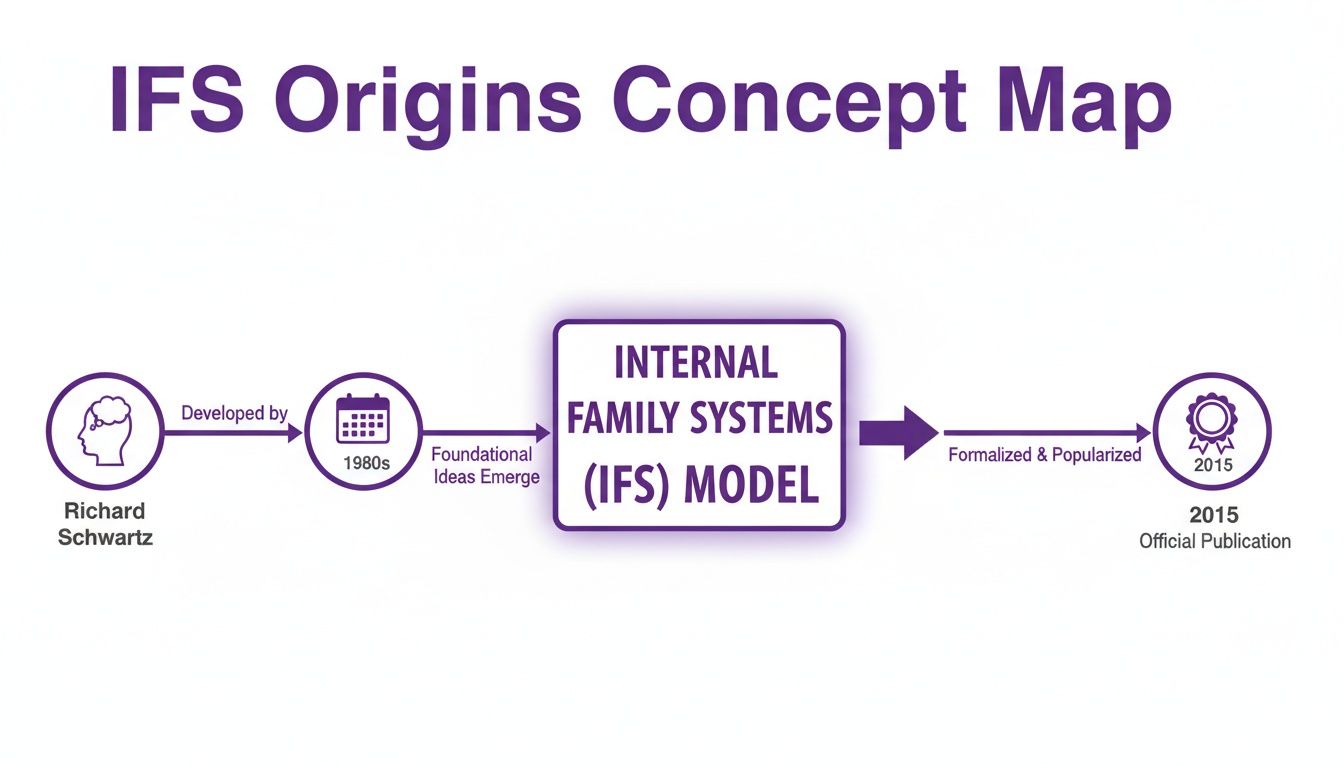
It really shows how these ideas were built upon over decades, moving from a therapist's personal observations to a solid, evidence-based model for healing.
The Wounded Parts: Exiles
So what are the Protectors working so hard to protect? They're protecting the Exiles. These are the young, vulnerable parts of you that carry the burdens of past trauma, shame, fear, and pain. Managers and Firefighters go to extreme lengths to keep these Exiles locked away because they believe that if their pain ever came to the surface, it would be utterly devastating.
Think of an Exile as a small child, alone in a dark room, holding a painful memory. The Managers stand guard outside the door, trying to keep everything under control. The Firefighters create loud distractions throughout the house anytime the child begins to cry. The whole system is organized around keeping that child's pain hidden.
These are the parts of us that hold deep-seated beliefs like "I'm not good enough" or "I'm unlovable." The real heart of IFS healing is about safely reaching these parts, hearing their stories, and finally freeing them from the heavy burdens they were never meant to carry.
Here's a quick look at how these different parts function within your internal system.
Understanding the Roles of Your Internal Parts
| Part Type | Primary Role | Common Behaviors |
|---|---|---|
| Managers | Proactively protect you from pain by controlling your environment and behavior. | Perfectionism, people-pleasing, excessive worrying, inner criticism, over-achieving. |
| Firefighters | Reactively distract or numb you when deep emotional pain (from an Exile) is triggered. | Binge eating, substance use, excessive sleeping, compulsive shopping, zoning out. |
| Exiles | Hold the burdens of past trauma, shame, and painful emotions. | Feelings of worthlessness, intense fear, deep sadness, feeling fragile or invisible. |
Getting to know these distinct roles is the first step toward bringing compassion and understanding to your inner world, rather than judgment.
Finding Your Core Self
If all these are just "parts," then who are you? In IFS, the real you is the Self. The Self isn't another part; it's the very essence of who you are. It’s that calm, curious, confident, and compassionate core that exists within every single one of us, completely untouched by trauma.
The Self has a natural healing capacity, often described by the "8 Cs":
- Curiosity
- Calmness
- Confidence
- Compassion
- Courage
- Clarity
- Creativity
- Connectedness
The whole point of IFS therapy is to help you access this core Self. When you can approach your internal world from this centered place, you stop getting hijacked by your parts' intense emotions. Instead of being anxiety, you can be with the anxious part of you from a place of calm strength.
Learning to lead from the Self means building your capacity for curiosity and compassion, which allows you to have a different kind of inner dialogue. It's a lot like applying powerful active listening skills to your own mind.
From this state of Self, you can listen to your Managers, understand their fears, and offer reassurance. You can finally witness the pain of your Exiles and give them the safety and comfort they've been desperately needing.
This shift in internal leadership changes everything. Protectors can finally relax their extreme jobs, and Exiles can be healed. This process is deeply connected to the body, as unburdening these parts often releases physical tension and trauma stored somatically. You can learn more about this mind-body link by exploring these somatic healing exercises. It's from this place of Self-leadership that true, lasting inner peace becomes possible.
A Look Inside a Typical IFS Therapy Session
Stepping into a therapist’s office for the first time can feel like a bit of a mystery, especially with a model like Internal Family Systems (IFS). What does a session actually look like? The good news is, the whole experience is designed to be gentle, collaborative, and deeply respectful of your inner world, making it feel safe and approachable from the moment you start.

Unlike some therapies where the therapist is positioned as the expert who analyzes you, an IFS therapist is more like a compassionate guide. They operate from the core belief that you already hold the capacity for healing within your Self. Their job is simply to help you access that core wisdom and create a safe space to get to know all the different parts of you.
A session might start with you talking about a specific challenge—maybe a persistent knot of anxiety in your stomach or a critical inner voice that won't quiet down. Instead of jumping into logical problem-solving, your therapist will gently guide you to turn your attention inward. They might ask, "Where do you notice that feeling in your body?" This is the first step: identifying a specific part that’s asking for your attention.
The Gentle Art of Getting Acquainted
Curiosity, not judgment, is the guiding principle here. You are always in the driver's seat, and the therapist follows your lead. There's no forcing a part to change or pushing you into something you’re not ready for.
The core of an IFS session is collaboration between you, your therapist, and your internal system. Your therapist helps you listen to your parts from a place of Self-leadership, allowing you to build trust and understanding rather than being overwhelmed by intense emotions.
It’s this collaborative spirit that paves the way for deep, lasting healing by honoring the wisdom already inside you.
Following the Six Fs
To help give this internal conversation some structure, IFS uses a simple but powerful framework called the Six Fs. It’s not a rigid, step-by-step manual, but more of a natural flow for getting to know a part of yourself. Think of it as a roadmap for building a trusting and compassionate relationship with your inner world.
The process usually unfolds something like this:
- Find: Your therapist helps you locate a specific part by noticing a feeling, thought, or physical sensation.
- Focus: You gently bring your full attention to that part, holding it with curiosity.
- Flesh Out: You get to know it better. What does it look like? Sound like? Feel like? The goal is to see it as a distinct presence within you.
- Feel Toward: From the calm, centered perspective of your Self, you check in on how you feel toward this part. Are you curious? Annoyed? Afraid of it?
- Befriend: This is where you start building a trusting connection, letting the part know you're here to listen without judgment.
- Fear: You compassionately ask the part what it’s afraid would happen if it stopped doing its job. This question often gets to the heart of its protective intentions.
This framework makes what could feel like an overwhelming process feel structured and manageable. It’s a gentle way to approach even the most difficult or painful parts of yourself.
A Safe and Collaborative Space
Throughout the entire session, a therapist at reVIBE Mental Health is constantly checking in to make sure you feel safe and in control. If another protective part gets activated and tries to run the show, the therapist will guide you to pause and give that part attention, too. Every single part is welcome.
The process isn't about digging for trauma or forcing you to relive painful memories. It’s about creating a secure, trusting relationship between your Self and your parts. As that bond strengthens, your parts begin to feel safe enough to unburden their pain and find new, more helpful roles. This gentle, respectful dialogue is the very heart of healing in IFS.
The Real-World Benefits of IFS Therapy
So, what does all this theory about 'parts' and 'Self' actually do for you? The results of IFS therapy go way beyond just managing symptoms. We're talking about deep, lasting changes that can reshape your entire inner world, moving it from a state of constant conflict to one of genuine harmony.
The ultimate goal here is to help you live your life from your core Self. When you can tap into that calm, curious, and confident center, you're just better equipped to handle whatever life throws your way. This shift—from being tangled up with reactive parts to being led by your Self—is the bedrock of emotional resilience.
Getting to the Root of Anxiety and Depression
Many therapies work on managing negative thoughts or changing behaviors, and that can be useful. But IFS goes a level deeper. It helps you understand the protective parts that are actually driving the anxiety and depression in the first place.
Instead of seeing anxiety as a problem to be squashed, IFS helps you recognize it as a well-intentioned 'Manager' part working overtime, desperately trying to keep you safe from future pain. Depression might be the heavy, quiet blanket of a wounded 'Exile' part that’s been pushed down for years.
By learning to connect with these parts with genuine compassion, you can finally hear their stories, understand what they’re afraid of, and help them let go of the pain they carry. This isn't just about symptom relief; it's about healing the source. In fact, one study showed that IFS was just as effective as gold-standard treatments like CBT for reducing depressive symptoms.
Healing Trauma and Finding True Self-Worth
IFS is incredibly powerful for healing trauma because it offers a safe, gentle way to approach wounded parts without getting flooded by their pain. The whole process is designed to make sure you're grounded in your calm, centered Self before you even approach these vulnerable 'Exiles'. This creates a secure inner space where they can finally feel seen and heard.
As you help these parts release their old burdens—the shame, fear, and feelings of worthlessness they've held for so long—their pain stops running the show.
A huge outcome of IFS is finding an unshakable sense of self-worth. When you heal your wounded parts and show them compassion, you start to truly believe that every single part of you is valuable. This builds a deep, authentic confidence from the inside out, one that doesn't rely on anyone else's approval.
This internal healing journey brings some very real, tangible benefits to your everyday life:
- More Inner Peace: As your parts start to trust your Self, that constant inner noise and conflict finally begins to quiet down.
- Greater Emotional Resilience: You'll find yourself less reactive to triggers because your internal system is more balanced and secure.
- Clearer Decision-Making: When you lead from your Self, you can access your own inner wisdom, making it easier to make choices that feel right for you.
Building Healthier, More Connected Relationships
Something really beautiful happens as you do this work: the compassion and curiosity you learn to give your own parts naturally starts to extend to others. When you understand that even your most difficult parts have good intentions, you get much better at seeing the positive intent behind other people's challenging behaviors.
This inner work fundamentally improves your ability to connect with others. By healing the old relational wounds your 'Exiles' carry, you can show up in your relationships from a place of security instead of fear. You learn to set better boundaries, communicate your needs clearly, and build connections based on real, mutual respect. Here at reVIBE Mental Health, our therapists see this ripple effect into relationships as one of the most powerful outcomes of the entire IFS journey.
How to Begin Your IFS Journey with reVIBE Mental Health
Understanding the ideas behind Internal Family Systems therapy is a huge first step. The next is finding a trusted guide to help you put those ideas into practice. At reVIBE Mental Health, our team includes compassionate therapists skilled in IFS-informed approaches, ready to create a safe, non-judgmental space for you to do this important work.
Taking that first step can feel like the hardest part, but we’ve made the process as simple and supportive as possible. Our focus is on connecting you with a therapist who truly gets you and your goals, so you feel comfortable and understood right from the start.
Find a reVIBE Location Near You!
We currently have five locations for your convenience. (480) 674-9220
reVIBE Mental Health – Chandler
3377 S Price Rd, Suite 105, Chandler, AZ
reVIBE Mental Health – Phoenix Deer Valley
2222 W Pinnacle Peak Rd, Suite 220, Phoenix, AZ
reVIBE Mental Health – Phoenix PV
4646 E Greenway Road, Suite 100, Phoenix, AZ
reVIBE Mental Health – Scottsdale
8700 E Via de Ventura, Suite 280, Scottsdale, AZ
reVIBE Mental Health – Tempe
3920 S Rural Rd, Suite 112, Tempe, AZ
For those who prefer the flexibility of meeting from home or the office, we also offer secure online therapy sessions. We use technology that you can trust, similar to many of the HIPAA compliant video conferencing platforms available today, ensuring your privacy is always protected.
Your path to inner peace begins with a single, courageous step. We are here to ensure that step feels safe, supported, and empowering, connecting you with the right care to help your internal system heal and thrive.
Your Next Steps to Inner Harmony
Getting started is straightforward. We accept most major insurance plans and are always happy to help you figure out your benefits to make your care affordable.
When you're ready to begin your journey toward self-leadership and inner peace, all you have to do is reach out.
You can call us at (480) 674-9220 to speak with our care team, or you can visit our website to be matched with a therapist who fits your needs. If you're feeling a bit nervous, that's completely normal. Check out our guide on how to prepare for your first therapy session to help put your mind at ease. We look forward to supporting you.
Common Questions About IFS Therapy
It's completely normal to have questions when you first hear about Internal Family Systems. It’s a unique way of looking at ourselves—focusing on our inner world of "parts"—and it's quite different from other kinds of therapy you might have heard of.
To help you get a clearer picture, I've answered some of the questions we hear most often from people just like you. My goal is to give you the confidence and clarity to decide if this gentle, yet powerful, approach feels like the right fit for your healing.
How Is IFS Different From CBT?
While both can be incredibly helpful, Internal Family Systems and Cognitive Behavioral Therapy (CBT) work from completely different playbooks. CBT is all about identifying and changing unhelpful thought patterns and behaviors that are causing you distress. Think of it as a practical, skill-building approach to managing your symptoms.
IFS, on the other hand, isn’t about correcting your thoughts—it’s about getting to know where they come from. It sees a persistent negative thought not as a flaw, but as the voice of a part of you that’s trying its best to protect you. Instead of fighting that thought, IFS encourages you to get curious about the part behind it. This builds a compassionate internal relationship that gets to the root of the issue.
Here's the bottom line: CBT helps you manage your symptoms by changing what you think and do. IFS helps you heal the source of your symptoms by changing your relationship with the parts of you that are hurting.
What Kinds of Issues Does IFS Work Best For?
One of the great things about IFS is just how flexible it is. It's been shown to help with a whole host of emotional and psychological challenges. It’s especially powerful for working with the deep roots of trauma and PTSD, mainly because it’s such a gentle and safe process. It helps you build a secure connection with yourself, allowing old wounds to heal without the risk of re-living them.
Beyond trauma, IFS is also fantastic for:
- Anxiety and Depression: By understanding and working with the protective parts that often fuel these feelings.
- Low Self-Esteem: By healing the wounded inner children (or "Exiles") and nurturing a genuine sense of self-worth from the inside out.
- Relationship Problems: By helping you see how your internal dynamics play out with the people in your life.
- Addiction and Compulsions: By connecting with the "Firefighter" parts that use these behaviors to douse emotional pain.
How Long Does IFS Therapy Usually Take?
There’s really no one-size-fits-all answer here. The length of your therapy journey is deeply personal and depends entirely on your own goals and what’s going on inside. It's a process guided by your own system's pace, not a rigid timeline.
Some people feel a profound sense of relief and gain amazing tools in just a few months. For others, particularly those with complex trauma, the work might take longer. The real focus is on creating deep, lasting change, not just putting a band-aid on things. You and your therapist will work together to find a rhythm that feels right for you.
Can I Use IFS With Other Kinds of Therapy?
Absolutely. IFS isn’t an "either/or" model; it actually plays incredibly well with other therapeutic approaches. For instance, you could use CBT to learn practical skills for managing a panic attack in the moment, while using IFS to explore the deeper story behind the panicked part of you.
It also pairs beautifully with somatic (body-based) therapies, since IFS acknowledges that our parts often hold their pain and beliefs in our physical bodies. Here at reVIBE Mental Health, our therapists are trained in various methods, allowing them to create a care plan that truly supports your whole being—mind, body, and internal family.
Ready to get to know your own internal family? The team at reVIBE Mental Health is here to guide you with compassion and real-world expertise. Visit our website at revibementalhealth.com or give us a call at (480) 674-9220 to find a therapist who’s right for you and start your journey toward inner calm.