
By the time many people search for why marriage and family therapy matters, the argument has already happened again. One partner comes home from work carrying stress, a child's behavior escalates during homework, and another adult tries to keep everyone calm until the evening ends in silence. The next morning, nobody remembers the original trigger, but everyone feels its effects.
That pattern can happen around anxiety, depression, trauma, caregiving, parenting disagreements, grief, separation, or simple exhaustion. Marriage and family therapy, often called MFT, looks at the connections among those experiences instead of assuming that one person is the entire problem. It can help couples change repetitive conflict, help parents respond more consistently, and help families build a safer way to handle difficult transitions.
When One Person's Stress Becomes the Whole Household's Problem
Consider a composite Phoenix-area household. A teenager has become withdrawn and irritable. One parent responds with stricter rules, the other tries to protect the teen from pressure, and the disagreement between the adults becomes louder than the original concern. Soon, the teen avoids both parents, the parents argue about parenting, and everyone starts treating the home as a place to get through rather than a place to recover.
Families often try to solve this privately first. They hold a meeting, promise to communicate better, or wait for the stressful season to pass. Sometimes they repeat the same conversation for years because each person is reacting to the others' reactions. The parent who pushes harder sees avoidance. The parent who softens sees criticism. The child sees no safe response.
A useful shift: The question isn't always “Who is causing the problem?” It may be “What pattern keeps the problem going?”
MFT brings that pattern into view. A therapist may listen to each person's experience, observe how conflict unfolds, and help the household practice a different response in real time. The work can focus on a couple, a parent and child, siblings, or the wider family, depending on the concern and the therapist's assessment.
Caregivers supporting an autistic family member may also benefit from practical guidance on advice for exhausted autism caregivers while they consider professional support. The point isn't to label a family as dysfunctional. It's to recognize that stress travels through relationships, and that changing the interaction can reduce pressure on everyone.
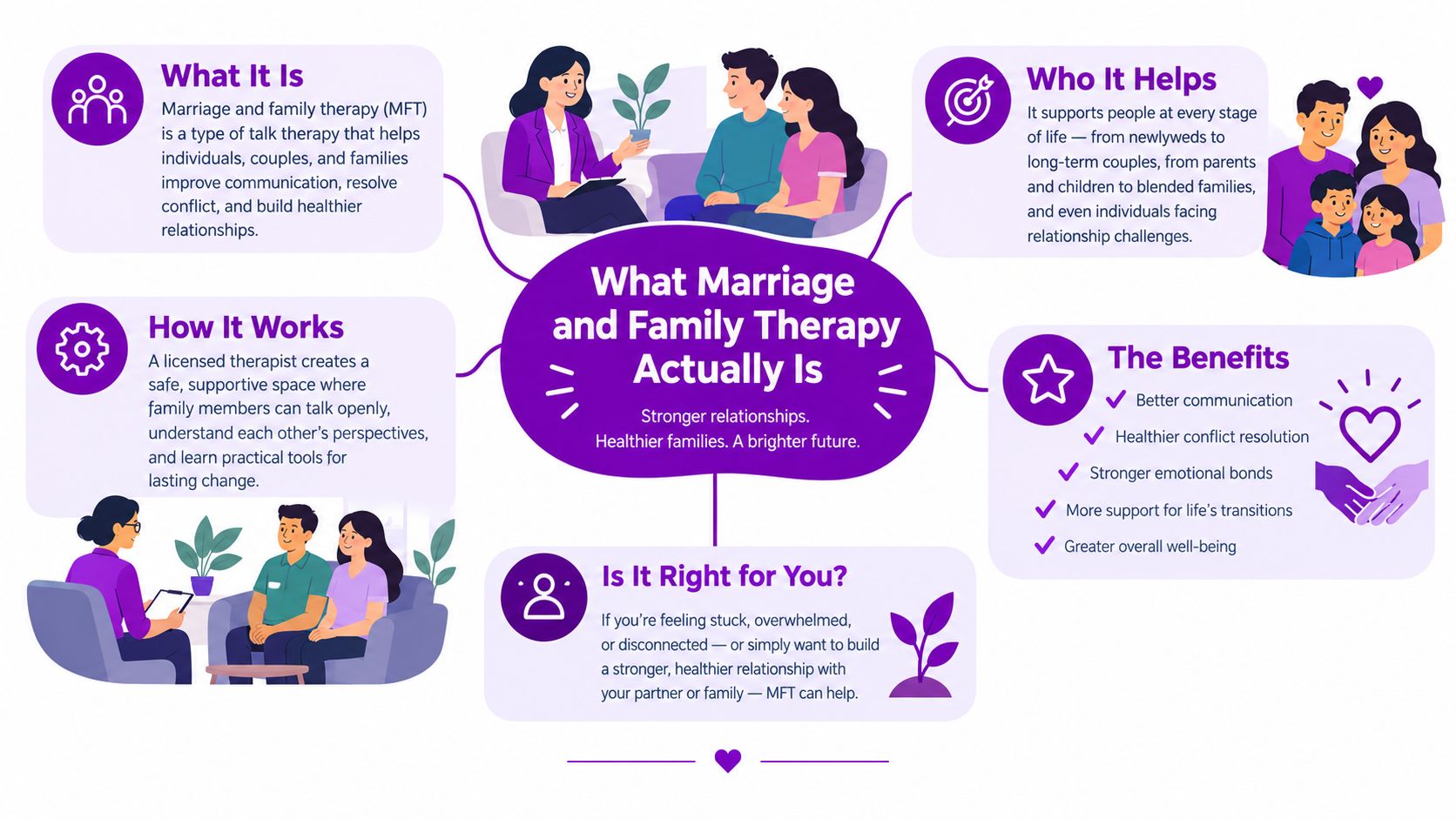
What Marriage and Family Therapy Actually Is
Marriage and family therapy is licensed mental-health care centered on relationships and family systems. It doesn't require every family member to attend every appointment, and it isn't limited to married couples. An MFT may work with an individual when that person's relationships, household roles, or family history are clinically important.
A helpful analogy is an electrical circuit. If one light flickers, replacing the bulb may help, but the electrician also checks the wiring, switches, and power source. In a household, one person may show anxiety, anger, depression, or withdrawal, while communication habits, unclear boundaries, caregiving demands, or unresolved conflict keep the distress active.
What the therapist examines
An MFT may explore:
- Communication: How do people ask for help, respond to criticism, or shut down?
- Roles: Who manages appointments, discipline, money, meals, or emotional support?
- Boundaries: Where does support end and overinvolvement begin?
- Conflict cycles: What happens immediately before and after an argument?
- Transitions: How has illness, divorce, remarriage, grief, or another change altered the household?
This relationship-based perspective is described in more detail through family systems theory. The therapist isn't taking sides or deciding which person is “the difficult one.” Instead, they help clients identify the sequence that repeatedly produces pain and develop more workable alternatives.
Why credentials matter
MFT is a regulated clinical profession, not a peer-support line, life-coaching service, or informal advice session. The U.S. Bureau of Labor Statistics explains marriage and family therapist licensure as a state-regulated process. All states require MFTs to hold a license, and typical requirements include a master's degree, supervised postdegree clinical experience, a state-recognized examination, and continuing education.
Requirements vary by state. In Arizona, prospective clients should verify the therapist's license and scope of practice before treatment begins. That check protects your household and helps clarify what kind of care the clinician can provide.
How Marriage and Family Therapy Differs From Individual Therapy
Suppose a spouse has panic symptoms whenever the couple discusses money. Individual therapy could help that person understand fear, practice regulation skills, and process earlier experiences. Couples therapy could also examine what happens during the money conversation, including one partner's repeated questions, the other's withdrawal, and the resentment that follows.
Neither format automatically replaces the other. The best starting point depends on where the problem lives, who is affected, and what must change for daily life to improve.

When relationships belong in the room
MFT often makes sense when:
- The same conflict repeats. Couples may understand the issue intellectually but still follow the same pursue-and-withdraw sequence.
- A symptom affects household functioning. Depression, substance use, trauma responses, or serious mood symptoms can change caregiving, trust, routines, and safety.
- Several people must coordinate care. Parents may need a shared response to a child's behavior, or family members may need a common plan around illness and support.
A U.S. evidence review found family-involved treatments across 39 randomized controlled trials were generally as effective as or more effective than alternative psychotherapies, with two reported exceptions. The review covered conditions including substance-use disorders, bipolar disorder, post-traumatic stress disorder, sexual-function concerns, and depression. The evidence review also supports matching the therapy model to the diagnosis rather than promising that family treatment is always superior.
When individual therapy may come first
Solo therapy may be the better initial format when a person needs private trauma processing, has symptoms that make joint discussion unsafe, or wants to build emotional-stability skills before involving relatives. It may also be appropriate when family members aren't available or when the client's immediate goals are primarily personal.
Blended care is common. One person may attend individual therapy for trauma or depression, while a couple works on trust and communication. A psychiatrist may manage medication, and an MFT may help the household understand symptoms, coordinate support, and reduce responses that unintentionally intensify distress.
The Common Concerns Marriage and Family Therapy Treats
Phoenix-metro households don't arrive with one standard problem. They arrive after a difficult conversation in the car, a parenting disagreement at bedtime, or a family transition that has made ordinary routines feel impossible.
Couples caught in the same argument
A couple may argue about dishes, spending, in-laws, or screen time, but the deeper cycle often involves feeling ignored, criticized, controlled, or alone. One partner raises the volume to feel heard. The other leaves the room to feel safe. The therapist slows that sequence down and helps both partners state the underlying need without turning it into an accusation.
Betrayal and trust injuries require careful pacing. An MFT may help partners establish honest communication, clarify boundaries, and decide what rebuilding trust would require. Therapy doesn't force reconciliation, and it shouldn't overlook safety concerns.
Parenting and adolescent concerns
Parents may disagree about consequences after a teenager misses curfew. One sees a need for structure, while the other sees a child already overwhelmed by school, peers, or mood symptoms. Family sessions can give the adults a shared plan and create space for the adolescent's perspective.
The therapist may work with the whole family, just the parents, or the young person individually. The attendance plan can change as the clinician learns more.
Divorce, remarriage, grief, and illness
A divorce can turn ordinary logistics into emotional flashpoints. A remarriage can bring loyalty conflicts, stepparent boundaries, and different household rules. Illness and grief can shift caregiving roles so quickly that family members don't know how to ask for help.
Families dealing with custody questions may need legal information in addition to therapy. For a separate discussion of protecting custody with a mental health history, consult a qualified family-law professional rather than relying on therapy as legal advice.
When MFT works alongside other care
MFT can complement individual therapy, EMDR, psychiatry, medication management, or specialized treatment for eating disorders. If one person has depression or trauma, the family may need help understanding symptoms and responding supportively while that person receives focused clinical care.
What Sessions Typically Look Like From Start to Finish
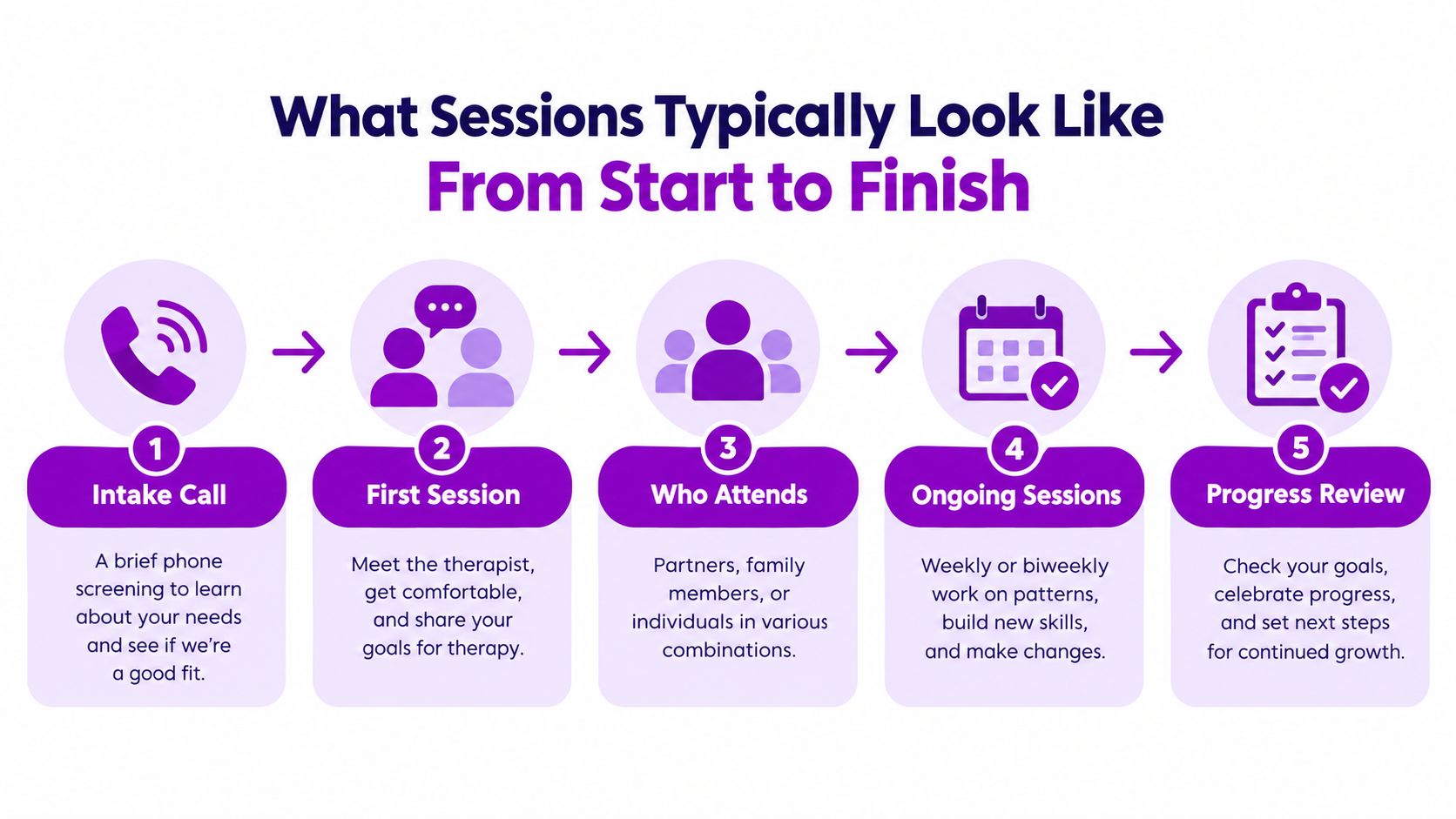
The first contact usually begins with a brief intake conversation. You'll describe who is affected, what prompted the call, whether anyone is at immediate risk, and what kind of appointment you're seeking. The clinician may also ask about insurance, availability, preferred format, and who might attend.
The first full session is less like a test and more like a mapmaking conversation. Each person gets an opportunity to explain the concern, while the therapist listens for the interactional pattern beneath competing accounts. You may leave with an initial goal, such as reducing late-night arguments, creating a parenting plan, or improving how the family responds to panic symptoms.
Who attends
Attendance isn't fixed. A course of care might include:
- Both partners: Useful for recurring conflict, trust concerns, intimacy issues, or major decisions.
- Parents together: Helpful when adults need consistent responses to a child's behavior or adolescent distress.
- The full family: Appropriate when several relationships are affected by illness, grief, separation, or caregiving.
- One person: Sometimes the safest or most practical beginning, especially when individual symptoms need stabilization.
Confidentiality deserves a direct conversation when multiple people participate. Ask the therapist how private disclosures are handled, what information can be shared, and how safety concerns change those boundaries. A responsible clinician should explain the policy before sensitive material emerges.
Pacing and progress
Some clients need focused skill-building around one conflict. Others need longer relational work because the pattern is connected to trauma, grief, chronic illness, or years of mistrust. Sessions may occur weekly or biweekly, depending on clinical need, availability, and the treatment plan.
Progress isn't measured only by whether nobody argues. The therapist may track whether arguments end sooner, whether people repair after conflict, whether routines become more predictable, and whether each person can ask for support without escalating the cycle. EMDR, talk therapy, or psychiatric care may be coordinated when one family member needs additional treatment.
What the Evidence Actually Shows
The evidence for family-focused care is meaningful, but it isn't a promise that every household will improve through the same method. The strongest rationale appears when symptoms and relationships influence one another, when caregivers need guidance, or when the household must coordinate a response to serious mental illness.
The World Health Organization guidance on psychoeducation and family interventions recommends routinely offering psychoeducation to people with psychotic disorders, including schizophrenia, and bipolar disorders, along with family members and caregivers. WHO also states that family interventions and cognitive-behavioral therapy can be considered for adults with psychotic disorders when trained professionals are available, with support continuing as long as the person and family need it.
Findings that support family involvement
A 2025 pilot randomized trial evaluated Resilience Enhancement Skills Training for home-visited mothers with moderate-to-severe depressive symptoms and moderate-to-high family conflict. Compared with standard care, the intervention produced greater reductions in family conflict, with effect sizes of -1.19 for mothers and -0.77 for family members, and reduced maternal depressive symptoms with an effect size of -0.96. Anxiety symptoms declined with an effect size of -0.59, family cohesion increased with effect sizes of 0.99 for mothers and 0.94 for family members, and job attainment or school enrollment improved with an effect size of 0.70. The published pilot trial involved a specific population, so those findings shouldn't be generalized to every family or diagnosis.
Where the evidence stays uncertain
A systematic review of family-focused interventions for anxiety or depression in people aged 14 to 24 included seven randomized controlled trials. The studies found mixed results for communication, and reviewers concluded that more research is needed. Some studies reported reduced depressive symptoms, including beta = 1.02 with P < 0.001, and reductions in major-depressive-disorder diagnoses, including beta = -1.11 with P < 0.001, but the review found no clear evidence that family-focused interventions were more effective than approaches without a family-communication component for depression symptoms. The systematic review also found that the one study assessing anxiety at a 24-month follow-up favored cognitive behavioral therapy over a family-focused intervention.
A careful answer to why marriage and family therapy matters is therefore specific: it can be a strong fit when relational patterns are part of the clinical problem, but treatment should reflect the diagnosis, age, safety needs, goals, and response to care. More detail on practical benefits is available in this overview of family therapy benefits.
Choosing the Right MFT in the Phoenix Metro
Start with qualifications, not convenience alone. The guide to what to look for in a therapist can help you prepare questions, but you should also confirm the clinician's Arizona license, clinical scope, experience with your concern, and approach to working with couples or families.
Ask the practice:
- Who should attend first? The answer may depend on safety, age, diagnosis, and the concern that brought you in.
- How do you handle confidentiality? This matters especially when a partner, parent, child, or sibling may share private information.
- What treatment models do you use? Ask whether the therapist uses family-systems work, cognitive-behavioral strategies, emotionally focused couples work, trauma-informed care, or another approach.
- How will we know therapy is helping? Look for concrete goals and planned progress reviews.
- What will we pay? Confirm insurance participation, copays, deductibles, self-pay expectations, cancellation policies, and telehealth coverage before booking.
Fit matters as much as credentials. After the first session, ask whether the therapist made room for each person, explained the plan clearly, stayed neutral without minimizing harm, and seemed comfortable discussing safety. A good match doesn't mean every conversation feels easy. It means the clinician can create enough structure for difficult conversations to become useful.
In-person sessions may work better for families who benefit from a shared physical space. Secure online appointments can help when traffic, work schedules, caregiving, or distance make office visits difficult. Choose the format that your household can attend consistently.
For local readers, reVIBE Mental Health offers therapy and psychiatric services through five Phoenix-metro locations, with in-person and secure online care available.
| Location | Address | Phone |
|---|---|---|
| reVIBE Mental Health, Chandler | 3377 S Price Rd, Suite 105, Chandler, AZ | (480) 674-9220 |
| reVIBE Mental Health, Phoenix Deer Valley | 2222 W Pinnacle Peak Rd, Suite 220, Phoenix, AZ | (480) 674-9220 |
| reVIBE Mental Health, Phoenix PV | 4646 E Greenway Road, Suite 100, Phoenix, AZ | (480) 674-9220 |
| reVIBE Mental Health, Scottsdale | 8700 E Via de Ventura, Suite 280, Scottsdale, AZ | (480) 674-9220 |
| reVIBE Mental Health, Tempe | 3920 S Rural Rd, Suite 112, Tempe, AZ | (480) 674-9220 |
Before contacting a practice, write down the main concern, who is affected, preferred appointment format, insurance details, and any urgent safety issue. You don't need a perfect explanation. A clear sentence such as “We keep having the same parenting conflict and need help changing the pattern” is enough to begin.
reVIBE Mental Health offers couples and family therapy for communication problems, conflict, trust concerns, parenting challenges, divorce, grief, and related mental-health needs, with talk therapy, EMDR, and psychiatric support available across its Phoenix-metro locations. Visit reVIBE Mental Health to request an appointment and begin discussing which care format fits your household.