
Many people ask the wrong question about EMDR. They ask whether it works at all, as if the only choices are miracle cure or fad. The better question is narrower and more useful, whether EMDR therapy research supports it as a real trauma treatment, how it compares with other evidence-based options, and where the evidence still leaves room for caution.
That distinction matters because EMDR has a strong research footprint, but it's often marketed more confidently than the data allow. The literature shows a therapy that can help, not a therapy that reliably outperforms every alternative in every situation. The practical questions are harder and more important, what the strongest trials show, how EMDR stacks up against other trauma-focused therapies, what scientists think the eye movements are doing, and which populations still need better evidence.
Why EMDR Therapy Research Matters Now
EMDR sits in a strange place in public conversation. Online, it's often described as either a breakthrough or a gimmick, and neither label fits the evidence well. The research base is large enough to take seriously, but it's also nuanced enough to resist hype.
That nuance matters for anyone choosing trauma care. The question is not only whether symptoms improve, but also how they improve, compared with what, and for whom. A therapy can be evidence-based without being uniquely superior, and that distinction changes how a patient should choose between EMDR, trauma-focused CBT, prolonged exposure, cognitive processing therapy, and written exposure therapy.
A useful way to think about the current evidence is to treat it like a map with four landmarks. First, the strongest studies show symptom reduction. Second, comparison studies show EMDR is not always better than other active trauma treatments. Third, the eye-movement mechanism is plausible but still debated. Fourth, the evidence gets thinner in complex or medically induced trauma.
Practical rule: A strong evidence base is not the same as a universal answer. The right therapy depends on symptom pattern, trauma type, availability, and what a person can realistically tolerate.
That framing protects people from two common mistakes. One is dismissing EMDR because it sounds unusual. The other is assuming that a well-known therapy automatically beats every other trauma approach. The evidence supports neither extreme.
The 1989 Trial and Why Randomized Studies Matter
EMDR entered the scientific literature in 1989 when Francine Shapiro published a randomized controlled trial on disturbing traumatic memories, and a later bibliometric review identified that paper as the first RCT of EMDR source. That matters because a randomized study is the cleanest way to test whether a treatment is doing the work, rather than whether people are just getting better over time.
Why that design changed the conversation
An RCT is a controlled comparison, not a loose before-and-after story. This is comparable to tasting two versions of the same dish when only one ingredient changes. If the result changes, the added ingredient may matter. If it doesn't, the ingredient probably isn't driving the outcome.
That same logic helps separate treatment effects from other explanations, like natural recovery, expectancy, or the simple benefit of a therapist's attention. If someone improves after starting any therapy, you still need a control condition to know whether the improvement is likely due to the intervention itself.
The 1989 paper didn't settle every question, but it changed EMDR from an observed clinical phenomenon into something researchers could test repeatedly. That's why later reviews and meta-analyses became possible at all. A therapy with no randomized studies can be discussed anecdotally. A therapy with randomized studies can be measured, pooled, challenged, and refined.
The historical point is easy to miss, but it shapes everything that followed. EMDR research did not appear overnight. It developed across decades, with the 1989 trial acting as the starting line rather than the finish.
What the Meta-Analyses Show
Pooled trial data give a better read on EMDR than isolated success stories. A 2014 meta-analysis of 22 randomized controlled trials found a statistically significant pooled Hedges' g of -0.662 for PTSD symptoms, with a 95% confidence interval from -0.887 to -0.436 PLOS One meta-analysis. In the same pooled analysis, depression also improved, with g = -0.643 and a 95% confidence interval from -0.864 to -0.422, while subjective distress showed a larger pooled effect.
How to read those numbers without getting lost
A negative effect size here favors EMDR over the comparison condition. The key word is average. These results do not mean every person improves to the same degree, or that every clinic gets the same outcome.
The same pooled analysis also reported an overall effect size of g = 0.93 against controls, but with I² = 72% heterogeneity, which means the studies differed substantially from one another. That matters because pooled findings can be informative without being uniform. They show what the evidence looks like across studies, not what any single therapist, setting, or comparison treatment will produce.
A pooled effect size works like an average temperature. It is real, but it will not tell you what today feels like outside. The evidence has that same limitation: it describes the broad climate of EMDR research, not the exact forecast for one person's care.
For readers who want a broader look at complementary therapy options while sorting out trauma care, ACT resources from Uptown Psychology can be a useful background reference alongside trauma-focused treatment research.
The practical takeaway is straightforward. EMDR has support in pooled trials, so it is not a fringe idea. The evidence is still stronger for “helpful on average” than for “uniformly large and fast,” and that is the level at which treatment choices should be made.
EMDR Compared to Other Trauma-Focused Therapies
The most useful comparison is EMDR versus other active trauma treatments, because that is what patients choose between. The evidence base is more restrained than many marketing claims suggest. A recent systematic review of EMDR for PTSD after traumatic medical events found preliminary benefit, but it did not show clear superiority over comparators such as written exposure therapy, EMDR-informed group protocols, or repetitive transcranial magnetic stimulation.
The comparator question changes the answer
EMDR tends to look stronger against passive controls and less clearly superior against active treatments. That does not make it weak. It means the comparison group matters.
For someone choosing care, the better question is fit. A person who wants less between-session homework may find EMDR more workable than approaches that rely on repeated exposure exercises outside therapy. Another person may prefer trauma-focused CBT because it offers a more explicit cognitive framework. Someone interested in prolonged exposure may want a method built around repeated, structured confrontation of trauma reminders. Cognitive processing therapy may appeal to people who want to work directly with stuck beliefs. Written exposure therapy may suit someone who wants a briefer written format.
| Therapy | Typical Session Count | Between-Session Work | Best-Fit Patient | Comparator Evidence |
|---|---|---|---|---|
| EMDR | Typically 6-12 sessions in PTSD trials | Often less homework than exposure-based methods | Someone who wants structured trauma processing with limited verbal retelling | Effective against controls, but not clearly superior to every active treatment |
| Trauma-Focused CBT | Typically 8-12 sessions in PTSD trials | Often includes practice or worksheets | Someone who wants a skills-plus-cognition model | Strong trauma evidence, often used as a comparator |
| Prolonged Exposure | Commonly 8-15 sessions in PTSD trials | Usually more between-session exposure work | Someone ready for repeated trauma-related exposure | Strong evidence, comparator effects can be similar |
| Cognitive Processing Therapy | Typically 8-12 sessions in PTSD trials | Commonly includes written and reflective work | Someone focused on changing trauma-related beliefs | Strong evidence, especially for belief-focused symptoms |
| Written Exposure Therapy | Typically 5 sessions | Writing-based practice | Someone who prefers a concise format | Promising, and used as an alternative in comparisons |
If you are weighing these options, a broader treatment guide can help frame the discussion with a clinician. The top PTSD treatments from Integrative Psychiatry provides a useful overview of trauma-focused choices without assuming EMDR is the automatic answer.
For readers comparing EMDR specifically with CBT, this EMDR therapy vs CBT overview gives a practical side-by-side view of how the two approaches differ in structure and emphasis.
Bottom line: EMDR has evidence behind it, but that is not the same as being better than every other evidence-based trauma therapy.
How Bilateral Stimulation Is Thought to Work
The strongest explanation for the eye-movement component is the working-memory account. If you recall a traumatic image while also tracking a therapist's moving fingers, attention has to be split. The memory becomes harder to hold in full detail, which can reduce its vividness and emotional force working-memory review.
Why the mechanism still sparks debate
Recall the argument while your eyes track the ball, and the memory loses some of its sharpness and saturation. That is the core claim behind the theory.
The same review counts more than 30 published randomized controlled trials and argues that horizontal eye movements may increase access to episodic memories. It also leaves room for a narrower conclusion. The eye movements may matter, but they are probably not the entire explanation.
The protocol matters more than any single part of it.
A systematic review focused on eye movements found broad agreement that they can reduce the vividness or emotionality of aversive memories in laboratory settings, while the clinical PTSD trial evidence was less conclusive. Other dual-attention tasks may produce similar effects eye-movement review. That keeps the central question open. Are the eye movements necessary, or are they one practical way to tax working memory during trauma recall?
The cautious answer is that the full EMDR protocol has evidence behind it, while the mechanism is still being refined. That distinction matters because it keeps expectations realistic. Patients do not need to show that the eye movements are magical. They need to know whether the structured treatment is likely to help enough to justify trying it.
For a plain-language walkthrough of the process, how EMDR therapy works is a useful companion read. If you are trying to connect research language to everyday symptoms, the 17 PTSD symptoms list can help put the findings in context.
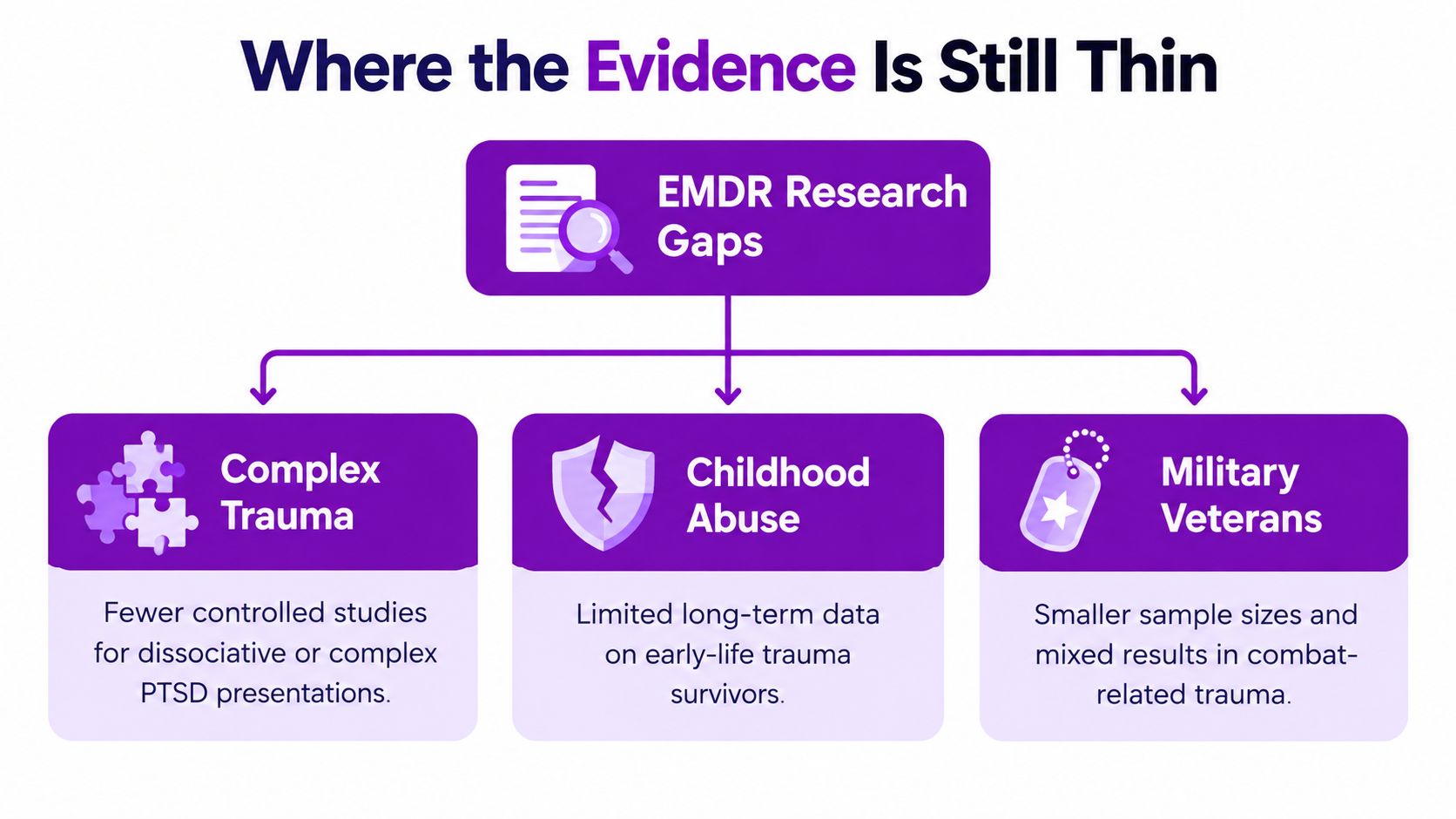
Where the Evidence Is Still Thin
EMDR has a stronger evidence base for standard PTSD than for more complex presentations, and that difference should shape expectations. A 2025 systematic review of randomized trials in people with psychosis found that EMDR generally improved PTSD and some negative or paranoid symptoms compared with treatment as usual or waitlist, but effects on delusions and auditory hallucinations were mostly not significant. The review included four RCTs, and follow-up periods were short to modest, which limits how confidently the findings can be extended over time psychosis review.
Why complex cases need extra care
Medically induced trauma is another area where the evidence is still early. A separate review of PTSD after traumatic medical events found signs of benefit, but the available studies were too limited to show that EMDR was clearly better than other active approaches, including written exposure therapy, EMDR-informed group protocols, or repetitive transcranial magnetic stimulation medical-event review. The practical message is narrower than the headlines suggest, EMDR is reasonable to consider, but superiority is not established here.
Complex cases often ask different clinical questions than single-event trauma. Does the person have dissociation that calls for preparation before memory processing? Is there active psychosis, suicidality, or a medication issue that changes sequencing? Does stabilization need to come first? Those are treatment decisions, not signs that a case is untreatable.
The safest conclusion is restraint. For psychosis, medically induced PTSD, and other complicated presentations, EMDR remains promising, but the research is still too thin to promise the same response pattern seen in standard PTSD trials.
Clinical Guidelines and Acknowledged Limitations
EMDR is not just a niche technique sitting outside mainstream care. Major guideline bodies, including the VA/DoD Clinical Practice Guideline for PTSD, APA, ISTSS, and the WHO, recognize it as an evidence-based trauma-focused psychotherapy. That endorsement matters because guidelines don't reward novelty, they reward the weight of trial evidence.
What the field still isn't pretending to know
The strongest limitation is heterogeneity. Studies differ in participant populations, trauma histories, treatment protocols, control groups, therapist experience, and follow-up periods. That variation helps explain why pooled effects are meaningful but not uniform.
Another limitation is comparator strength. EMDR often performs well against passive controls, but the margin can shrink when the comparison is another active trauma treatment. A third limitation is that complex populations still have fewer randomized trials, so conclusions there are thinner. A fourth is that researchers still debate which protocol components are essential.
Pooled statistics describe averages, not guarantees.
That sentence should stay in mind every time a study result sounds decisive. A trial can show a group-level advantage without telling you exactly how one person will respond. Good clinicians use that fact as a guide, not as an excuse to overstate certainty.
The research record supports EMDR as a legitimate option for trauma care. It does not support treating it as universally superior, universally fast, or equally proven across every diagnosis and trauma type. That's the kind of honesty patients deserve, and it's also what the literature shows.
What This Means if You Are Considering EMDR in Arizona
If you're looking at EMDR in the Phoenix metro area, the most useful question is not whether the therapy has a scientific basis. It does. The practical question is whether the clinic screening, pacing, and coordination around that therapy are strong enough for your situation. Good EMDR-informed care starts with a careful intake, including dissociation, suicidality, complex trauma history, medication needs, and whether a preparation phase should come before trauma processing.
What to ask before you start
A first consultation should answer a few direct questions.
- Training: What EMDR training did the therapist complete, and how do they use the protocol in practice?
- Screening: How do they assess complexity, stability, and readiness before trauma work starts?
- Measurement: How do they track progress, symptoms, and setbacks across sessions?
- Coordination: If medication or psychiatric support is needed, how is that handled?
If you want a local starting point, EMDR therapy near me can help you find a nearby option and compare care models. One Arizona practice that offers therapy, EMDR, and psychiatry in an integrated setting is reVIBE Mental Health. It serves Scottsdale, Tempe, Chandler, Phoenix, and Paradise Valley, and its central number is (480) 674-9220.

The locations listed are reVIBE Mental Health – Chandler, 3377 S Price Rd, Suite 105, Chandler, AZ; reVIBE Mental Health – Phoenix Deer Valley, 2222 W Pinnacle Peak Rd, Suite 220, Phoenix, AZ; reVIBE Mental Health – Phoenix PV, 4646 E Greenway Road, Suite 100, Phoenix, AZ; reVIBE Mental Health – Scottsdale, 8700 E Via de Ventura, Suite 280, Scottsdale, AZ; and reVIBE Mental Health – Tempe, 3920 S Rural Rd, Suite 112, Tempe, AZ. A setup like that can matter when trauma care needs to be coordinated with other services, especially if anxiety, depression, or medication management are part of the picture.
Choose EMDR because the evidence supports it, then choose a clinician who uses that evidence with care. If you're ready to explore treatment, visit reVIBE Mental Health to review local options, ask about EMDR fit, and take the next step with a provider who can match treatment to your goals, symptoms, and pace.