

You're lying awake after work, staring at the ceiling, trying to answer a simple question: Is this bad enough to call someone, or am I just having a rough stretch? That's where most adults get stuck. They wait too long because they don't want to overreact, then they wait even longer because the search for help feels vague and exhausting.
Psychiatry treatment for depression works best when it's treated like a clinical process, not a one-time prescription. Good care is measured, sequential, and specific. It starts with the right level of urgency, then moves through assessment, medication decisions, therapy choices, and follow-up that checks whether you're getting better.
Starting the Right Way, Crisis or Routine Care
If you are deciding whether to call for help, start with safety. Suicidal thoughts, an inability to stay safe, behavior that scares you, or a level of distress that makes daily functioning impossible all belong in the crisis lane. Call emergency services or go to the nearest emergency department right away. In the U.S., 988 is the right number for immediate mental-health crisis support.
If you are still getting through work, parenting, or basic tasks, but sleep is off, interest is fading, and your mood stays flat, routine psychiatric care is the right move. You do not need to wait until everything falls apart. Depression is common and undertreated, and the World Health Organization depression fact sheet notes that about 322 million people globally were living with depression in 2023 and that only about one-third of people with depression in high-income countries receive mental-health treatment.
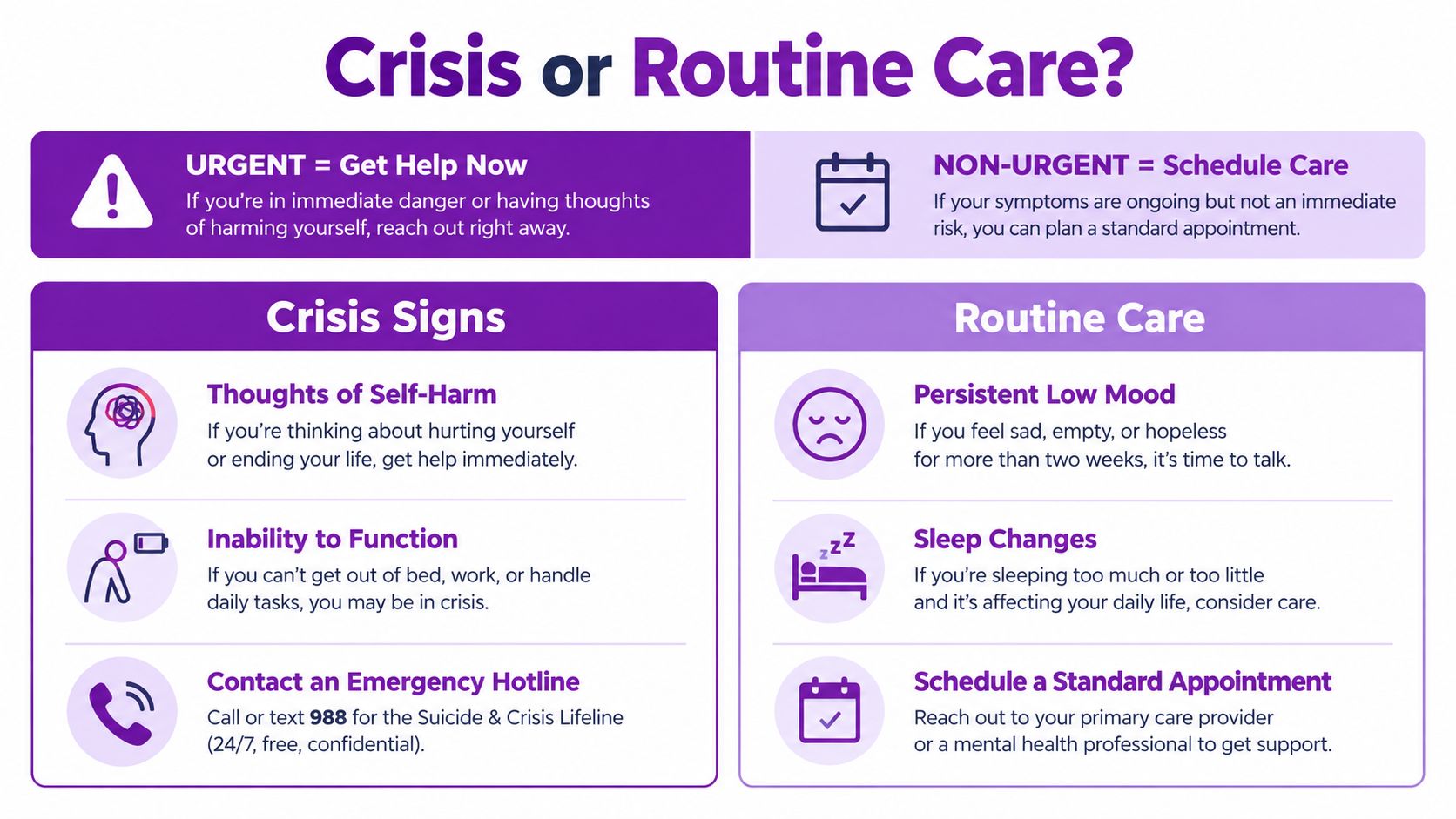
A quick self-check for routine care
Ask yourself three blunt questions. Are you still functioning, even if it takes real effort? Have mood, sleep, motivation, or concentration problems lasted long enough that other people notice? Are you reorganizing life around feeling worse, avoiding calls, or skipping things that used to matter?
If the answer is yes, book a standard psychiatric appointment this week. That is the sensible move, not an overreaction.
Practical rule: if safety is the issue, treat it as urgent. If symptoms are persistent and you are still basically functioning, book routine care and stop bargaining with yourself for another month.
If your clinic uses a structured intake workflow like PatientNotes for psychiatrists, the information you bring to a first visit tends to be organized instead of scattered.
What a Psychiatrist Does in Depression Care
A psychiatrist should not be there just to write a prescription. The job is to sort out what is happening, what is safe, and what is most likely to help. That starts with a careful diagnostic interview, because depression can hide bipolar-spectrum symptoms, substance use, trauma, sleep problems, medication side effects, or medical contributors.
Medication review comes next. Antidepressant choices do not happen in isolation, especially when someone is already taking sedating medicines, stimulants, blood pressure drugs, or hormone-related treatment. If a visit skips that review, the plan is incomplete.
The treatment gap matters here, as noted earlier in the WHO fact sheet cited above. Depression is common and often undertreated, so the difference between partial relief and real change is usually the quality of follow-up, not a flashy first move.
The three jobs that matter
- Assessment. The clinician clarifies symptoms, severity, safety, family history, and possible alternate diagnoses.
- Medication management. If medication belongs in the plan, the prescriber chooses it, adjusts it, and watches for side effects and response.
- Care coordination. The psychiatrist keeps therapy, medication, and outside medical care aligned instead of letting each piece drift on its own.
Practices that follow a solid mental health billing guide are better positioned to keep care accessible and organized, which matters when treatment is supposed to continue over time.
A psychiatrist also needs to work in sequence. First comes the diagnosis, then the first treatment choice, then a follow-up interval long enough to see whether the plan is helping or needs to change. That is the part many people never get from a rushed visit, and it is the part that usually separates stalled care from steady improvement.
A strong psychiatrist does not just ask, “How do you feel today?” They ask whether the plan is working, whether it is safe, and what has to change next.
If you want a plain-English explainer on the role itself, the internal overview at https://revibementalhealth.com/what-does-a-psychiatrist-do/ is a useful companion piece.
Therapy Options That Pair with Medication
Medication can help, but it rarely deserves to be the whole plan. For many adults, the better question is which therapy fits the shape of the depression. Cognitive behavioral therapy is the most familiar option because it targets thought patterns, behaviors, and routines that keep mood low. Interpersonal therapy is a better fit when grief, conflict, role changes, or relationship strain are part of the picture NIMH depression publication.
That same NIMH guidance makes the clinical point clearly, for moderate or severe depression, medication is commonly part of the initial plan alongside therapy. For milder symptoms, therapy may come first. The mistake is assuming every adult needs the same sequence. They don't.
How clinicians usually think about the options
CBT is the workhorse when a person needs structure, behavioral activation, and a concrete plan for unhelpful thought loops.
IPT makes sense when the depression is tied to a breakup, conflict, loneliness, role transition, or unresolved loss.
EMDR is often considered when trauma is driving or intensifying depressive symptoms, especially when the person also has intrusive memories or hyperarousal.
Mindfulness-based approaches can help people with recurrent depression who need a better relationship to rumination and distress.
Telehealth and in-person care each have a place. Virtual therapy reduces friction, while in-person sessions can feel more grounded for people who struggle to protect time or privacy at home. The best format is the one you'll attend consistently.

If the clinician treats therapy and medication like rivals, keep looking. Good depression care uses whichever tool matches the problem.
In an integrated practice, therapy and psychiatry can work as one plan instead of two disconnected appointments. That's the model I'd rather see for adults who don't have the time or energy to coordinate everything themselves.
The First 90 Days of Measurement-Based Care
The first 90 days should feel structured, not improvised. Start with a baseline PHQ-9, a diagnostic review, suicide-risk screening, bipolar-spectrum screening, and medication reconciliation. Without that baseline, every follow-up turns into a vague conversation about whether you feel “a little better.”
The cadence should be tight. NICE recommends reviewing treatment between 2 and 4 weeks after starting, with closer monitoring early on for adherence, side effects, harms, and suicidal ideation, and a review after 1 week for adults aged 18 to 25 or when suicide risk is specifically in play NICE recommendations.
The point is measurable change. Look for a symptom drop, better sleep, improved function, and side effects the patient can tolerate. In measurement-based care, response means at least a 50% improvement on the PHQ-9, while remission means a PHQ-9 score of 4 or less sustained for at least one month VA/DoD provider summary.
What the first 90 days usually look like
| Time Point | What Is Measured | What the Numbers Mean |
|---|---|---|
| Baseline | PHQ-9, safety, diagnosis, current meds | Establishes the starting point and rules out obvious mismatches |
| 2 to 4 weeks | Symptoms, adherence, side effects, function | Early response should be visible, and problems should be corrected |
| About 6 to 7 weeks | Symptom change and remission trajectory | This is the window where remission becomes realistic for many adults |
| 8 to 12 weeks | Function, residual symptoms, next-step planning | Partial improvement should trigger a deliberate decision, not drift |
In the STAR*D trial, about one-third of participants reached remission after the first medication step, and roughly half became symptom-free across the first two steps when they stayed in treatment STAR*D results. That is the message patients need to hear. The first medication is a test, not a verdict.
If the first plan is not enough, the next move is to verify adherence, dose, diagnosis, and duration before changing course. The internal guide on medication management for depression fits well here because it focuses on the practical side of medication follow-up, not the fantasy that one visit solves everything.
Finding a Local Provider and Using Insurance
People don't stall because they're uninterested. They stall because the search is annoying. The fastest way through it is to stop shopping for a perfect listing and instead pick a real workflow: a prescriber, a therapy option, a location or telehealth format, and an insurance check.
Start with practices that offer both therapy and psychiatry under one roof if your depression is already affecting daily function. That setup cuts down on handoffs and makes follow-up simpler. If you're in the Phoenix area, a multi-location practice can also reduce commute friction, which matters more than people admit when motivation is low.
reVIBE Mental Health is one example of that model, with locations in Chandler, Phoenix Deer Valley, Phoenix PV, Scottsdale, and Tempe. That kind of distribution helps patients choose the closest office instead of abandoning care because the drive feels impossible.
A fast way to shortlist providers
- Confirm the service mix. Look for psychiatry, therapy, and medication management together if you want one coordinated plan.
- Check format. Decide whether in-person, secure online visits, or a mix makes the most sense for your schedule.
- Verify insurance early. Ask the office to check benefits before the first visit so you're not guessing about coverage.
- Ask how follow-up works. You want to know whether medication checks and therapy coordination are built in.

The part that saves the most time is the insurance call. Good offices will walk through it for you, and that's normal. You're not being difficult by asking whether a clinician is in-network, whether telehealth is covered, or whether medication management is billed separately.
If the search is taking more than 20 minutes, you're probably overcomplicating it. Pick the nearest competent option and move.
What Your First Psychiatric Visit Really Looks Like
Bring the basics: a medication list, prior records if you have them, your insurance card, and the name of any therapist you're already seeing. If you've tried antidepressants before, know which ones, what doses you took, and what went wrong. That history matters more than polished wording.
The psychiatrist will ask about mood, sleep, appetite, concentration, energy, prior episodes, family history, substance use, and safety. That's not interrogation. It's how a clinician decides whether this is straightforward depression, something more complex, or a combination of issues that needs a different approach.
For anyone with passive or active suicidal thoughts, a strong safety plan should include warning signs, people to contact, steps to reduce access to lethal means, and clear instructions for what to do if the situation worsens. The FDA requires clinicians to monitor patients of all ages for worsening depression and emerging suicidal thoughts or behaviors, and notes that short-term studies found increased suicidal thoughts and behavior in children, adolescents, and young adults aged 18 to 24 taking antidepressants FDA labeling.
That warning is about monitoring, not avoiding treatment. It means the follow-up plan has to be real.
For a practical example of how reception and intake can be handled well, the article on how AI answers patient calls is worth a look because it shows how practices reduce friction before the first visit even happens.
How to judge fit after one or two visits
- The clinician uses a standardized scale. If there's no measurement, there's no baseline.
- Options are explained clearly. You should hear more than one path when more than one path is reasonable.
- The pace feels deliberate. If medication is pushed without review of risks, prior trials, or safety, that's a bad sign.
- You leave with a follow-up date. Open-ended care is a common failure point.
If the visit feels rushed, generic, or dismissive, keep shopping. Depression care is too important to place with someone who can't explain the plan in plain language.
Staying Well After Remission and Planning for the Long Run
A good remission visit is not a victory lap. It is the point where psychiatric care shifts from getting better to staying better. Document the target you reached, name the first warning signs you tend to miss, and set a follow-up cadence that keeps sleep, energy, motivation, and safety under review.
Depression comes back often. One episode is not the end of the story, and the odds of another episode rise after each recurrence, which is why maintenance planning belongs at remission, not after a slide has already started recurrence data. Keep the plan in place while things are stable, then revisit it before symptoms start drifting.
What a sensible long-term plan includes
Continuation treatment. Stay on the medication dose and therapy plan that worked while symptoms remain controlled.
Maintenance review. Recheck mood, side effects, and whether the current plan still fits your goals. NICE recommends reviewing relapse-prevention antidepressant treatment at least every 6 months, as noted in the guidance cited earlier in this article.
Taper planning. Reduce medication carefully so withdrawal symptoms are not mistaken for relapse.
If treatment feels stuck after two adequate medication trials, do not keep repeating the same move. Recheck the diagnosis, ask whether psychotherapy needs to be strengthened, and discuss whether a more specialized next step is appropriate.
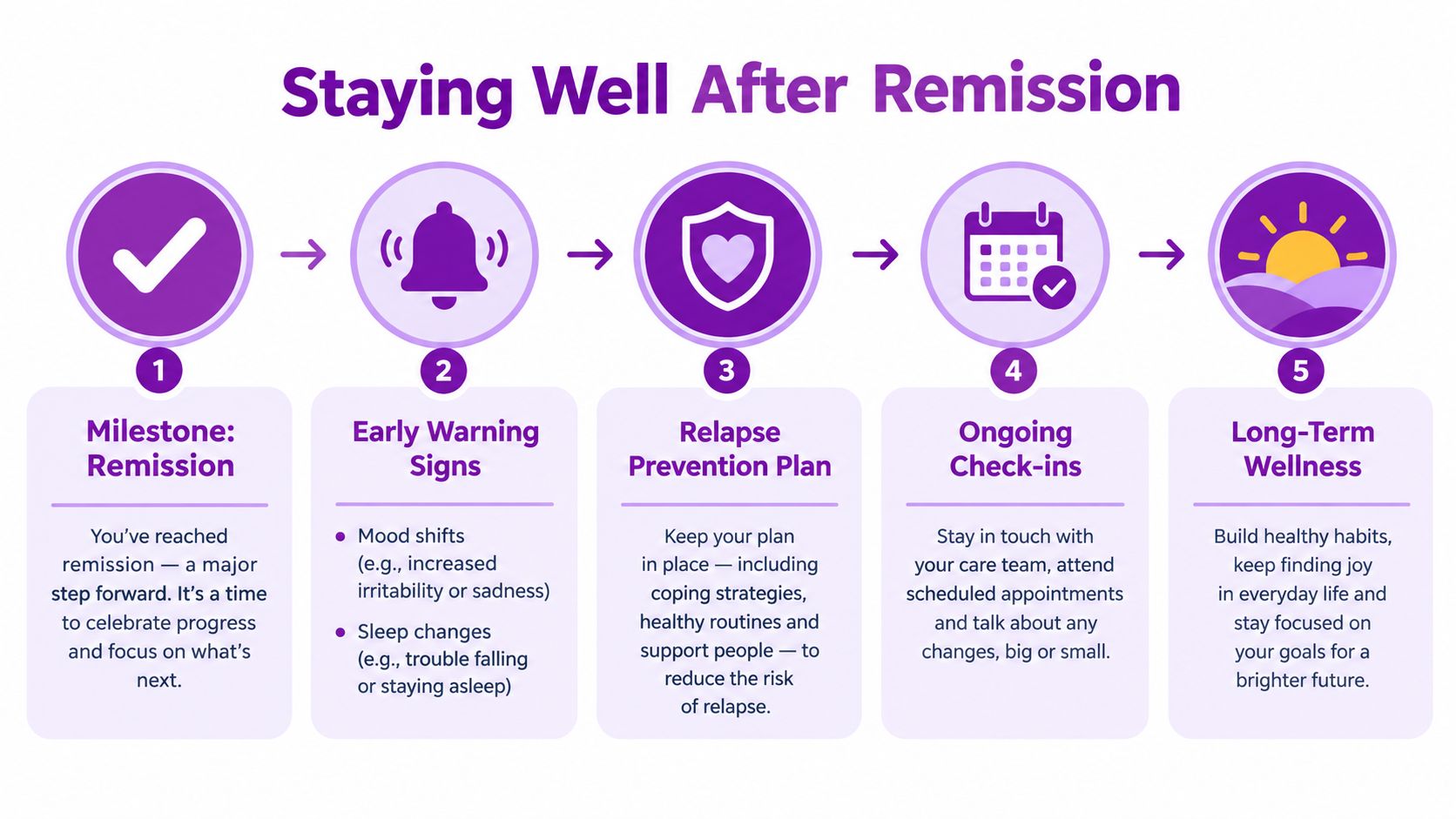
The best long-term psychiatric care is boring in the right way. Regular check-ins, clear notes, and early course correction beat dramatic resets.
If you want depression care that treats psychiatry as a coordinated process, not a rushed prescription, reVIBE Mental Health offers therapy, EMDR, and medication management across multiple Arizona locations, with in-person and secure online visits.