

You may know that trauma is shaping your sleep, relationships, concentration, or sense of safety, yet still feel unsure which therapy could help. Perhaps talking about the event in detail feels unbearable. Or perhaps your mind keeps generating the same fearful conclusions, and you want practical tools you can use between appointments. The question, EMDR therapy vs CBT, isn't really about choosing a universal winner. It's about matching treatment to the symptoms that interfere with your life most.
Eye Movement Desensitization and Reprocessing, or EMDR, and Cognitive Behavioral Therapy, or CBT, are established trauma-focused approaches, but they ask you to work in different ways. EMDR centers on reprocessing distressing memories, while CBT focuses on the thoughts, emotions, and behaviors that keep distress active. Both can be appropriate, and a qualified clinician should help you decide based on your history, preferences, safety, and goals.
Navigating Your Mental Health Treatment Options
Consider someone who has completed therapy before but still feels their body react as if danger is present. A car crash may have happened years ago, yet a sudden brake light triggers panic. They understand logically that the event is over, but their heart races, their shoulders tense, and they avoid driving. At the same time, they may feel depressed, isolated, or ashamed of how much the experience still affects daily life.
That person might benefit from EMDR if the central problem is the emotional and physical charge attached to a particular memory. Another client may be more troubled by beliefs such as “I can't trust anyone,” “Everything is my fault,” or “I'll never feel normal again.” For that person, trauma-focused CBT may provide a direct way to examine those beliefs, test them against evidence, and build different behavioral responses.
A useful starting point: Don't ask only which therapy has the strongest reputation. Ask which symptoms you most want to change first.
The search itself can become tiring. You may be comparing providers, reading about coping skills, and trying to maintain a calmer resilient mind daily through routines, movement, social support, or other resources such as this mental health fitness guide. Those efforts can support treatment, but they shouldn't replace an individualized assessment when trauma symptoms are persistent or disrupting your functioning.
EMDR and CBT aren't competing trends. They're distinct clinical tools. The best fit may depend on whether your main difficulty is a distressing memory, avoidance, persistent anxiety, low mood, rigid self-criticism, emotional dysregulation, or several of these concerns together.
How EMDR and CBT Actually Work in Session
EMDR follows a structured eight-phase protocol. The phases include history-taking, preparation, assessment, desensitization, installation, body scan, closure, and reevaluation, as described by EMDR International Association's overview of the therapy experience.
The EMDR process
The therapist first learns about your history and identifies memories, current triggers, and future situations that need attention. Preparation comes before intensive processing. You and the therapist develop ways to stabilize, ground yourself, and return to the present if distress rises.
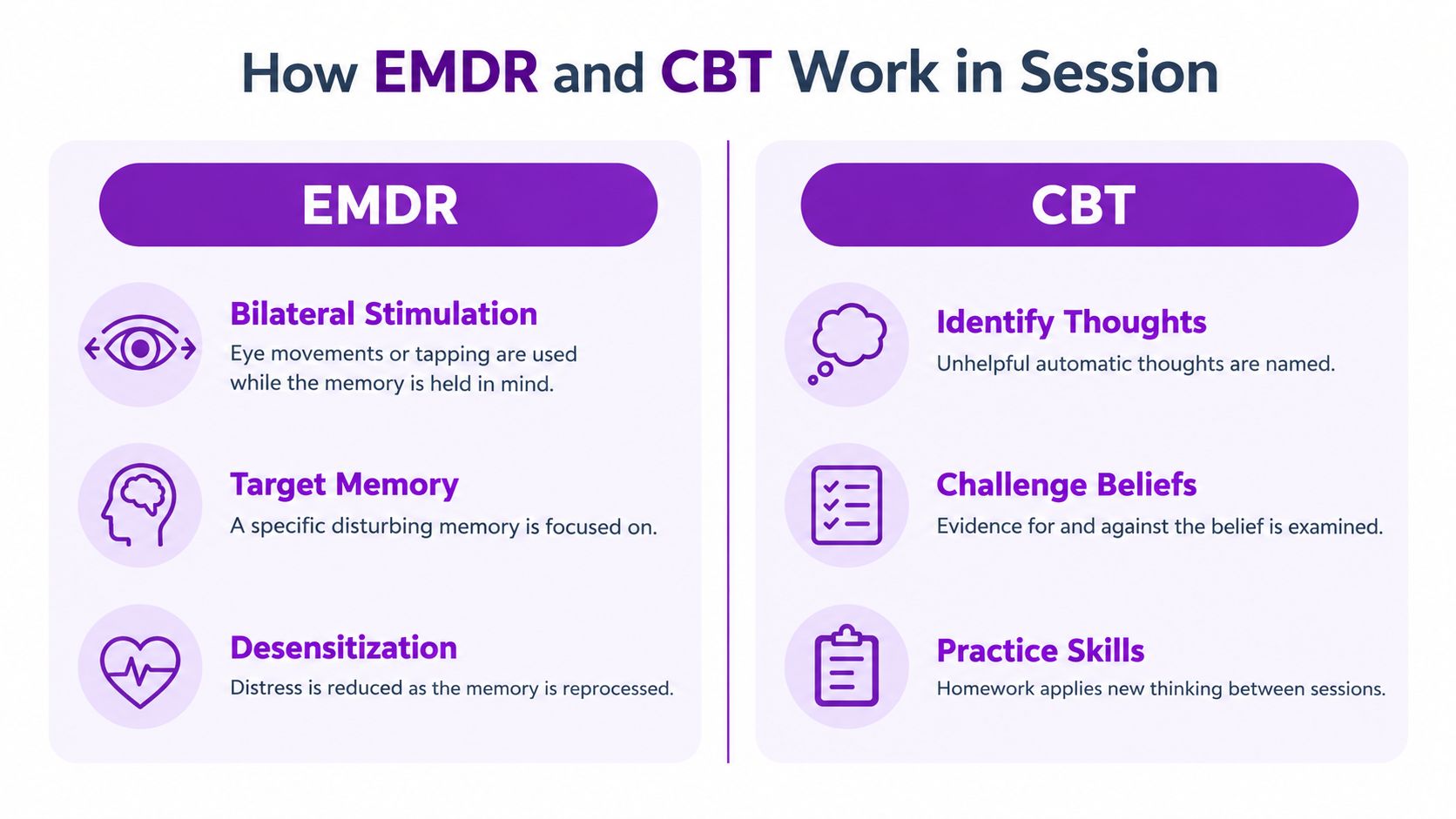
During assessment, you identify a target memory, the negative belief connected to it, the emotions involved, and the physical sensations you notice. In the desensitization phase, you briefly hold aspects of the memory in mind while following bilateral stimulation, such as guided eye movements or alternating taps. The therapist doesn't force a detailed, uninterrupted retelling.
The aim is to help the memory become less emotionally charged and less likely to trigger the same automatic alarm response. Installation strengthens a more adaptive belief, while the body scan checks whether tension remains. Closure helps you leave the session regulated, and reevaluation determines what has shifted before further processing.
Learn more about the practical sequence in how EMDR therapy is done.
The CBT process
Trauma-focused CBT is collaborative and educational. Your therapist helps you notice links between situations, interpretations, emotions, body responses, and actions. You may track automatic thoughts, identify unhelpful thinking patterns, examine evidence for and against a belief, and develop a more balanced interpretation.
Behavioral work matters just as much as cognitive work. If avoidance keeps fear alive, treatment may introduce gradual, planned practice with situations or reminders that you currently avoid. You learn coping strategies and apply them between sessions through worksheets, exercises, or real-world experiments.
CBT can involve detailed discussion of thoughts and meanings attached to trauma. That level of verbal and written engagement suits people who want a clear framework and active skills. It may feel demanding if concentration, memory, or homework completion is difficult during a period of severe distress.
Comparing Session Structure and Treatment Timelines
Treatment logistics can affect whether a therapy is sustainable. A person who prefers to process mainly in the room may feel more comfortable with EMDR. Someone who wants practice assignments and a clear explanation of how symptoms work may prefer CBT.
The following table describes common differences without treating either approach as a guaranteed schedule.
EMDR vs CBT treatment logistics
| Feature | EMDR Therapy | Trauma-Focused CBT |
|---|---|---|
| Primary focus | Reprocessing distressing memories and related body responses | Examining trauma-related thoughts, emotions, and behaviors |
| Session structure | Follows a defined protocol with preparation, target selection, bilateral stimulation, closure, and review | Uses education, cognitive restructuring, behavioral practice, and gradual work with avoided situations |
| Verbal processing | Can require less detailed verbal recounting, although communication remains important | Usually involves sustained discussion of thoughts, beliefs, feelings, and interpretations |
| Between-session role | Often centers on noticing reactions, using stabilization skills, and allowing processing to continue | Commonly includes structured practice, worksheets, exposure tasks, or behavioral exercises |
| Typical schedule | Often one to two sessions weekly, with a total of about 6 to 12 sessions according to Cleveland Clinic's EMDR treatment overview | The schedule depends on the specific trauma-focused CBT protocol, symptoms, goals, and clinical response |
| Single-event trauma | A clinical source describes a possible course of 3 to 6 sessions in some cases, while other courses are longer | May require a structured course of cognitive and behavioral work tailored to the event and its effects |
| Complex or repeated trauma | May take 8 to 12 sessions or more when the history is layered or developmental, according to the same clinical overview | May also take longer when trauma is chronic, relational, or accompanied by significant mood and anxiety symptoms |
| Patient involvement | Active attention to memory, sensations, beliefs, and present-moment regulation | Active examination of thinking patterns, behavioral avoidance, and between-session practice |
These ranges are not promises. NICE guidance says EMDR is typically delivered over 8 to 12 sessions and may be considered for adults 1 to 3 months after a non-combat trauma when the person prefers EMDR, as stated in its PTSD treatment recommendations.
Frequency and duration also change when someone has ongoing danger, multiple traumatic experiences, dissociation, major depression, substance use, chronic pain, or limited support. A responsible therapist may spend time on stabilization before trauma processing, or may address sleep, safety, and daily functioning alongside the trauma itself.
Practical rule: The shortest advertised course isn't automatically the most appropriate course. A treatment plan should be long enough to support safe processing and meaningful change.
What the Clinical Evidence Says About Symptom Relief
The evidence doesn't support a simple declaration that one therapy is always better. A 2022 meta-analysis pooling seven studies found little to no difference between EMDR and CBT for post-traumatic symptoms. The between-group test wasn't statistically significant, with t6 = 0.77 and p = 0.44, while both treatments reduced PTSD symptoms, according to the published meta-analysis.
Earlier findings were somewhat more favorable to EMDR in specific outcomes. A 2015 meta-analysis of 11 studies involving 424 participants reported that EMDR was slightly superior to CBT for total PTSD scores, particularly intrusion and arousal symptoms, while avoidance outcomes weren't significantly different. This is one reason people may encounter apparently conflicting answers when they search for comparisons.
Why symptom clusters matter
A direct comparative meta-analysis of 11 studies with 547 participants found EMDR outperformed CBT on post-traumatic symptoms, with a standardized mean difference of -0.43, 95% CI -0.73 to -0.12, as reported in this review. The same evidence base also describes a separate review in which EMDR and CBT didn't differ significantly from baseline to post-intervention for PTSD symptoms, while EMDR showed stronger effects for depression and anxiety in that analysis.
Another adult PTSD network meta-analysis found a moderate short-term effect for trauma-focused CBT, 0.56, 95% CI 0.38 to 0.74, and an effect for EMDR of 0.46, 95% CI 0.14 to 0.77, compared with active controls. The findings suggest both approaches work, while trauma-focused CBT may have a modest advantage for durability at follow-up in some datasets, as reported in the network meta-analysis.
The practical interpretation is more useful than the contest. EMDR may be a strong match when intrusive memories, flashbacks, physiological reactivity, and specific trauma triggers dominate. CBT may be especially useful when depression, generalized anxiety, self-blame, avoidance, and difficulty regulating emotion are central treatment targets.
A 2026 study of earthquake survivors found both therapies feasible and effective when delivered remotely, with EMDR showing stronger results for core PTSD symptoms and CBT showing stronger results for depression, anxiety, and emotion regulation, according to the Frontiers in Psychiatry study. A 2026 clinical and cost-effectiveness review found no significant overall difference between EMDR and trauma-focused CBT for PTSD improvement.
Patient preference still matters. If you feel unable to describe the trauma in detail, EMDR's memory-focused format may feel more accessible. If you want to understand your thinking patterns and practice concrete skills, CBT may be a better starting point. Discussing EMDR therapy reviews can help you prepare questions, but online experiences shouldn't substitute for a clinician's assessment.
Matching the Therapy to Your Specific Trauma Profile
A useful decision begins with the symptom that controls your day. Two people can meet criteria for PTSD and need different starting points because their memories, bodies, beliefs, and environments respond differently.
EMDR may fit when memory reactivity leads
EMDR may be worth discussing when one event or a small group of linked memories produces intense distress. You might know the event is in the past, yet still experience vivid images, nightmares, startle responses, body tension, or sudden fear when something reminds you of it.
It may also appeal to people who find extended verbal descriptions re-traumatizing. Some trauma is stored more through sensations, images, or fragmented impressions than through a clear narrative. EMDR doesn't eliminate the need to communicate with your therapist, but it can reduce the emphasis on constructing a detailed spoken account.
CBT may fit when beliefs and behavior maintain distress
CBT can be a strong option when your main struggle involves recurring interpretations and habits. Perhaps you assume every relationship will end in betrayal, avoid crowded places, repeatedly seek reassurance, or withdraw from activities that used to provide structure. Cognitive and behavioral exercises give you a way to test those patterns instead of just analyzing them.
CBT may also be practical when you need immediate coping tools for anxiety, sleep disruption, low mood, or emotional overwhelm. Its educational style can make the treatment feel concrete, especially if you prefer agendas, written exercises, and measurable practice.

Trauma timing changes the decision
A recent single-event trauma may call for a different plan than years of repeated interpersonal trauma. A 2026 meta-analysis found that EMDR's results vary according to comparator type, trauma type, timing of intervention, number of sessions, and who reports the outcome, with differences often narrowing at follow-up, as described in the PubMed review.
That doesn't mean chronic trauma rules out EMDR or that a recent event rules out CBT. It means the clinician should assess the full profile, including current safety, dissociation, relationships, mood symptoms, physical health, and your readiness to process trauma. Sometimes the most sensible plan begins with stabilization and skills, then adds trauma processing after you have a stronger foundation.
Finding Integrated Care and Support in Arizona
The therapist's training and the practice's care model matter as much as the modality label. Ask whether the clinician has specific training in trauma-focused CBT or EMDR, how they handle intense activation, how they track progress, and what happens if the first approach isn't helping enough.
An integrated practice can make those adjustments easier. reVIBE Mental Health offers therapy, EMDR, psychiatry, and medication management through therapists and licensed psychiatric professionals, allowing a care plan to be shaped around trauma symptoms, anxiety, depression, sleep, and other concerns rather than a single technique. The practice also provides in-person and secure online sessions, with appointments available seven days a week.
For people in the Phoenix metro area, reVIBE has five locations:
- Chandler: 3377 S Price Rd, Suite 105, Chandler, AZ
- Phoenix Deer Valley: 2222 W Pinnacle Peak Rd, Suite 220, Phoenix, AZ
- Phoenix PV: 4646 E Greenway Road, Suite 100, Phoenix, AZ
- Scottsdale: 8700 E Via de Ventura, Suite 280, Scottsdale, AZ
- Tempe: 3920 S Rural Rd, Suite 112, Tempe, AZ
Call (480) 674-9220 to ask about availability, insurance verification, and whether in-person or online care fits your circumstances. A welcoming setting can also influence whether you feel able to return consistently. Look for a practice that explains the process clearly, listens without judgment, and treats your preferences as clinically relevant information.
Your Guide to Choosing the Right Modality
Use these questions to prepare for a focused consultation:
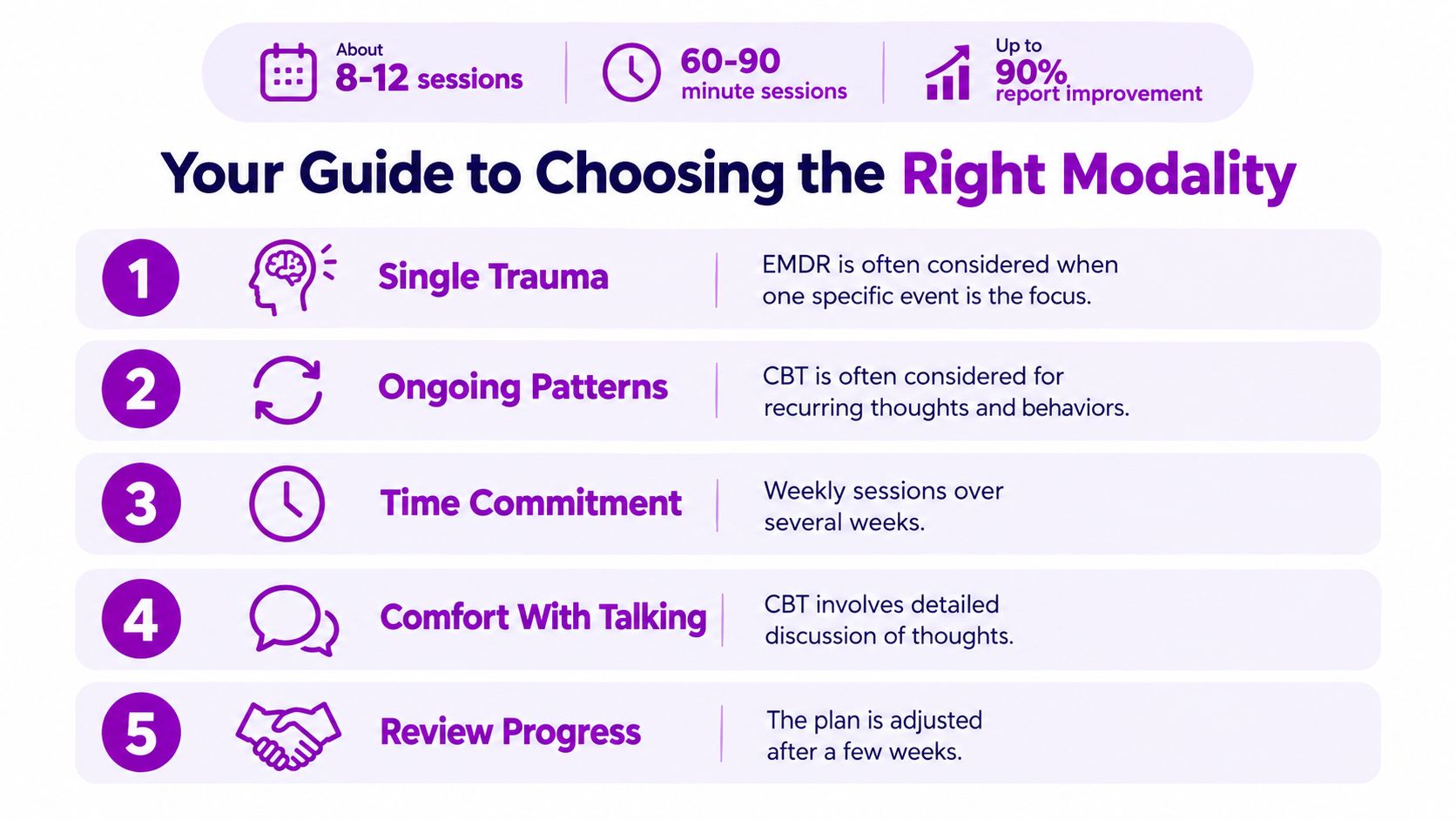
- Name the primary target. Is one memory and its physical alarm response causing the greatest disruption, or are recurring thoughts, avoidance, depression, anxiety, and emotion regulation the broader concerns?
- Assess your communication preference. Would you rather focus on a memory with limited detailed narration, or discuss beliefs and complete structured exercises? Review what cognitive behavioral therapy involves to understand the CBT side of this choice.
- Consider your capacity between sessions. CBT often includes practice outside therapy. EMDR places more active processing within sessions, though preparation and regulation work still require participation.
- Describe the trauma timeline. Tell the clinician whether the trauma involved a single event, repeated exposure, developmental experiences, recent events, or ongoing safety concerns.
- Review progress collaboratively. Ask how change will be measured and when the treatment plan will be revisited.
During the initial consultation, ask about the clinician's trauma training, how they would choose between EMDR and trauma-focused CBT for your symptoms, what they do if you become overwhelmed, and how they will know treatment is working. Ask whether they can add skills-based therapy, medication management, or another approach if your needs change.
The right choice is a collaborative starting point, not a permanent label. Choose a provider who explains the rationale, respects your pace, and adjusts care when your response provides new information.
reVIBE Mental Health offers EMDR, talk therapy, psychiatry, and medication management through in-person and secure online care across the Phoenix metro area. Visit reVIBE Mental Health or call (480) 674-9220 to discuss whether EMDR, CBT, or an integrated plan fits your symptoms and goals.