
You're exhausted, but bedtime brings another round of worrying. At work, familiar tasks take more effort, and at home, you've started declining plans because you don't have the energy to explain how you feel. You may be considering psychiatric care while wondering whether it will help you feel like yourself or just add medication to an already complicated life.
The positive effects of psychiatry can include symptom relief, clearer treatment decisions, and a return to activities that matter to you. But those benefits aren't automatic. Good care depends on careful assessment, honest discussion of trade-offs, and a plan that changes when your needs change.
Why People Seek Psychiatry and What They Can Realistically Gain
You don't need to arrive at an appointment knowing your diagnosis or wanting a prescription. A reasonable starting point is recognizing that your usual ways of coping aren't enough.
Consider a hypothetical person who's still getting to work but spends the evening recovering from the effort. They might describe themselves as functioning because they haven't missed a shift. Yet they're no longer cooking, seeing friends, or enjoying anything outside work. That distinction matters: getting through the day isn't the same as feeling well.
Start with the life you want back
A useful psychiatric conversation connects symptoms to specific losses and goals. Rather than stopping at feeling anxious, you might explain that you repeatedly check messages, avoid meetings, or can't settle enough to sleep.
- Describe the disruption. Explain what has become harder, including ordinary tasks you previously managed comfortably.
- Name your priorities. You might value clearer thinking, more restful sleep, or enough energy to reconnect with people.
- Share your reservations. Concerns about side effects, cost, privacy, or becoming dependent on treatment deserve discussion, not dismissal.
For readers whose difficulties are especially visible on the job, Fluidwave's mental health guide offers an additional workplace-focused resource. It can sit alongside clinical care rather than substitute for an individualized assessment.
A useful starting question: What would feeling better allow you to do that you can't comfortably do now?
Realistic expectations leave room for uncertainty. An assessment may lead to medication, therapy, a combination, or further evaluation before making a treatment decision. You should leave understanding the reasoning behind the recommendation, not feeling that accepting care means surrendering control.
What Psychiatry Actually Is and How It Differs From Therapy Alone
Psychiatry is a medical specialty focused on mental health assessment and treatment. A psychiatrist considers symptoms, treatment history, physical health, medications, and the circumstances surrounding your difficulties. Prescribing can be part of that work, but it isn't the whole job.
Therapy focuses on psychological treatment through approaches that address thoughts, behavior, emotional experiences, and relationships. The distinction isn't that psychiatrists handle real illness while therapists handle everyday problems. Both can contribute to meaningful care, and their work often overlaps.
A whole-building assessment
Think of your difficulties as a problem in a building. A thorough inspection considers the foundation, wiring, rooms, and conditions outside rather than assuming every problem needs the same repair.
Similarly, psychiatric assessment shouldn't reduce your experience to a presumed chemical imbalance. Sleep, appetite, attention, medical conditions, stress, and previous treatment responses all belong in the conversation. Therapy can help examine patterns within that broader picture.
| Question | Why it belongs in an assessment |
|---|---|
| What changed, and when? | The sequence helps clarify the problem. |
| What have you already tried? | Previous benefits and difficulties inform the next decision. |
| What else affects your health? | Medical concerns and other medications deserve consideration. |
| What treatment feels acceptable? | A workable plan needs your participation. |
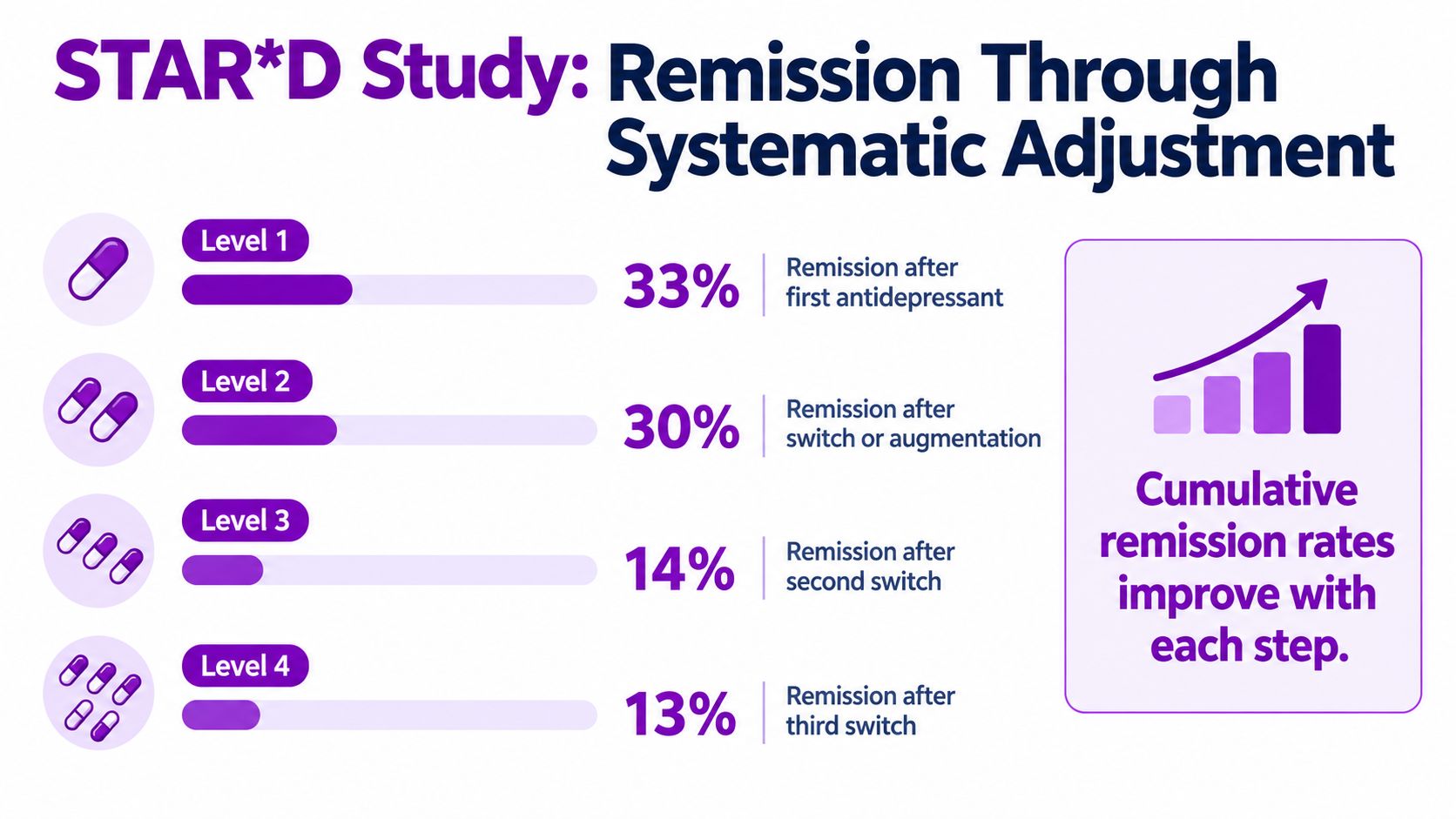
The following graphic introduces the idea of staged treatment. Read its percentages as a simplified illustration, not as personalized predictions; outcome estimates depend on how researchers define and measure remission.
The practical distinction is that psychiatric care adds medical assessment and medication decisions when appropriate. It doesn't make therapy unnecessary, and an evaluation doesn't commit you to taking medication. You can ask what the clinician thinks is happening, what remains uncertain, and what alternatives are reasonable.
How Systematic Medication Adjustment Produces Real Remission Rates
An unsuccessful antidepressant trial doesn't automatically mean psychiatric treatment can't help. It means the clinician and patient need to examine what happened before deciding what comes next.
Response means symptoms have meaningfully improved. Remission means symptoms have fallen below the threshold used to define ongoing illness in the study or assessment. Neither term, by itself, tells you whether someone has regained the life they want.
What STAR*D actually tells us
In the NIMH STAR*D study, about one-third of participants achieved remission during initial treatment; after an unsuccessful initial SSRI, roughly one in four who switched antidepressants and one in three who added another medication reached remission, while the original summary reported cumulative remission approaching 70% among participants who remained in treatment across all treatment levels (NIMH's STAR*D findings).
That final qualification matters. The cumulative figure isn't a guarantee for everyone who starts treatment. Later analyses using stricter criteria produced lower estimates, so the most defensible takeaway is that systematic adjustment can help some people who don't improve initially, not that persistence guarantees remission.
Before changing a prescription, a clinician should consider:
- Adequacy of the trial. Was the medication taken consistently, at an appropriate dose, for an appropriate duration?
- Partial benefit. Which symptoms improved, and which remain disruptive?
- Tolerability. Are adverse effects undermining the benefit or making the plan difficult to follow?
- Diagnostic fit. Does the original assessment still explain the person's experience?
The decisions involved in medication management for depression are therefore broader than choosing another pill. They include deciding when not to increase treatment and when another approach deserves consideration.
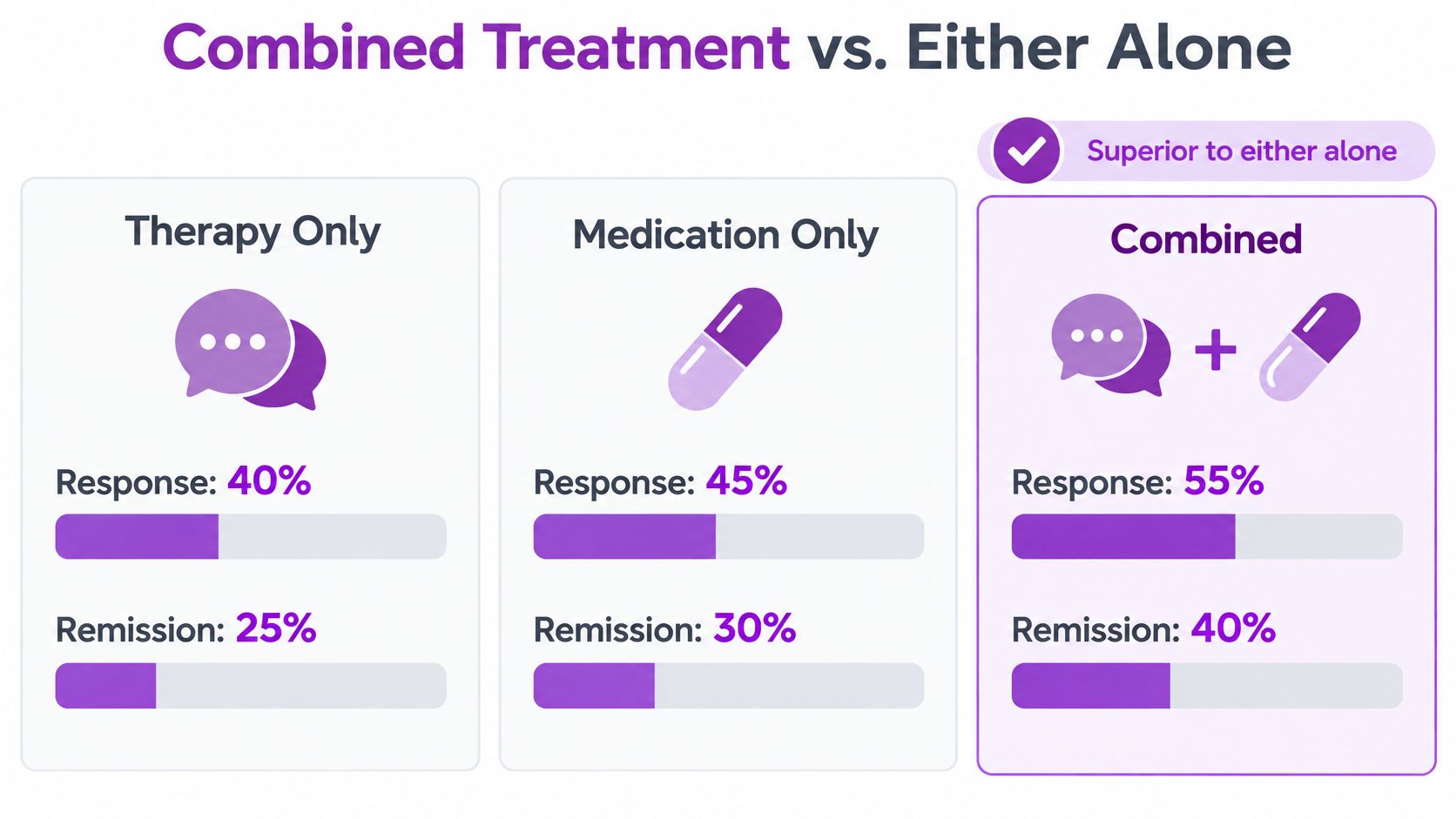
The comparison graphic below illustrates combined care conceptually. Its displayed absolute percentages aren't universal treatment rates; the research comparison is better understood through the relative effects discussed next.
Why Combining Medication and Therapy Often Outperforms Either Alone
Medication and therapy can address different parts of the same difficulty. Someone may regain enough energy to leave the house yet still avoid friends because they expect rejection. Another person may understand their patterns in therapy but struggle to practice new skills while depression remains overwhelming.
That's the practical rationale for coordinated care: reducing symptom burden and changing unhelpful patterns can support each other. Neither treatment needs to be framed as a failure of the other.
Understanding the research comparison
A large network meta-analysis found that combined psychotherapy and medication outperformed psychotherapy alone for response (RR 1.27) and remission (RR 1.22), and medication alone for response (RR 1.25) and remission (RR 1.23); compared with pill placebo, combined treatment increased remission relatively by 59%, with an RR of 1.59 and a 95% confidence interval of 1.27–2.00 (network meta-analysis of depression treatments).
A relative improvement isn't an increase by the same number of percentage points. These findings also concern depression; they shouldn't be treated as identical estimates for every anxiety condition or every individual.
Combined care should mean a coordinated plan, not simply separate appointments with professionals who never communicate.
Coordination might involve a therapist identifying persistent avoidance while a psychiatric clinician reviews whether fatigue reflects residual symptoms or a medication problem. With your permission, each professional can contribute observations that help clarify the next decision. For anxiety-focused questions, this discussion of therapy versus medication for anxiety can help you prepare for a treatment conversation.
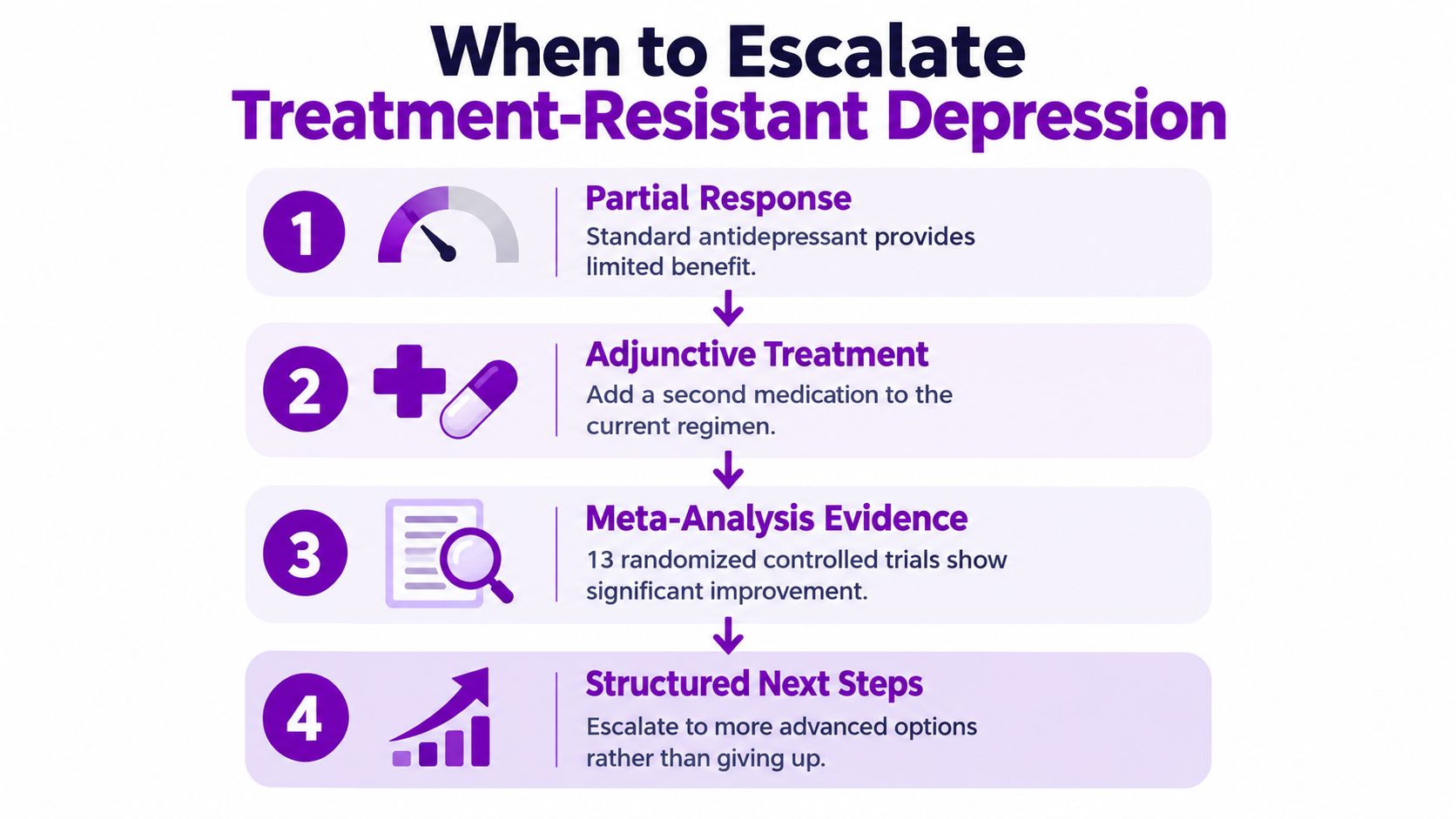
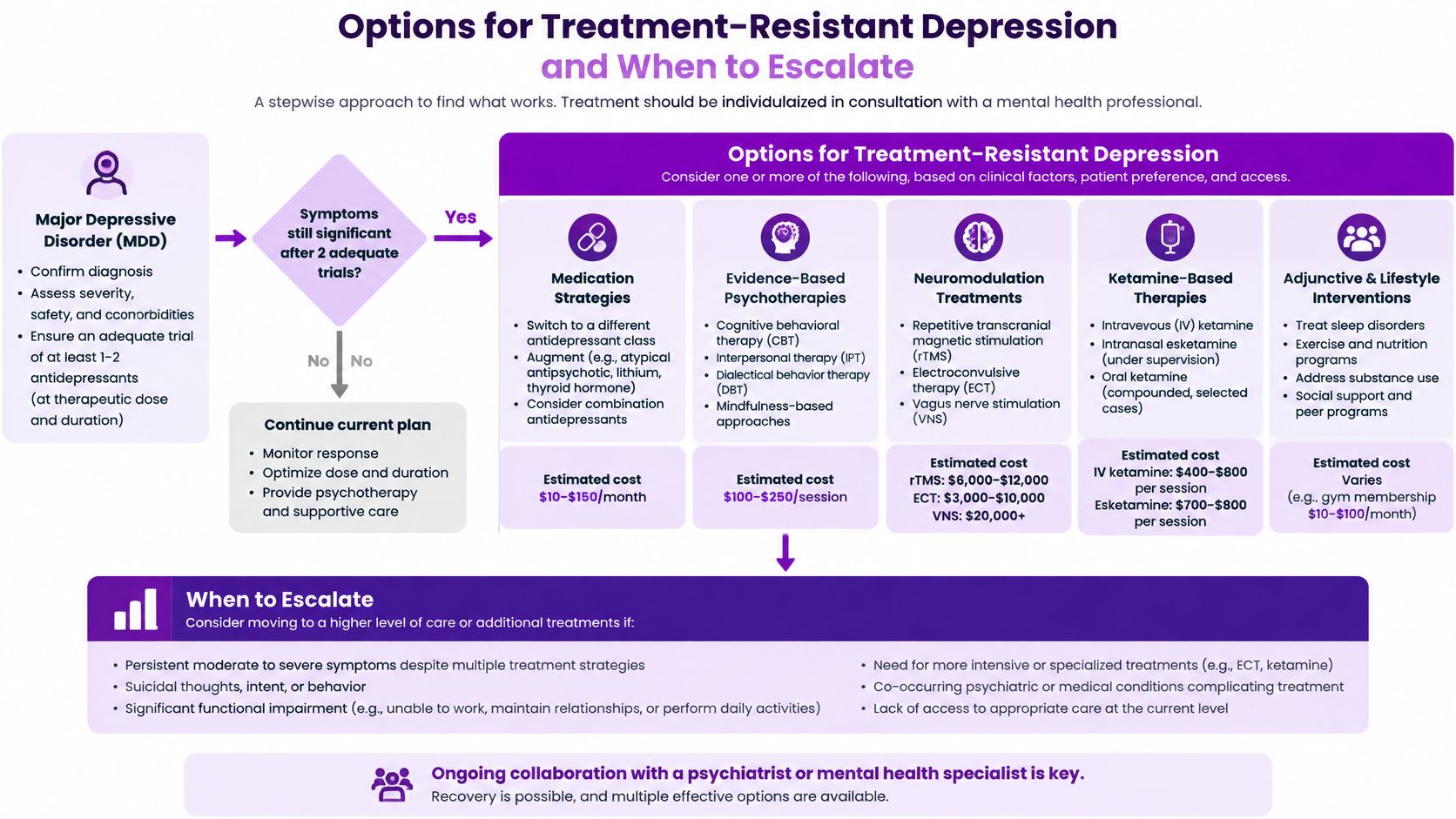
If depression remains difficult despite coordinated care, further options may deserve evaluation. The graphic below previews that discussion, but it shouldn't be read as a mandatory sequence in which everyone must receive an additional medication.
Options for Treatment-Resistant Depression and When to Escalate
When depression persists, the next step should follow a reassessment, not an automatic increase in treatment intensity. A clinician needs to understand what you've tried, what helped, and what made treatment difficult.
Augmentation means adding a treatment to improve an incomplete response. Switching means replacing the existing treatment. Choosing between them requires discussing likely benefits, risks, practical demands, and your preferences.
Weighing additional medication against other options
A meta-analysis of 13 randomized controlled trials found that adding an atypical antipsychotic increased the odds of remission compared with placebo augmentation, with an odds ratio of 1.77, a 95% confidence interval of 1.49–2.09, and a number needed to treat of approximately 10 (meta-analysis of adjunctive antipsychotics for depression).
That treatment category can sound confusing: using an antipsychotic as depression augmentation doesn't by itself mean someone has a psychotic disorder. Benefits must be weighed against medication-specific risks, including weight gain, metabolic effects, sedation, and movement symptoms.
For antidepressant-resistant depression, an NIMH-supported study found remission in 14% of patients receiving active repetitive transcranial magnetic stimulation, or rTMS, compared with approximately 5% receiving sham treatment; remission approached 30% during a later open-label phase without the simulated-treatment comparison (NIMH's rTMS study summary). The later result is less conclusive because it lacked that comparison.
- Ask about suitability. Which findings make a proposed option appropriate for you?
- Clarify the burden. Discuss visits, monitoring, transportation, and costs before committing.
- Agree on reassessment. Establish how benefits and adverse effects will influence the next decision.
You can also ask about SPRAVATO for depression without assuming it's the right fit. For readers encountering psychosis-specific assessment terminology, Orange Neurosciences' practical PANSS workflow tips provide a separate resource; PANSS shouldn't be confused with a depression outcome measure.
The Honest Gap Between What Psychiatry Can Do and Who Can Reach It
An effective treatment that you can't afford, access, or continue isn't an effective solution for your everyday life. That's why discussions of psychiatric benefits need to include appointment availability, insurance, medication costs, and follow-up.
In 2025, WHO reported that more than one billion people live with a mental health condition, mental health receives approximately 2% of national health budgets globally, the median workforce is 13 mental-health workers per 100,000 people, and fewer than 10% of countries have fully transitioned to community-based care; globally, only 9% of people with major depressive disorder receive minimally adequate treatment (WHO's report on mental-health access gaps).
These figures describe more than a shortage of prescriptions. They point to the conditions needed to make treatment usable and sustainable.
Access means being able to continue
A video appointment may solve a transportation problem without solving an insurance problem. An available prescriber may still be a poor practical fit if you can't get a timely response when adverse effects develop.
| Access question | What to clarify |
|---|---|
| Can I afford ongoing care? | Appointment charges, medication costs, and coverage requirements |
| Who handles problems between visits? | Contact procedures and reassessment availability |
| Will I feel understood? | Language needs, cultural context, and communication preferences |
| Can I keep seeing the same team? | Continuity and coordination arrangements |
If you're reviewing employer-sponsored coverage, Benely's mental health parity explained for HR provides a starting point for questions to take to a benefits administrator. It doesn't replace checking your own plan's terms.
Before booking: Ask what happens after the first appointment, especially if the recommended treatment is unaffordable or causes problems.
A credible care plan accounts for these constraints rather than interpreting every missed appointment or interrupted prescription as a lack of motivation.
How to Tell Whether Psychiatric Care Is Actually Working for You
A lower questionnaire score can be encouraging while still leaving an important question unanswered: Is your life becoming more manageable and more your own? You might worry less but feel emotionally flattened, or sleep longer without waking rested. Those experiences belong in the assessment.
A 2025 systematic review covering 901 patients and 2,831 clinicians found that measurement-based care improved communication, patient involvement, insight, and treatment tracking, while identifying concerns about missed complexity, privacy, and administrative burden (systematic review of measurement-based care experiences). A scale is useful information, not a verdict that overrides your experience.
Build a practical progress checklist
Choose observations that reflect your priorities rather than trying to track everything.
- Sleep and energy. Are you resting more comfortably and able to begin necessary activities?
- Work and daily responsibilities. Can you concentrate, make decisions, and manage ordinary tasks with less strain?
- Relationships. Are you more present with others, rather than less visibly distressed?
- Emotional range. Can you experience interest, pleasure, sadness, and connection in ways that feel authentic?
- Treatment burden. Are adverse effects or appointment demands interfering with the improvements you value?
Bring examples to appointments. Explaining that you cooked dinner and enjoyed talking with your partner communicates something different from saying your mood was better.
Questions that keep you involved
Ask what improvement the clinician expected by this point, how they interpret partial benefit, and what would justify changing the plan. Discuss expected treatment duration, alternatives, and how any future reduction or discontinuation would be supervised rather than making medication changes on your own.
You should also be able to explain why you're continuing a treatment. If concerns are repeatedly dismissed, you don't understand the rationale, or your functioning is worsening, ask for a dedicated reassessment or another clinical opinion. Shared decision-making means your observations can change the plan, not merely that you're informed after decisions have been made.
Bringing It Together and Taking the Next Step With the Right Team
The positive effects of psychiatry are most meaningful when treatment helps you reclaim something specific: attention for your work, interest in your relationships, or enough emotional steadiness to participate in life again. Research supports useful treatment options, but your experience determines whether a particular plan is worth continuing.
Look for a team that explains its reasoning, welcomes questions, and makes follow-up practical. Ask how psychiatric care and therapy are coordinated, how insurance is verified, and how you can raise concerns between appointments.
Find a reVIBE Location Near You!
reVIBE Mental Health is one Phoenix-metro option offering an integrated team of therapists and licensed psychiatric professionals, including medication management, talk therapy, and EMDR. The practice offers in-person and secure online sessions, appointments seven days a week, and guidance with insurance verification; confirm your specific coverage and provider availability when contacting the team.
We currently have five locations for your convenience. (480) 674-9220
- reVIBE Mental Health – Chandler
3377 S Price Rd, Suite 105, Chandler, AZ - reVIBE Mental Health – Phoenix Deer Valley
2222 W Pinnacle Peak Rd, Suite 220, Phoenix, AZ - reVIBE Mental Health – Phoenix PV
4646 E Greenway Road, Suite 100, Phoenix, AZ - reVIBE Mental Health – Scottsdale
8700 E Via de Ventura, Suite 280, Scottsdale, AZ - reVIBE Mental Health – Tempe
3920 S Rural Rd, Suite 112, Tempe, AZ
You don't have to arrive with a complete explanation of what's wrong. Bring the changes you've noticed, your treatment history, and the questions you need answered before deciding what comes next.
reVIBE Mental Health offers therapy and psychiatric medication management with in-person and secure online appointments, helping you explore a plan focused on symptoms, daily functioning, and your preferences. Visit reVIBE Mental Health or call (480) 674-9220 to discuss provider fit, insurance coverage, and scheduling an evaluation.