
The most popular advice about somatic therapy vs EMDR is to follow your gut: choose the body-based option if you want something gentle, choose eye movements if you want something fast. That advice sounds even-handed, and it dodges the question that decides whether therapy works.
EMDR is a manualized, trauma-focused psychotherapy with a defined eight-phase protocol and a base of randomized trials behind it. Somatic therapy is an umbrella label covering Somatic Experiencing, sensorimotor psychotherapy and a long tail of other body-oriented methods that share no single schedule, technique set or training standard. You can compare one protocol with another protocol. You can't rank a protocol against a category and expect the ranking to mean anything.
The better first question: not "which one is better," but "what does the evidence support for the symptoms I have, and who is trained to deliver it."
Separate the strength of the evidence from the question of personal fit, and the decision narrows into something you can act on.
Somatic Therapy and EMDR Side by Side
The one-sentence difference: EMDR reprocesses a specific distressing memory while bilateral stimulation is applied, and somatic therapy works on the body's arousal and regulation patterns, often without naming a memory at all.
Both take the nervous system seriously. Beyond that, they diverge on nearly every criterion that matters when you're the one choosing.
The chart below treats them as two distinct practices rather than rival brands of the same thing.
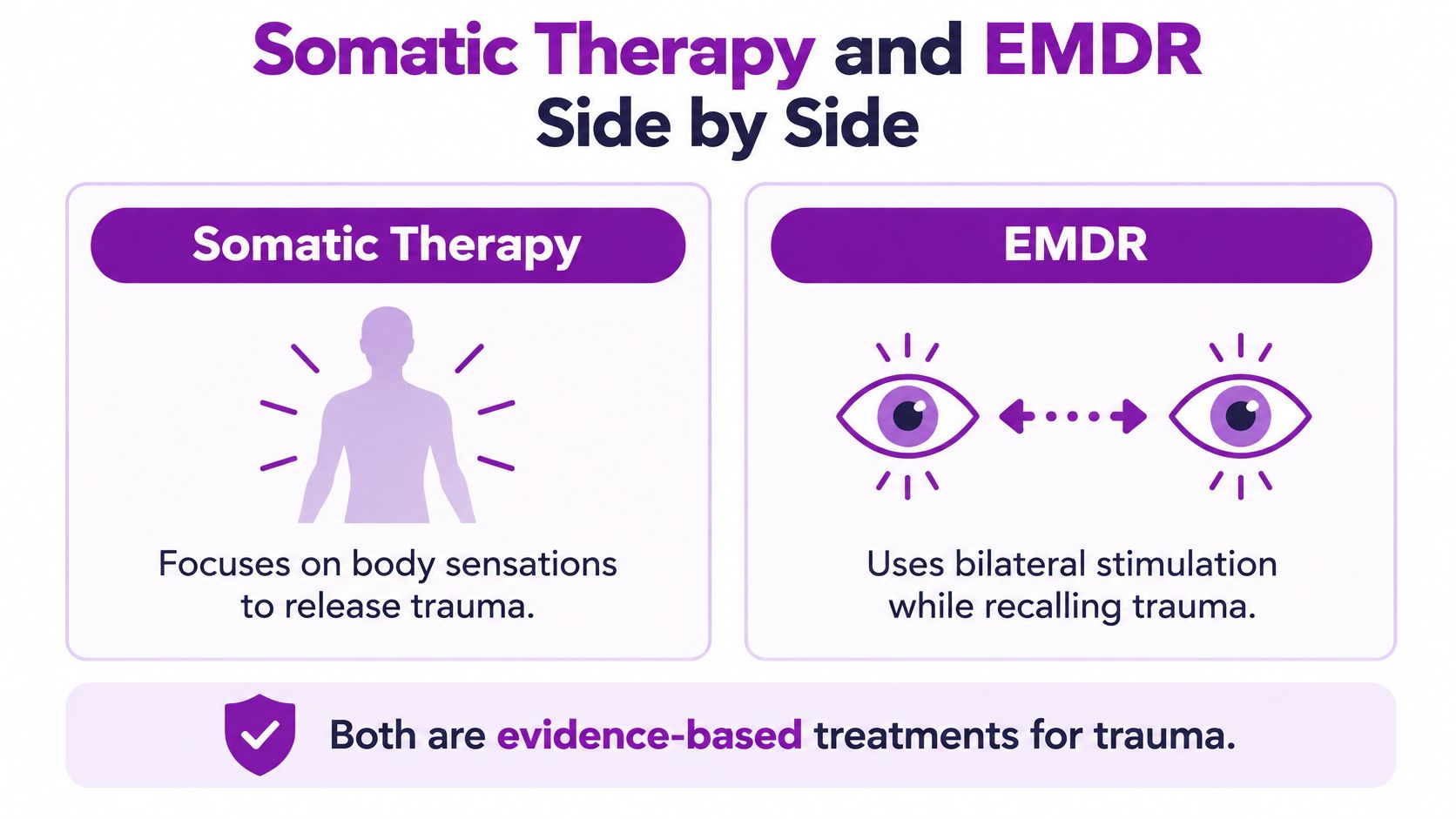
| Criterion | EMDR | Somatic therapy |
|---|---|---|
| Core approach | Reprocesses a distressing memory while bilateral stimulation (eye movements, taps or sounds) is applied | Works with bodily sensations, autonomic arousal and regulation, often through titrated exposure to sensation |
| Structure | Defined eight-phase protocol with measurable milestones | Umbrella term; methods and dosing vary by practitioner |
| Typical format | Weekly individual sessions of up to 90 minutes over about three months | No single standard schedule; set by the practitioner and method |
| PTSD evidence base | Several randomized trial meta-analyses and a 2023 VA/DoD recommendation | No equally robust randomized meta-analysis identified for somatic approaches |
| Benchmarking across studies | Easier, because protocol fidelity and pre/post PTSD scores can be measured | Harder, because techniques differ between practitioners and studies |
Three of those rows carry most of the weight. Start with format, because it tells you what you're committing to. The U.S. Department of Veterans Affairs describes a typical EMDR course as weekly individual sessions lasting up to 90 minutes over approximately three months, according to its EMDR overview for clinicians. Nothing comparable exists for somatic therapy, where the number of sessions is set by the method and the practitioner rather than by a published schedule.
Then look at the evidence row, which is where the two stop being symmetric. EMDR has been tested in randomized trials against controls, against wait-lists and against other therapies. Somatic approaches have not been pooled into an equally rigorous benchmark for PTSD, which doesn't make them useless. It makes them unproven by the same standard.
Practical rule: a treatment with a smaller evidence base can still be the right treatment. What it can't honestly be sold as is the equivalent of one with a larger base.
The weight of each row shifts with the person. Someone with one clear intrusive memory and someone who freezes at the first hint of body sensation will read the same table and reach opposite conclusions.
How EMDR Works Phase by Phase
EMDR's real advantage in practice is that it's boringly predictable. Every session sits inside the same eight-phase sequence, which means both people in the room know what stage the work is at.
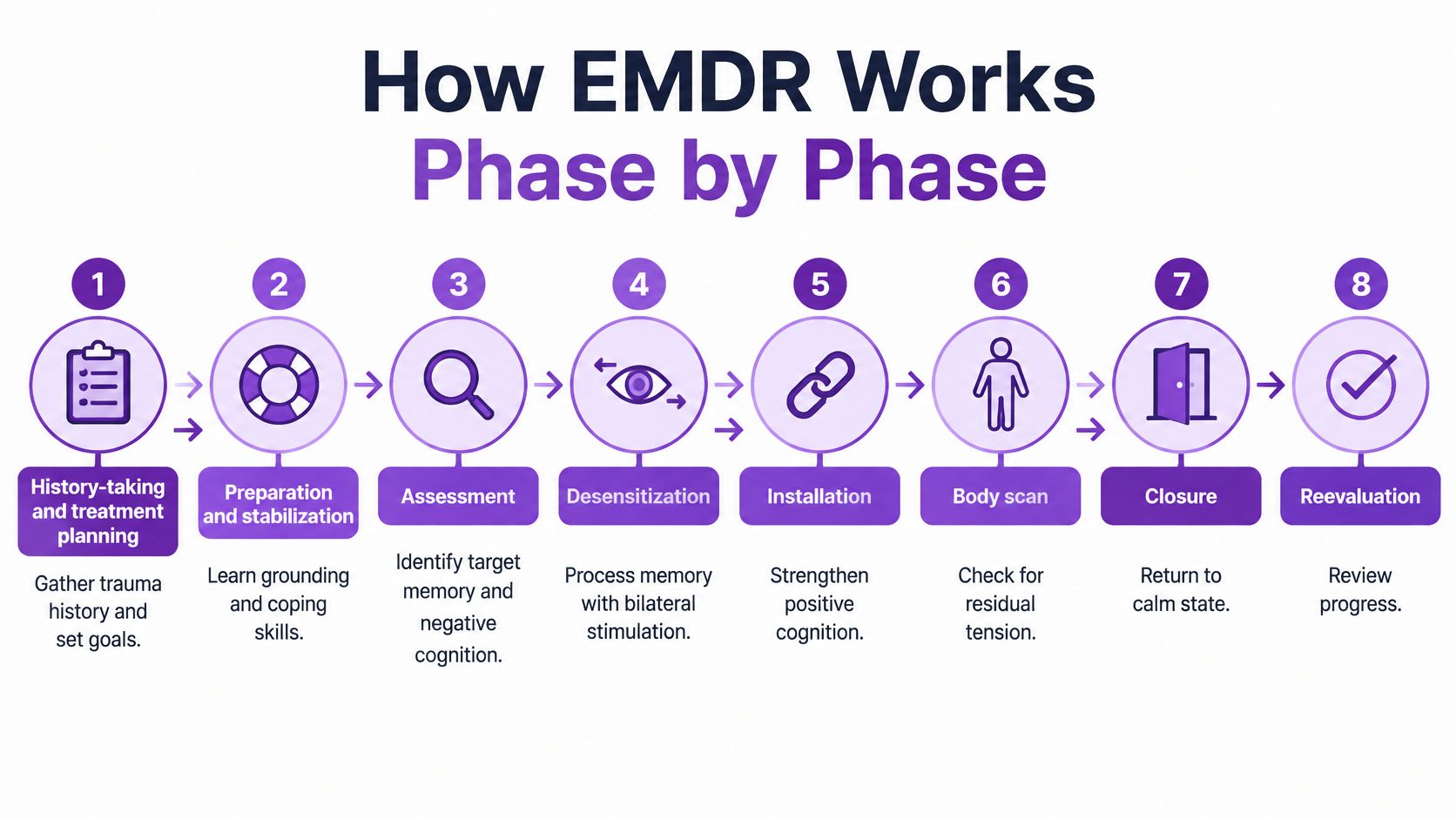
1. History-taking and treatment planning. The therapist maps the trauma history, identifies which memories will be targeted and sets goals, so treatment starts with a list rather than a vague intention to feel better.
2. Preparation and stabilization. Before any memory work, you learn grounding and coping skills you can use between sessions. This phase is why a competent EMDR clinician rarely starts reprocessing on day one.
3. Assessment of the target memory. You name the image, the negative belief attached to it, the emotions and the body sensations, and you rate how disturbing it feels. That rating becomes the baseline everything else is measured against.
4. Desensitization with bilateral stimulation. You hold the memory in mind while following side-to-side eye movements, taps or alternating tones, and you report whatever associations surface. The therapist's job is to keep you moving and return your attention to the target when it drifts.
5. Installation. You pair the memory with a more adaptive belief, such as "I did what I could," and stay with it until it feels true rather than aspirational.
6. Body scan. You check the body for residual tension connected to the memory, because a memory that no longer distresses you verbally can still leave a tight jaw or a clenched stomach.
7. Closure. Every session ends with stabilization, whether or not the processing finished. You leave regulated, not raw.
8. Reevaluation. The next session opens by checking whether last week's gains held and what needs attention, which is how treatment avoids drifting.
EMDR therapy helps people heal from trauma by reprocessing distressing memories while bilateral stimulation, such as eye movements, taps or sounds, is applied.
Why the structure matters more than the eye movements
The eight phases aren't decoration. A synthesis of the technical literature on EMDR and somatic approaches describes the sequence as creating measurable milestones and supporting protocol fidelity, which is why an EMDR course can be run with standardized intake, defined session goals, fidelity supervision and pre/post PTSD scores.
That matters for you as a client, not just for a clinic's paperwork. When each phase has a name and a rating attached, "is this working?" becomes an answerable question around session six instead of a matter of opinion. Somatic work leaves far more to the individual practitioner, which is both its flexibility and its weakness in any comparison.
How Somatic Therapy Works Through the Body
Somatic therapy is a family, not a technique. Somatic Experiencing, developed by Peter Levine, is the best known; sensorimotor psychotherapy is another; beneath those sit a range of body-oriented practices that borrow from both. What they share is a working assumption that trauma lives in the body's alarm system as much as in the story you can tell about it.

Interoception, or noticing the signal before it becomes a symptom
Interoception is the sense of what's happening inside you: heart rate, breath, temperature, tension. Trauma narrows that channel, so people either stop feeling their body or feel it only as a warning siren. A somatic session trains the channel back up.
Say someone notices a tight chest while recounting an argument with a sibling. Instead of interpreting the tightness, the therapist asks where it starts and stops, how heavy it is, and what happens if it is tracked for thirty seconds. Often the sensation shifts on its own. That shift is the entire intervention, and it is why clients sometimes describe somatic work as strange and then unexpectedly effective.
Titration, pendulation and grounding
Titration means approaching distressing material in small doses rather than flooding through it. Pendulation means deliberately moving attention between a place of distress and a place of relative ease, so the nervous system practices the return trip instead of staying stuck in activation. Grounding connects attention to the room you're in: the chair under you, the floor, the temperature of the air.
In practice: a somatic therapist spends more time asking "what do you notice right now?" than "what happened next?"
The weakness is consistency. Techniques and dosing differ between practitioners, so two people who both say they had somatic therapy may have had sessions that barely resemble each other. That's not a reason to avoid it. It's a reason to ask which method, which training, and what the therapist tracks as progress.
If you want a sense of the basic skills before you sit with anyone, our guide to somatic healing exercises walks through grounding and tracking practices you can try at home. Body-based work is often used first when dissociation, strong physiological reactivity or a low tolerance for direct memory processing is the main obstacle.
What the Evidence Shows for PTSD Treatment
Start with the strongest finding, stated plainly. EMDR works for PTSD, and the evidence behind it is stronger than anything currently assembled for somatic therapy as a category.
A 2023 systematic review and meta-analysis of randomized clinical trials found that EMDR reduced trauma-associated symptoms versus controls with Hedges' g = 0.33 (95% CI 0.12 to 0.54), per the published meta-analysis of EMDR trials. Heterogeneity was moderate at I² = 56%, and the review pooled 18 randomized trials and 21 post-treatment comparisons.
A g of 0.33 is a real but modest average benefit. The prediction interval, which runs from -0.47 to 1.10, is the number worth sitting with: across different populations, protocols and comparison conditions, some settings could see no benefit at all while others see a large one. An average effect is not a promise to any individual.
| Measure | Value |
|---|---|
| Hedges' g, EMDR vs controls | 0.33 (95% CI 0.12 to 0.54) |
| Heterogeneity I² | 56% (moderate) |
| Prediction interval | -0.47 to 1.10 |
| Studies included | 18 randomized trials, 21 post-treatment comparisons |
| EMDR vs active treatments | g = -0.26 (95% CI -0.51 to 0.00) |
| EMDR vs passive controls | g = -0.93 (95% CI -1.68 to -0.17) |
The gap that rarely gets named
The same review did not identify an equally strong randomized-trial meta-analysis establishing comparable benchmark effects for Somatic Experiencing or other broadly defined somatic therapies. That is an evidence gap rather than a verdict. Nobody has assembled the trials that would let anyone claim somatic work meets the same standard, which is a different statement from saying it fails.
Part of the problem is structural. EMDR is a single manualized protocol, so researchers can test whether the protocol works. Somatic therapy is an umbrella covering methods with different techniques and dosing, and until those methods are studied separately at scale, a pooled effect size for the whole category cannot exist. The honest comparison is therefore one protocol with tested outcomes against a category that has not been tested in the same way.
What follows from that is positioning. Somatic work fits as a body-oriented adjunct or an individualized approach, with no current basis to claim equal standing on PTSD treatment efficacy.
For anyone choosing: ask your clinician which validated PTSD measure they will use to track change, and how many points of movement would count as progress.
Two findings that complicate the headline
Look at the last two rows of the table again. The advantage shrinks against active treatments and grows against passive controls, which means the measured effect is a benefit over doing nothing or waiting rather than superiority over other therapies.
An individual-participant-data meta-analysis of eight randomized controlled trials involving 346 patients found no statistically significant difference between EMDR and other psychological treatments in PTSD symptom severity, treatment response, remission or dropout, according to the Cambridge analysis of EMDR versus other psychological therapies. That comparison covered other psychological treatments rather than somatic therapy specifically, so it is not a head-to-head result. It does mean EMDR's defensible claim is "comparable to other evidence-based therapies" rather than "better than everything."
If you want the study-level detail on how these trials were designed and measured, our overview of EMDR therapy research collects the protocols and outcome measures.
Which Approach Fits Which Situation
The best guide for matching a client to a method is the evidence behind each one, and that evidence is uneven. The 2023 VA/DoD clinical practice guideline recommends EMDR, Cognitive Processing Therapy and Prolonged Exposure over pharmacologic interventions for PTSD in adults, and the 2023 VA/DoD key recommendations add a caution that matters here: evidence is insufficient to recommend isolated components of a manualized protocol instead of, or in addition to, the complete treatment. Eye movements alone, or grounding alone, aren't what was studied. The full protocol is.
That unevenness is also why "somatic therapy versus EMDR" can't be settled as a contest. EMDR is a defined protocol with a trial record. Somatic therapy is an umbrella covering several methods, some far better studied than others. Ranking a category against a protocol confuses the comparison. What can be matched is a client's situation to the tool that fits it.
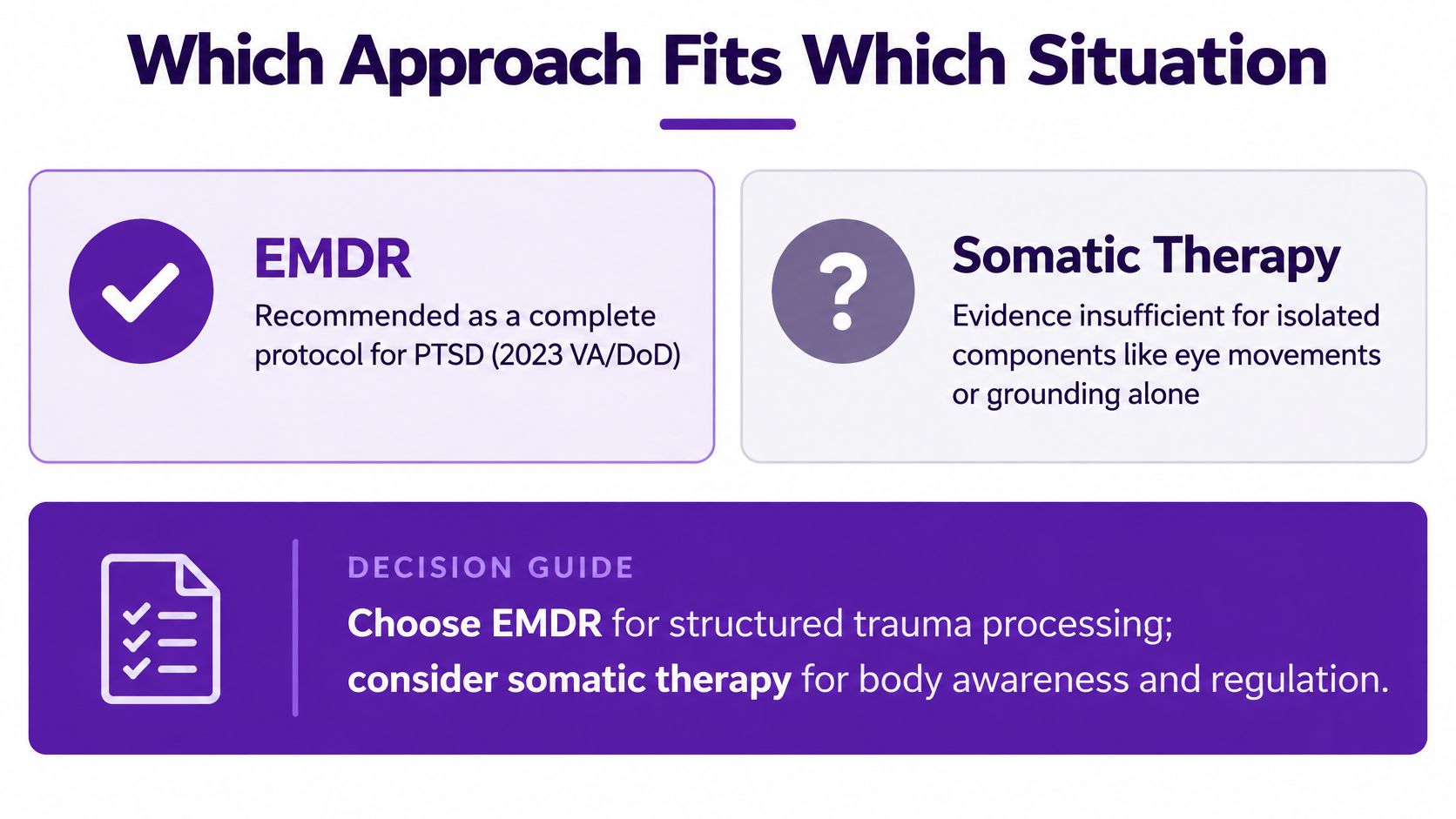
| Client situation | Usually starts with | Reason |
|---|---|---|
| Clear single trauma memory with intrusive symptoms | EMDR | The protocol targets the memory directly through reprocessing |
| Frequent dissociation or freezing during memory work | Somatic skills first | Grounding and titrated exposure build tolerance before reprocessing |
| Severe depression, unstable safety or active crisis | Stabilization and assessment first | Memory work may worsen symptoms until risk is screened |
| Body-centred symptoms without a defined trauma memory | Somatic therapy | The focus is physiological regulation rather than memory processing |
| Need for measurable PTSD milestones | EMDR | Standard phases and pre/post scores make progress easier to track |
| Phobia or single anxiety trigger | EMDR in practice, though the PTSD trials reviewed don't cover phobias | The research reviewed does not establish EMDR outcomes for phobias; decide with a clinician |
The last row needs a caveat rather than a recommendation. EMDR therapy is used for PTSD, anxiety and phobias, and clinicians routinely apply it to specific fears. The trial evidence reviewed here, though, is PTSD evidence. A phobia is a different target with a different research base, so the decision belongs with a clinician who can tell you what they've treated.
The readiness screen
Before any memory work, a careful assessment covers current safety, sleep, substance use, dissociation, suicidality, medical factors, your goals and the coping resources already in place. A client with severe depression or unstable housing may need stabilization first. A client with one defined memory and steady ground under them may be ready for the full protocol now.
Anxiety on its own is not a reason to postpone trauma-focused treatment. The question is whether risk is screened and capacity is in place, not whether the idea feels daunting.
Ask directly: "What would make you pause memory work with me, and what would tell you I'm ready?"
EMDR research is also being extended beyond conventional PTSD populations into other diagnoses. That work is newer and thinner than the PTSD trials, and much of it measures improvement against waiting rather than against another therapy, so it widens the questions being asked more than it settles them.
For trauma rooted in childhood, the fit question often widens further, since that work tends to run longer than a single-protocol course. adult trauma therapy at Uptown Psychology outlines how ongoing trauma-focused treatment is structured, which gives a concrete picture of what committing to longer-term work involves when you're deciding where to begin.
Verify Training Before You Book
Two clinicians can advertise trauma therapy with credentials that mean very different things. EMDR has a formal training pathway with supervised practice and a defined protocol. Somatic therapy is an umbrella, and "somatic-informed" can describe anything from a multi-year Somatic Experiencing program to a weekend workshop. Asking "are you trained?" gets you a yes either way. Asking what the training consisted of gets you something useful.
For an EMDR clinician, the useful question is whether they completed formal EMDR training and whether they deliver the full eight-phase protocol or only selected components. For a somatic practitioner, ask which method they practise, what lineage the training comes from, and whether they receive ongoing supervision. A clinician who answers vaguely on any of these is telling you something.
Questions that produce a specific answer
- How do you screen for dissociation and safety? A trained clinician describes a screening process, not a feeling.
- What makes you slow down or pause? Listen for concrete markers such as flooding, numbing or lost time in session.
- Which outcome measures do you use? An EMDR clinician can usually track PTSD scores against the protocol phases; a somatic clinician should be able to name what they track, whether that is regulation, sensation tolerance or daily functioning.
- What happens if I get worse? An honest answer includes a plan for stabilization and referral, not reassurance alone.
A specific answer on any of these beats a broad promise of relief. If you are comparing remote providers before deciding, the Aroma Warehouse counselling guide covers practical questions worth settling before committing to online sessions. For what each credential behind a therapist's name means, our guide to mental health therapy certifications breaks them down one by one.
Choose Your First Step With a Licensed Clinician
Here's the recommendation by situation. If you have a defined trauma memory and PTSD symptoms such as intrusions, avoidance or hyperarousal, EMDR has the strongest evidence and a complete protocol behind it. If body activation, dissociation or the absence of a clear memory is the main feature, somatic work or stabilization usually comes first, with EMDR reconsidered once readiness is established. The two can be sequenced or integrated, so the first choice isn't permanent.
Bring three questions to the consultation: which approach the clinician would start with and why, how progress will be measured, and what would signal that the plan should change.
If you're in the Phoenix area, reVIBE Mental Health offers EMDR therapy in person at five locations, plus psychiatry and medication management when those belong in the plan. Every site also runs secure online sessions, so distance from a clinic doesn't have to decide this for you.
- Chandler: 3377 S Price Rd, Suite 105, Chandler, AZ
- Phoenix Deer Valley: 2222 W Pinnacle Peak Rd, Suite 220, Phoenix, AZ
- Phoenix PV: 4646 E Greenway Road, Suite 100, Phoenix, AZ
- Scottsdale: 8700 E Via de Ventura, Suite 280, Scottsdale, AZ
- Tempe: 3920 S Rural Rd, Suite 112, Tempe, AZ
Request a readiness assessment before any memory work begins. The main line is (480) 674-9220, and a short conversation about your symptoms and goals is usually enough to know whether to start with stabilization or go straight to the protocol.
Somatic therapy and EMDR ask different things of you, and reVIBE Mental Health can help you work out which fits your situation rather than guessing at it. Our therapists deliver EMDR therapy in person across Chandler, Phoenix, Scottsdale and Tempe, and through secure online sessions if getting to an office isn't realistic, with psychiatry and medication management available when depression or anxiety needs more than therapy alone. Visit reVIBE Mental Health or call (480) 674-9220 to set up a readiness assessment and start with a plan instead of a coin flip.