
If EMDR can help with sexual trauma, does that mean starting immediately is always the best choice? Not necessarily. Timing and readiness are treatment decisions, not measures of how committed you are to healing.
EMDR, short for eye movement desensitization and reprocessing, combines a structured therapy process with guided attention tasks. Understanding what it involves, what the evidence supports, and when preparation should come first can help you consider care without feeling pushed toward detailed disclosure.
Whether EMDR Helps With Sexual Trauma
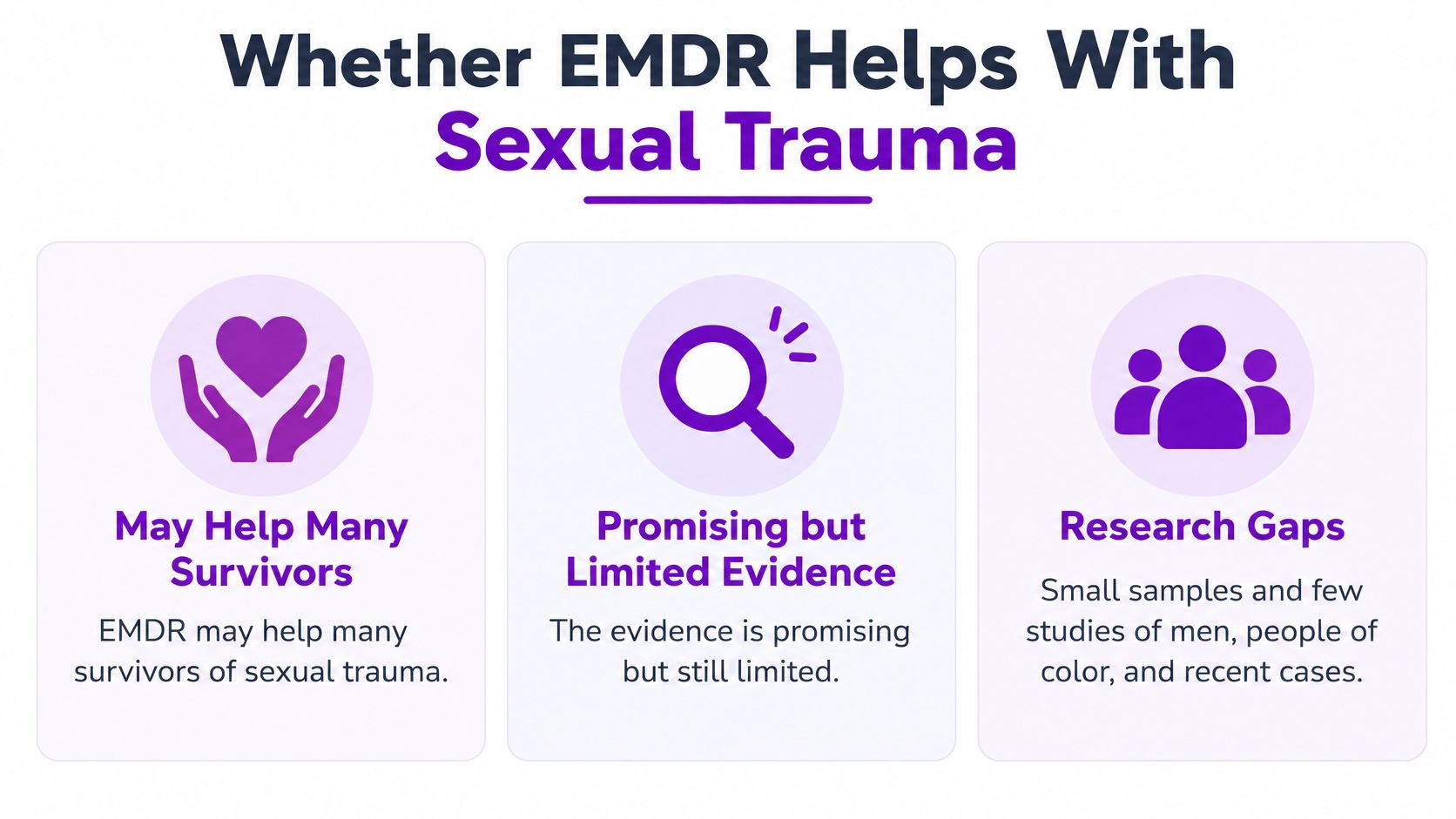
EMDR may help many survivors of sexual trauma, but the evidence is promising and still limited. Small samples, different treatment formats, and limited representation of men and people of color make broad promises inappropriate. Recent assault, childhood abuse, and exposure to multiple forms of violence also aren't interchangeable clinical situations.
A review of sexual-assault-related PTSD reports that approximately 50% of women who have experienced sexual assault develop PTSD over their lifetime, and cites research finding that 94% of women experienced PTSD symptoms during the first two weeks after an assault. Early symptoms deserve attention, but experiencing them isn't the same as knowing how someone's recovery will unfold.
Key EMDR studies in sexual and interpersonal trauma
| Study Design | Participants | Comparison | Main Finding |
|---|---|---|---|
| Randomized trial of two EMDR sessions 14–28 days after assault | 57 recent rape survivors | Watchful waiting | No extra reduction in PTSD, depression, guilt, or shame at 8- and 12-week follow-ups in the early-intervention trial. |
| Randomized study of three EMDR sessions | 21 sexual-assault survivors | Waiting-list control | Greater improvement in depression and PTSD scores than control, as summarized in the BJPsych Advances review. |
| Randomized trial of EMDR using the G-TEP group protocol | 19 women with childhood sexual abuse | Trauma-focused CBT | Both reduced symptoms; EMDR improved dissociation and perceived quality of life. |
| Randomized study of EMDR | 120 women exposed to physical, psychological, and sexual violence | Narrative exposure therapy | Greater reductions in anxiety, depression, and post-traumatic symptoms with EMDR. |
What these comparisons can tell you
A waiting-list comparison asks whether treatment helps more than waiting without that treatment. An active comparison asks a harder question: whether it helps more than another therapy. Neither establishes that every survivor will benefit, and short follow-ups don't establish how gains hold over years.
The childhood-abuse and interpersonal-violence findings also require attention to treatment format and participant characteristics. For developmental context, our explanation of whether EMDR works for childhood trauma can help distinguish longstanding patterns from a recent traumatic event.
Recovery timelines shouldn't become deadlines. For readers comparing trauma resources, AskLegally's explanation of how long PTSD lasts after crashes concerns a different trauma context, not a timetable for sexual-assault recovery.
Ask a clinician which outcomes they'll track and what meaningful progress would look like for you. Better sleep, less avoidance, improved functioning, and feeling more present may matter alongside PTSD symptom scores.
The Eight Phases of EMDR Treatment, Step by Step
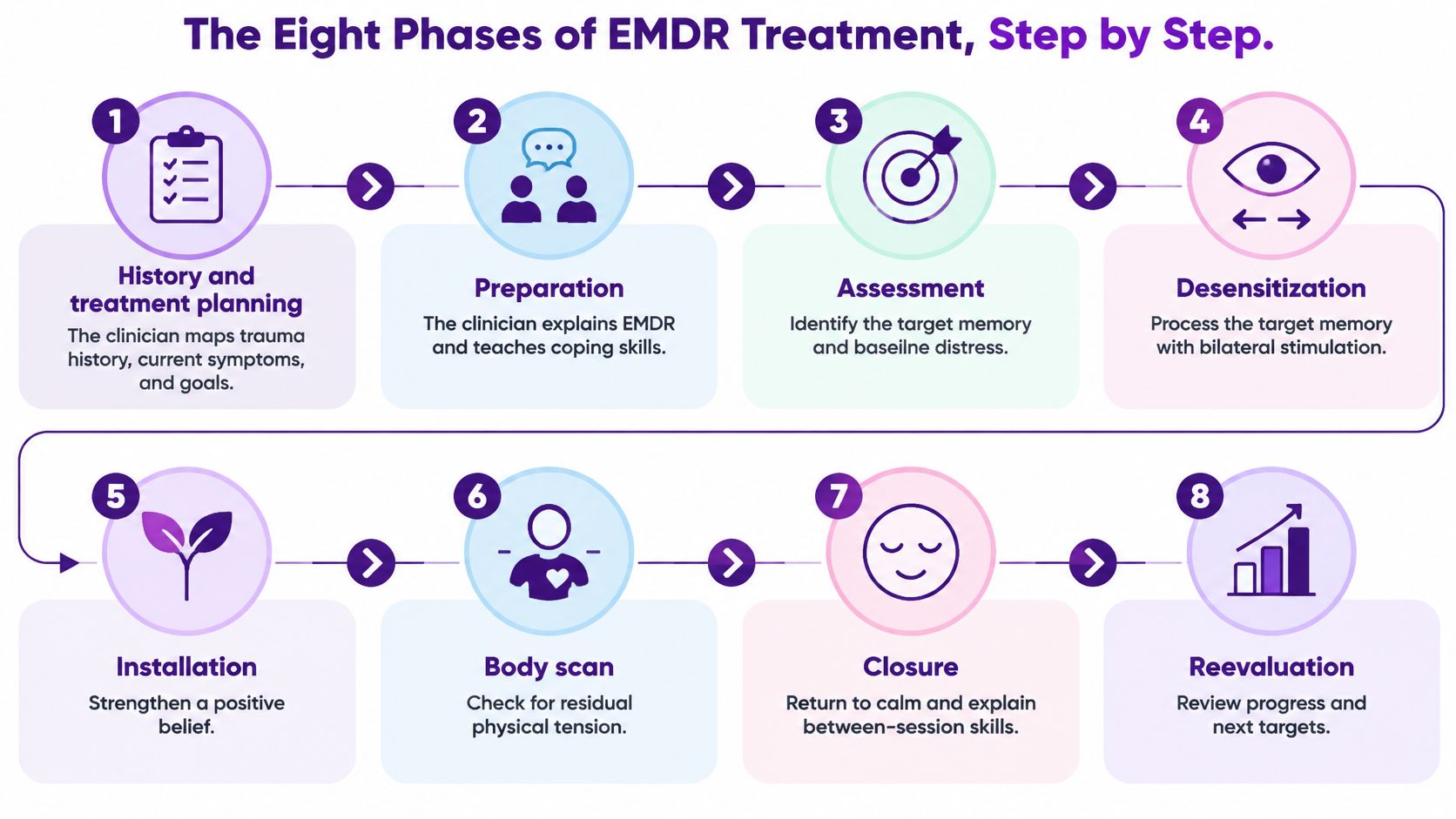
EMDR isn't just watching a therapist's fingers move. The Journal of Traumatic Stress description of EMDR outlines an eight-phase protocol that includes preparation, memory processing, closure, and reevaluation.
The structure helps the clinician decide what to work on, whether you're prepared to approach it, and how to finish without treating distress reduction as the only priority.
What each phase does
History and treatment planning. The clinician asks about current difficulties, relevant experiences, support, and goals. You can begin with broad information rather than a detailed account of the assault.
Preparation. You learn how the process works and practice ways to stay oriented to the present. Grounding might involve noticing the room, feeling your feet against the floor, or imagining a place that feels sufficiently calm.
Assessment. You and the clinician identify a target image, the distressing meaning attached to it, and a more adaptive belief you'd like to hold. Ratings help describe how disturbing the target feels and how believable the preferred belief currently seems.
Desensitization. You attend to the target while completing a dual-attention task, commonly guided eye movements. The therapist checks what you notice between sets and adjusts the work rather than demanding a particular response.
Installation. The focus shifts toward strengthening an adaptive belief connected with the memory. That belief should feel personally meaningful, not like a positive statement you're expected to accept.
Body scan. You notice whether thinking about the target brings up remaining bodily discomfort. The clinician helps distinguish what needs further attention from what can be left safely for another appointment.
Closure. The therapist supports a return to present-day orientation and reviews a between-session plan. Unfinished processing calls for careful closure, not pressure to keep going.
Reevaluation. At a later appointment, you review what changed, what remained difficult, and whether the treatment plan needs adjustment.
A sequence, not a deadline
Preparation can occupy multiple appointments before memory processing begins. A clinician may also return to grounding or assessment when circumstances change.
Practical rule: Moving through the phases safely matters more than moving through them quickly.
The aim isn't to complete a checklist on schedule. It's to use the structure in a way that respects your capacity, your goals, and the conditions of your life.
How Bilateral Stimulation Is Thought to Work
Bilateral stimulation means alternating left-right input. It may involve following eye movements, using alternating taps, or listening to tones presented to each ear.
Think of a disturbing memory as a photograph under a bright spotlight. An attention task may soften the intensity of that spotlight while leaving the photograph recognizable. This is an analogy for a possible change in experience, not a claim that EMDR erases memories.

Proposed explanations
A review of proposed EMDR mechanisms describes working-memory demands, an orienting response, and processes resembling those associated with rapid-eye-movement sleep as possible explanations.
- Working memory. Holding a vivid image in mind while doing another attention-demanding task may make it harder to maintain the image at full intensity.
- Orienting response. Alternating input may prompt an automatic shift of attention, somewhat like noticing a sound and briefly losing your train of thought.
- Sleep-related processing. Another hypothesis involves processes resembling those linked with rapid-eye-movement sleep and the handling of emotional material. This doesn't mean therapy puts you into a sleep state.
These remain proposed mechanisms, not proof that EMDR suits every survivor. Evidence concerning eye movements also shouldn't be treated as proof that every form of alternating stimulation works identically.
Choosing manageable input
A therapist can discuss taps or sounds when eye movements feel uncomfortable or difficult to follow. You can ask to change the speed, shorten the sets, or pause entirely.
The movement is an attention tool within therapy, not a stand-alone explanation for healing.
A useful question is which form of input allows you to notice the memory while still recognizing that you're in the room with the therapist. There's no need to tolerate an uncomfortable method just to perform EMDR correctly.
Timing Your EMDR Work to Your Readiness
The belief that earlier trauma processing must be better is understandable, but it isn't supported as a universal rule. An early appointment can be valuable without becoming an early memory-processing appointment.
In a randomized trial of 57 recent rape survivors, two EMDR sessions delivered 14–28 days after assault produced no greater reduction than watchful waiting in PTSD, depression, sexual dysfunction, guilt, or shame at 8- and 12-week follow-ups; temporary anxiety and dissociation improvements didn't persist. That finding challenges a default early-processing schedule, not EMDR as a whole.
Typical starting focus by time since assault
These are discussion points, not a treatment calendar or a requirement to wait.
| Time Since Assault | Typical Starting Focus | Clinical Reasoning |
|---|---|---|
| First 14 days | Stabilization, sleep, safety planning, and a symptom check | Early symptoms warrant assessment of intrusion, avoidance, arousal, and shame rather than an automatic move to reprocessing. |
| 14–28 days | Watchful waiting, supportive care, or stabilization unless a clinician judges otherwise | The early-intervention trial doesn't establish an advantage for routine immediate processing. |
| Several weeks to months, once coping holds | Phased EMDR after preparation | Grounding, consent, and an agreed way to pause support a manageable approach. |
| Years later, if stable | A full phased course at the client's pace | Longstanding symptoms can be addressed without a deadline based on the assault date. |
| Any time with legal proceedings, an unsafe person, unstable housing, medical crisis, or intense dissociation | Safety planning and supportive care before memory work | Competing demands may make immediate processing poorly timed. |
What readiness can look like
Possible signs include being able to approach the event in manageable pieces, having some regularity in eating and sleep, and recovering after brief distress. These aren't admission requirements. A clinician considers them alongside your preferences, support, and current risks.
Watchful waiting should involve a plan, not abandonment. Agree on what to monitor, when to check in, and what changes would prompt more support.
Legal proceedings, medical treatment, or housing instability don't automatically rule out EMDR. They do warrant a conversation about what you can realistically carry right now.
Consent remains active throughout care. Pausing bilateral stimulation, changing the target, or choosing supportive work can be sound clinical decisions, not failed sessions.
Dissociation, Complex Trauma and Safety Limits
Brief numbness or zoning out can occur around distress. More concerning dissociation may involve memory gaps, losing time, feeling unreal or far away, or difficulty staying aware of the present.
These experiences need assessment rather than self-diagnosis. Noticing distinct internal parts doesn't by itself establish dissociative identity disorder, and outwardly appearing calm doesn't necessarily mean someone feels grounded.

Encouraging outcomes don't replace screening
A 2024 randomized study of 120 women exposed to physical, psychological, and sexual violence reported greater reductions in anxiety, depression, and post-traumatic symptoms with EMDR than narrative exposure therapy, alongside quality-of-life and cognitive improvements. Those results don't establish that unmodified EMDR is appropriate for severe dissociation or ongoing danger.
Assessment should explore what happens when you become distressed: whether you remain oriented, can communicate, remember the experience afterward, and regain steadiness. Our explanation of why dissociation happens offers language you can bring to that conversation.
Adaptations are practical responses
A clinician may use:
- Longer preparation. Practice grounding and recognizing early signs of disconnection before approaching difficult targets.
- Flexible stimulation. Adjust the method and pace rather than continuing input that increases disorientation.
- An agreed stop signal. Choose a word or hand gesture that doesn't require a lengthy explanation.
- Parts-informed pacing. Explore conflicting internal reactions without forcing agreement or assuming a diagnosis. People with dissociative identity disorder may need a highly experienced clinician using adapted procedures.
Between appointments, pay attention to sleep disruption, rising self-harm thoughts, increased substance use, and changes in relationship safety. Bring these changes to the clinician promptly so the plan can be adjusted.
Body awareness also needs consent. If physical sensations or intimacy feel difficult, Lake City Physical Therapy's resource on reconnecting with your body after trauma may offer useful questions for a suitably qualified professional, without making body-focused work an obligation.
Safety first: Detailed disclosure isn't a prerequisite for beginning assessment and support.
Active suicidality, intoxication, ongoing coercive control, or substantial medical needs call for urgent assessment, referral, or coordinated care. If you're in immediate danger or can't keep yourself safe, contact emergency services. A national sexual assault hotline can also help you explore support and safety options.
What Happens Inside a Single EMDR Session
Say Dana comes to an appointment wanting help with a particular moment that keeps returning. She doesn't want to recount her entire history, and the therapist doesn't make that the price of participation.
They begin with a check-in about mood, sleep, safety, and what has felt hardest since their last meeting. If Dana feels unusually disconnected or overwhelmed, they can use the appointment for preparation rather than processing.
Choosing a manageable target
Dana identifies a specific image and gives it a short label that she and the therapist understand. She rates its distress using the agreed scale and notices the belief attached to it, perhaps a sense of powerlessness.
With her consent, the therapist begins brief sets of bilateral input while Dana attends to the target. Between sets, the therapist asks what she notices. Dana might report an image, a thought, pressure in her chest, or no obvious change.
Brief reporting is enough. She doesn't need to turn each response into a detailed retelling, and the therapist shouldn't supply an interpretation that Dana feels pressured to endorse.
Following the response, not forcing an ending
If Dana becomes less oriented to the room, they stop and ground. If she remains present but the memory is still disturbing, they may continue or choose a stopping point that leaves enough space for closure.
The target doesn't have to be finished during that appointment. They end by reconnecting with the present, checking how settled Dana feels, and deciding what she'll do if distress rises afterward.
A randomized trial involving 19 women with childhood sexual abuse compared group-protocol EMDR with trauma-focused CBT: both reduced trauma-related symptoms, while EMDR also improved dissociation and perceived quality of life. Childhood-abuse literature also describes safe-space grounding exercises as a preparation tool, though an imagined safe place should be adapted or replaced if it doesn't feel helpful.
Dana's between-session plan might include:
- A grounding anchor. Notice a familiar object, the chair beneath her, or neutral details in the room.
- Brief observations. Record changes in sleep, triggers, or functioning without writing a trauma narrative.
- A contact plan. Know how to seek additional support if she feels less safe or increasingly disconnected.
The appointment is collaborative. Dana can stop, question the method, or reconsider the target without having to justify her limits.
Choosing Your First Step in EMDR Care
Before a consultation, write down your current safety situation, sleep and eating patterns, and what you most want to change. You can bring that page instead of preparing a detailed account of what happened.
Our explanation of trauma-informed therapy can help you put preferences about choice, communication, and boundaries into words. If legal concerns are taking up attention, the Law Office of Bryan Fagan PLLC's Bryan Fagan's survivor rights overview addresses Texas-specific information, not Arizona legal guidance.
Questions for a consultation
- Assessment. How do you screen for dissociation and current safety before processing?
- Control. How will we pause or change bilateral stimulation?
- Progress. What will we track beyond symptom totals?
- Preparation. How do you decide which grounding skills I need?
- Coordination. How do you work with psychiatric or medical care when needed?
At reVIBE Mental Health, we offer EMDR, therapy, psychiatry, and medication management, with in-person sessions and secure online care. Our therapists have diverse specialties, training, and individual styles, so fit matters alongside credentials.
Find a reVIBE Location Near You!
We currently have five locations for your convenience. Call (480) 674-9220 and ask which clinician can match your pacing preferences, dissociation-screening needs, and preference for in-person or secure online care.
- reVIBE Mental Health – Chandler
3377 S Price Rd, Suite 105, Chandler, AZ - reVIBE Mental Health – Phoenix Deer Valley
2222 W Pinnacle Peak Rd, Suite 220, Phoenix, AZ - reVIBE Mental Health – Phoenix PV
4646 E Greenway Road, Suite 100, Phoenix, AZ - reVIBE Mental Health – Scottsdale
8700 E Via de Ventura, Suite 280, Scottsdale, AZ - reVIBE Mental Health – Tempe
3920 S Rural Rd, Suite 112, Tempe, AZ
Choose a first step that feels manageable. You can revisit timing as your circumstances and readiness change.
reVIBE Mental Health offers EMDR therapy and coordinated mental health care for people working through trauma, in person or through secure online sessions. Visit reVIBE Mental Health or call (480) 674-9220 to discuss a clinician match and a starting pace that respects your safety, goals, and readiness.