
You might be here because something unsettling keeps happening. You're driving home and suddenly realize you don't remember the last stretch of road. You're in a meeting, people are talking, and you can hear every word, but none of it seems to land. Or you're standing in your kitchen and, for a few seconds or a few minutes, the room feels oddly flat, far away, or not fully real.
When people ask, “Why do I dissociate?”, they're often afraid the answer will mean something dramatic. In many cases, it doesn't mean you're “going crazy,” and it doesn't automatically mean you have a dissociative disorder. It usually means your mind and body have learned a way to pull back when stress, emotion, or threat feels too intense to process all at once.
That shutdown can happen in trauma. It can also happen in anxiety, depression, burnout, panic, grief, sleep disruption, and periods of overload. The practical question isn't just why is this happening. It's also what kind of dissociation is this, what do I do in the moment, and what level of help fits what I'm dealing with.
What Dissociation Actually Feels Like
A lot of people don't recognize dissociation the first time it happens. They call it spacing out, brain fog, panic, exhaustion, or “just being weird.” But the experience usually has a specific texture.
One person notices it on the drive home. They arrive safely, but the last few miles feel missing. Another is sitting across from a partner during an argument and suddenly feels like they're watching the conversation through thick glass. Someone else is at work, staring at an email they've read three times, and nothing sticks.
The lived feeling
Dissociation is a disruption in your usual sense of connection to yourself, your surroundings, your memory, or the flow of time. In plain language, it's a kind of protective disconnection. Not chosen. Not fake. Not weakness.
It can show up in a few common ways:
- Derealization means the world feels unreal, dreamlike, foggy, flat, or visually “off.”
- Depersonalization means you feel detached from yourself, almost like you're watching your body or your voice from a slight distance.
- Time distortion means minutes disappear, drag, or lose their normal shape.
- Emotional numbing means you know something should feel upsetting, important, or joyful, but your emotions seem muted.
Dissociation often feels less like “I lost control” and more like “I'm here, but not fully here.”
A useful analogy is a circuit breaker. When too much load hits the system, the breaker trips. The lights may still be on in part of the house, but something essential has gone offline to prevent overload.
Another analogy is your phone backgrounding apps when memory runs low. The device is still operating, but it starts reducing what's active in the foreground. Dissociation can work like that. Your brain narrows access to emotion, sensation, memory, or presence to get you through a moment it reads as too much.
Why it can feel frightening
The confusing part is that reality testing often stays intact. You may know, at least partly, that what you're feeling is strange. That's one reason dissociation can be so scary. You're aware something is off, but you may not have words for it.
Brief depersonalization or derealization is also more common than many people realize. A major clinical reference notes that 25% to 75% of people have at least one lifetime episode, while only about 1% to 2% meet criteria for depersonalization/derealization disorder (Merck Manual on depersonalization and derealization disorder).
That difference matters. An episode can be real, upsetting, and worth attention without automatically meaning you have a chronic disorder.
The Spectrum of Dissociative Experiences
Dissociation exists on a spectrum. That spectrum runs from ordinary mental drift to persistent symptoms that need formal evaluation.
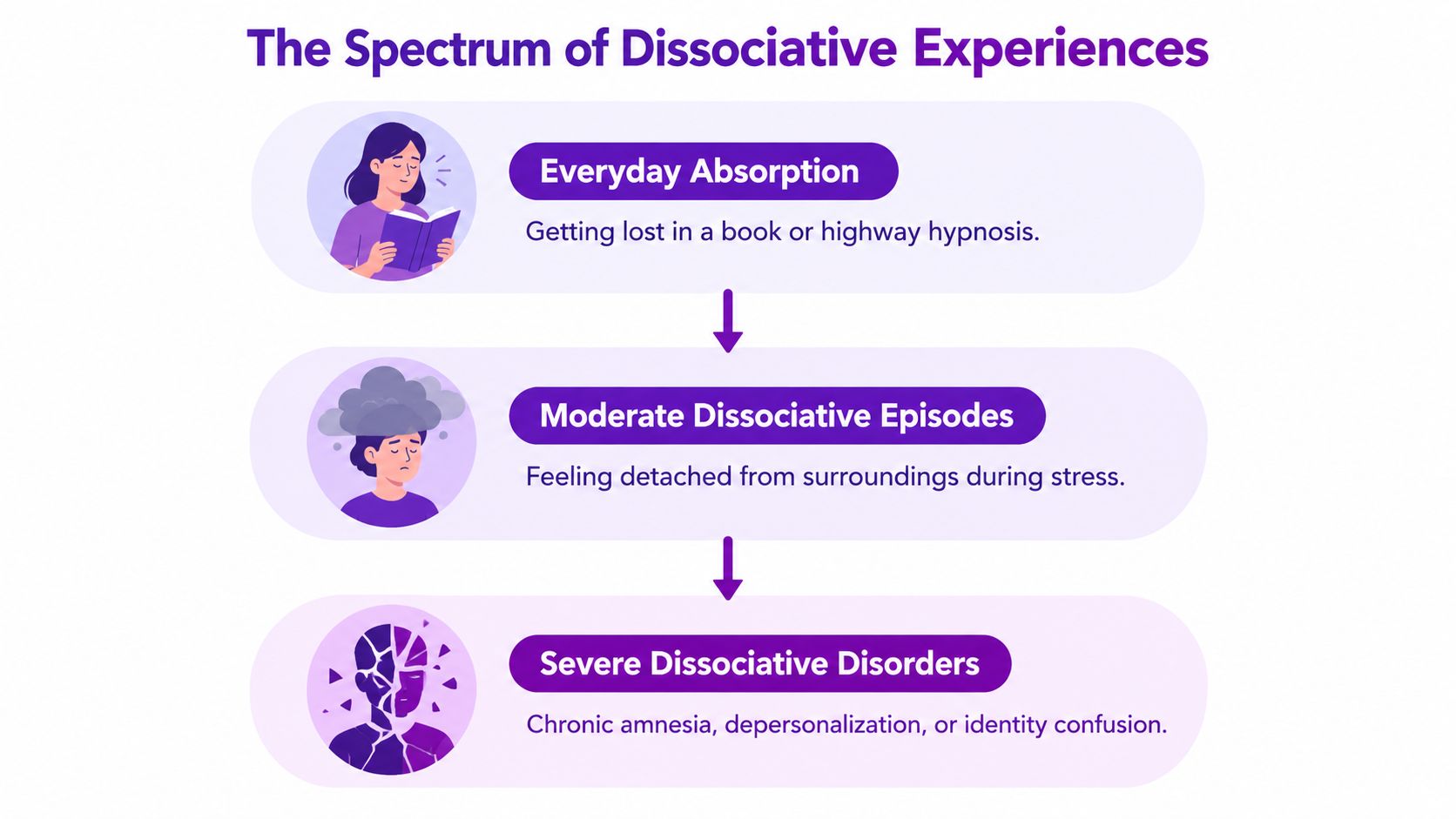
Mild forms
At the mild end, think of absorption. You get lost in a novel. You miss part of a podcast because your mind wandered. You drive a familiar route and remember only pieces of it. That isn't automatically pathological. Human attention naturally narrows and shifts.
What changes the picture is frequency, intensity, and cost. If the experience becomes recurrent, distressing, or disruptive, it moves out of the “ordinary zoning out” category.
Moderate forms
In the middle of the spectrum, people often describe stress-related episodes such as:
- Feeling far away during conflict
- Going blank in high-pressure settings
- Feeling unreal after bad news, a medical scare, or panic
- Running on autopilot while emotionally shut down
This is the range where many adults asking “Why do I dissociate?” tend to land. They're functioning, but something in the system keeps flipping into detachment under strain.
Clinical disorders
At the more severe end are conditions where dissociation becomes persistent, impairing, or tied to major memory and identity disruption.
Here's a simple map:
| Experience | What it tends to look like |
|---|---|
| Depersonalization/derealization disorder | Recurrent or persistent episodes of feeling detached from self or surroundings |
| Dissociative amnesia | Important autobiographical memory gaps that aren't ordinary forgetting |
| Dissociative identity disorder | Disruption in identity with distinct self-states and memory discontinuity |
| PTSD with dissociative features | Trauma-related symptoms plus prominent depersonalization or derealization |
For depersonalization/derealization disorder, diagnosis requires persistent or recurrent depersonalization, derealization, or both, intact reality testing, significant distress or impairment, and symptoms that aren't better explained by substances, a medical condition, or another mental disorder (PsychDB diagnostic summary for depersonalization).
A practical rule: An occasional detached moment is different from a pattern that regularly scrambles your memory, work, relationships, or sense of self.
If you're trying to locate yourself on the spectrum, don't ask only, “Do I dissociate?” Ask, “How often, how intensely, and what does it cost me?”
Common Causes and Triggers You Should Know
The biggest misconception is that dissociation has one cause. It doesn't. It's better understood as a shutdown response that can be recruited by different conditions and stressors.
Trauma is one major pathway
Dissociation is strongly tied to trauma-related disorders, especially PTSD. A 2017 meta-analysis of 33 studies with 2,106 PTSD patients found a mean Dissociative Experiences Scale score of 28.6 with a 95% CI of 25.6 to 31.5, which shows dissociation is a prominent symptom cluster in PTSD rather than a rare side feature. A 2022 systematic review estimated that the dissociative subtype of PTSD accounts for 38.1% of people already diagnosed with PTSD across all samples, with estimates ranging from 22.8% to 48.1% depending on the method used. Older cross-national survey data also found dissociative symptoms in 14.4% of people with 12-month PTSD, compared with 2.8% in the rest of the sample, and that pattern didn't differ by country income level (American Journal of Psychiatry PTSD dissociation findings).
That's the research version of a very human reality. When escape from threat is impossible or dangerous, the mind may protect itself by creating distance from what's happening. Reviews of trauma-related dissociation describe it as an adaptive defense associated with detachment, fragmented memory, and altered time perception, especially after childhood maltreatment and overwhelming stress (review on trauma-related dissociation as defense).
Stress, mood, and overload also matter
Not every dissociative episode points back to trauma alone. Dissociation also shows up across psychiatric conditions and is strongly associated with anxiety and depression, which makes a trauma-only explanation incomplete. For some people, the repeated trigger is panic. For others, it's chronic burnout, loneliness, emotional overload, or prolonged strain.
A recent report on young people highlighted a wider risk picture, including everyday stress, loneliness, marginalization, negative self-image, depression, anxiety, and emotion regulation difficulty, not just childhood trauma (EurekAlert report on predictors of dissociation in young people).
What happens in the brain
Researchers often describe dissociation as a state of top-down overcontrol. Brain studies and reviews link it to increased recruitment of the medial prefrontal cortex, dorsolateral prefrontal cortex, and anterior cingulate cortex, along with attenuated amygdala activity. In plain terms, parts of the brain involved in control and inhibition may dampen the threat and emotion systems, which fits the felt sense of numbing or shutting down (neurobiology of dissociation review).
Another model describes dissociation as a defensive state of hypoarousal, often linked to parasympathetic dominance. That helps explain why people feel numb, slowed, unreal, or far away rather than revved up in obvious panic (hypoarousal model of dissociation).
Triggers usually stack
Rarely is it just one thing. More often, several stressors pile up.
| Trigger Category | What Happens in the Brain | Typical Example |
|---|---|---|
| Trauma reminders | The nervous system shifts into protective shutdown when something resembles earlier threat | A smell, tone of voice, or conflict suddenly makes the room feel unreal |
| Acute stress | Overload outpaces your ability to process what's happening in real time | After a car scare or medical appointment, you feel detached for hours |
| Anxiety or depression | High distress or emotional flattening lowers your threshold for disconnection | During a panic spiral, your body feels unreal |
| Sleep loss and burnout | Reduced mental and physical reserve makes checking out more likely | After weeks of poor sleep, you start functioning on autopilot |
| Substances or medication effects | Perception and self-awareness can become altered or blunted | Alcohol, cannabis, hallucinogens, or sedating medications mimic or trigger detachment |
Symptoms That Show Up in Mind and Body
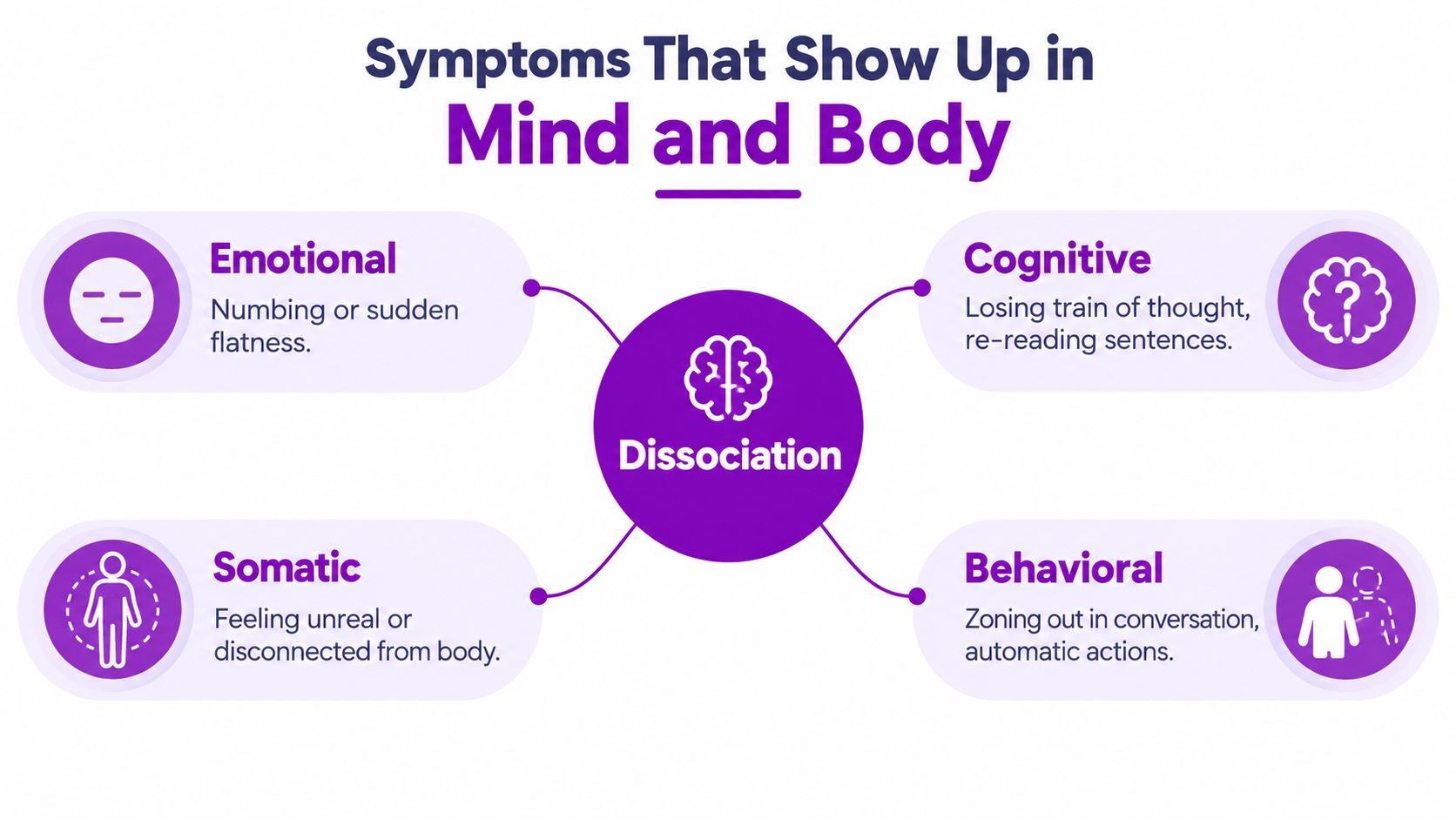
Dissociation doesn't live only in thoughts. People often feel it in four lanes at once: emotion, thinking, body sensation, and behavior.
Emotional and cognitive signs
You may notice sudden flatness. Maybe you know you should feel angry, sad, relieved, or scared, but all you can access is blankness. Some people describe it as their emotions being behind soundproof glass.
Thinking often changes too. You lose your train of thought mid-sentence. You reread the same paragraph without taking it in. During a hard conversation, you can hear the words but can't organize a response.
Sometimes dissociation looks less like drama and more like your mind quietly slipping into low power mode.
Body and time clues
In the body, people often report feeling lightheaded, floaty, numb, tingly, unreal, or disconnected from their own skin. You might look down at your hands and feel a strange split second of unfamiliarity, even though you know they're yours.
Time gets odd. A meeting seems to vanish. A grocery trip feels dreamlike and stretched out. You send texts, answer questions, or finish tasks, but later the memory feels thin or patchy.
A few recognizable examples:
- At work you stare at your phone while someone is speaking and realize you haven't tracked any of the conversation.
- At home you move through chores automatically, then feel unsure how the last hour passed.
- During conflict your partner says you went quiet, distant, and robotic, while you experienced it as going offline.
Behavioral signs
Behaviorally, dissociation often looks like:
- Zoning out in conversation
- Automatic actions with little memory afterward
- Long pauses or blank spells
- Withdrawal when stress rises
These signs can overlap with fatigue, panic, and depression, which is one reason people often miss what's happening. Naming the pattern doesn't solve it by itself, but it usually reduces some of the fear.
Is Dissociation Always Trauma or Something Else
The short answer is no. Trauma is one important pathway, but it isn't the only one.
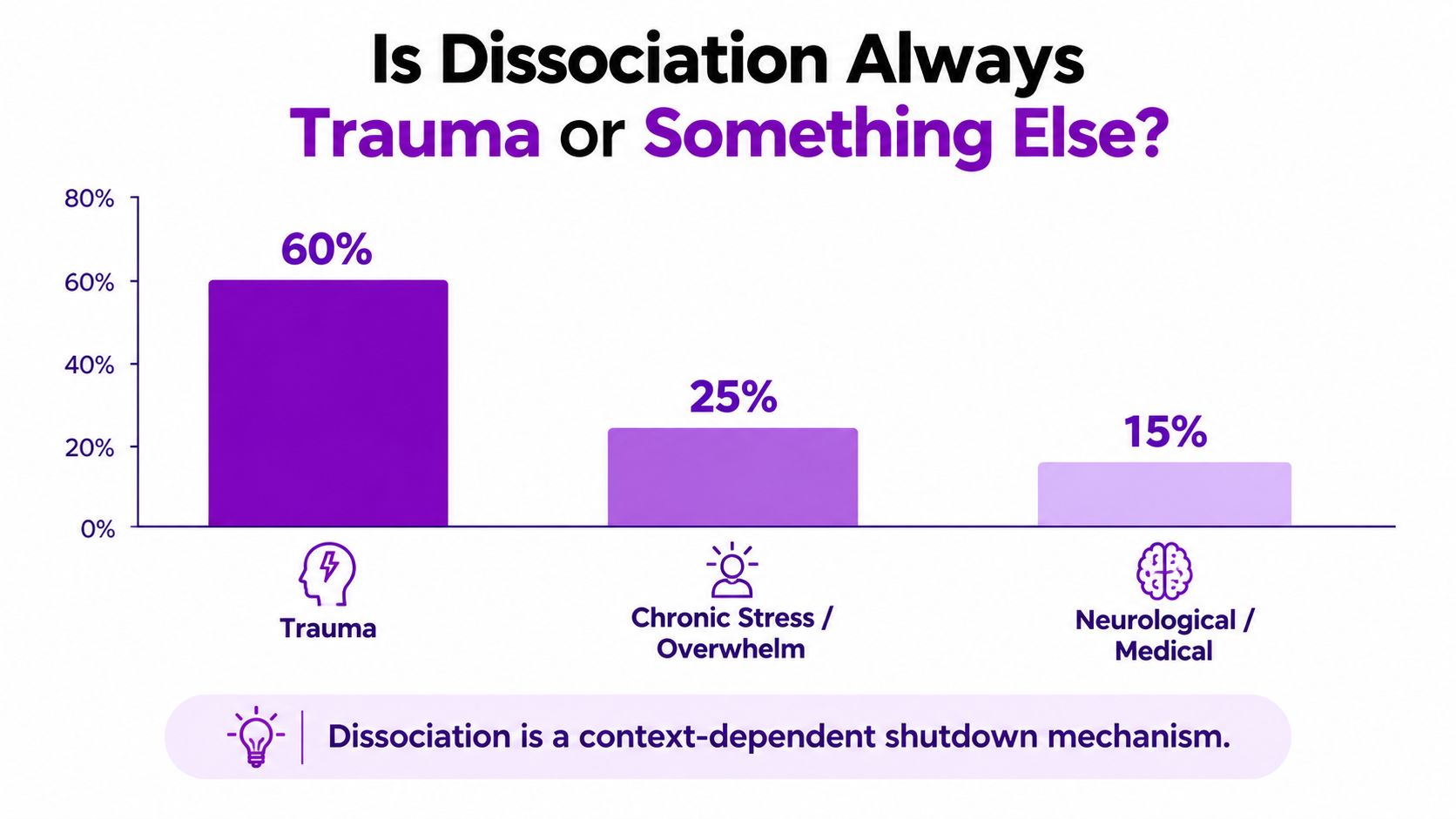
That image offers a simple way to think about the problem, but it shouldn't be read as a diagnostic formula. Real people rarely fit neat buckets. Dissociation is better understood as a context-dependent shutdown mechanism. The same outward feeling can come from different underlying patterns.
A practical decision path
Three questions usually help sort it out.
1. How often does it happen?
If it's brief, rare, and tied to obvious overload, stress may be the main driver. If it's frequent or becoming part of daily life, it deserves a fuller assessment.
2. What tends to happen right before it?
If episodes appear after reminders of earlier threat, trauma may be central. If they show up during panic, burnout, sleep disruption, or depression, the picture may be broader. Sleep is especially important because chronic exhaustion can make the nervous system easier to tip into shutdown. If that piece fits your experience, this overview of trauma and sleep is a useful companion read.
3. Are there memory gaps, or mainly feelings of unreality?
Feeling detached is one pattern. Losing chunks of autobiographical memory is another. Bigger memory gaps raise the need for a more careful diagnostic look.
Three common pathways
Here's a simple way to think about the main routes:
- Stress-based dissociation often tracks overload, panic, burnout, grief, conflict, or too little sleep.
- Trauma-linked dissociation tends to show up around reminders of threat, especially when the original threat felt inescapable.
- Mood and anxiety related dissociation rides alongside depression, anxiety, or mixed emotional states and may persist even when no obvious trauma cue is present.
A 2022 review notes that lifetime prevalence of dissociative disorders ranges from about 9% to 18%, while inpatient and outpatient clinical samples can reach as high as 46%. The same review states that the vast majority of people with dissociative disorders also have comorbid PTSD. It also notes that the dissociative subtype of PTSD was only added to DSM-5 in 2013, even though research on dissociative symptoms in trauma goes back much further (review of dissociative disorders and trauma connection).
Is dissociation always helping
Not necessarily. People often hear that dissociation is a coping mechanism, and that's partly true. It can begin as protection. But protection and relief aren't always the same thing.
Some newer work suggests dissociation may track distress without reducing it, which challenges the idea that it's always self-soothing. That matters because treatment shouldn't stop at “your brain is coping.” It should ask whether the pattern is still serving you.
If you want a framework for how trauma can split experience into parts that react differently under stress, reVIBE's overview of the structural dissociation model is a helpful next step.
Grounding Techniques You Can Use Right Now
When dissociation hits, the first job isn't deep insight. It's reorientation. You want to help your brain and body register: I'm here. This is now. I have a way back.
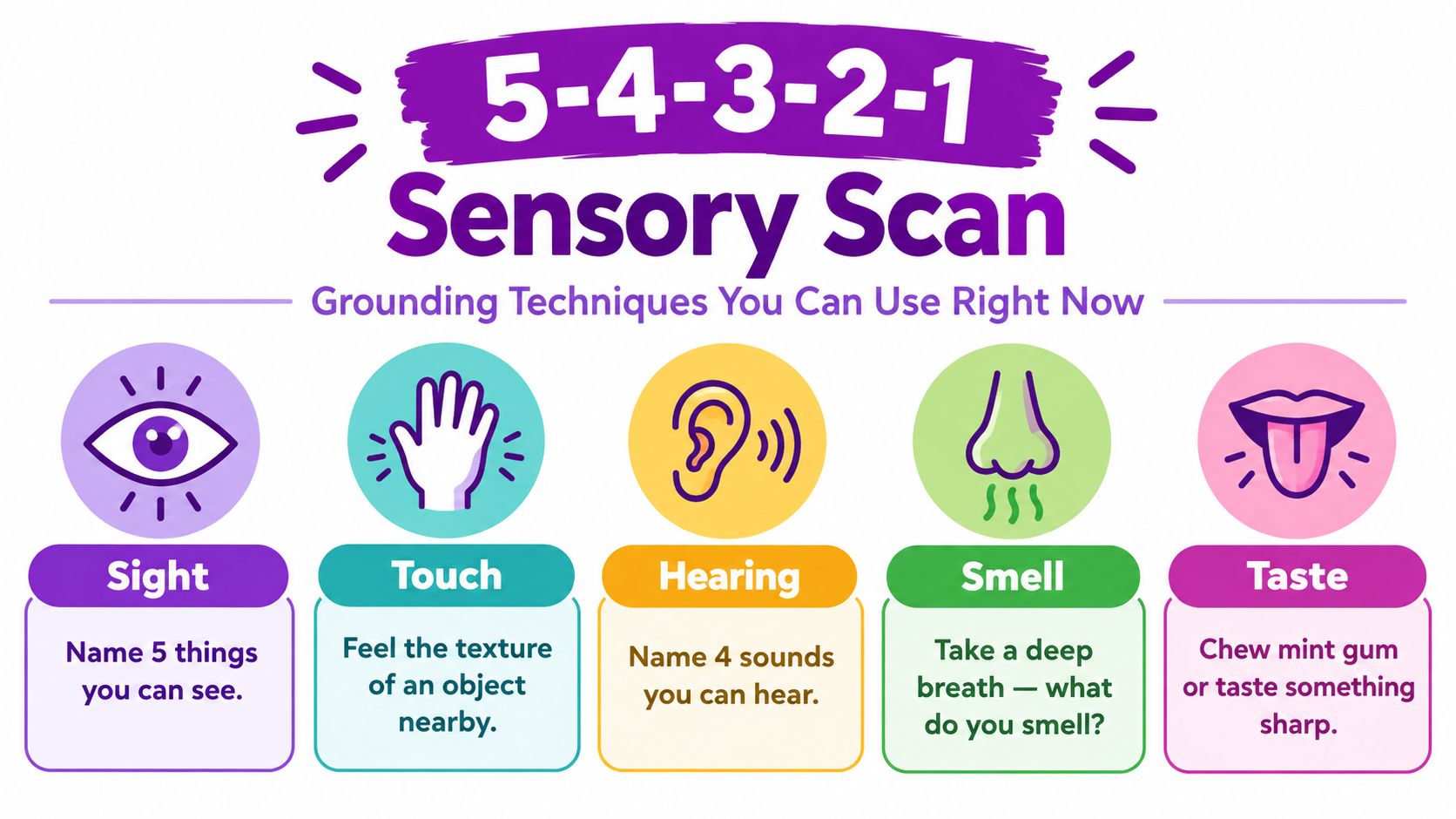
A short toolkit by situation
If you're at your desk, in class, or sitting in your car, start with the 5-4-3-2-1 sensory scan:
- Five things you can see
- Four things you can feel
- Three things you can hear
- Two things you can smell
- One thing you can taste
If you're in a public place and need something faster, use cold temperature. Run cold water over your hands, hold a chilled drink, or press a cool washcloth to your face. The point isn't comfort. It's a clear sensory signal.
For derealization, use orientation cues out loud or in your head:
- Name the date
- Name where you are
- State one plain fact, like “I'm in my office. It's Tuesday. The chair is blue.”
Try this: Don't ask, “Why am I like this?” in the middle of an episode. Ask, “What will help me reconnect to this room in the next 30 seconds?”
A few add-ons that help
Paced breathing can help if it doesn't make you more inwardly focused. Keep it simple. A slow exhale is often better than forcing a deep breath.
A grounding object also helps some people. Keep one thing with a distinct texture in your pocket or bag, such as a smooth stone, rubber band, keychain, or piece of fabric. Describe it to yourself in concrete detail.
If you're also trying to reduce your overall baseline arousal between episodes, some people find it useful to learn more about ways to calm the nervous system with supplements, alongside sleep, nutrition, and therapy. And if you want more exercises in this style, reVIBE has a practical guide to grounding techniques for anxiety.
Grounding is a moment skill. If dissociation keeps returning, it's a sign to look beyond symptom management and toward a fuller treatment plan.
Treatment Options and Your Next Steps
If dissociation keeps showing up, the goal isn't only to stop the feeling in the moment. It's to understand what's driving it, reduce the triggers that keep it going, and build enough stability that your system doesn't have to shut down so often.
What treatment can include
For many adults, treatment works best when it matches the pattern underneath the symptom.
- Trauma-focused therapy can help when dissociation is tied to earlier overwhelming experiences.
- EMDR may be part of that work for some people, especially when traumatic memories keep intruding or the nervous system gets pulled into shutdown around reminders.
- DBT-informed skills can help with emotion regulation, distress tolerance, and staying present under pressure.
- Somatic or body-based approaches can help people notice early shutdown signals and respond before they fully disconnect.
- Psychiatric evaluation and medication management can be useful when anxiety, depression, panic, or sleep disruption are making dissociation more likely.
If you're curious about one common trauma treatment, this overview of how EMDR therapy works gives a straightforward explanation of the process.
What a first assessment often looks like
A good intake usually covers more than “Do you dissociate?” It should ask about:
| Area | What the clinician is trying to understand |
|---|---|
| Pattern | When episodes happen, how long they last, and what precedes them |
| Functioning | Whether work, parenting, driving, relationships, or sleep are being affected |
| Safety | Whether you're losing time, using substances, or feeling at risk |
| History | Trauma exposure, anxiety, depression, panic, medical issues, and medication effects |
| Goals | Whether you need stabilization, trauma work, symptom relief, or diagnostic clarification |
Some people do well with weekly outpatient therapy. Others need a higher level of support for a while, especially if dissociation comes with severe depression, frequent panic, major memory gaps, or difficulty functioning day to day.
When to reach out sooner
Contact a clinician promptly if dissociation is coming with:
- Frequent lost time
- Major memory gaps
- Unsafe driving or work mistakes
- Substance-related episodes
- Rapid worsening after trauma
- Thoughts of self-harm or inability to stay safe
One practical option in the Phoenix metro is reVIBE Mental Health, which offers therapy, EMDR, psychiatry, and medication management in one practice, so people who need both symptom stabilization and deeper trauma or anxiety treatment don't have to piece everything together on their own.
Find a reVIBE location near you
Find a reVIBE Location Near You!
We currently have five locations for your convenience. (480) 674-9220
reVIBE Mental Health – Chandler
3377 S Price Rd, Suite 105, Chandler, AZreVIBE Mental Health – Phoenix Deer Valley
2222 W Pinnacle Peak Rd, Suite 220, Phoenix, AZreVIBE Mental Health – Phoenix PV
4646 E Greenway Road, Suite 100, Phoenix, AZreVIBE Mental Health – Scottsdale
8700 E Via de Ventura, Suite 280, Scottsdale, AZreVIBE Mental Health – Tempe
3920 S Rural Rd, Suite 112, Tempe, AZ
What matters most is fit. On a first call, ask whether the clinician has experience with dissociation, trauma, panic, and shutdown states. Ask how they handle grounding, pacing, and treatment planning. If you leave that conversation feeling rushed or misunderstood, keep looking.
If dissociation has started to shape your days, you don't have to sort it out alone. reVIBE Mental Health offers therapy, EMDR, and psychiatry for adults dealing with trauma, anxiety, depression, burnout, and stress-related shutdown, with in-person and online care across the Phoenix metro. If you're ready to get matched to the right level of support, reaching out is a solid next step.