
EMDR stands for Eye Movement Desensitization and Reprocessing. It’s a bit of a mouthful, but the concept is actually quite straightforward. In essence, EMDR is a structured form of therapy designed to help people heal from trauma and other distressing life experiences.
At its core, EMDR helps your brain re-file painful memories so they no longer cause you distress. It uses what's called bilateral stimulation—like guided side-to-side eye movements or tapping—to kickstart your brain’s natural healing process. The goal isn't to erase the memory, but to take the emotional sting out of it. You'll still remember what happened, but you won't feel like you're reliving it.
What EMDR Is and How It Rewires the Brain
Have you ever found yourself overreacting to something small and feeling like the emotion came from somewhere deeper? That’s a common sign that a past distressing memory is "stuck." Think of your brain’s memory system like a sophisticated library. Most experiences are processed, cataloged, and neatly placed on a shelf, ready for you to access later.
But when something traumatic happens, the brain's librarian gets overwhelmed and panics. Instead of properly filing the memory away, it just gets dropped in the middle of the floor. This "stuck" memory keeps all its original sights, sounds, and intense feelings. So, when something in the present reminds you of it—even slightly—you stumble over that misplaced memory and all the raw emotion comes rushing back.
Unlocking the Brains Natural Healing System
The theory behind EMDR is called the Adaptive Information Processing (AIP) model. It's based on a simple but powerful idea: our brains are naturally wired to heal. Just like a cut on your skin heals on its own, your mind has an innate ability to process difficult emotional experiences. Trauma can block this system, leaving that memory unprocessed and raw.
EMDR therapy is like a key that unlocks this blocked system. The bilateral stimulation—whether it's following a therapist's finger with your eyes, listening to alternating sounds, or feeling taps on your hands—seems to get both sides of your brain working together. Many experts believe this process mimics what happens during REM (Rapid Eye Movement) sleep, which is when our brains work hard to sort through the day's events.
EMDR helps you access your brain's natural memory-processing system while you're fully awake and in a safe space. It allows the stuck memory to finally connect with more helpful, adaptive information in your brain.
This is where the "reprocessing" part comes in. The therapy doesn't just numb you to the memory; it helps your brain digest it properly. The "corrupted file" gets repaired, and the memory is integrated into your larger life story. After successful EMDR, the event becomes just that—a memory of something that happened in the past, not a painful experience you’re constantly reliving. This is why it can bring such lasting relief from conditions like PTSD, anxiety, and phobias.
To give you a quick overview, here are the core components of EMDR therapy in a nutshell.
EMDR Therapy At a Glance
| Component | Brief Explanation |
|---|---|
| Bilateral Stimulation (BLS) | Using alternating, side-to-side stimuli (like eye movements, sounds, or taps) to engage both hemispheres of the brain. |
| Adaptive Information Processing (AIP) | The underlying theory that the brain has a natural system for healing from trauma, which EMDR helps to activate. |
| Memory Reprocessing | Connecting a "stuck" traumatic memory to more helpful information, allowing it to be stored correctly without the intense emotional charge. |
| Desensitization | Reducing the emotional and physical distress associated with a traumatic memory. |
| Eight-Phase Approach | A structured, comprehensive process that guides the client from history-taking and preparation all the way through reprocessing and re-evaluation. |
This structured approach ensures that the therapy is both safe and effective, guiding you through the healing process one step at a time.
The Eight Phases of Your EMDR Healing Journey
To understand how EMDR really works, it’s helpful to see it less as a single technique and more as a structured, eight-phase journey. It's not a quick fix, but a deliberate process where each step is designed to make sure you feel safe, supported, and ready for effective healing. Think of your therapist as an expert guide on an expedition, carefully navigating the terrain of your memories with you.
This structured approach is what allows EMDR to systematically detangle distressing memories and help your brain file them away properly, as this illustration shows.
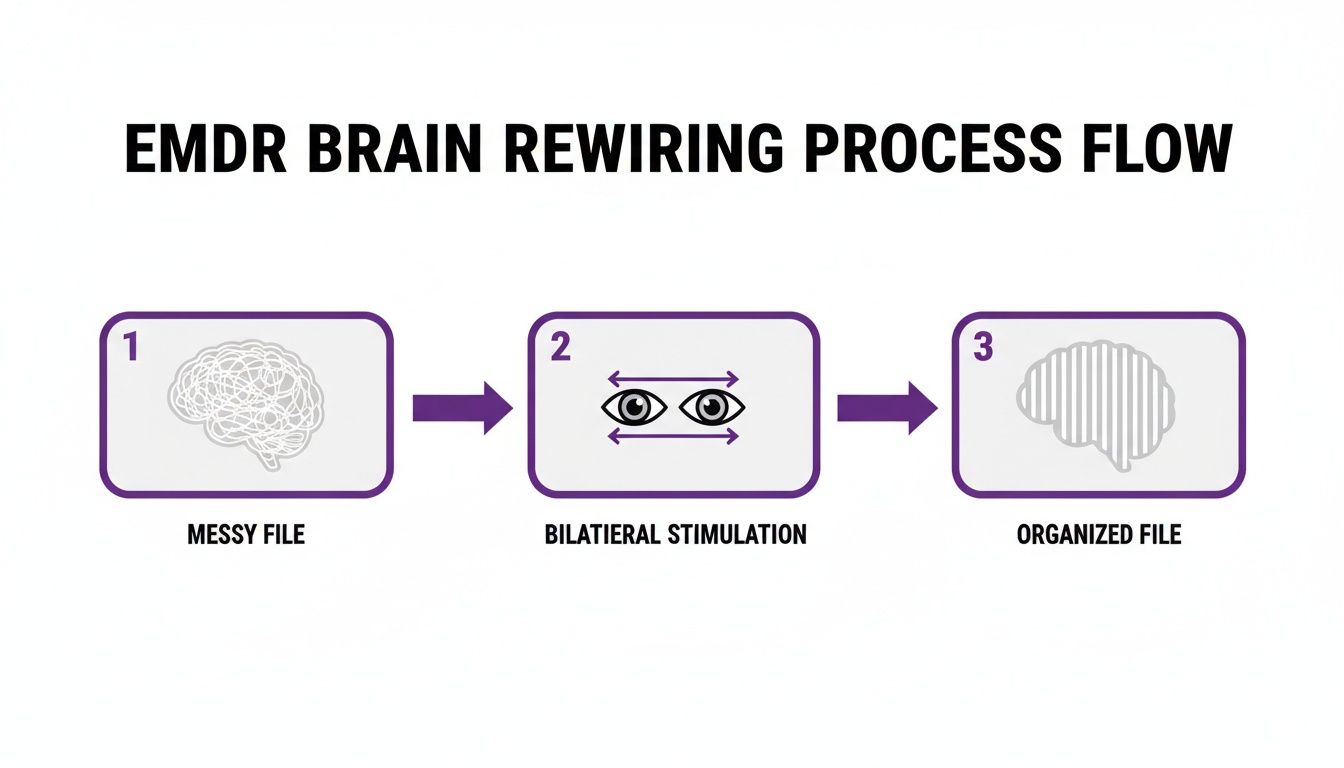
The image visualizes how the process, sparked by bilateral stimulation, can help the brain move from a chaotic state of unprocessed trauma to a calm, organized one where those memories no longer hold the same power.
Phases 1 and 2: Laying the Foundation
Your journey starts with Phase 1: History-Taking and Treatment Planning. This is far more than just paperwork; it’s where you and your therapist begin to build a trusting therapeutic relationship. You'll talk through your history and collaboratively identify the specific memories or negative beliefs you want to address.
From there, you move into Phase 2: Preparation. This phase is absolutely critical for success. Your therapist will teach you grounding techniques and coping skills to help you manage any strong emotions that might surface during the process. The entire point is to make sure you feel prepared and in control before you ever start the deeper work.
Phases 3 Through 6: The Core Reprocessing Work
With a solid foundation in place, the active reprocessing can begin. Phase 3: Assessment involves calling up the target memory. You’ll pinpoint a specific image connected to the memory, a negative belief you formed about yourself because of it, and the emotions and physical sensations that come with it.
Then comes Phase 4: Desensitization, which is where the bilateral stimulation (BLS) comes in. While you hold the memory in your mind, your therapist will guide you through sets of eye movements, gentle taps, or tones. This is the heart of the EMDR process, where the memory's emotional charge begins to fade.
Next up is Phase 5: Installation. Here, the focus shifts to strengthening a positive, healthier belief about yourself. You’ll work to replace the old negative thought with a new, empowering one, like "I am safe now" or "I am in control."
In Phase 6: Body Scan, you'll bring the original memory to mind again and check in with your body. The goal is to notice if any tension or discomfort remains. If anything is still there, your therapist will continue with more BLS until you feel clear and calm when thinking about the event.
At reVIBE Mental Health, our EMDR-trained therapists guide clients through these phases with expertise and compassion, ensuring each person feels secure. Whether you're at our Scottsdale or Tempe office, our goal is to create a safe space for this profound work.
Phases 7 and 8: Closing the Loop for Lasting Change
The final two phases are all about making sure your progress sticks. Phase 7: Closure takes place at the end of every reprocessing session. Before you head out, your therapist will walk you through grounding exercises to help you feel calm and present, leaving the intensity of the session behind.
Finally, Phase 8: Re-evaluation happens at the start of each new session. You and your therapist will review the progress you've made, check on memories you've already processed, and identify any new targets that have come up. This ongoing check-in ensures the healing is both thorough and lasting. It’s this complete, eight-phase structure that makes EMDR such a reliable and effective path toward moving beyond the past.
The Science Behind Why EMDR Is So Effective
At its heart, EMDR therapy is so effective because it works with the brain's own incredible ability to heal. The whole approach is built on something called the Adaptive Information Processing (AIP) model. Think of it this way: your brain has a natural system for taking in experiences, learning from them, and storing them as memories in a useful, healthy way.
But when something truly traumatic happens, this system can get completely overloaded. The memory doesn't get filed away properly. Instead, it gets stuck—frozen in time, complete with all the raw emotions, sounds, and physical sensations from the original event.
This is where the magic of bilateral stimulation (BLS) comes in. The side-to-side eye movements, alternating sounds, or gentle taps are thought to mimic what your brain does every single night during Rapid Eye Movement (REM) sleep. REM sleep is the brain's natural "filing" time, when it processes the day's events and sorts everything into your long-term memory.

Unlocking the Brain’s Natural Processing Center
By stimulating the brain in this REM-like way while you're fully awake, EMDR creates a unique state of “dual awareness.” You’re safe and present in the therapy room, but you're also able to access that stuck memory. This connection allows the frozen information to finally link up with the more logical, adaptive parts of your brain.
You're essentially giving your brain a second chance to digest what it couldn't handle at the moment the trauma occurred. The bilateral stimulation helps dial down the intense physical and emotional reaction tied to the memory, making it feel less immediate and overwhelming.
This process helps the memory travel from the limbic system (your brain’s alarm center) to the cortex (the part responsible for thought and reason). The memory is transformed from a raw, painful flashback into a cohesive story—something that happened in your past, but is no longer a threat in your present.
EMDR doesn't erase the memory; it simply files it away correctly. The memory's power to trigger distress is neutralized, allowing you to recall the event without reliving the trauma.
The Evidence Supporting EMDR's Effectiveness
The scientific community has put EMDR therapy under the microscope for years, and the results speak for themselves. Major health organizations, including the World Health Organization and the American Psychiatric Association, now endorse it as a top-tier treatment for trauma.
The research also shows just how efficient it can be. One landmark study found that an incredible 84%-90% of single-trauma victims no longer had PTSD after just three 90-minute sessions. Another study revealed that 100% of single-trauma victims and 77% of multiple-trauma victims were free of their PTSD diagnosis after only six sessions. These are remarkable outcomes, especially when compared to more traditional talk therapies. You can explore more on the benefits of EMDR to see the full scope of these findings.
This kind of rapid, lasting relief is exactly why clinicians at reVIBE Mental Health, from our Phoenix locations to our Scottsdale office, are trained in this powerful, evidence-based therapy. It offers a structured and scientifically-backed path to healing.
Who Is EMDR Therapy For?
When most people hear about EMDR, they immediately think of Post-Traumatic Stress Disorder (PTSD). And for good reason—it’s an incredibly effective treatment for it. But its reach extends far beyond that single diagnosis.
The real magic of EMDR is that it addresses the root cause of so many mental health challenges: distressing past experiences. When these events get stuck, they can create a ripple effect of negative beliefs and emotional patterns that mess with our daily lives.
EMDR gets right to the heart of the matter by targeting and reprocessing these foundational memories. It’s not about just managing symptoms; it’s about healing from the ground up. This makes it a powerful option for anyone whose present-day struggles feel connected to something that happened in their past.
It's Not Just About Big "T" Trauma
So many common struggles are fueled by unprocessed memories that keep our nervous systems stuck in high-alert mode. Think about it: that persistent social anxiety might trace back to a single moment of humiliation in school. A crippling phobia could have started with one frightening event.
EMDR can be a game-changer for a whole range of issues:
- Anxiety Disorders: This covers everything from generalized anxiety and panic attacks to social anxiety. By targeting the memories that fuel the fear, we can often find lasting relief. Our guide on EMDR therapy for anxiety goes into more detail on how this works.
- Phobias: Specific fears—like a fear of flying, needles, or public speaking—often have a clear origin story. EMDR can help neutralize the emotional charge of that original event.
- Chronic Pain: When physical pain is tangled up with psychological trauma, EMDR can help untangle them, often reducing the emotional distress that makes the pain feel so much worse.
- Grief and Loss: Sometimes grief feels stuck and overwhelming. EMDR can help process the more traumatic aspects of a loss, allowing for healthier grieving.
- Performance Anxiety: For athletes, artists, and public speakers, EMDR can help clear away the mental blocks left behind by past failures or high-stakes moments.
A Powerful Tool for Depression
EMDR is also gaining ground as a highly effective approach for depression, especially when traditional talk therapy or medication haven't quite done the trick. This is often because the depression is tied to underlying trauma that other treatments might not address directly.
By getting to these root causes, EMDR can lead to some pretty significant and lasting shifts. One study showed that for people with major depression, 55% achieved remission after EMDR treatment, and most of them stayed stable long-term. In some cases of chronic, treatment-resistant depression, people have seen a complete turnaround after just a few sessions. You can dig into the research yourself in this study on EMDR's effectiveness for depression.
Ultimately, a good candidate for EMDR is anyone who feels ready to gently and safely work through the past events that are holding them back today. If you're curious, our therapists at reVIBE Mental Health across Chandler, Phoenix, Scottsdale, and Tempe can help you figure out if this evidence-based therapy is the right next step for you.
What to Expect During Your First EMDR Session
It’s completely normal to feel a bit anxious or just plain curious before your first EMDR session. Let's pull back the curtain so you know exactly what to expect. The first appointment isn't about jumping into the deep end of a traumatic memory; it's all about building a solid, trusting foundation with your therapist.

Think of your therapist as a supportive guide for this journey. They’ll walk you through the entire process, making sure you feel comfortable and informed every step of the way. A big chunk of this first meeting covers the first two phases of EMDR: taking a detailed history and getting you prepared. Together, you'll pinpoint the specific memories or negative beliefs you want to work on.
Your Role and Your Therapist's Role
When it's time to begin the reprocessing work, you'll see how the mechanics of EMDR come to life. Your therapist will start what’s called bilateral stimulation. This most often involves you following their fingers back and forth with your eyes, but it can also be done with alternating sounds in headphones or gentle taps on your hands.
And your job? It's surprisingly straightforward. You simply let your mind go where it goes and notice whatever comes up. There’s no need to analyze, judge, or force anything. You just observe. This unique process allows your brain to do the heavy lifting and make its own healing connections.
One of the most important things to remember is that you are always in complete control. If things ever feel too intense, all you have to do is raise your hand to signal "stop." Your therapist will pause immediately, no questions asked.
Common Experiences and Closing the Session
As the bilateral stimulation continues, you might be surprised by what surfaces. It could be a sudden emotional shift, a new perspective on an old problem, or a memory you haven't accessed in years. This is all a normal and very productive part of the process. It's a sign that the "stuck" traumatic information is finally starting to link up with healthier parts of your memory network.
No EMDR session ever ends abruptly. Your therapist will always guide you through a grounding exercise to ensure you leave feeling stable and calm, not emotionally raw. The goal is to close the loop, so you can walk out of the session and get back to your day feeling safe and centered. This is where the skill of a great psychiatric mental health practitioner is so crucial—they know how to navigate this process safely and make sure you feel supported from start to finish.
Ready to Start Healing? Let's Talk.
Learning about EMDR is a great first step, but taking action is where real change happens. If you’ve read this far, chances are you’re curious about whether this powerful, evidence-backed therapy could be right for you. The compassionate team here at reVIBE Mental Health is ready to help you find out.
Our certified EMDR clinicians specialize in creating a safe, supportive space where you can finally process what’s been holding you back and start building the future you deserve.
We know that reaching out for help can feel like the hardest part. That’s why we make the logistics as simple as possible. Our team can quickly verify your insurance and get you scheduled for a consultation, so you can focus on what matters most—your healing.
You can learn more about our specific approach to trauma treatment and see how we create a plan that fits your unique needs.
Find a reVIBE Location Near You!
We currently have five locations for your convenience. (480) 674-9220
- reVIBE Mental Health – Chandler
3377 S Price Rd, Suite 105, Chandler, AZ - reVIBE Mental Health – Phoenix Deer Valley
2222 W Pinnacle Peak Rd, Suite 220, Phoenix, AZ - reVIBE Mental Health – Phoenix PV
4646 E Greenway Road, Suite 100, Phoenix, AZ - reVIBE Mental Health – Scottsdale
8700 E Via de Ventura, Suite 280, Scottsdale, AZ - reVIBE Mental Health – Tempe
3920 S Rural Rd, Suite 112, Tempe, AZ
Your Questions About EMDR Therapy, Answered
It's completely normal to have questions when you're thinking about a unique approach like EMDR therapy. Understanding how it all works can make a huge difference in feeling confident and ready to start.
We've pulled together some of the most common questions we hear from people just like you. Our goal is to give you clear, straightforward answers to help you decide if this is the right path for your healing journey.
Is EMDR a Form of Hypnosis?
That’s a great question, and one we get all the time. The short answer is no, it's not hypnosis.
In an EMDR session, you are always 100% awake, alert, and in control. You’re an active participant, fully aware of what’s happening. Think of your therapist as a guide sitting beside you, but you're the one steering the ship. With hypnosis, the goal is to enter a trance-like state, but EMDR keeps you grounded in the present moment.
How Long Does EMDR Therapy Take?
Everyone's journey is unique, but one of the things that stands out about EMDR is that it can often work faster than traditional talk therapy. The timeline really depends on your personal history and what you're hoping to address.
For a single, specific event—like a car accident or a frightening medical procedure—it’s not unusual for people to feel a significant shift in just 3-6 sessions. For more complex or long-term trauma, it will naturally take a bit longer to work through all the connected memories.
A key advantage of EMDR is its efficiency. By directly targeting the way a memory is stored, it can resolve long-standing issues without the need for years of therapy, helping you feel better, faster.
Are There Any Side Effects?
It's possible to notice some temporary effects between sessions, and that's actually a good sign. As your brain continues to process the memories, you might experience more vivid dreams, a surge of emotion, or sudden new insights.
This just means the healing is still happening—your brain is hard at work. Your therapist will make sure you have plenty of grounding techniques and coping skills (from Phase 2) to manage anything that comes up. These side effects are almost always temporary and ease up once the memory is fully processed.
Do I Have to Describe My Trauma in Detail?
This is a huge relief for many people: No, you do not have to talk about your trauma in exhaustive detail. You won't be asked to verbally relive the entire event over and over again, which can be re-traumatizing in itself.
While your therapist needs to know which memory you're targeting, the real healing comes from your brain’s own internal processing, kickstarted by the bilateral stimulation. This makes EMDR a powerful option for anyone who finds it too painful to talk about their experiences but is deeply ready to heal from them.
If you're ready to explore how EMDR can help you process the past and build a more peaceful future, the compassionate team at reVIBE Mental Health is here to guide you. Our certified clinicians specialize in creating a safe and supportive environment for your healing journey. Take the first step by visiting us at https://revibementalhealth.com to schedule a consultation.