

So, what really happens behind the closed doors of a marriage therapist's office? If you're picturing a referee blowing a whistle on your arguments, you can relax. The simplest way to think about it is a guided conversation in a safe space. It’s not a courtroom for figuring out who's "right" and who's "wrong," but more like a workshop where you and your partner learn new tools for communication, conflict resolution, and rebuilding intimacy with a trained professional guiding you.
Your First Step Into Couples Counseling
Walking into that first therapy session can feel like a huge step into the unknown. It’s completely normal to feel a mix of hope and nervousness. A lot of couples worry that needing therapy is a sign of failure or that it’s the last stop before calling it quits.
But I encourage you to see it differently. Choosing therapy is a proactive, courageous move to strengthen your relationship. Think of it like hiring a skilled guide to help you both navigate a really tough part of the trail you’re on together.
The goal isn't to point fingers or assign blame. A good therapist creates a neutral space where you can both finally feel heard and understood—sometimes for the first time in a long, long time. The whole point is to help you break free from those frustrating, repetitive fights that leave you both feeling completely stuck.
The Core Goals of Marriage Therapy
Most couples therapy journeys focus on three core goals. Each one builds on the last, moving you from just understanding the problem to actively creating a better future together.
- Identify Negative Patterns: First, your therapist will help you see the "dance" you two are stuck in—those recurring cycles of conflict that trap you. It’s all about recognizing the what and why behind your arguments.
- Learn Practical Skills: This is where the work really begins. You’ll learn proven techniques for communicating and solving problems. These aren't just abstract ideas; they are real, tangible tools you can use to stop a fight from escalating and actually express what you need in a way your partner can hear.
- Build a Stronger Connection: Ultimately, the aim is to rebuild that feeling of emotional intimacy and trust. Therapy guides you in creating new, positive ways of interacting that remind you why you chose each other in the first place.
This process is designed to move you from insight to action, and finally, to a renewed sense of partnership.
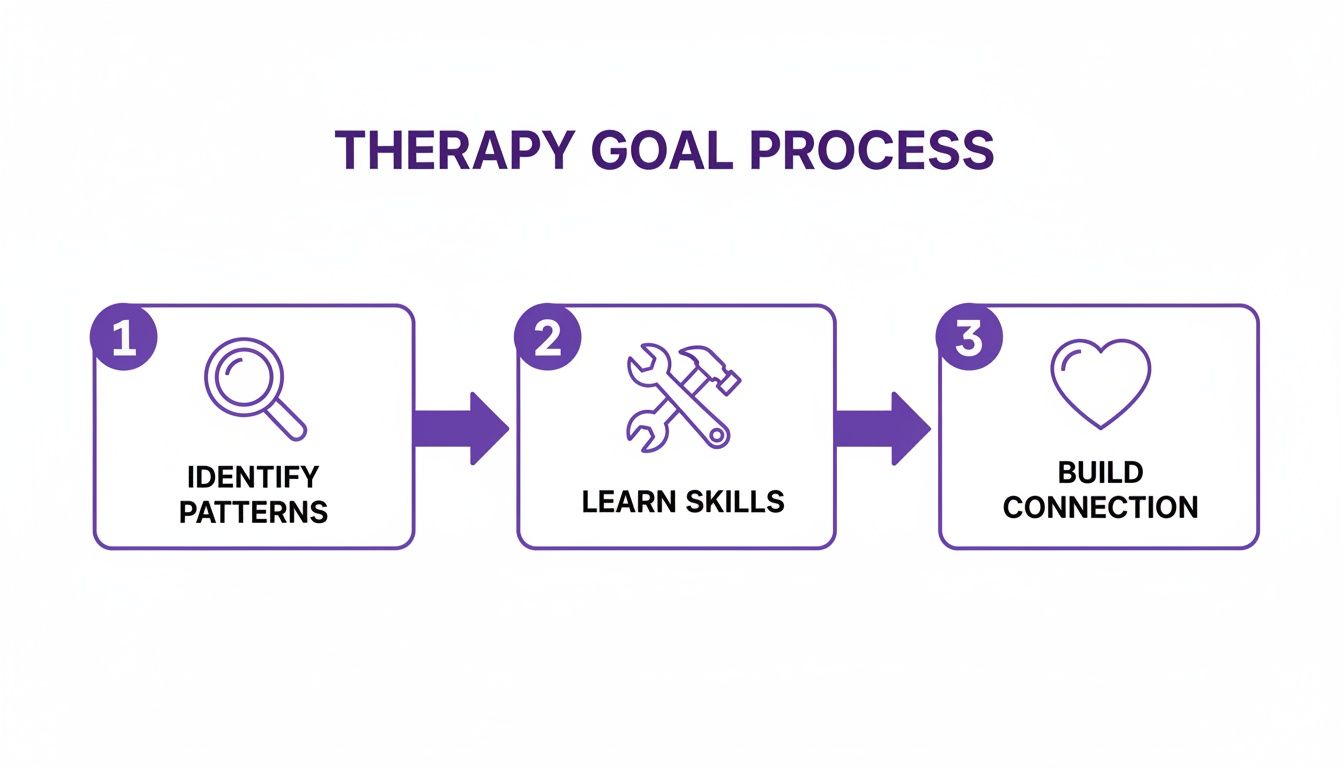
This simple framework shows that therapy isn't just about venting week after week. It's a strategic process designed to create real, lasting change in your relationship.
To give you a clearer picture, here’s a quick summary of what the journey often looks like from start to finish.
Your Marriage Therapy Journey at a Glance
| Therapy Stage | What You Can Expect |
|---|---|
| The First Few Sessions | A lot of information-gathering. Your therapist will learn about your history as a couple, the main issues, and what you both hope to achieve. You'll set some initial goals. |
| The Middle Phase | This is the "work" phase. You'll be actively learning and practicing new communication skills, exploring deeper issues, and challenging old patterns right there in the session. |
| The Later Stages | The focus shifts to solidifying your progress. You’ll work on handling future conflicts on your own and begin to phase out your sessions as you feel more confident in your new skills. |
| "Graduation" & Maintenance | You’ll have a final session or two to review how far you've come. Some couples schedule periodic "check-in" appointments every few months to keep their progress on track. |
Every couple's path is a little different, but this gives you a general roadmap for the process.
Feeling nervous before that first appointment is completely okay. In fact, it’s a good sign—it means you care deeply about your relationship and are truly invested in making it better. Remember, your therapist is an ally for your partnership, dedicated to helping you both find a healthier, happier way forward.
Navigating Your First Marriage Therapy Session
Walking into that first therapy session can feel like the biggest hurdle. It’s completely normal to have a knot in your stomach, a mix of nerves and maybe even a little hope. The good news? Your therapist’s number one job is to create a safe, non-judgmental space where both of you feel heard and respected from the get-go.
Think of this first meeting less like an interrogation and more like a structured orientation. Your therapist is there to be a neutral guide, setting the foundation for the work you'll do together.

What Will the Therapist Cover First?
Before getting into the heavy stuff, your therapist will take care of some important housekeeping. This is all about making the process transparent so there are no surprises down the line.
You can expect them to clearly explain a few key things:
- Confidentiality: They'll go over the strict privacy rules that protect everything you share. This creates that secure container you need for an honest conversation.
- Their Therapeutic Approach: Your therapist will give you a quick rundown of their professional style and the methods they often use, whether that’s the Gottman Method, Emotionally Focused Therapy (EFT), or something else.
- Session Structure: They’ll give you an idea of what a typical session looks like, how long it lasts, and how often you'll meet.
This initial chat gets everyone on the same page and helps take the mystery out of the process, making it all feel much more manageable.
The Heart of the First Conversation
Once the framework is in place, the focus will shift to your unique story as a couple. The therapist will start asking questions to get a 360-degree view of your relationship—your history, the problems that brought you in, and what each of you hopes to get out of this.
This isn’t about pointing fingers or figuring out who's to blame. It’s a fact-finding mission to help the therapist understand the dynamics at play.
Your therapist’s role is not to be a referee who decides who is right or wrong. Instead, they act as a "relationship consultant," helping you both identify the unhealthy patterns that keep you stuck and guiding you toward more effective ways of relating to each other.
This collaborative mindset is absolutely fundamental to making progress.
Will You Have Individual Sessions?
It's very common for a therapist to schedule one individual session with each partner within the first few appointments. If this happens, don't worry—it’s not about taking sides or digging for secrets.
This is actually a crucial step that allows the therapist to get an unfiltered look at each person's perspective, history, and experience in the relationship. It gives you a chance to speak freely about your personal feelings and background without your partner in the room. These individual insights help the therapist build a much more accurate and complete roadmap for your work together.
To feel more confident and calm before your first appointment, you might find it helpful to learn more about how to prepare for your first therapy session.
By the time you walk out of that first meeting, you should have a good sense of the therapist's style, a feeling of being understood, and a rough idea of the plan ahead. You’ve taken the biggest step. Now you’re on your way.
Proven Techniques Used in Couples Therapy
A lot of people think couples therapy is just about venting or having a refereed argument. That couldn't be further from the truth. Real, effective therapy isn't an unstructured conversation; a skilled therapist uses specific, evidence-based methods to help you create lasting change.
Think of these techniques as a strategic toolkit. They give us a framework to get to the root cause of your conflicts and, more importantly, start rebuilding a stronger connection. Once you understand a little about how it works, the whole process feels a lot less mysterious.
Two of the most well-respected and effective models you'll encounter are the Gottman Method and Emotionally Focused Therapy (EFT). Each offers a unique but powerful way to look at and repair your relationship. Knowing the "why" behind your therapist's approach can make a huge difference in how engaged and empowered you feel.
The Gottman Method: Spotting and Fixing Negative Patterns
Developed by Drs. John and Julie Gottman, this method is the result of decades of research watching thousands of couples interact. It’s like a science-backed blueprint for what makes relationships thrive or fail. The focus is on tangible behaviors and communication skills that are either building you up or tearing you down.
A cornerstone of this approach is identifying what the Gottmans famously call the “Four Horsemen of the Apocalypse.” These are four communication habits that are huge predictors of a breakup if they go unchecked.
- Criticism: This isn’t just a complaint; it’s an attack on your partner's character. "I'm feeling overwhelmed and need help with the dishes" is a complaint. "You never help around the house because you're lazy" is criticism. See the difference?
- Contempt: This one is the most corrosive. It's sarcasm, name-calling, eye-rolling, or any kind of mockery. Contempt sends a message of disgust and superiority, and it's poison to a relationship.
- Defensiveness: We all do this. It’s that knee-jerk reaction to feeling attacked where you make excuses, flip the blame ("Well, you didn't take out the trash!"), or play the victim. It just escalates the fight.
- Stonewalling: This is when one partner completely shuts down and withdraws from the conversation. It might look like the silent treatment or physically leaving the room, making it impossible to resolve anything.
A Gottman-trained therapist will help you spot these "horsemen" as they show up in your arguments and teach you the specific antidotes to replace them with healthier, more respectful ways of communicating.
Emotionally Focused Therapy: Rebuilding Your Emotional Bond
While the Gottman Method zeroes in on behaviors, Emotionally Focused Therapy (EFT) goes a layer deeper to the emotions that drive those behaviors. Developed by Dr. Sue Johnson, EFT is grounded in attachment theory—the fundamental human need to feel securely connected to the people we love.
EFT helps you see the negative cycle you're stuck in. I often describe it to clients as a destructive dance you do over and over. One partner's move triggers a reaction in the other, which in turn triggers another reaction, and around you go. For example, one person might feel disconnected and protest by becoming critical (which is really a desperate bid for attention), causing their partner to withdraw to avoid a fight. This withdrawal then confirms the first partner's fear of being abandoned, and the cycle gets worse.
An EFT therapist guides you through three main stages:
- De-escalate the conflict by helping you both see and name this negative dance.
- Restructure your interactions by helping you share the vulnerable feelings (like fear, loneliness, or shame) hiding beneath the anger or silence.
- Consolidate your progress by creating new, positive patterns that build a secure and lasting bond.
These aren't just feel-good theories; the data backs them up. Statistically, 70-80% of couples who commit to proven models like Emotionally Focused Therapy (EFT) or the Gottman Method see significant, lasting improvements. We're talking deeper intimacy, fewer explosive fights, and a genuine feeling of reconnection.
Developed by Dr. Sue Johnson in the 1980s, EFT is particularly powerful, with studies showing 70-75% full recovery rates and 90% significant improvement for distressed couples. It works by repairing the hidden attachment wounds that make you feel unseen or unloved. Meanwhile, the Gottman approach, which targets those "Four Horsemen" of conflict, shows a 70-75% success rate in helping couples maintain their progress even 18 months later. You can discover more about the impressive success rates of these counseling methods.
Putting in the Work Between Your Sessions
While your weekly therapy session is the strategic huddle, the real game is played in your day-to-day life. Think about it: one hour a week just isn't enough time to undo years of ingrained habits and emotional reflexes. The biggest breakthroughs rarely happen on the therapist’s couch; they happen in the kitchen on a Tuesday morning or during a tense car ride on Friday.
This is where therapeutic "homework" comes in. I like to think of a therapist as a personal trainer for your relationship. We can give you the workout plan, demonstrate the correct form, and cheer you on. But to actually build that relational muscle, you have to do the reps during the week. Completing these assignments is what turns fragile insights into gut-level instincts.

What Does Therapy Homework Look Like
First off, therapy assignments aren’t like the schoolwork you’re used to—there’s no grading! These are practical, real-world applications of the skills you’re discussing in session. Each task is customized to your specific goals and designed to speed up your progress by reinforcing new, healthier behaviors.
Here are some common examples of what you might practice between sessions:
- Communication Drills: You might work on "soft start-ups" to bring up a complaint gently, or practice using "I statements" to share your feelings without accidentally blaming your partner.
- Structured Check-Ins: A therapist might ask you to carve out 10-15 minutes each day to talk about anything except logistics (like bills or schedules), focusing only on connecting with each other.
- Reflective Journaling: Sometimes, you'll be asked to individually write down your thoughts after a disagreement. This isn't about proving who was right; it's about better understanding your own triggers and emotional reactions.
- Intentional Connection: This could be as simple as scheduling a non-negotiable weekly date night or practicing a six-second hug every day to start rebuilding physical intimacy and affection.
These exercises are designed to empower you both to be the primary agents of change in your relationship. Beyond structured tasks, simply finding new, shared activities can also elevate your love life and create positive memories outside the therapy room.
Why Committing to the Work Is Crucial
Honestly, fully engaging with these assignments is often the single biggest predictor of success in couples therapy. The effort you put in between your appointments directly correlates to how quickly and how much you'll improve.
It’s a tough reality that many couples wait far too long to seek help, letting small frustrations fester into major crises.
Research shows that, on average, unhappy partners wait six years after problems begin before they seek counseling. By then, fixable issues have often become entrenched battles. The good news? Once couples start, the results are promising: about 75% of couples report significant improvements in their relationship. While success rates were closer to 50% back in the 1980s, today that number has climbed to 70%. Committing to the entire process—especially the work between sessions—is what puts you in that successful majority.
When you practice these new skills at home, you're doing more than just following instructions. You are actively building a new, healthier dynamic, brick by brick. This is how you move from just knowing what to expect in marriage therapy to truly experiencing the positive changes it can bring to your life together.
Recognizing Real Progress in Your Relationship
So, how do you know if all this therapy stuff is actually working? It's easy to hope for a magic wand that instantly ends every argument, but real progress is usually quieter and much deeper than that. The goal isn’t a "perfect" relationship free of conflict. It’s about building a partnership that feels resilient, deeply connected, and emotionally safe for both of you.
Success isn't measured by the absence of fighting. It's about a fundamental change in how you handle those disagreements when they pop up. Think of it like learning to dance together. At first, you're clumsy, stepping on each other's toes. But with practice, you start to move in sync, anticipating each other's steps and navigating the turns with grace—even when the music gets complicated.
This shift appears in small, meaningful ways long before the big issues feel "solved." Noticing and celebrating these little wins is what keeps you going and reminds you that you're building something better, together.
From Blame Game to Genuine Curiosity
One of the first and most powerful signs that things are improving is when the blame game starts to fade. Instead of fixating on who’s right and who’s wrong, you find yourselves getting curious about where the other person is coming from. You start to see your partner not as an opponent, but as a person who's just trying to get their needs met—same as you.
This might look like:
- Shifting your language: "You always…" becomes "I feel…" This tiny change can stop a fight in its tracks because you're talking about your own experience, not attacking their character.
- Really listening: Instead of just reloading for your rebuttal, you actually start hearing the feelings behind their words.
- Validating their feelings: You learn to say things like, "I can see why you feel hurt." You don't have to agree with their version of events to acknowledge that their emotions are real.
This growing empathy is the foundation of a healthier connection. It’s the difference between feeling like you’re on opposing teams and remembering you’re both on the same side, figuring out the problem together.
Getting Better at Fighting (and Making Up)
Another huge win is when you notice you can stop a fight from spiraling out of control. That familiar, painful loop that used to go on for hours—or even days—starts getting cut short. You get better at spotting the warning signs, like a raised voice or a defensive shutdown, and you consciously choose to do something different.
Even more important is your ability to repair the damage afterward. Let's be real: every couple fights. The ones who make it are the ones who know how to find their way back to each other. A good repair isn’t about pretending nothing happened. It's about owning the hurt and intentionally rebuilding the connection.
The goal isn’t to eliminate conflict. That's impossible. The real measure of success is how quickly you can bridge the gap between disconnection and reconnection. It’s about building that bridge back to each other, faster and stronger each time.
The Everyday Signs of a Stronger Bond
As therapy progresses, you’ll start seeing positive changes bleed into your daily life, far away from any talk about conflict. These are often the most rewarding signs that your hard work is paying off.
You might notice:
- More spontaneous affection—a random hug, a hand squeeze while you're driving.
- Genuine laughter and more inside jokes making a comeback.
- A renewed sense of being a team, cheering each other on in your individual pursuits.
And the data backs this up. Around 70% of couples who stick with therapy report a big boost in relationship satisfaction. What’s more, 90% of those who work with well-trained therapists say their overall emotional health has improved. Couples who commit to at least 12 sessions are far more likely to see changes that last, with 66% showing improvement within 20 sessions. You can read more about the positive outcomes of couples counseling from well-researched studies.
Learning to spot these markers helps you see the progress you're making in real-time. To explore this a bit more, take a look at our guide on how to know if therapy is working.
Finding the Right Therapist in the Phoenix Area
Of all the factors that determine whether couples therapy will work, the connection you have with your therapist is arguably the most important. It’s what we call the therapeutic alliance, and it’s the bedrock of any real progress. You’re not just looking for qualifications on a wall; you’re looking for a guide you both genuinely trust and feel comfortable with.
So, how do you find that person? It helps to break it down into a few manageable steps. A great starting point is figuring out your insurance benefits to see what’s covered. From there, you can start looking for therapists who specialize in working with couples—specifically those with training in well-researched methods like the Gottman Method or Emotionally Focused Therapy (EFT). This specialized experience really does make a difference.
Ultimately, though, it comes down to fit. When you sit in the room with them, do you both feel seen and respected? A good therapist creates a space that feels safe enough for you both to be completely honest, without fear of judgment.
Find a reVIBE Location Near You!
We currently have five locations for your convenience. (480) 674-9220
- reVIBE Mental Health – Chandler
3377 S Price Rd, Suite 105, Chandler, AZ - reVIBE Mental Health – Phoenix Deer Valley
2222 W Pinnacle Peak Rd, Suite 220, Phoenix, AZ - reVIBE Mental Health – Phoenix PV
4646 E Greenway Road, Suite 100, Phoenix, AZ - reVIBE Mental Health – Scottsdale
8700 E Via de Ventura, Suite 280, Scottsdale, AZ - reVIBE Mental Health – Tempe
3920 S Rural Rd, Suite 112, Tempe, AZ
Making Your Next Step Simple
If you’re in the Phoenix metro area, we at reVIBE Mental Health aim to be that safe space for your relationship. Our whole goal is to make the path back to each other feel as clear and supported as possible.
We've built our practice around a few simple ideas:
- A Welcoming Environment: We’ve designed our offices to feel more like a comfortable living room than a sterile clinic, so you can feel relaxed from the moment you walk in.
- Flexible Scheduling: We know life is complicated. That’s why we offer appointments seven days a week—we’ll work with your schedule, not against it.
- Expert Care: Our therapists are dedicated professionals who are truly passionate about helping couples rebuild and grow.
Getting started shouldn't feel like another chore. We’re here to walk you through everything, from checking your insurance to matching you with a therapist who fits your specific situation. You’re never on your own in this process. For more local advice, our guide to couples counseling near you is a great resource.
Finding the right therapist is about more than just credentials. It's about finding a partner in your healing process—someone who can hold hope for your relationship even when you feel like you can't. This alliance is what transforms therapy from a series of conversations into a truly powerful experience.
When you’re ready to take that first step, just give us a call at (480) 674-9220.
Answering Your Biggest Questions About Marriage Therapy
Deciding to start couples therapy is a huge step, but it often brings a wave of "what ifs." These nagging questions and worries can be strong enough to keep you from seeking the very help that could bring you and your partner back together. Let's tackle these common concerns head-on, clear away the unknowns, and make the path forward feel a lot less intimidating.
"What If My Partner Won't Go?"
This is easily one of the most common and painful roadblocks. You're ready to dive in and do the work, but your partner is digging their heels in. It’s true that therapy works best when both people are in the room, but that doesn't mean all hope is lost if they aren't.
Starting therapy on your own, specifically to work on relationship issues, can still make a massive difference. You can learn to:
- Shift your own communication patterns and how you react during conflict.
- See your own role in the frustrating cycles you both get trapped in.
- Set healthier boundaries for your own well-being.
Think of your relationship as a dance. If one person changes their steps, the old routine simply can't continue in the same way. Your personal growth and the positive changes you make might just be the thing that encourages your partner to see the value in the process and decide to join you.
"Are Our Problems Really Bad Enough for Therapy?"
So many couples fall into this trap, wondering if their issues are severe enough to warrant professional help. It's easy to downplay our own struggles or feel like we should be able to figure things out on our own.
Here's a helpful way to think about it: You wouldn't wait for your car's engine to completely blow up before getting an oil change. Proactive maintenance is key. The same goes for your relationship.
Addressing recurring arguments, a growing emotional distance, or a breakdown in communication early on is always the smartest move. Waiting until you're in a full-blown crisis just makes the repair work that much harder. Therapy is a valuable tool at any stage, whether you're healing deep wounds or just want to tune up your communication skills.
"Will Our Insurance Cover It?"
This is a practical question that deserves a straight answer, even if navigating insurance feels like a maze. Coverage for couples counseling really depends on your specific plan and the primary reason you're seeking therapy.
Often, insurance will cover sessions if one partner has a diagnosable mental health condition (like anxiety or depression) that is being made worse by the relationship stress. The absolute best first step is to call the member services number on the back of your insurance card. Be sure to ask about your benefits for "family therapy" or "conjoint psychotherapy" to get a clear picture of what your plan covers.
"What If Therapy Just Makes Things Worse?"
This is a deep-seated and totally valid fear. It's true that therapy requires you to talk about painful subjects and dig up things you may have been avoiding. For a little while, it can definitely feel like things are getting worse before they get better.
But a skilled therapist doesn't bring these issues up to create more chaos. They create a safe, structured space where you can finally address the problems that have been festering under the surface. This temporary discomfort is part of the process—it's what allows you to move toward real, long-term healing and build a much stronger, more honest foundation for the future.
If any of these questions hit home, please know you're not alone. The first step is always the hardest, but you don't have to take it by yourself. The team at reVIBE Mental Health is here to offer a welcoming, non-judgmental space for you and your partner to reconnect and grow. Find out how we can help by visiting us at https://revibementalhealth.com.