

If you're wondering whether insurance covers EMDR, you can breathe a little easier. The short answer is: yes, in most cases.
Eye Movement Desensitization and Reprocessing (EMDR) isn't some experimental, fringe therapy. It’s a well-respected, evidence-based treatment, which means major insurance providers typically cover it as a medically necessary service for diagnosed conditions like PTSD.
Yes, EMDR Is Often Covered by Insurance

This is great news if you’re considering EMDR, because it means you likely won’t have to shoulder the full cost yourself. Insurance companies see EMDR for what it is—an effective, mainstream form of psychotherapy, not an alternative treatment. That recognition is the key to getting your sessions approved.
Think about it from an insurer's perspective: when a treatment is proven to work, they are far more willing to pay for it. Prestigious organizations like the American Psychological Association and the Department of Veterans Affairs endorse EMDR, which gives it the credibility needed for insurance approval. In their eyes, an EMDR session is often treated just like any other standard talk therapy session.
Understanding Your Plan's Coverage
Now, "covered" doesn't automatically mean "free." Your out-of-pocket costs will still depend on the fine print of your specific plan—things like your deductible, copayments, and coinsurance. The important part is that the service itself is recognized as legitimate. You can learn more about the specifics of EMDR therapy and its process to see if it’s the right fit for you.
To give you a better idea of what to expect, let's break down how coverage generally works across different types of insurance plans.
The most important step is confirming that EMDR is considered a "medical necessity" for your diagnosed condition. A qualified therapist can provide the necessary documentation to establish this with your insurance provider.
EMDR Insurance Coverage at a Glance
This table provides a quick reference to help you get a sense of what to expect based on the type of insurance plan you have.
| Insurance Plan Type | Typical EMDR Coverage Likelihood | Key Considerations |
|---|---|---|
| PPO Plans | High | Gives you the flexibility to see in-network or out-of-network providers, though costs will differ. |
| HMO Plans | High (In-Network) | Coverage is usually strong, but you must stick with therapists within your plan's network. |
| Medicare | Generally Covered | Part B typically covers outpatient mental health services like EMDR when deemed medically necessary. |
| Medicaid | Varies by State | While most state Medicaid programs cover EMDR, the specific rules and number of available providers can vary widely. |
While this gives you a starting point, remember that your individual plan holds the final say. Always verify your benefits directly.
Why Your Insurance Company Will Likely Pay for EMDR
When you discover a powerful, life-changing therapy like EMDR, it's totally normal to ask the big question: "Will my insurance actually cover this?" Thankfully, the answer is usually yes. The reason is pretty simple: EMDR has a rock-solid reputation for getting results.
Insurance companies are all about evidence. Before they'll open their wallets for any treatment, they need solid proof that it's effective and widely accepted by the medical community. EMDR passes this test with flying colors. It’s not some new, experimental fad; it's a well-established psychotherapy with decades of research and backing from the biggest names in healthcare.
It's All About Credibility and Proof
Think of it this way: EMDR has received the ultimate stamp of approval from the most respected authorities in mental health. When organizations like the American Psychological Association (APA) and the Department of Veterans Affairs (VA) give a therapy their blessing as a first-choice treatment, insurance providers take notice.
These endorsements are the clinical proof they need to classify EMDR as a medically necessary service for treating conditions like PTSD. This is the green light for coverage.
It's why most major private insurers in the United States cover EMDR therapy. Aetna, for example, is one of the country's largest insurance providers, and their clinical policies specifically state that EMDR is a medically necessary treatment for PTSD. You can even read their detailed policy bulletin to see exactly how they view it.
A Simple, Standard Billing Process
Here’s another big piece of the puzzle: how EMDR is actually billed. You might think a specialized therapy requires a complicated, unique billing code, but that’s not the case at all. Therapists use the exact same standard CPT (Current Procedural Terminology) codes that they use for any other individual therapy session.
Common CPT Codes for Therapy Sessions:
- 90834: The code for a 45-minute individual psychotherapy session.
- 90837: The code for a 60-minute individual psychotherapy session.
This is a bigger deal than it sounds. It means that when a claim comes in, the insurance company's system sees an EMDR session just like it would a standard talk therapy session. There are no special hoops to jump through or administrative red tape to cut.
Because EMDR fits so seamlessly into the existing billing system, it becomes an easy "yes" for most insurance plans, as long as it's being used to treat a covered diagnosis. This straightforward approach is why the question "is EMDR covered by insurance" so often has a positive answer. The combination of proven effectiveness and a hassle-free billing process makes insurers confident in paying for it.
How Different Insurance Plans Handle EMDR
Not all insurance plans are created equal, and your coverage for Eye Movement Desensitization and Reprocessing (EMDR) therapy really depends on the kind of plan you have. Think of it like a roadmap; different routes can get you to the same destination, but the tolls and rules of the road change along the way. Getting a handle on your specific plan is the key to navigating the costs without any surprise bills.
The insurance world basically breaks down into a few main categories, each with its own rulebook for mental health services like EMDR. Whether you've got a private plan through your job or a public one like Medicare, the details really matter.
Private Insurance Plans: HMOs vs. PPOs
Most of us get health insurance through an employer, which usually means having either an HMO or a PPO. While both typically cover EMDR, they work very differently, especially when it's time to pick a therapist. This choice is what directly drives your out-of-pocket costs.
- HMO (Health Maintenance Organization) Plans: With an HMO, you have to use therapists who are in-network. An in-network provider is one who has a contract with your insurance company, agreeing to their set rates. Your coverage is usually pretty solid, but your choices are limited to their pre-approved list of clinicians.
- PPO (Preferred Provider Organization) Plans: PPOs give you a lot more freedom. You can see both in-network and out-of-network therapists. You'll always pay less for an in-network provider, but a PPO gives you the option to see any licensed EMDR therapist you feel is the right fit, even if it means paying a bit more out of your own pocket.
Just knowing whether you have an HMO or a PPO is the first big step in figuring out if the therapist you want to see is a realistic financial option.
Public Insurance Plans: Medicare and Medicaid
Public insurance plans also cover EMDR, but they follow a different set of federal and state regulations. For millions of people, these plans are the only way to get the mental health support they need.
Medicare typically covers outpatient mental health services, including EMDR, under Part B. As long as a licensed provider who accepts Medicare agrees that the therapy is medically necessary, you should be covered. You’ll still have to meet your annual Part B deductible and then pay your 20% coinsurance for each session.
Medicaid coverage for EMDR is decided at the state level. The good news for Arizonans is that Medicaid plans here do cover EMDR therapy. The tricky part can sometimes be finding an in-network provider who has openings. Because the rules and payment rates vary, it's always best to check directly with your specific state Medicaid office or find a provider who already knows the ins and outs of your plan.
The Bottom Line: Your insurance plan—whether it’s a flexible PPO, a structured HMO, Medicare, or Medicaid—sets the rules for how you can access and pay for EMDR. Understanding these rules from the start puts you in the driver's seat.
To make things clearer, let's break down how these plans stack up against each other.
Comparing EMDR Coverage by Plan Type
| Feature | Private/Commercial Plans (PPO/HMO) | Medicare | Medicaid |
|---|---|---|---|
| Provider Choice | PPO: In-network & out-of-network. HMO: In-network only. | Must use a provider who "accepts assignment" with Medicare. | Must use a provider enrolled with the state's Medicaid program. |
| Referral Needed? | HMO: Yes, usually from a Primary Care Physician (PCP). PPO: No. | No, a referral is not required for outpatient mental health. | Varies by state; some may require a referral from a PCP. |
| Pre-authorization | Often required, especially after an initial set of sessions. | Generally not needed for standard outpatient therapy sessions. | Frequently required to prove medical necessity before starting. |
| Typical Costs | Co-pays, deductibles, and co-insurance. Out-of-network costs are higher. | Annual Part B deductible, then 20% co-insurance per session. | Very low or $0 cost for covered services if you meet state criteria. |
This table gives you a bird's-eye view, but always remember to confirm the specifics of your own policy.
The Rise of Telehealth EMDR Coverage
Thankfully, insurance providers have kept up with the times. Today, most insurance plans that cover in-person EMDR sessions will also cover telehealth EMDR sessions. This shift has made treatment accessible to so many more people, letting you connect with a qualified therapist right from your own home.
If you're in Arizona, reVIBE Mental Health offers telehealth sessions from our locations in Chandler, Scottsdale, and across the Phoenix area. We can help you sort through your benefits and confirm your coverage for virtual care.
Overcoming Common Insurance Roadblocks
Getting a denial from your insurance company is frustrating, to say the least. But it’s almost never the end of the road. Think of it less as a final "no" and more as a temporary roadblock—one you can navigate with the right information and a clear plan.
Most of the time, claims get denied for simple administrative reasons, not because the insurance company has a problem with EMDR itself. It could be something as straightforward as a missing pre-authorization or an issue with your provider being out-of-network. The good news? These are fixable problems.
Navigating Pre-Authorizations and Denials
A pre-authorization is basically your insurer’s green light to start treatment. Many health plans require it to make sure the therapy is medically necessary for your specific diagnosis. If you get a denial because you didn't get one first, don't panic.
Here’s what you can do:
- Read the Denial Letter: Take a close look at the Explanation of Benefits (EOB) they send you. It will spell out exactly why they denied the claim.
- Talk to Your Therapist: Your therapist is your biggest advocate in this process. They can pull together the clinical notes and documentation needed to show why the treatment is essential for you.
- Submit the Pre-Authorization: With your therapist's help, formally submit the request, making sure it includes your diagnosis and a clear treatment plan.
If the denial is for another reason, you have the right to appeal. This is a formal process where you ask the insurer to take a second look at their decision, and you’ll want to back it up with strong evidence from your therapist. Working with an experienced psychiatric mental health practitioner can make a huge difference in building a solid case for your appeal.
This flow chart gives a bird's-eye view of the process for getting EMDR covered, whether you have private insurance, Medicare, or Medicaid.
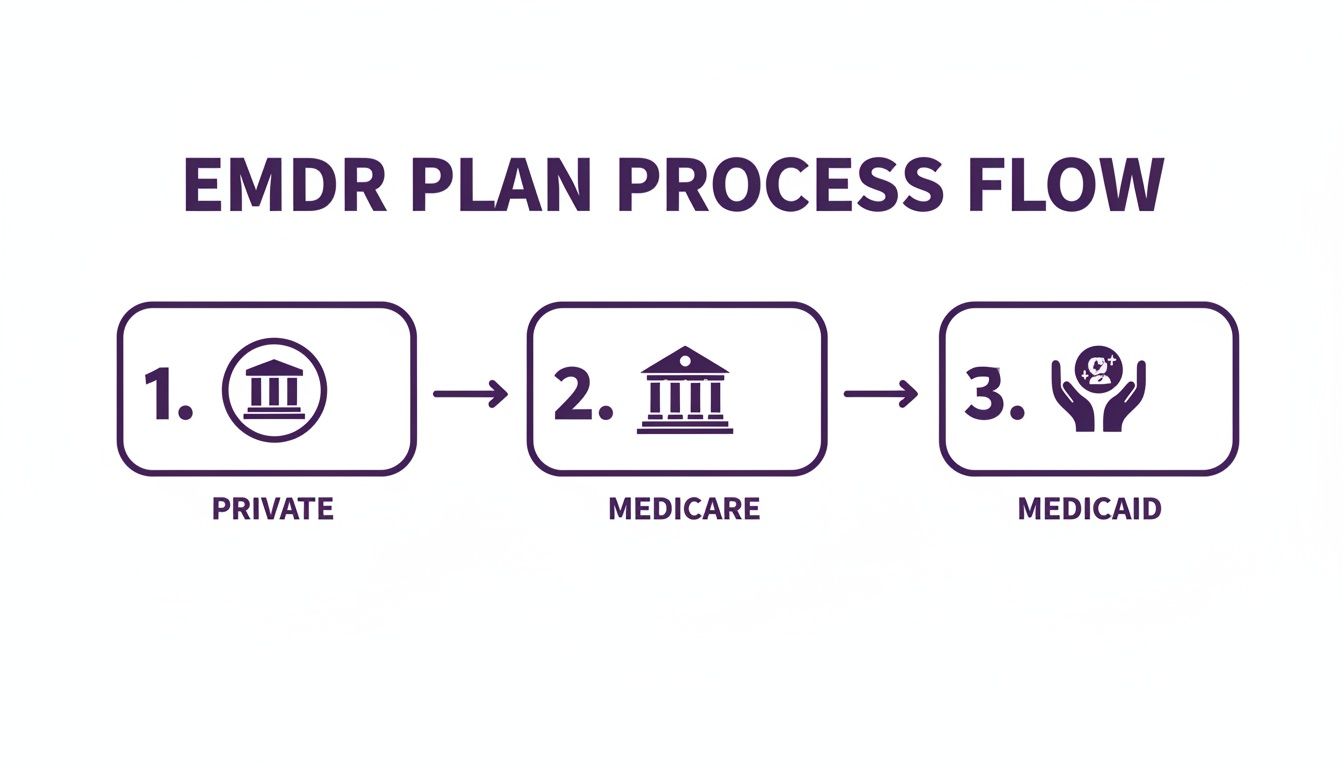
While each path is a little different, they all come down to one thing: proving medical necessity with a proper diagnosis and treatment plan.
Building a Strong Case for Coverage
Even with all the evidence supporting EMDR, insurers can sometimes be hesitant to cover it for conditions other than PTSD. Some reports suggest denial rates hover around 10-15% for these uses.
But the data is on your side. With studies showing that 67% of patients with PTSD from accidents or assaults found relief after just six EMDR sessions, insurers are more willing than ever to approve it—especially when they see a well-documented plan.
It also helps to understand that a lot of initial rejections happen because of automated claims processing, which can flag things for minor errors. By working closely with your therapist and staying persistent, you can often get past these initial hurdles and turn a denial into an approval.
Managing the Cost of EMDR Therapy
Let's talk about the financial side of things, because it’s a real and important part of starting therapy. Figuring out if EMDR is covered by insurance is a great first step, but what does that actually mean for your wallet? Knowing the practical costs and how to handle them can make the whole process feel much more manageable.
So, what's the bottom line for a full course of EMDR? It really depends, but studies looking at the cost-effectiveness give us a good ballpark. An average treatment plan runs about eight therapy hours, which often adds up to a total of $1,200 to $2,500. For a well-established treatment for PTSD, plans like Medicare Part B will typically reimburse a big chunk of that. If you're interested in the data behind this, you can dig into the cost-benefit analyses that have helped solidify insurance coverage over the years.
Decoding Your Insurance Plan's Lingo
When you start looking at your insurance plan, you’ll run into some specific terms. Getting a handle on what they mean is the key to understanding what you'll actually have to pay.
-
Deductible: Think of this as the amount you have to pay yourself before your insurance company starts chipping in. If your plan has a $1,000 deductible, you’ll cover the first $1,000 of your medical bills that year.
-
Copayment (Copay): This is a simple, flat fee you pay for each visit once your deductible is met. It might be something like $30 every time you see your therapist.
-
Coinsurance: Instead of a flat fee, coinsurance is a percentage. If your plan has 20% coinsurance, it means that after you've hit your deductible, you'll pay 20% of the session's cost, and your insurance will cover the remaining 80%.
Financial Tools to Make Therapy Affordable
Your insurance plan isn't the only tool you have. There are several other ways to make EMDR fit into your budget, giving you the flexibility to get the care you need without breaking the bank.
Don't let cost be the barrier that stops you from getting help. There are almost always multiple pathways to make therapy affordable, from using tax-free accounts to discussing payment options directly with your provider.
One of the best strategies is to use a Health Savings Account (HSA) or a Flexible Spending Account (FSA). These accounts let you use pre-tax money for medical expenses—including your therapy sessions and copays. Using pre-tax dollars is basically like getting an immediate discount on your treatment.
On top of that, don't hesitate to ask providers if they offer sliding scale fees, which are adjusted based on your income. It's a common practice. And if you end up seeing a therapist who is out-of-network, you can always ask them for a "superbill." This is a detailed receipt you can submit to your insurance company yourself to get some of your money back.
Let Us Help You Navigate Your Insurance

Trying to make sense of your insurance plan can feel overwhelming, especially when you’re already dealing with so much. You absolutely don’t have to tackle it alone. At reVIBE Mental Health, our team is here to take that weight off your shoulders.
We specialize in helping people all across Arizona understand exactly what their plan covers so they can get the care they need. Our administrative experts will get on the phone with your insurance company for you. We’ll sort through the paperwork, confirm your specific benefits for EMDR therapy, and handle any pre-authorizations that might be required.
This way, you can focus on what’s most important: your own well-being and healing.
Your Local Arizona EMDR Provider
Our mission is to make quality mental healthcare accessible right here in the valley. A big part of that is making the insurance side of things as straightforward and transparent as possible, right from your very first call.
We believe that worrying about whether is EMDR covered by insurance should never be a roadblock to getting help. Let our team give you the clear answers you need to move forward with confidence.
Ready to take the next step? We offer EMDR therapy at five convenient locations:
- reVIBE Mental Health – Chandler: 3377 S Price Rd, Suite 105
- reVIBE Mental Health – Phoenix Deer Valley: 2222 W Pinnacle Peak Rd, Suite 220
- reVIBE Mental Health – Phoenix PV: 4646 E Greenway Road, Suite 100
- reVIBE Mental Health – Scottsdale: 8700 E Via de Ventura, Suite 280
- reVIBE Mental Health – Tempe: 3920 S Rural Rd, Suite 112
To get started, simply contact us online or give our team a call at (480) 674-9220 today.
Answering Your Questions About EMDR and Insurance
Let's be honest, figuring out insurance can feel like a full-time job. When you're trying to get help for your mental health, the last thing you need is more confusion. So, let’s cut through the noise and answer some of the most common questions about getting EMDR therapy covered.
Will My Insurance Pay for EMDR if I Have Anxiety or Depression?
While EMDR is famous for its success with PTSD, its benefits don't stop there. Many insurance companies will absolutely cover EMDR for other conditions like anxiety and depression, but there's one key concept you need to know: medical necessity.
Think of it this way: your therapist needs to make a clear, compelling case to the insurance company, explaining why EMDR is the right tool for the job in your specific situation. When your therapist provides a strong clinical justification, approval is much more likely. It all comes down to good communication between your provider and the insurer.
How Is EMDR Billed? What Codes Are Used?
This is actually one of the simplest parts of the process. You might think a specialized therapy like EMDR would have its own complicated billing code, but it doesn’t.
Therapists use the same standard CPT (Current Procedural Terminology) codes that are used for any other talk therapy session. The most common ones you'll see are 90834 for a 45-minute session and 90837 for a 60-minute session. This is great news because it means insurance companies treat EMDR claims just like any other routine mental health visit, which helps streamline the whole approval process.
My EMDR Claim Was Denied. Now What?
First, don't panic. A denial from an insurance company often feels final, but it's usually just the first step in a negotiation. Think of it as an invitation to provide more information.
Start by looking at the Explanation of Benefits (EOB) they sent you. It will list a specific reason for the denial, and sometimes it's as simple as a typo or a coding mix-up.
Your next move is to team up with your therapist to file an appeal. Here’s what that usually involves:
- Writing a formal letter asking the insurer to reconsider their decision.
- Submitting supporting documents, like your therapist's clinical notes and your treatment plan.
- Including research or evidence that shows how effective EMDR is for your specific diagnosis.
A well-documented, persistent approach often turns a denial into an approval. For therapists looking to simplify their administrative tasks, tools like AI answering for mental health providers can be a huge help in managing the backend work that comes with insurance claims and scheduling.
Can I Pay for EMDR With My HSA or FSA?
Yes, you certainly can! EMDR with a licensed therapist is a qualified medical expense, which means you can use the pre-tax money in your Health Savings Account (HSA) or Flexible Spending Account (FSA) to cover the cost.
This is a fantastic way to pay for your sessions, copays, or any deductible costs, making your care significantly more affordable.
Tackling insurance paperwork is just the first hurdle on the path to healing, and you shouldn't have to do it by yourself. The team at reVIBE Mental Health is here to step in. We'll verify your benefits and connect you with the right provider, so you can put all your energy into feeling better.
Find a reVIBE Location Near You!
We currently have five locations for your convenience. (480) 674-9220
reVIBE Mental Health – Chandler
3377 S Price Rd, Suite 105, Chandler, AZ
reVIBE Mental Health – Phoenix Deer Valley
2222 W Pinnacle Peak Rd, Suite 220, Phoenix, AZ
reVIBE Mental Health – Phoenix PV
4646 E Greenway Road, Suite 100, Phoenix, AZ
reVIBE Mental Health – Scottsdale
8700 E Via de Ventura, Suite 280, Scottsdale, AZ
reVIBE Mental Health – Tempe
3920 S Rural Rd, Suite 112, Tempe, AZ