Deciding to start couples counseling is a huge step, and it's completely normal to feel a mix of hope and nervousness about what actually happens in that first session. The best way to think about it is as a kind of 'relationship health check-up.' It’s a structured, judgment-free zone where you and your partner finally get to tell your story to a neutral guide. The initial goal isn't to solve everything at once, but simply to understand where you both are coming from and start to picture what a better future could look like.
Your First Session: What to Expect When You Start

Walking into a therapist's office for the first time can feel a little daunting, but the initial phase is really designed to ease you into the process. This isn't about jumping into your most heated arguments on day one. Instead, it’s more of a fact-finding mission for your therapist and a chance for you to see if the fit feels right.
The first appointment is usually called the intake session, and it’s all about gathering information. Your therapist’s job is to create a safe space to talk about the history of your relationship, the specific challenges that brought you in, and even the strengths you still have together.
Building a Foundation for Trust
The main goal of these first few meetings is to build what we call a "therapeutic alliance." This is just a clinical way of saying we need to build a trusting, collaborative relationship between the three of us—you, your partner, and me (the therapist). To get there, your therapist will ask a lot of questions to get the full picture, like:
- What’s the story of how you two got together?
- Can you tell me about the big issues that keep coming up?
- What have you already tried on your own to fix these problems?
- If things were better, what would that look and feel like for each of you?
It's pretty common to have the first session together, then have a brief individual session with each of you. This gives the therapist a chance to hear each person's side of the story without interruption, making sure both of you feel equally heard and understood right from the get-go. For a deeper dive, check out our guide on how to prepare for your first therapy session.
To give you an even clearer picture, here's a simple timeline for what those initial sessions typically look like.
Your First Three Sessions: A Practical Timeline
This table breaks down the initial phase of counseling so you know exactly what to anticipate. Knowing the roadmap can help calm any nerves and get you focused on the work ahead.
| Session | Primary Focus | What You Will Do |
|---|---|---|
| Session 1 (Intake) | Information Gathering & Alliance Building | Meet together with the therapist to share your relationship history, current struggles, and what you hope to achieve. You'll get a feel for the therapist's style and the counseling process. |
| Session 2 (Individual) | Deepening Understanding | Meet one-on-one with the therapist. This is a chance to share your personal perspective, history, and concerns in a private setting. The therapist does this with each partner separately. |
| Session 3 (Goal Setting) | Creating a Shared Roadmap | Come back together as a couple. The therapist will share their initial observations (without breaking confidentiality) and help you collaboratively define clear, achievable goals for your work together. |
This structured start ensures that everyone is on the same page before diving into the deeper work of healing and rebuilding.
Setting Collaborative Goals
A huge part of early couples counseling is setting clear goals. This is a team effort. Your therapist acts as a facilitator, guiding a conversation about what you both genuinely hope to accomplish. Are you trying to rebuild trust after an affair? Improve the way you talk to each other day-to-day? Or maybe figure out how to navigate a major life change as a team?
Your therapist doesn't take sides or decide who is 'right' or 'wrong.' Their role is to advocate for the relationship itself, helping you both find common ground and create a plan to get there.
This goal-setting phase is incredibly empowering because it makes the process transparent and focused. It’s a sad fact that most couples wait far too long to get help—on average, about six years after problems begin. But the good news is that when they finally do, the experience is overwhelmingly positive. In fact, nearly 98% of couples who go through counseling rate it as a good or excellent experience. This initial groundwork is what paves the way for real, lasting change.
What Actually Happens in a Couples Counseling Session?
So, you’ve made it through the initial assessment. Now you’re probably wondering what a regular therapy hour actually looks like. It’s not just an hour of rehashing old fights; it’s about learning to talk to each other differently in a place that’s safe and supportive. The goal is to build on what you learn each week, turning those "aha" moments into real, lasting change.
Most sessions kick off with a quick check-in. Your therapist will probably ask how the past week has been since you last saw them. This is your chance to talk about any arguments that popped up, any wins you had (big or small), or how you did with the "homework" you all agreed on. Think of it like a coach reviewing game tape with the team to figure out what went right and what needs a new play.
A Coach in the Room
The real meat of the session is all about guided communication. This is where your therapist steps in as a facilitator—almost like a communication coach. They create a space where you and your partner can finally tackle those tough topics that would normally explode into a full-blown argument at home.
The therapist's job is to spot those unhelpful communication habits as they happen and gently hit the pause button. We all have them. It could be things like:
- The Blame Game: Pointing the finger and making it all your partner’s fault.
- Interrupting: Jumping in before your partner has a chance to finish their thought.
- Mind-Reading: Acting like you know exactly what your partner is thinking or feeling (when you probably don't).
When these old patterns show up, the therapist will pause the conversation and offer a healthier, more productive way to connect. Having that neutral third party there to intervene is what makes therapy so different from trying to sort this stuff out on your own couch. It's this structured, expert-guided approach that really works.
Don't just take my word for it. Modern couples counseling has a solid 70% success rate on average. With proven methods like Emotionally Focused Therapy (EFT), that number climbs to an impressive 70-75%. You can read more about the data behind therapy success rates if you're curious.
Turning "You Always" into "I Feel"
Here’s a classic example of how this plays out. One partner might say, "You never help with the kids." It’s an accusation, plain and simple, and it immediately puts the other person on the defensive. Game over.
A therapist would jump in right there. They’d guide the speaker to rephrase that thought from the heart, using an "I feel" statement. It might become, "I feel overwhelmed and unsupported when I'm managing the kids' bedtime routine by myself." See the difference? That one little shift turns a fight-starter into an invitation for connection and problem-solving. It opens a door instead of slamming it shut.
As the session wraps up, you'll usually summarize the key things you uncovered together. Then, you’ll nail down one small, concrete step to practice before your next appointment. This is crucial—it ensures you walk out the door not just with new insights, but with a clear plan to keep the momentum going at home.
Understanding Different Therapy Approaches
Couples counseling isn't a one-size-fits-all experience. Just like a doctor has different tools for different ailments, a good therapist will draw from specific, evidence-based methods to address what's really going on in your relationship. Getting a handle on these approaches can help you know what to expect and find a therapist whose style feels right for you both.
Think of it this way: your relationship is a car that isn't running right. Different therapy methods are like different master mechanics. One might specialize in the electrical system (your emotional connection), while another is an expert at tuning the engine for better performance (your behaviors and communication skills). They're all aiming for the same destination—a healthier, happier partnership—but they take different roads to get you there.
The Gottman Method: Building A Stronger Foundation
One of the heavyweights in the field is the Gottman Method. This approach is the result of decades of research by Drs. John and Julie Gottman, who literally observed thousands of couples to figure out what makes a relationship thrive or dive. It’s incredibly practical.
Essentially, the Gottman Method gives you a blueprint for building a "Sound Relationship House." You’ll work on strengthening the foundation of friendship, building up walls of trust and commitment, and putting on a roof of shared dreams. A therapist will teach you concrete skills to manage conflict, like spotting the infamous "Four Horsemen"—criticism, contempt, defensiveness, and stonewalling—and replacing them with healthier habits. It’s less about plumbing the depths of your childhood and more about building tangible, day-to-day skills.
Emotionally Focused Therapy (EFT): Getting To The Heart Of The Matter
Another incredibly powerful approach is Emotionally Focused Therapy (EFT). If Gottman is the blueprint, EFT is about understanding the emotional wiring inside the house. This therapy zeroes in on the attachment needs and fears that fuel your conflicts. It helps you both realize that the fight over the dishes isn't really about the dishes—it's about a deeper question like, "Are you there for me?" or "Do I still matter to you?"
EFT is all about getting to the root of those raw emotions and learning to express them in a way your partner can finally hear and respond to. The goal is to de-escalate the cycle of conflict and rebuild a secure emotional bond. And it works. Research shows that 90% of couples see significant improvements. Many couples, even those in deep distress, can rebuild trust and connection in as few as 8-12 sessions.
No matter the specific method, most sessions follow a general rhythm. You check in, you do the work, and you leave with a plan.
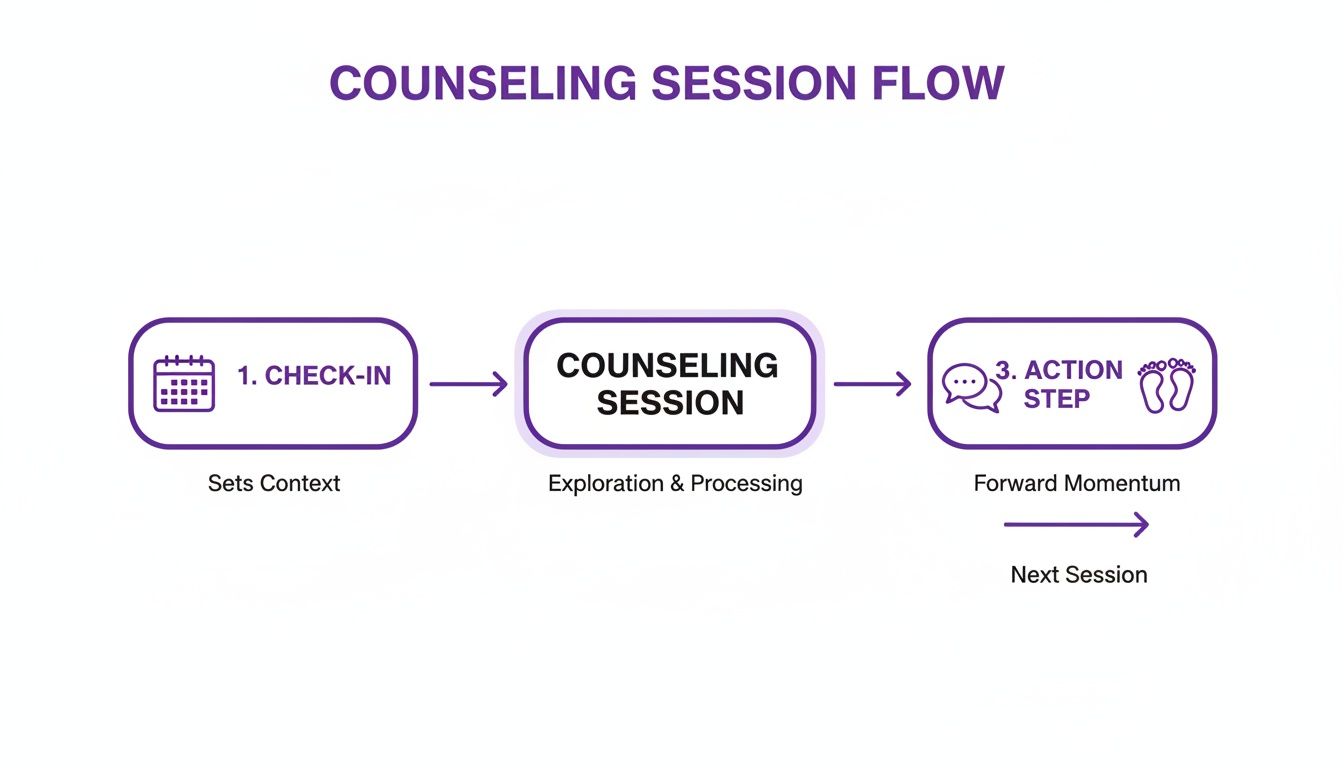
This flow ensures each session builds on the last, creating real momentum toward your goals.
Other Effective Counseling Styles
While EFT and the Gottman Method are very popular, they're far from the only games in town. A skilled therapist often pulls from several models to best suit the couple in front of them.
To make sense of the main players, here’s a quick-glance table comparing some common approaches.
Comparing Popular Couples Counseling Methods
| Therapy Method | Main Focus | Best For |
|---|---|---|
| Gottman Method | Building practical skills for communication, friendship, and conflict management based on decades of research. | Couples who want a structured, skills-based approach and clear tools to improve their daily interactions. |
| Emotionally Focused Therapy (EFT) | Identifying and de-escalating negative interaction cycles by exploring the underlying attachment needs and emotions. | Couples stuck in high-conflict cycles who need to rebuild emotional safety, trust, and a secure bond. |
| Cognitive Behavioral Therapy (CBT) | Identifying and changing the unhelpful thoughts and behaviors that contribute to relationship problems. | Couples where specific negative thought patterns or behaviors are driving conflict and disconnection. |
This is just a starting point, of course. Many therapists will blend these methods to create an approach that’s tailored to you.
Other therapies you might encounter include Imago Relationship Therapy, which helps you understand how your childhood experiences are showing up in your current relationship. Some couples also find huge benefits in less traditional methods; for instance, learning what art therapy is can open up new ways to communicate and connect when words fail.
Many therapists also integrate principles from Cognitive Behavioral Therapy (CBT) to help couples challenge the negative thought patterns that fuel arguments. You can learn more about how that works in our guide on what is cognitive behavioral therapy. The bottom line is that the best therapists have a full toolbox and know which tool to use and when.
The Real Work Happens Between Sessions
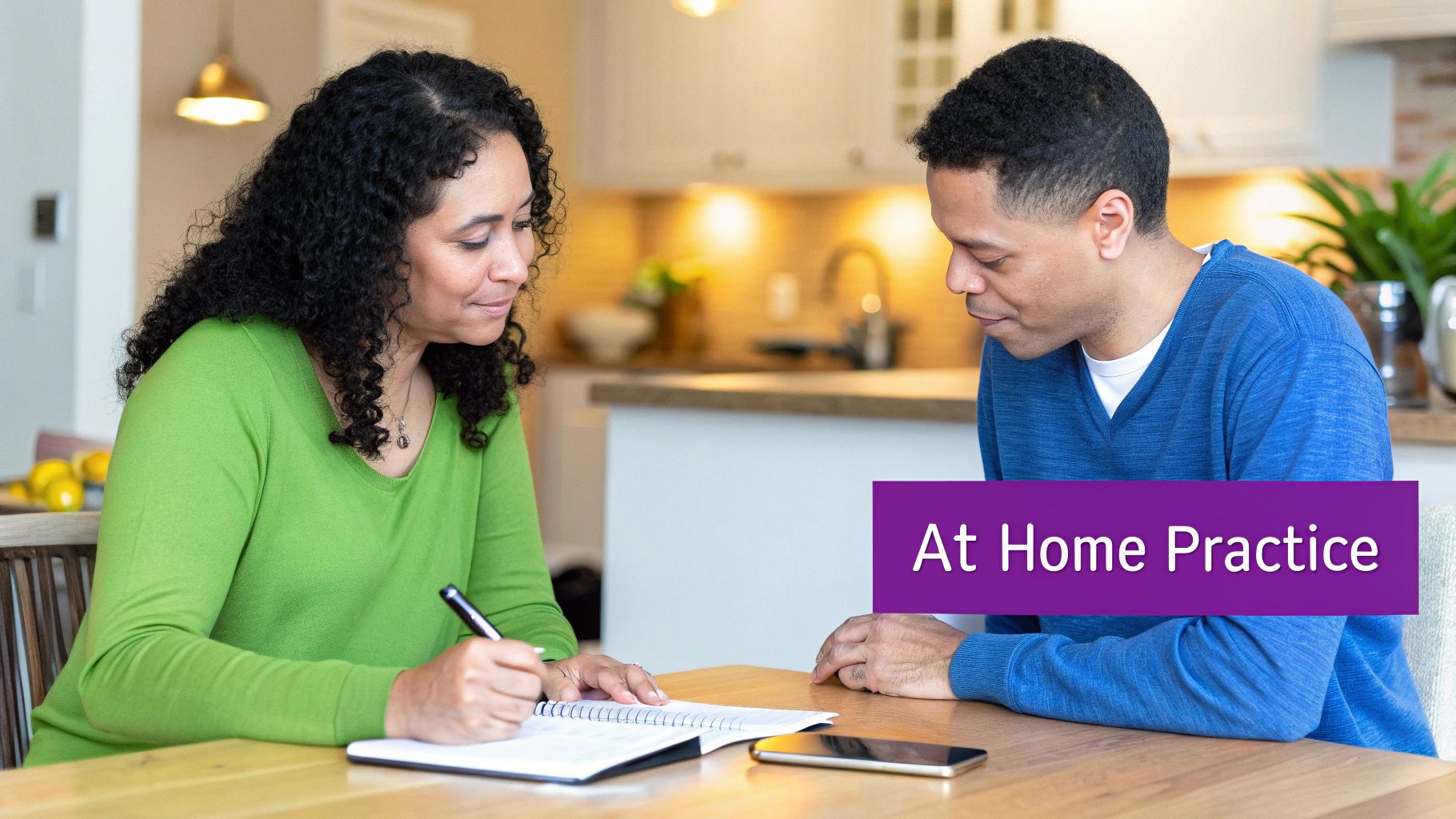
It's a common misconception that all the magic happens inside the therapist's office. While that hour is incredibly important, the truth is, the most meaningful change in your relationship will happen at home, in the days between your appointments.
Think of your therapy session as the team huddle where you learn the new plays. The rest of the week is game time—it's your chance to practice those skills in the real world. This is where insights from therapy start to become second nature.
Your therapist will almost certainly give you "homework," but don't worry, it's not like school. These are practical exercises designed to help you and your partner actually use what you're learning. This is the bridge between talking about change and actually living it.
What Does Therapy Homework Look Like?
These assignments are always designed to fit your specific goals, and they’re meant to be manageable. The goal is consistent effort, not perfect execution.
While learning to compromise is a huge part of counseling, sometimes it’s equally insightful to figure out where your individual needs simply can't bend. Exploring ideas like the end of compromise can bring surprising clarity to a relationship's give-and-take.
Here are a few examples of what you might practice:
- Structured Check-ins: Taking just ten minutes every evening to talk, using a new communication skill you learned in your last session.
- Intentional Connection: Planning—and protecting—a weekly date night. It doesn't have to be fancy; it just has to be a phone-free, focused hour together.
- Conflict De-escalation: Trying out a script or a simple worksheet to navigate a tricky topic that usually blows up into a fight.
How to Measure Real Progress
Progress in therapy isn't a straight line. You'll have amazing weeks and some that feel like a step backward. That's totally normal. The key is to notice the small but powerful shifts that prove your hard work is making a difference.
Change takes time, so be patient with yourselves. The average course of couples counseling is between 8-20 sessions. A study in The Journal of Marital and Family Therapy found that 65.6% of couples wrapped up their therapy in under 20 sessions.
Keep an eye out for these signs that you're moving in the right direction:
- You're getting better at stopping arguments before they spiral out of control.
- You start to feel more emotionally safe and genuinely connected to each other again.
- You find yourselves laughing more and just enjoying being together.
- You begin tackling problems as a team instead of pointing fingers at each other.
Don't forget to celebrate these small wins. They're tangible proof that your effort is paying off, and that recognition is what will keep you both motivated when the work gets tough.
The Nuts and Bolts: Navigating Costs, Insurance, and Session Types
Let's talk about the practical side of things. Figuring out the logistics of therapy ahead of time can take a huge weight off your shoulders, letting you focus on what really matters: your relationship. When you have a clear picture of the costs, insurance details, and session formats, it's so much easier to get started.
What Does Couples Counseling Cost?
One of the first things on everyone's mind is the cost. It’s a valid question. The best way to frame it is as an investment in the long-term health and happiness of your relationship. Prices can vary quite a bit depending on the therapist's experience and location.
A common question is, "Will my insurance cover this?" The answer is… maybe. It can be a bit tricky. Insurance companies don't always cover "couples counseling" outright. However, if one partner is dealing with a diagnosed mental health condition like anxiety or depression, and the relationship stress is making it worse, your sessions might be covered as part of that individual's treatment plan. It's always worth a call to your insurance provider to ask.
In-Person vs. Online Therapy: Which Is Right for You?
You'll also need to decide where you want to have your sessions—in a therapist's office or from your own home. There’s no right or wrong answer here; it’s all about what works for you and your partner.
- In-Person Counseling: There's something powerful about sitting in a neutral space, away from the kids, the dog, and the pile of laundry. Being physically in the room together with a therapist can create a unique, focused energy that’s hard to replicate.
- Online Counseling (Telehealth): The convenience here is undeniable. No commute, no finding a babysitter, no trying to sync up two crazy work schedules to get to an office. For busy couples, online therapy can be the difference between getting help and putting it off forever.
The most effective therapy is the one you actually attend. Pick the format that removes the most obstacles and makes it easiest for both of you to commit and show up, week after week.
Finding Accessible Care in Arizona
Making this process feel easy is the key to taking that first step. For example, here at reVIBE Mental Health, we've tried to remove as many barriers as possible. With offices in Scottsdale, Tempe, Chandler, and Phoenix, we have an integrated team that accepts most major insurances to keep care affordable.
We also offer appointments seven days a week, both in-person and online, so you can find a time that truly works. You can find out more about how we make counseling accessible.
To help figure out your next move, sit down together and ask a few simple questions:
- Realistically, what can we budget for therapy each week or month?
- Do our jobs or commutes make getting to an office a major headache?
- Do we have a spot at home where we can have a private, uninterrupted online session?
- Would we feel more focused and open in a professional setting, away from home?
Talking through these points can quickly clear up the best path forward, so you can stop worrying about the logistics and start doing the work.
How to Start Couples Counseling in Phoenix
Alright, so you've learned a bit about what to expect from couples counseling. Now comes the hard part—and the most important one: actually making the call. If you and your partner are ready to start building a healthier relationship right here in the Phoenix area, the good news is that getting started is probably easier than you think.
Your journey will likely begin with a simple phone call or by filling out a contact form on a website. At a practice like reVIBE Mental Health, this first touchpoint is designed to be as low-pressure as possible. You'll connect with a care coordinator whose entire job is to listen, understand what you're going through, and help find a therapist who’s the right fit for your unique situation and your insurance.
Find a reVIBE Location Near You!
We currently have five locations for your convenience. (480) 674-9220
reVIBE Mental Health – Chandler
3377 S Price Rd, Suite 105, Chandler, AZ
reVIBE Mental Health – Phoenix Deer Valley
2222 W Pinnacle Peak Rd, Suite 220, Phoenix, AZ
reVIBE Mental Health – Phoenix PV
4646 E Greenway Road, Suite 100, Phoenix, AZ
reVIBE Mental Health – Scottsdale
8700 E Via de Ventura, Suite 280, Scottsdale, AZ
reVIBE Mental Health – Tempe
3920 S Rural Rd, Suite 112, Tempe, AZ
Taking that first step is often the biggest hurdle, but it's also where your power lies. When you invest in your relationship this way, you’re giving yourselves the tools and dedicated support you need to build a stronger, more connected future.
Whether you're just exploring your options or you feel ready to book an appointment, help is just around the corner. You can learn more about our specific approach by checking out our page on couples counseling near you.
There’s no reason to wait to start creating a better dynamic. Call us at (480) 674-9220 or visit our website to schedule a consultation. It’s a single, powerful step toward a happier and more resilient partnership.
Answering Your Biggest Questions About Couples Counseling
It's completely normal to have a ton of questions before starting couples counseling. Let's be honest, the idea can feel a little intimidating. Getting some clear answers can go a long way in making you both feel more comfortable and ready to take that first step.
"What if my partner refuses to go?"
This is probably the most common roadblock couples run into, so you're not alone. The key is how you bring it up. Try to start the conversation from a place of vulnerability, using "I" statements to share how you're feeling without pointing fingers.
For instance, instead of saying, "You never listen to me, we need therapy," try something like, "Lately, I've been feeling disconnected from you, and I really miss us. I was thinking we could learn some new ways to support each other."
When you frame it as a project you can tackle together—strengthening your team rather than "fixing" one person—it changes the entire dynamic. It can also help to suggest just one session as a trial run. No strings attached. This takes the pressure off and can make a hesitant partner more willing to at least see what it's like.
"Will the therapist pick a side?"
Nope, not a chance. A good couples therapist acts like a neutral referee, not a judge. Their actual client isn't you or your partner individually; it's the relationship itself.
Think of the therapist's job as ensuring both people feel seen and heard, not deciding who's right or wrong. The goal is to help you break out of that cycle by truly understanding where the other person is coming from.
Their focus is on helping you both build healthier ways of communicating and connecting, together.
"I'm worried counseling could actually make things worse."
This is a valid fear. Therapy sessions can definitely be tough. They bring up old hurts and frustrating patterns that might be easier to ignore.
But here's the thing: those issues are already there, bubbling under the surface and impacting your relationship whether you talk about them or not. Counseling just provides a safe, structured environment to finally deal with them constructively, with a trained professional to guide you. It prevents those same arguments from exploding in your kitchen on a Tuesday night.
It often feels a little harder before it gets better, but that challenging work is exactly what creates real, lasting change.
Taking that first step is often the hardest part, but you don't have to figure it out on your own. The compassionate team at reVIBE Mental Health is here to support you with convenient locations and flexible scheduling. Start your journey toward a stronger connection today.