
Some evenings feel tense before anyone says a word. A child goes quiet when a stepparent asks about homework. One parent thinks the rule is simple, while the other worries it will sound too harsh. By bedtime, everyone feels misunderstood, and the house that was supposed to feel like a fresh start feels heavy instead.
That doesn't mean your family is failing. It often means you're trying to build something new with old hurts, different habits, and very human emotions all under one roof. Blended family therapy helps families slow that process down, make sense of the friction, and build a family life that fits the people living it.
What Is Blended Family Therapy
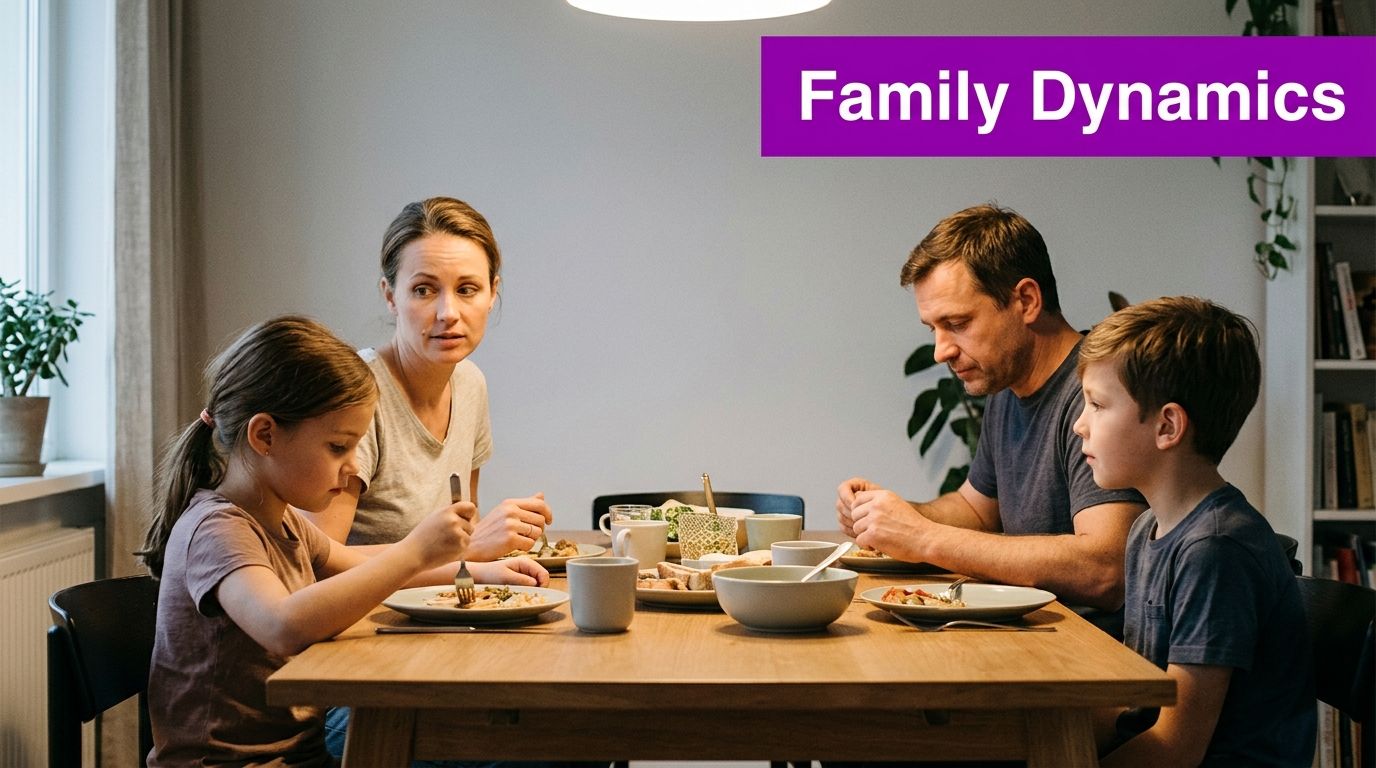
Blended family therapy is counseling designed for families formed through remarriage, re-partnering, or the joining of households where children and adults bring prior relationships, routines, and roles with them. It isn't about forcing everyone to feel close right away. It's about helping people understand each other, reduce conflict, and create rules and relationships that are realistic.
A simple way to think about it is this. A blended family is a bit like joining a new team sport halfway through the season. Everyone may want the team to succeed, but players come in with different habits, expectations, and loyalties. If no one stops to explain the new playbook, people step on each other's toes. Therapy gives the family a place to learn the rules together.
Stepfamilies are common, not unusual. About 15% to 16% of children in the U.S. live in a blended family, and approximately 25% of families in therapy involve blended families or stepfamilies, according to blended family statistics compiled here. If you've been telling yourself, “Why is this so hard for us?” it may help to know that many families need support with these exact dynamics.
What therapy is really helping you build
Many parents come in thinking therapy will teach the kids to behave or help the stepparent gain authority. Those can be part of the work, but the deeper task is building a new family culture.
That includes:
- Shared expectations that don't rely on mind reading
- Clearer roles so children know who does what
- Safer communication when feelings are strong
- Room for grief about what changed before this family formed
Blended families usually don't struggle because people care too little. They struggle because everyone is caring from a different starting point.
Therapists often look at how each person's stage of development, past experiences, and family role shape current reactions. If you want a broader way to understand those patterns, family development theory can help explain why change in one part of a family affects the whole system.
What it is not
Blended family therapy isn't a courtroom. The therapist isn't there to decide who the “real” parent is or who's right in every disagreement. The work is more practical than that.
It helps families answer questions like these:
| Common question | What therapy explores |
|---|---|
| Why does this small issue turn into a big fight? | Hidden loyalty, grief, or role confusion |
| Why does my stepchild reject help from me? | Trust, timing, and authority that may need to be built slowly |
| Why do my partner and I keep splitting on discipline? | Differences in parenting history, guilt, and unclear agreements |
Navigating the Unique Challenges of a Blended Family
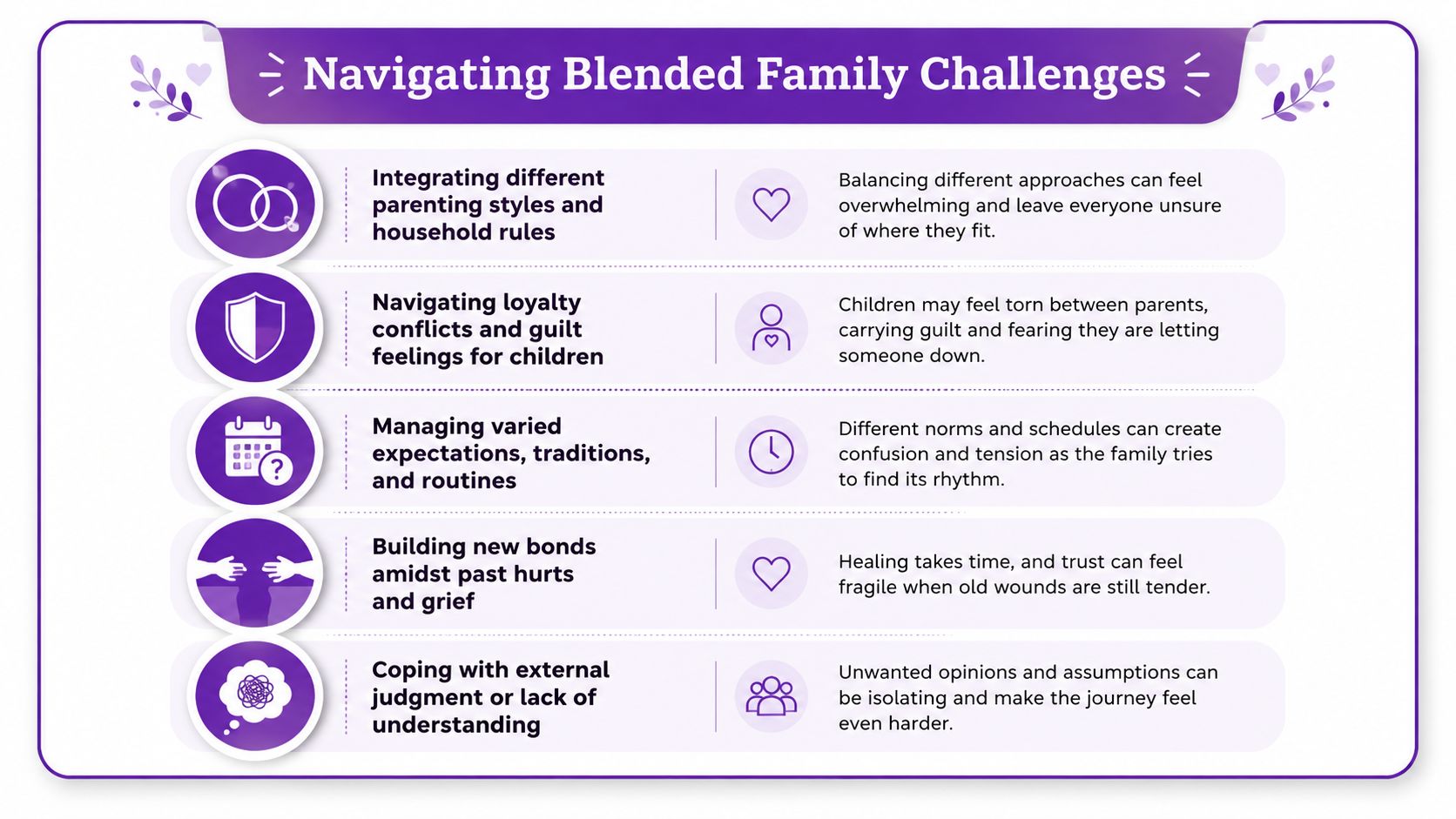
Some blended family problems look small from the outside. A child refuses a ride from a stepparent. A teen says, “You're not my dad.” A couple argues in whispers after the kids go to bed about whether a consequence was fair. These moments can feel personal, but they're often predictable parts of blending a family.
Loyalty can make closeness feel risky
A child may like a stepparent and still pull away. Why? Because accepting care from a new adult can feel disloyal to a biological parent. Kids don't always say that directly. Instead, you might see eye-rolling, distance, or sudden resistance around ordinary requests.
A parent can get caught in the middle too. If they worry their child already feels loss or instability, they may overprotect that bond and unintentionally leave the stepparent on the outside.
Practical rule: When a child resists a stepparent, don't assume the problem is dislike. Sometimes the child is trying to protect an older bond.
Professional guidance on counseling blended families notes that trust-building is often non-linear, especially when children have strong loyalty ties, and that a stepparent's role is usually better earned gradually through consistency rather than pushed through immediate authority, as discussed in this counseling guidance on blended family challenges.
The stepparent role is often the most confusing seat in the house
Stepparents often ask a painful question: “How involved am I supposed to be?” If they step in quickly, children may see them as intrusive. If they hang back, they may feel invisible or unsupported. That tension can wear people down fast.
Mini-scenarios like these are common:
- At dinner the stepparent reminds a child about manners. The child snaps back. The biological parent freezes because they don't want a blowup.
- During homework time one adult values structure, while the other is more flexible. The child learns quickly which parent to ask.
- On holidays different traditions collide, and no one wants to admit they miss the way things used to be.
Families also run into practical concerns outside the therapy room. For example, if household authority or decision-making becomes tangled with custody questions, resources on legal rights for Texas stepparents can clarify how emotional roles and legal roles aren't always the same.
Discipline and house rules can expose deeper wounds
Arguments about chores, bedtime, screens, or curfews are rarely only about chores, bedtime, screens, or curfews. They often uncover deeper differences.
One parent may be carrying guilt from divorce and avoid consequences. Another may believe consistency is the only path to respect. A stepparent may feel set up to enforce rules they didn't help create. Children notice every inconsistency.
When this happens, families often need more than “better communication.” They need a way to reduce triangulation, resolve recurring standoffs, and stop every disagreement from turning into a loyalty test. That's where structured support for family conflict resolution can be useful.
The Therapeutic Process for Blending Families
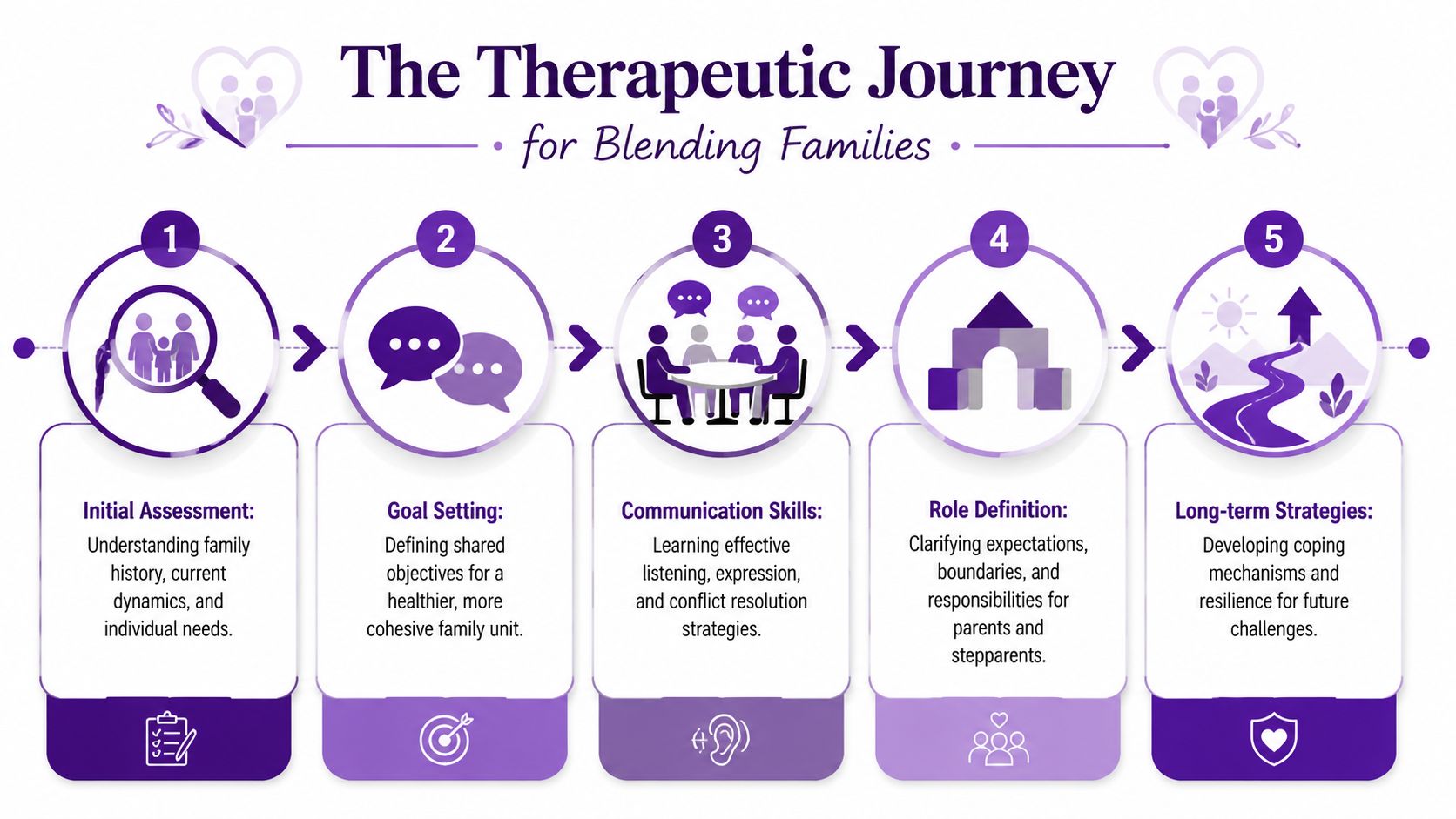
Good blended family therapy has structure. It isn't a long series of vague conversations where everyone repeats the same argument in softer voices. A therapist usually follows a staged process so the family can solve the right problem in the right order.
Therapy often starts with the adults
One of the most important ideas in this work is that the couple relationship often needs attention before the whole family can settle. That doesn't mean children are less important. It means family change is hard to sustain when the adults are divided on roles, limits, or expectations.
Clinical guidance on blended family work describes a staged systems approach in which therapists first secure the couple's alignment and clarify roles before moving to parent-child subsystems and then whole-family integration, as outlined in this overview of blended family therapy.
A therapist may begin by helping the adults answer questions like:
- Who handles discipline first
- What support does the stepparent need from the biological parent
- Which household rules are essential
- Where flexibility makes sense
Then the therapist maps the family system
Once the adults are more aligned, therapy often widens. The therapist may meet with different combinations of family members rather than insisting everyone attend every time. Sometimes the most productive session is with the couple. Sometimes it's a parent and child. Sometimes the full family needs to practice a new way of talking together.
Tools can make this process feel concrete:
| Tool | How it helps |
|---|---|
| Genograms | Map relationships, divorces, losses, alliances, and recurring stress points |
| Role clarification | Makes expectations visible instead of assumed |
| Communication exercises | Helps family members speak without blaming and listen without defending |
| Parenting-plan work | Creates consistency across decisions and routines |
Therapy works best when families stop asking, “How do we make this feel normal right now?” and start asking, “What foundation does this family need first?”
Integration happens in pieces
Many families worry that slow progress means therapy isn't working. In reality, progress often looks like smaller but meaningful shifts. A child becomes less reactive. A stepparent backs off power struggles and becomes more approachable. A couple argues less about parenting because they've made decisions before the conflict starts.
That kind of change tends to last because it grows from clearer structure, not pressure.
Your First Steps What to Expect in Sessions
Starting therapy can feel awkward before it feels helpful. Many parents worry about the same things. Will the therapist blame someone? Will the kids shut down? Does every person need to be in every session?
Usually, the first session is more practical than dramatic. The therapist asks what's happening at home, what each person wants to change, and where things tend to go off track. You don't need to arrive with polished language or a full family agreement about the problem.
Who might attend
Attendance is often flexible. The therapist may recommend different combinations depending on the issue that's most urgent.
For example:
- Just the couple when parenting disagreements are driving most conflict
- A parent and child when trust has broken down or emotions escalate quickly
- The full household when routines, rules, or communication patterns need shared practice
This surprises some families. They assume family therapy always means everyone on the couch every week. In practice, a therapist often moves between individual relationships and the full system so each part gets the attention it needs.
What the therapist will ask
Expect questions that sound simple but open important doors:
- What changed recently?
- When does the house feel calmest?
- Who feels stuck with what role?
- What does each child seem to need most right now?
- What has already been tried?
The therapist is listening for patterns, not just incidents. A disagreement about bedtime might reveal grief, guilt, loyalty conflict, or a struggle between adults over authority.
What sessions feel like
A good session should feel steady, respectful, and clear. You may talk through a recent conflict, slow it down, and identify where it escalated. Then you might practice one small change, such as having the biological parent take the lead on a difficult conversation while the stepparent focuses on connection instead of correction.
Some sessions feel relieving. Others feel tender because people finally say what they've been holding in. Both can be productive.
If your first session feels less like “fixing everything” and more like getting oriented, that's usually a good sign. Therapy often starts by making the family map clearer.
What helps before the first appointment
You don't need to prepare much, but these steps can help:
- Write down recent flashpoints so you can describe patterns clearly
- Talk to children in simple terms such as, “We're getting help talking and solving problems together”
- Drop the idea of picking a villain because therapy works better when the goal is understanding and change
Building Resilience The Positive Outcomes of Therapy
The most hopeful outcome of blended family therapy isn't a perfectly conflict-free home. It's a home that can recover. People repair faster, talk more clearly, and stop interpreting every hard moment as proof that the family doesn't work.
That resilience often grows from very practical gains. The adults become more coordinated. Children know what to expect. The stepparent role becomes less forced and more grounded. Family members start responding to the current moment instead of reacting from older pain.
What improvement can look like in real life
Change often shows up in ways families can feel quickly:
- Less tension before routines like meals, school nights, and transitions between homes
- Fewer authority battles because expectations are clearer
- More emotional safety for children to say, “I miss how things used to be,” without fearing they'll hurt someone
- A stronger couple foundation that protects the family from splitting into sides
These outcomes matter because family therapy has a solid evidence base more broadly. Independent treatment summaries report that over 75% of families in brief strategic family therapy see reductions in youth conduct-disorder symptoms, and about 93% maintain improvement at a 1-year follow-up, as described in this family therapy summary.
Why these gains last
Therapy helps because it targets interaction patterns, not just isolated feelings. If a family only treats one child as “the problem,” they may miss the cycle keeping everyone stuck. When therapy helps the whole system shift, progress is easier to maintain.
A family may still have stress. Ex-partner conflict may still flare. Holidays may still be complicated. But the household becomes more capable. People know how to regroup.
Recognizing When Your Family Needs Support
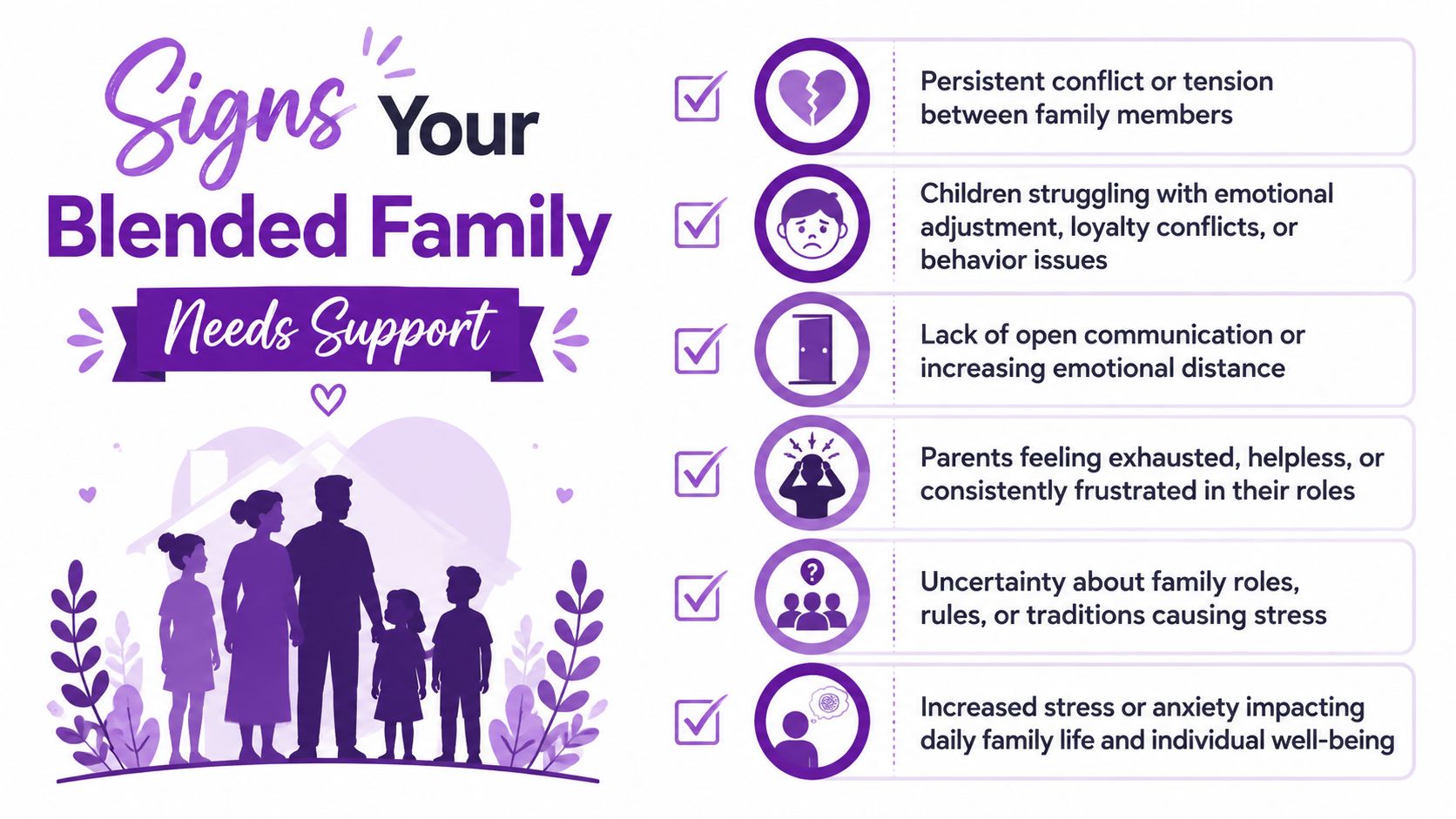
Many parents wait too long because they think therapy is only for families in crisis. More often, it helps when the strain is persistent, confusing, and starting to shape daily life. If your home feels tense more days than not, that's worth taking seriously.
Signs the family system is under strain
Look for patterns, not one bad week.
- Conflict keeps repeating. You resolve the same argument again and again, but nothing really changes.
- Children seem emotionally overloaded. They become more withdrawn, more irritable, or more reactive around transitions, discipline, or loyalty-sensitive situations.
- The adults are losing their partnership. Parenting disagreements spill into the relationship, and resentment starts replacing teamwork.
- Everyone is walking on eggshells. Family members stay quiet to avoid setting someone off, which creates more distance, not less.
A household under this kind of stress often starts narrowing. People stop joking. They avoid shared time. Ordinary requests feel charged.
When support should include individual care too
Sometimes family friction isn't only about the family structure. Anxiety, depression, trauma history, grief, or burnout can intensify every interaction. A parent who's emotionally exhausted may sound harsher than they intend. A teen with anxiety may resist transitions more strongly. A child carrying unresolved loss may react to small changes as if they're major threats.
That's why some families benefit from an integrated setting where family therapy can happen alongside individual therapy or psychiatric support when needed. If both relationship patterns and mental health symptoms are present, treating both can make the work more effective.
The clearest sign you need help isn't that your family is broken. It's that love is present, but your current ways of handling stress aren't working.
A quick self-check
This short checklist can help you decide whether it's time to reach out:
| If this feels true most weeks | Support may help with |
|---|---|
| Our house feels tense and unpredictable | Restoring structure and emotional safety |
| My child seems stuck between adults | Reducing loyalty pressure and clarifying roles |
| My partner and I can't stay aligned | Strengthening the parenting team |
| We keep hoping time alone will fix it | Turning insight into concrete change |
How to Find a Blended Family Therapist in Phoenix
Finding the right therapist matters as much as deciding to start. Blended families usually need someone who understands family systems, role ambiguity, parenting conflict, and the emotional layers children carry across households. A general therapist can still be helpful, but it's reasonable to ask direct questions before booking.
What to ask when choosing a therapist
A few questions can tell you a lot:
- Do you work with stepfamilies or blended families regularly
- How do you decide who attends each session
- Do you begin with the couple, the full family, or some combination
- How do you handle conflicts involving ex-partners or co-parenting stress
- Can you support both family sessions and individual needs if those emerge
Practical access matters too. Families often stop therapy not because they don't care, but because scheduling, commute time, or insurance confusion gets in the way.
A local option for Phoenix area families
If you're looking in the Phoenix metro area, family counseling near me is available through reVIBE Mental Health, which offers family therapy along with individual therapy, EMDR, and psychiatry with medication management. The practice provides in-person and secure online appointments, accepts most major insurance plans, and offers appointments seven days a week.
Locations include:
Chandler
3377 S Price Rd, Suite 105, Chandler, AZPhoenix Deer Valley
2222 W Pinnacle Peak Rd, Suite 220, Phoenix, AZPhoenix PV
4646 E Greenway Road, Suite 100, Phoenix, AZScottsdale
8700 E Via de Ventura, Suite 280, Scottsdale, AZTempe
3920 S Rural Rd, Suite 112, Tempe, AZ
You can contact the practice at (480) 674-9220.
What makes the process easier
When you call a practice, it helps to keep the first goal simple. You don't need to explain your whole family story in perfect order. Start with the main concern. For example: “We're a blended family having trouble with parenting roles and conflict at home.” That gives the team enough to start matching you with an appropriate provider.
You can also ask:
- Whether telehealth makes sense for some sessions
- How insurance verification works
- Whether the therapist sees couples, parents, and families
The best next step is usually the easiest one you can take.
Answers to Your Questions About Blended Family Therapy
Do all family members have to attend every session
No. Many blended families do better when the therapist varies who comes in. Some sessions focus on the couple because that's where alignment needs to happen first. Others may include a parent and child, siblings, or the whole family.
This flexibility is useful because not every problem belongs to the full group at the same time.
What if my ex-partner refuses to participate
Therapy can still help. A household doesn't need every involved adult in the room for change to begin. If your current home becomes more predictable, less reactive, and clearer in its roles, children often benefit even if the other household remains difficult.
You can't control another adult's willingness. You can strengthen the part of the system you do influence.
How should I talk to my children about starting therapy
Keep it simple and calm. Avoid language that makes it sound like someone is in trouble.
You might say:
“We're going to meet with someone who helps families talk better, solve problems, and make home feel easier.”
For younger children, less is often more. For teens, honesty matters. You can acknowledge that change has been hard and that therapy is a place where everyone gets heard.
What if my stepchild says they don't want therapy
That doesn't automatically mean the process is doomed. Children often resist what they don't understand or fear will become a pressure-filled conversation. Adults can still start. In many cases, early sessions with parents create the safety and clarity needed before a child is asked to participate.
A reluctant child usually needs less pressure, not more.
Is online therapy effective for families
It can be, especially when scheduling, commuting, or shared custody logistics make in-person attendance difficult. Online sessions can work well for parent coaching, couple sessions, and some family meetings. In-person care may still be preferable for certain younger children or highly escalated situations.
The better option is often the one your family can attend consistently.
How long does it take before things feel better
There isn't one standard timeline. That uncertainty frustrates many families, especially when they want reassurance that the hard work will pay off. Usually, the first signs of progress are better understanding, fewer repeated blowups, and clearer agreements between adults.
Trust tends to grow through repeated experiences of consistency, not through one big breakthrough.
What if one adult thinks therapy means they failed
That fear is common. But getting help usually reflects effort, not failure. Families seek therapy because the situation matters enough to work on it intentionally. The process gives you tools, language, and structure that are hard to create alone while living inside the stress every day.
If your family is trying to adjust to new roles, repeated conflict, or emotional distance, reVIBE Mental Health offers therapy, EMDR, and psychiatry with medication management across Chandler, Phoenix, Scottsdale, and Tempe, with in-person and secure online appointments available seven days a week. A first conversation can help you figure out what kind of support fits your family and what next step makes the most sense.