A parent in Phoenix might notice a third grader's grades slipping, a teenager quitting soccer, or a kindergartner whose tantrums now fill every evening. You may compare your child with cousins, replay a playground moment, or search symptoms on your phone after midnight. The question often sounds simple, but carries a lot of weight: Does my child need help, or is this just a phase?
You don't need to wait for a crisis to ask. A child mental health evaluation can turn a growing worry into a clearer understanding of what's happening, what your child needs, and which support should come next. The process isn't a test your child can pass or fail. It's a shared effort to replace guesswork with a practical map.
When Parents Start Wondering If Their Child Needs Help
A parent may call after a teacher mentions that a child seems distracted and lonely. Another may notice that a teenager spends dinner in silence, avoids friends, and says everything is “fine.” A caregiver of a young child may feel confused because the behavior appears only at bedtime or during transitions, while the child seems cheerful at school.
Those observations matter because children often show distress through behavior rather than direct explanations. A child may not say, “I'm anxious about separating from you.” Instead, they may cling at the classroom door, complain of a stomachache, or refuse a birthday party. A teen may not describe depression. They may stop answering messages, sleep differently, or become unusually irritable.
A practical starting point: You don't need to prove that something is wrong before asking for professional guidance.
Parents also carry quiet doubts. They wonder whether they're being too strict, whether another family member would handle things better, or whether seeking help will make the problem feel more serious. Those doubts are common, but they shouldn't prevent you from gathering information. A consultation about child behavioral problems can help you sort ordinary developmental struggles from patterns that deserve closer attention.
What your concern can tell you
Start by writing down what you've seen without trying to diagnose it. Note when the change began, where it happens, how often it occurs, and what follows it. “My child is defiant” is less useful than “homework leads to a 30-minute meltdown most evenings, and the child then refuses dinner.”
Bring examples from several settings when possible:
- At home: sleep, appetite, sibling conflict, routines, and emotional recovery.
- At school: concentration, attendance, grades, classroom behavior, and friendships.
- With peers: invitations declined, conflicts, isolation, or changes in play.
- Inside the child: fears, sadness, anger, shame, physical complaints, or worries.
Early curiosity can prevent a child from spending years adapting around an unrecognized difficulty. An evaluation doesn't commit your family to medication or a particular diagnosis. It gives you a more informed next step.
What a Child Mental Health Evaluation Actually Is
A child mental health evaluation is a structured process for understanding a child's emotions, behavior, development, relationships, and everyday functioning. The clinician gathers information from parents or guardians, speaks with the child, considers teacher observations when available, and reviews relevant medical or educational records.
That's different from a quick screening. A screening questionnaire is a brief signal that certain concerns may deserve attention. The American Academy of Pediatrics recommends broad tools such as the Pediatric Symptom Checklist-17 and the Strengths and Difficulties Questionnaire, followed by targeted tools such as the GAD-7, SCARED, PHQ-9 modified for adolescents, Columbia Depression Scale, ASQ, or Vanderbilt, depending on the concern. (American Academy of Pediatrics screening tools)
A full diagnostic assessment goes further. It explores the history behind the symptoms, how they affect functioning, whether another explanation may fit better, and what kind of support is appropriate. An informal consultation may provide general guidance without producing a diagnostic conclusion, while an evaluation is designed to integrate enough information for a clinical impression or diagnosis when appropriate.
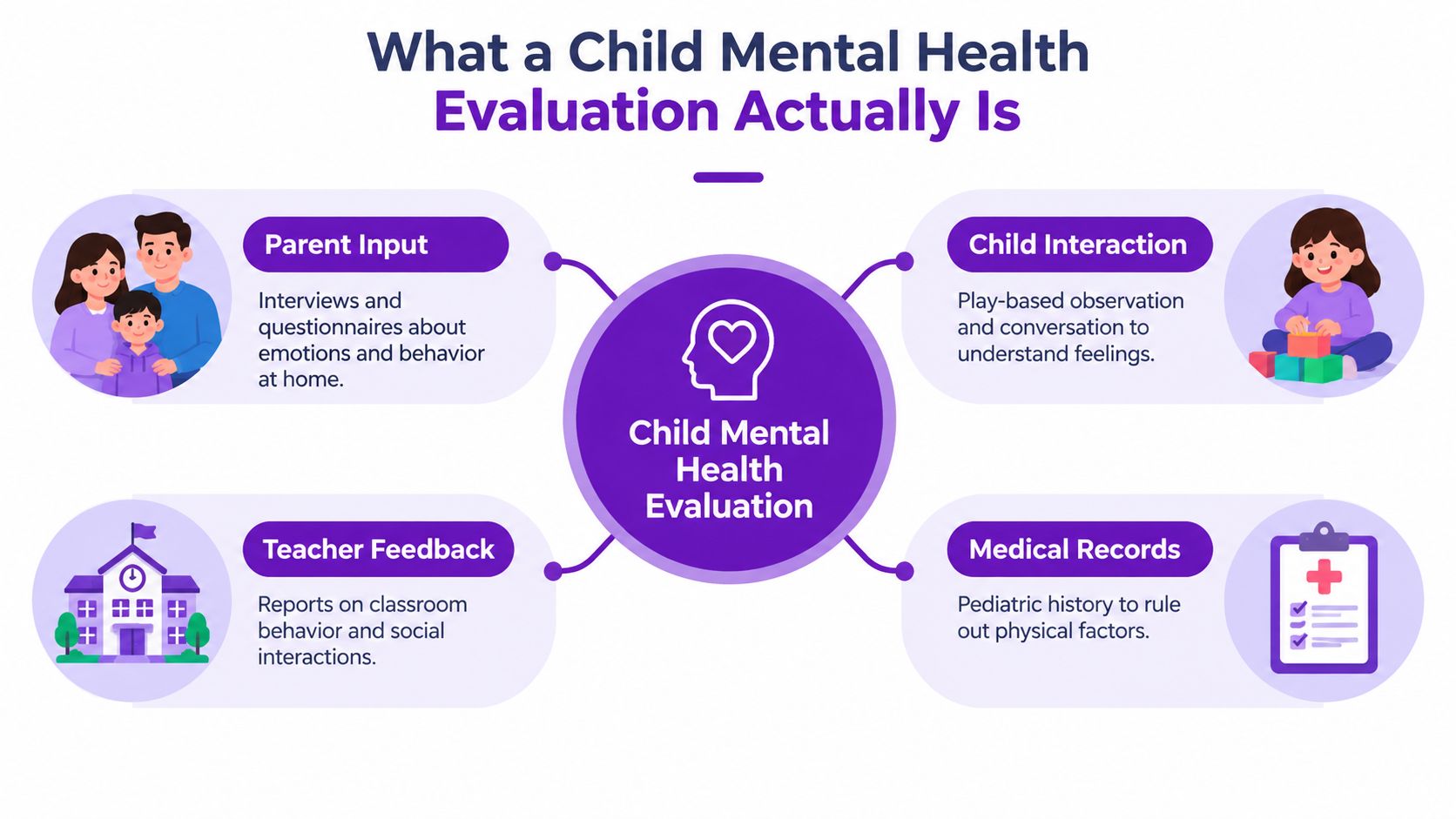
The information usually comes from several places
A clinician may use:
- Parent and caregiver interviews, which describe routines, developmental history, family relationships, and changes at home.
- Child or teen conversations, adjusted for age and comfort.
- Behavior rating scales, completed by adults who know the child in different settings.
- Play-based interaction, especially for younger children who communicate more naturally through play.
- School or pediatric input, when records or consent-based communication can clarify functioning.
- Additional testing, such as educational, speech-language, cognitive, or medical evaluation, when the history suggests it.
A positive screener isn't a diagnosis. Evidence reviewed in a 2024 systematic review of universal child mental health screening found limited evidence for overall effectiveness, although some studies reported increased referrals and better referral adherence after positive screens. The useful interpretation is simple: screening can point toward triage, but a clinician still needs to understand the whole child.
Signs Your Child May Benefit From an Evaluation
Children don't all express distress in the same way. A preschooler may regress in sleep or lose a previously mastered skill, while a teenager may hide distress behind irritability or withdrawal. The strongest reason to seek an evaluation is usually a persistent change that interferes with home life, school, friendships, safety, or development.
For young children, look beyond one difficult afternoon. Intense tantrums that are hard to settle, escalating separation anxiety, repeated sleep disruption, or a loss of developmental progress can justify a conversation with a professional. Parents seeking age-appropriate guidance may also find practical background on helping separation anxiety in infants.
School-age children may avoid school, report frequent stomachaches, stop accepting invitations, melt down over homework, or appear persistently sad. A child who once ran into birthday parties but now refuses to leave the car is showing a meaningful change, even if they can behave comfortably in other situations.
Teens may withdraw from family and friends, show a sharp drop in grades, become persistently irritable, experiment with substances, or mention hopelessness. Self-harm concerns, suicidal thoughts, or threats require immediate attention, not a routine wait for an evaluation. Contact emergency services or a crisis resource available in your area if your child may be in immediate danger.
| Age Group | Emotional Signs | Behavioral Signs | Functional Impact |
|---|---|---|---|
| Young children | Separation fear, intense distress, sadness, loss of confidence | Escalating tantrums, sleep regression, loss of milestones, rigid reactions | Difficulty with routines, preschool participation, or family activities |
| School-age children | Persistent sadness, worry, shame, frequent physical complaints | School refusal, homework meltdowns, friendship drop-offs, avoidance | Missed school, falling work completion, strained friendships |
| Teens | Irritability, hopelessness, emotional numbness, social disconnection | Withdrawal, declining grades, self-harm concerns, substance experimentation | Reduced attendance, unsafe choices, loss of activities and relationships |
Look for patterns, not isolated moments
A child can have a bad week without needing a formal assessment. The concern grows when the pattern persists, appears across settings, or keeps a child from doing ordinary age-appropriate activities. Ask whether your child can recover after disappointment, maintain relationships, sleep reasonably, attend school, and participate in interests.
A mental health evaluation can also help when the cause isn't obvious. Anxiety, attention difficulties, learning problems, trauma, sleep disruption, medical concerns, and family stress can overlap. The purpose isn't to attach a label to every behavior. It's to understand why the pattern is happening and what would make daily life safer and more manageable.
How the Evaluation Process Works Step by Step
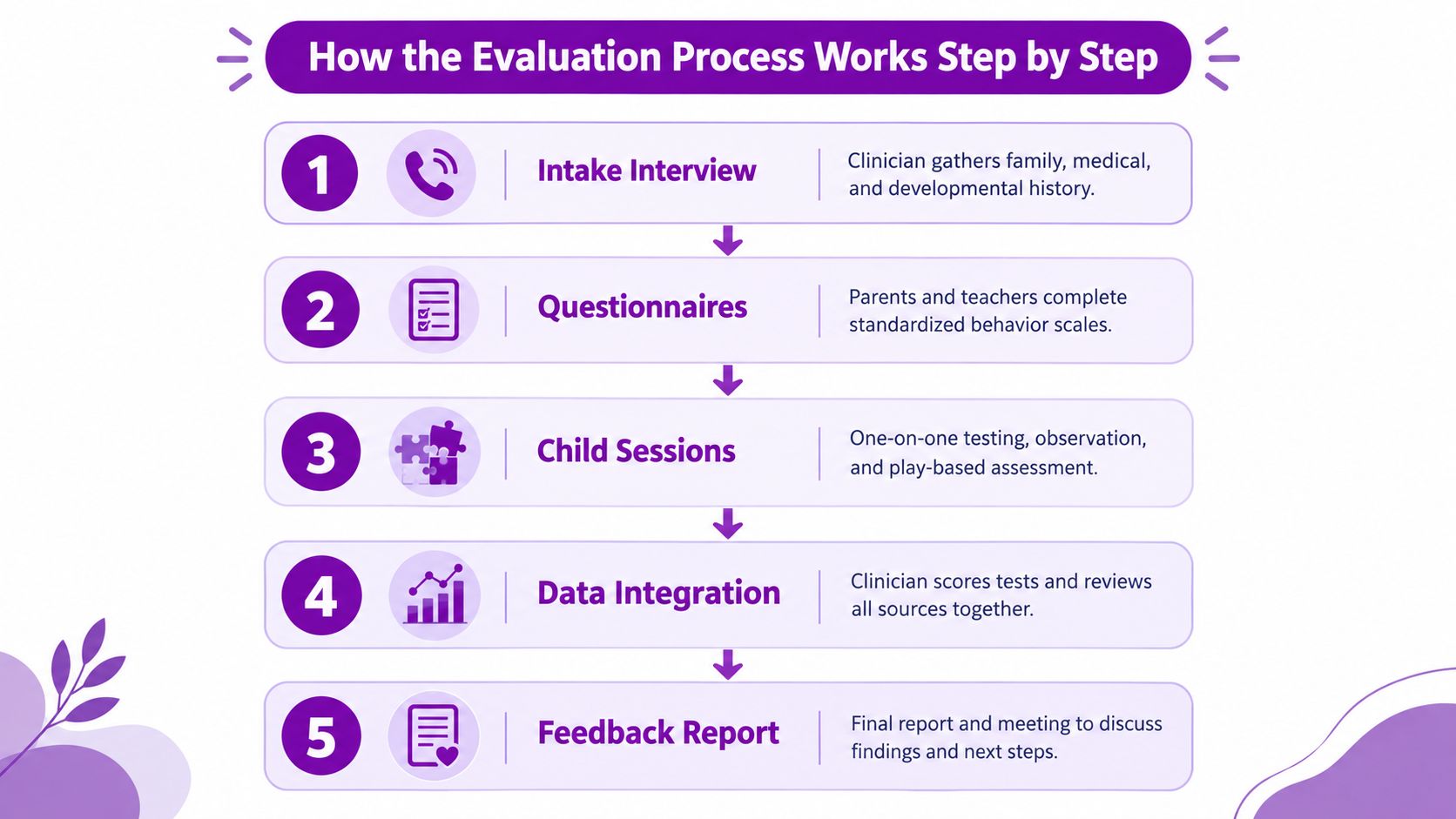
The first appointment usually starts before your child enters the office. During intake, the clinician asks what prompted the call, when the concerns began, what makes them better or worse, and how they affect family life. You'll likely discuss medical history, medications, development, school experience, family history, and previous services.
The American Academy of Child and Adolescent Psychiatry describes an evaluation as taking a few hours across one or more visits, with both parents and the child involved. It may include symptoms, medical and psychiatric history, medications, development, school and peer functioning, family relationships, interviews, and additional testing when needed. (AACAP comprehensive psychiatric evaluation)
What happens during the middle stages
Parents and teachers may complete forms such as the Child Behavior Checklist, Vanderbilt forms, or Conners forms. These tools organize observations about attention, mood, behavior, and functioning. Multiple perspectives matter because a child may struggle at school but not at home, or hold everything together in class and unravel after returning home.
The child's portion depends on age. A younger child may draw, play, answer simple questions, or interact with the clinician through structured activities. An adolescent may have a private conversation about mood, anxiety, friendships, school, safety, substances, and goals. Parents may be asked to join part of the visit and wait outside for another part.
The clinician then combines interviews, forms, observation, and records. Cognitive or academic testing may be considered when learning, language, intellectual development, or school performance needs closer examination. Pediatric input can help identify health factors, while medical review may consider sleep, thyroid concerns, medication effects, or developmental issues that can resemble emotional or behavioral symptoms.
Why one form can't answer everything
A systematic review found that commonly used screeners such as the CBCL, PSC, and SDQ often didn't achieve both high sensitivity and high specificity at the same time, particularly in medically complex or primary care populations. (PubMed review of child mental health screening tools) That's why a responsible evaluation doesn't treat one score as the final answer.
The work may unfold over several sessions rather than one long meeting. Ask the office how many visits are expected, whether a teacher form is needed, and when feedback will occur so you can arrange work, transportation, and school schedules.
Who Performs Evaluations and Which Professional Your Child Needs
The right professional depends on the question you're trying to answer. A pediatrician may begin with a brief screen, review physical health, and refer to a specialist. A licensed child therapist may assess emotional and behavioral concerns while also providing therapy, parent coaching, or play therapy.
A pediatric psychologist is often the better match when the family needs formal testing, an intellectual or learning assessment, or a complex differential diagnosis. A child psychiatrist is a medical doctor who can diagnose, evaluate medical contributors, and prescribe medication when medication becomes part of the plan.
| Professional | Training | Best For | Can Prescribe? |
|---|---|---|---|
| Pediatrician | Medical training in child health | Initial screening, physical health review, referrals | May prescribe within medical practice, but isn't usually the specialist for comprehensive mental health treatment |
| Licensed child therapist | Graduate clinical training and state licensure, such as LCSW, LPC, or LMFT | Anxiety, behavior, family conflict, trauma, emotional regulation, and therapy | Generally no |
| Pediatric psychologist | Advanced psychology training with expertise in child assessment | Learning questions, intellectual testing, autism questions, and complex diagnostic assessment | No |
| Child psychiatrist | Medical degree plus psychiatric specialization | Severe or persistent mood, anxiety, attention, safety, or medically complicated concerns | Yes |
A therapist may be the practical first choice when a child is anxious, overwhelmed, grieving, struggling socially, or having repeated behavioral conflicts. A psychologist may be more appropriate when parents need to understand how cognition, learning, language, or neurodevelopment relates to behavior. A psychiatrist becomes especially relevant when symptoms are severe, safety is a concern, or medication may be needed.
Many families need coordinated care rather than one professional doing everything. A pediatrician may rule out health concerns, a psychologist may clarify testing questions, a therapist may work with the child and caregivers, and a psychiatrist may manage medication. Parents can review the differences among providers in this guide to therapist, psychologist, and counselor roles.
What Happens After the Evaluation and Possible Outcomes
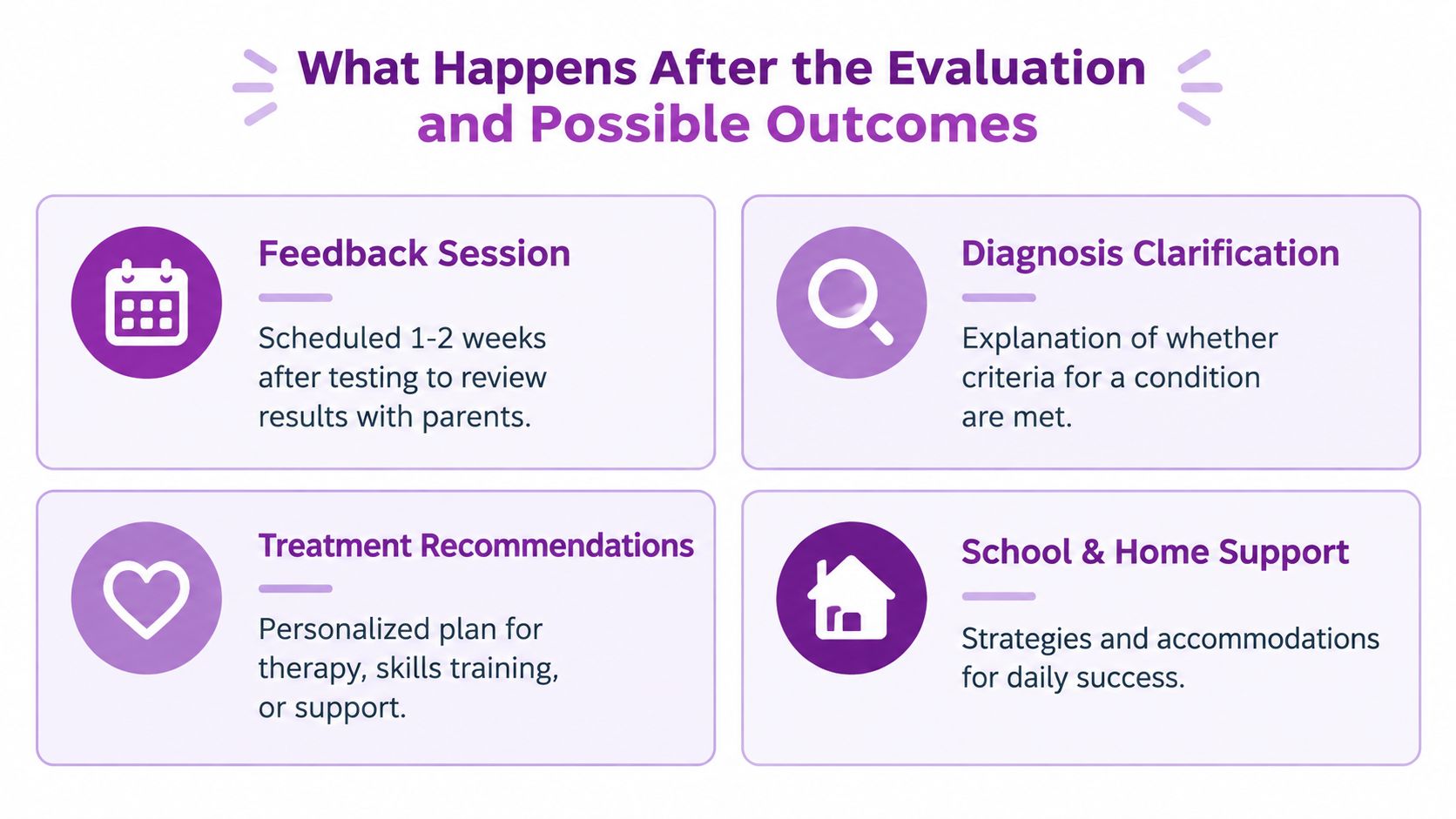
The feedback meeting is where scattered observations become a usable plan. The clinician explains the findings in plain language, describes the child's strengths, answers questions, and discusses what should happen next. Families should leave knowing what the results mean at home, at school, and in relationships.
A written report may summarize interviews, rating-scale results, observations, diagnoses when appropriate, and individualized recommendations. The outcome isn't always a diagnosis. It may be a clear diagnosis such as ADHD, anxiety, depression, autism spectrum disorder, or a trauma-related condition. It may also describe meaningful challenges and strengths without applying a formal label, or recommend further observation when symptoms are mild or still developing.
Turning findings into everyday support
Recommendations might include:
- Individual therapy: A private space to build coping, communication, and emotional regulation skills.
- Play therapy: A developmentally appropriate approach for younger children who communicate through play.
- Family therapy: Support for patterns affecting the whole household.
- Parent coaching: Specific responses for transitions, limits, anxiety, or emotional outbursts.
- School accommodations: Coordination with school staff when symptoms interfere with learning or participation.
- Psychiatric consultation: A medical review when medication may be warranted.
A diagnosis is a tool for choosing support, not a prediction of who your child will become. Recommendations can change as your child develops, symptoms shift, and the family learns what works. Ask the clinician which goals should be addressed first and how progress will be measured.
Preparing for Next Steps in the Phoenix Area
Once you have the evaluation findings, turn them into a short list of actions. Ask which provider should begin care, whether the child needs therapy, play therapy, psychiatry, or a combination, and whether the clinician can coordinate with the pediatrician or school.
Phoenix-area families can compare office-based care with secure online sessions. In-person visits may suit a child who benefits from a dedicated therapeutic setting, while online appointments can reduce commuting and help families work around school, childcare, or transportation. Before scheduling, ask about intake forms, insurance verification, expected wait times, availability of child therapists or play therapists, and access to child psychiatry.
Bring the evaluation report, school observations, relevant medical records, a current medication list, and a short description of your main concerns. You don't need a perfect timeline. A few concrete examples, such as “silence at dinner” or “homework ends in tears,” can help a new provider understand the pattern quickly.
Making the first weeks useful
Keep a brief weekly journal rather than monitoring every moment. Record sleep, school attendance, major emotional episodes, social participation, and one strength you noticed. Schedule a follow-up check-in with the provider after the initial treatment period so the plan can be adjusted based on what you're seeing.
For broader family education, the InchBug awareness resource hub offers material families can use while they learn about mental health and support options. Local guidance on mental health support for families can also help you think through care beyond the evaluation itself.
reVIBE Mental Health has locations in Chandler, Phoenix Deer Valley, Phoenix PV, Scottsdale, and Tempe, with in-person and secure online appointments, therapy, play therapy, and psychiatry with medication management. Call (480) 674-9220 to ask about matching your child with an appropriate provider, insurance verification, and current availability.
Find a reVIBE Location Near You!
We currently have five locations for your convenience. (480) 674-9220
reVIBE Mental Health – Chandler
3377 S Price Rd, Suite 105, Chandler, AZ
reVIBE Mental Health – Phoenix Deer Valley
2222 W Pinnacle Peak Rd, Suite 220, Phoenix, AZ
reVIBE Mental Health – Phoenix PV
4646 E Greenway Road, Suite 100, Phoenix, AZ
reVIBE Mental Health – Scottsdale
8700 E Via de Ventura, Suite 280, Scottsdale, AZ
reVIBE Mental Health – Tempe
3920 S Rural Rd, Suite 112, Tempe, AZ
If your child's behavior, mood, school life, or relationships have changed, contact reVIBE Mental Health to discuss whether therapy, play therapy, or psychiatry fits the next step. Visit reVIBE Mental Health to explore Phoenix-area locations, online sessions, provider matching, and insurance support.