In the CDC's nationally representative 2023 Youth Risk Behavior Survey, 76.1% of U.S. high-school students reported at least one adverse childhood experience, and 18.5% reported four or more, according to the CDC MMWR report. The CDC treats these as potentially traumatic childhood experiences that can affect physical and mental health across the life course. Child trauma symptoms still don't arrive as one label a child can name. A teen may look irritable, a younger child may cling, and a school screen for sadness may stay quiet.
Exposure is common. What follows is a lookup by cluster and age, a way to separate trauma from look-alike behavior, and concrete steps for caregivers and teachers. A sign shows a change worth recording. It does not, by itself, prove a diagnosis.
Child Trauma Symptoms at a Glance
A National Child Traumatic Stress Network summary of the 2005 National Survey of Children Exposed to Violence reported that more than half of sampled children experienced a physical assault during the study year, and more than one in three witnessed violence. The same summary notes that more than one in eight experienced child maltreatment such as abuse or neglect, and more than one in twelve experienced sexual victimization. The same NCTSN summary cites National Comorbidity Survey findings that 60.7% of U.S. males and 51.2% of U.S. females aged 14 to 24 reported exposure to at least one traumatic event.
Those exposures can be followed by re-experiencing, avoidance or emotional numbing, heightened arousal, distress, and trouble with daily functioning. The Children's PTSD Inventory organizes related patterns into trauma exposure and situational reactivity, re-experiencing, avoidance and numbing, increased arousal, and significant distress or impairment. A child may show fear, withdrawal, irritability, sleep or concentration problems, or a drop in functioning without ever saying the word trauma.
Scan the clusters below. The pattern matters more than any single sign, and a child may show only one or two rows.
| Symptom cluster | Observable signs | Typical example |
|---|---|---|
| Intrusion | Distressing memories, nightmares, flashbacks, trauma-themed reenactment in play | Repeated play about the event |
| Avoidance | Avoiding people, places, reminders, or conversations about the event | Refusing to enter a certain room or go to school |
| Negative mood and cognition | Fear, sadness, guilt, shame, detachment, reduced positive emotion | Saying the event was their fault |
| Altered arousal | Irritability, aggression, hypervigilance, exaggerated startle, poor concentration, sleep disturbance | Jumping at sudden sounds |
| Functional change | Regression, school decline, relationship or attachment problems, unexplained aches | Stomachaches before school |
How to use the table
Pick a specific event or loss, not a vague “bad year.” Note which signs are new since that point, and write the week they started. A stomachache every Monday after a crash is different from a stomachache that has come and gone for years.
Practical rule: Date the change. A new sign that started after a known event is more useful to a clinician than a long list of ordinary worries.
Developmental stage still shapes the read. A preschooler reenacts. A teen may go quiet or take risks. Neither presentation is “more real” than the other.
Core Symptom Clusters Explained With Examples
Clinicians document clusters in a set order, because NCTSN trauma screening guidance treats symptoms as a developmentally shaped pattern, not one behavior. Intrusion includes distressing memories, nightmares, flashbacks, trauma-specific reenactment in play, or a body reaction when reminded. Avoidance covers trauma-related thoughts, feelings, people, places, or conversations. Negative mood and cognition include fear, sadness, guilt, shame, detachment, reduced positive emotion, or constricted play. Altered arousal includes irritability, aggression, hypervigilance, exaggerated startle, poor concentration, reckless behavior, and sleep disturbance.

Five clusters, one example each
Intrusion is the event returning without an invitation. Say a six-year-old lines up toy cars and crashes them in every play session, same sequence, same ending. Another child wakes from nightmares around the same hour most nights and cannot say why the dream feels stuck.
Avoidance can look cooperative. A child refuses one route to school, will not enter a room, or changes the subject the moment a family argument is mentioned. Adults may call that “easygoing” because the child stays calm as long as the reminder stays away.
Negative mood and cognition often sounds like character, not injury. “I should have stopped it” is self-blame. Flat affect can look like being good: little joy, little protest, play that stays narrow.
Altered arousal is a nervous system that will not stand down. A slammed door makes the child jump, then homework never starts because attention keeps scanning the room.
Functional change is the cost in ordinary life. Grades drop after a move that followed a frightening event, friendships thin out, or skills the child had already mastered slip.
Children younger than six
In children younger than six, the same guidance says clinicians should look at relationships with caregivers, siblings, and peers. Symptoms often show through play, attachment behavior, regression, or emotional regulation, not a verbal story. If you can, write the child's baseline from before the event: sleep, toileting, clinginess, and how play used to look.
A useful caregiver record has three parts: what happened, when the change began, and what changed at home and at school. Those notes support a full evaluation. They do not replace one.
Pick the two clusters you see most clearly. Write two specific examples for each, with a day or week attached.
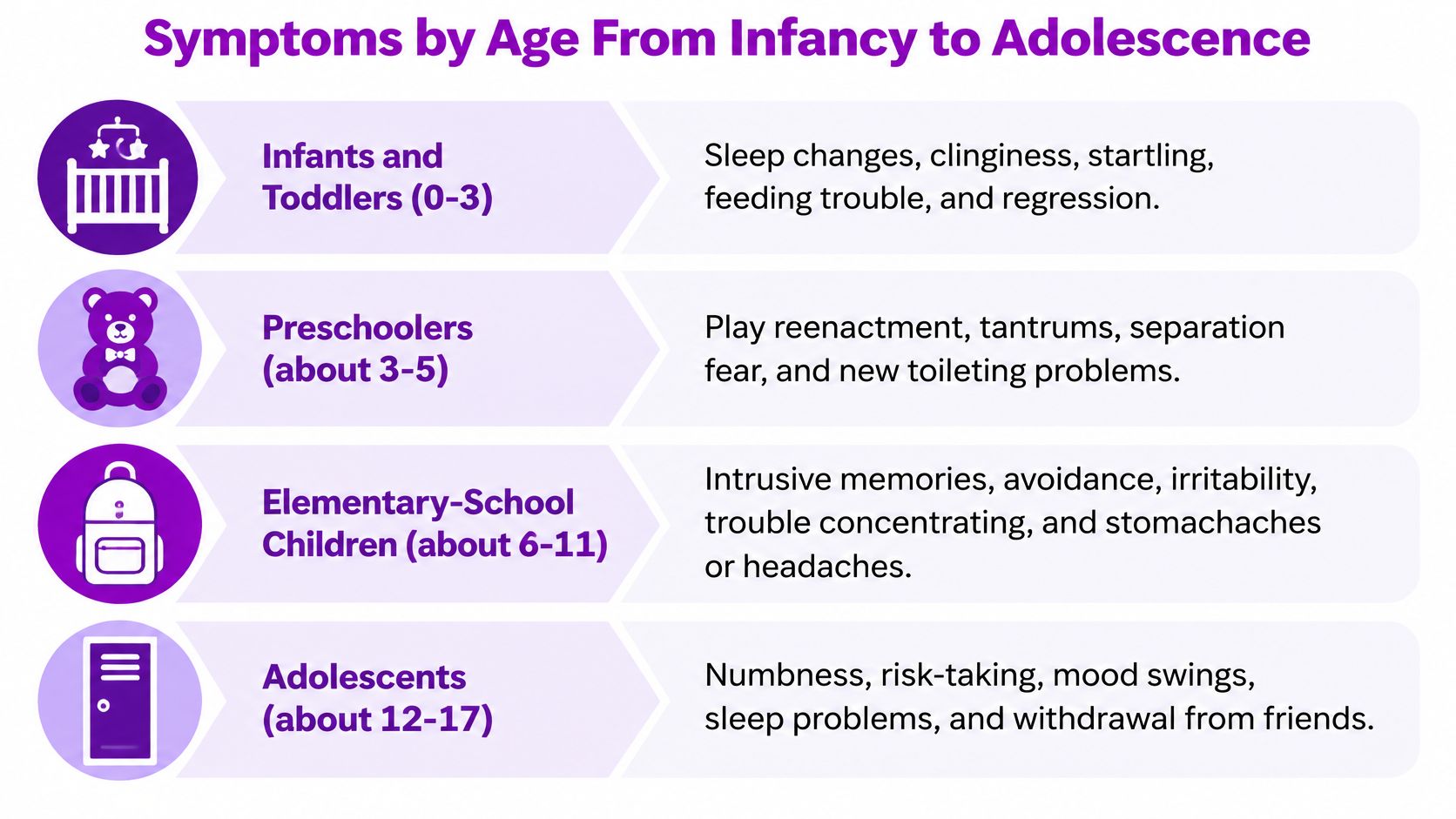
Symptoms by Age From Infancy to Adolescence
The same stress response does not look the same at four and at fourteen. Match each sign to this child's baseline and to how long it has lasted, not only to the age row.
| Age group | Common trauma signs | Often mistaken for |
|---|---|---|
| Infants and toddlers (0-3) | Developmental regression, disrupted sleep, altered attachment, increased startle, repetitive trauma-themed play | Clinginess, defiance, or a passing phase |
| Preschoolers (about 3-5) | Separation fears, frequent crying or screaming, nightmares, poor appetite | Ordinary tantrums or bedtime resistance |
| Elementary-school children (about 6-11) | Anxiety, guilt, shame, poor concentration, sleep difficulty, withdrawal, aggression | Laziness, attention problems, or bad behavior |
| Adolescents (about 12-17) | Depression, self-harm, substance use, withdrawal, risky behavior, aggression | Typical teen moodiness or rebellion |
What each stage is easy to misread
Clinical descriptions of trauma in children ages 0 to 3 point to developmental regression, disrupted sleep, altered attachment, increased startle, and repetitive trauma-themed play, with assessment resting on caregiver observation rather than the child's own report, as summarized in recent clinical evidence on early childhood trauma. Parents often file clinginess, toileting changes, aggression, withdrawal, or repetitive play under defiance or a phase. Those signs are not trauma-specific. Neurodevelopmental differences, grief, illness, family stress, and ordinary variation can look similar. Tools for this age are also less developed than tools for older youth, so observation across home and care settings matters.
SAMHSA's child trauma guidance identifies separation fears, frequent crying or screaming, nightmares, and poor appetite in preschool children. A new refusal to leave a caregiver after a frightening night is not the same as a long-standing bedtime battle.
Elementary-school children may show anxiety, guilt, shame, poor concentration, sleep difficulty, withdrawal or loss of interest, and aggression. Calling that laziness skips the question of whether focus collapsed after a specific event.
In middle and high school, warning signs can include depression, self-harm, substance use, withdrawal or disinterest, risky behavior, and aggression. Rebellion is a common misread when the shift is new, sharp, and tied to reminders.
A young child's regression or separation distress can be a trauma signal even when the child cannot describe intrusive memories in adult terms.
Hidden Signs and Look-Alike Conditions
A primary-care analysis of 24,675 youth ages 11 to 19 found that 15.5% reported trauma exposure, 7.5% reported moderate or high traumatic-stress symptoms, only about half of those with high traumatic-stress symptoms also had high anxiety and/or depression scores, and higher traumatic-stress symptom rates appeared among older, female, and Hispanic youth, as described in this AHRQ Integration Academy record of the analysis. A normal anxiety or depression screen does not clear trauma. A child can look composed, say “I'm fine,” or sit under a depression cutoff and still struggle at home or school.
Hidden reactions often show up in ordinary places. A stomachache before the bus works like a smoke alarm: it signals distress without naming the cause. The complaint is real. It does not, by itself, prove trauma, illness, or defiance.
Masked signs often include:
- Irritability: snapping at small requests after reminders of the event.
- School decline: grades or attendance drop without a learning explanation.
- Risk-taking: new reckless choices that do not match the child's history.
- Emotional numbing: “I'm fine” with a flat face and lost interest.
- Sleep problems: trouble falling asleep or staying asleep.
- Headaches or stomachaches: body complaints that cluster around school or reminders.
- Concentration difficulty: work that used to be easy now stalls.
- Relationship changes: pulling away from friends or clinging to one adult.
| Look-alike condition | Shared sign | Distinguishing question |
|---|---|---|
| Grief | Sadness, sleep change, withdrawal after a death | Did the change begin after a specific loss? |
| Medical illness | Fatigue, headaches, stomachaches | Has a medical check ruled out a physical cause? |
| Family stress | Irritability, sleep change, school decline | Did the change follow a household change such as separation, illness, or job loss? |
| ADHD | Concentration problems, impulsivity | Did inattention rise after an event, or appear mainly around reminders? |
| Anxiety or depression | Sleep problems, withdrawal, irritability | Do the symptoms trace to a specific event? |
| Attachment difficulties | Clinginess and regression in very young children | Did it follow caregiver instability or separation? |
| Sensory processing differences | Startle and reactions to sounds or touch | Do reactions appear across all settings, or mainly after an event? |
Exposure alone does not establish PTSD. Timing, symptom clusters, persistence, safety, and impact across settings still have to be assessed. PTSD is the subset of trauma reactions that meets full diagnostic criteria. Trauma-related impairment can matter even when that bar is not met.
The separating test is practical. Ask whether the change lines up with a known event, whether it persists, whether home and school are both affected, and whether this is a shift from the child's own baseline. A simple timeline helps: date the change, note the reminder that sets it off, and record what home and school each see. Families teaching at home can pair that log with broader safeguarding responsibilities for home schooling, so welfare concerns are not left only to a symptom checklist. If behavior is the main complaint, a child behavioral problems review can sit alongside the trauma questions rather than replacing them.
Note which look-alike the pattern most resembles, and bring that observation to the evaluation. A functional change still deserves a closer look, even without flashbacks or a depression diagnosis. Do not assign a label from the table alone.
When to Seek a Trauma Assessment
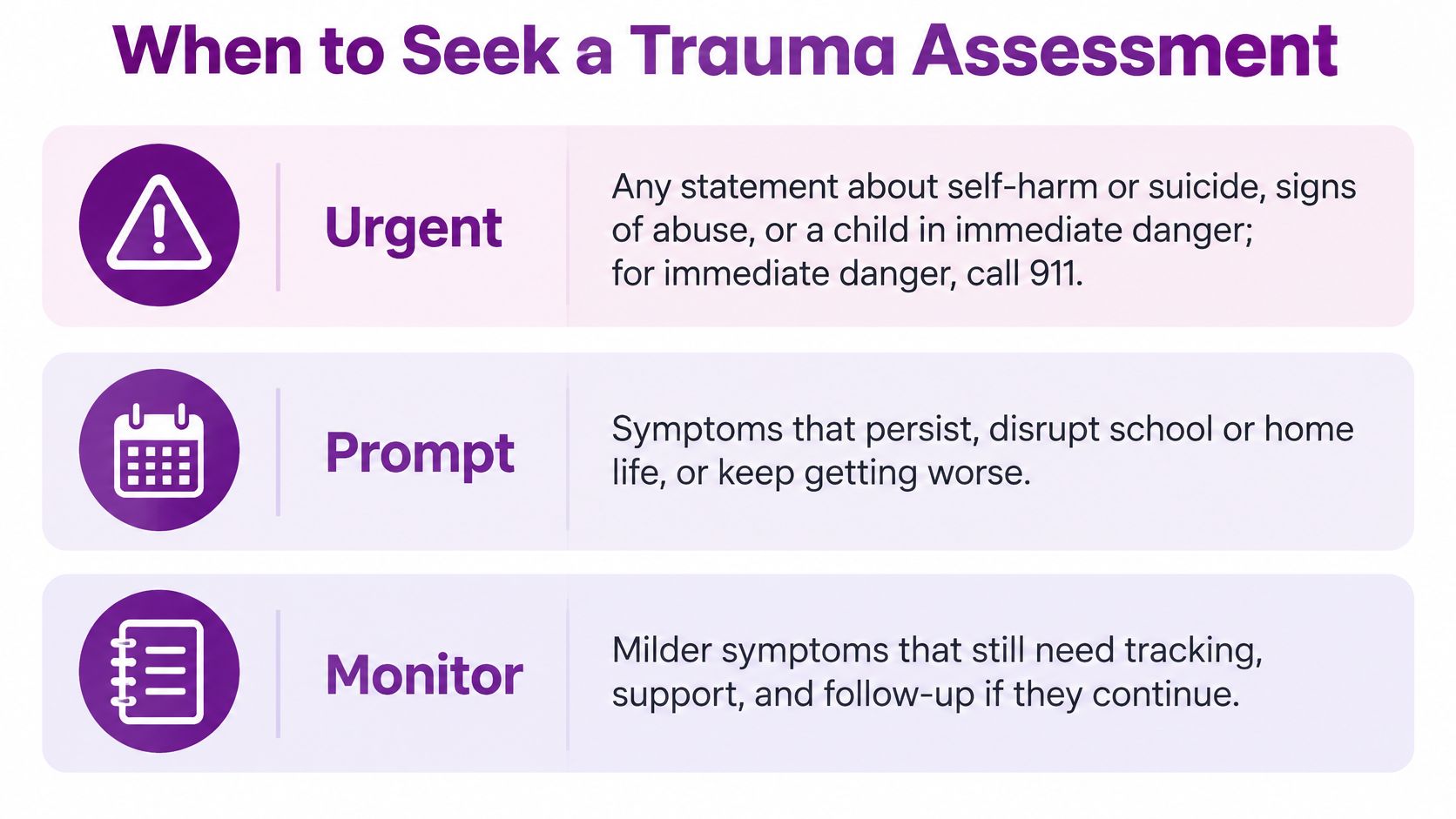
The right time for an assessment depends on safety, how much the child's functioning has changed, and whether symptoms persist. Screening can identify concerns and indicate when a fuller, trauma-informed evaluation is needed.
Three decision tiers
- Urgent. Seek immediate help if a child talks about self-harm or suicide, abuse is suspected, or the child is in immediate danger. Call 911 if there is immediate danger.
- Prompt, within days. Arrange an assessment if behavior, sleep, or school functioning changes sharply after an event such as abuse, violence, a serious accident, or a death.
- Routine. If symptoms continue for several weeks, even when mild, or the child keeps avoiding reminders, consider an assessment. Ongoing symptoms can merit attention even without an immediate crisis.
What the assessment includes
The National Child Traumatic Stress Network's trauma screening guidance distinguishes screening, which helps identify possible concerns, from a diagnostic assessment. Measures may include the 10-item Child Trauma Screen for ages 6 to 17, observer measures such as the Child Stress Disorders Checklist, and the Child Report of Post-traumatic Symptoms, which can track change over time. A fuller assessment may combine an interview, standardized measures, behavioral observation, developmental history, and an evaluation of how symptoms affect daily life. It also considers concerns that can overlap with trauma, such as depression, anxiety, ADHD, sleep problems, attachment difficulties, and behavioral dysregulation.
For younger children, caregiver interviews and observation of caregiver-child interaction can provide important context. The Diagnostic Infant and Preschool Assessment covers children from 9 months through 6 years. Repeated measures may help track change, but results need to be considered alongside clinical judgment, development, culture, and current safety.
A child mental health evaluation can help clarify what support is appropriate when screening indicates that more assessment is needed.
What to bring
- A written timeline of the event and subsequent changes, with dates.
- Current supports, including relatives, school staff, and any prior care.
- School observations, such as attendance, peer conflict, and reactions to bells or noise.
- Questions about confidentiality, including what a clinician must report.
At the first appointment, the clinician can explain confidentiality limits, ask about safety, and begin assessing the child's symptoms and needs. A timeline helps make changes easier to describe accurately.
What Caregivers and Teachers Can Do Now
You can steady the week before an appointment exists.
- Keep cues predictable. Same bedtime, meals, and drop-off. Predictability tells a jumpy nervous system what happens next.
- Name the feeling, not the behavior. “The loud door scared you” is clearer than “Stop overreacting.” Stay nearby when a reminder hits.
- Don't press for a full retelling. Let the child talk when ready. If the child discloses harm, write the exact words and the date.
- Keep a dated log. What happened, when each change began, and what shifted at home and at school. Bring it to the clinician.
- Teachers can lower the load without a spotlight. A predictable seat, a quiet exit, and one trusted adult for check-ins help. Note patterns across lessons, including reactions to bells, physical contact, slamming doors, or sudden movement. An educator toolkit from NCTSN also flags headaches, stomachaches, concentration trouble, academic changes, angry outbursts, withdrawal, absenteeism, and repeated talk about the event as clues, not as a diagnosis on their own, in the NCTSN child trauma toolkit for educators.
- Escalate when safety is in question. Use the urgent tier if self-harm, abuse, or immediate danger is suspected.
- Get support for yourself. A strained caregiver changes how a child settles. Ask the pediatrician or school counselor for your own support, not only the child's.
Early-years programs often pair those steady routines with a Kids Club Early Learning Centre resilience guide so adults practice calm responses, not only symptom watching.
Choose one step today. Record what you tried and what the child did next. That single line starts the log.
Therapies Used for Child Trauma
No single method fits every age or every caregiver schedule. The comparison below is a starting map, not a promise of outcome.
| Approach | Typical focus | Best suited for |
|---|---|---|
| Play therapy | Expressing emotions through play, art, sand tray, storytelling, and movement | Younger children who cannot yet describe events in words |
| Trauma-focused CBT | Recognizing and changing trauma-related thoughts and behaviors, with caregiver involvement | Children and teens with trauma symptoms and a caregiver able to take part |
| EMDR | Reprocessing distressing memories with bilateral stimulation such as eye movements, taps, or sounds | Older children, teens, and adults with trauma-related PTSD, anxiety, or phobias, adapted by the clinician |
Play therapy gives a child toys, art, a sand tray, stories, and movement when words are thin. Non-directive play lets the child lead. Directive play is more structured and targets specific behaviors or concerns. Both still need a trained clinician.
Trauma-focused CBT works with the child and, usually, a caregiver. Sessions build skills, then look at trauma-related thoughts and behaviors in a planned sequence. It fits when a caregiver can attend and practice between visits.
EMDR asks the person to hold a distressing memory while using bilateral stimulation, such as eye movements, taps, or sounds. Clinicians use it for PTSD, anxiety, and phobias, and they adapt the pace for older children and teens.
Children in foster care often need the same menu plus a stable daily base. Families comparing placement models can explore therapeutic fostering models to see how caregiving and therapy are meant to work together.
Practical notes before you choose
Age, language, and whether a caregiver can join all change the fit. A trained clinician should confirm the approach after assessing safety and overlapping conditions. Progress is tracked by repeating measures, not by a single good week. Our child therapy resources outline how those choices are organized for families.
Ask which approach is used, how caregivers take part, and how progress will be measured. If the answers stay vague, keep looking.
Book a Trauma-Informed Evaluation for Your Child
A useful first visit starts before anyone sits down. Write a short timeline from the age-band table: when sleep, school, or relationships shifted, and what was happening in the child's life then. Beside each date, name the symptom cluster you can observe. Then sort the situation. Immediate danger to the child or anyone else means call 911 before you book. A prompt visit fits when symptoms worsen week to week. A routine visit fits when the pattern is steady but still disrupts daily life.

Those notes work like a map. A cluster at one age can resemble trauma and still belong to another concern, such as anxiety, grief, or ADHD. Caregivers and teachers should each write what they saw, where, and how often. The clinician uses that contrast to separate trauma from look-alike behavior. Your list does not prove a diagnosis. It keeps the hour tied to dates instead of a story rebuilt in the waiting room.
reVIBE Mental Health serves Scottsdale, Tempe, Chandler, Phoenix, and Paradise Valley, Arizona, with in-person visits and secure online sessions, and appointments are available seven days a week. Clinicians are trained to support children and adults with trauma, PTSD, anxiety, depression, and grief. Play therapy addresses anxiety, trauma and PTSD, behavioral issues, and emotional regulation. Family therapy often includes collaboration with parents and caregivers. In the first session, the therapist explains the limits of confidentiality.
Bring the timeline, the clusters, and any teacher notes. Visit reVIBE Mental Health to match with a clinician whose training, schedule, and insurance fit the plan you need.