Celexa can work for anxiety, but its evidence base is thinner than that of some other SSRIs. In a controlled trial of escitalopram, the related active enantiomer, response rates were 58% versus 38% for placebo, while citalopram itself has continued to be used for anxiety, particularly panic disorder.
But does Celexa work equally well for every type of anxiety? That question matters because generalized anxiety disorder, panic disorder, and social anxiety can look similar from the outside while creating different treatment challenges. A medication that helps reduce persistent worry may not be the strongest choice for someone whose main problem is recurrent panic or fear of social judgment.
Understanding Whether Celexa Helps Anxiety
Consider someone who spends most of the day anticipating problems. They worry about work, health, finances, and relationships, then lie awake reviewing conversations and possible mistakes. They ask whether Celexa might quiet the constant alarm, but they also need to know whether it's the right medication for their particular pattern of anxiety.
Yes, citalopram, sold under the brand name Celexa, can help anxiety. It's a selective serotonin reuptake inhibitor, or SSRI, and clinical evidence supports benefit for generalized anxiety symptoms and panic disorder. The important qualification is that its research base is less substantial than the evidence for escitalopram, sertraline, and some other commonly recommended options.
That doesn't make Celexa ineffective. It means a prescriber needs to consider the diagnosis, previous medication response, other health conditions, and likely tolerability rather than treating the search phrase “does Celexa work for anxiety” as a simple yes-or-no decision.
Anxiety is not one single condition
Generalized anxiety disorder tends to involve persistent worry across several areas of life. Panic disorder centers on unexpected panic attacks and fear of having another one. Social anxiety focuses on scrutiny, embarrassment, and avoidance of social or performance situations.
Citalopram has been evaluated across anxiety presentations, but the strength of support differs by condition. Product information describes citalopram as an option for panic disorder with or without agoraphobia, while modern guidance more often gives prominent first-line status to escitalopram, sertraline, paroxetine, venlafaxine, or duloxetine for adult anxiety.
Practical rule: The medication should match the person's symptoms and medical history, not just the word “anxiety” on a problem list.
Anxiety often occurs alongside depression, and that combination can influence the treatment conversation. People seeking broader information about overlapping mood and health concerns may also find Sunridge Medical depression care useful as general educational context. A psychiatric evaluation can then determine whether citalopram, another SSRI, therapy, or a combination makes sense.
What the Evidence Shows About Celexa and Anxiety
The strongest way to interpret Celexa research is to separate direct citalopram evidence from evidence about escitalopram, its active enantiomer. The two medications are closely related, but results for escitalopram shouldn't automatically be presented as if they were trials of Celexa itself.
In a randomized controlled trial involving adults with generalized anxiety disorder, 158 patients received escitalopram and 157 received placebo. Over 8 weeks, mean improvement on the Hamilton Anxiety Rating Scale was -11.3 with escitalopram versus -7.4 with placebo, and response rates were 58% versus 38% using last-observation-carried-forward analysis. The trial supports the anxiolytic potential of the SSRI family and provides useful context for Celexa, but it isn't a direct citalopram trial. The escitalopram randomized trial presents that comparison.
Direct citalopram findings
Citalopram itself has been studied in adults with anxiety, including generalized anxiety disorder. In one comparative study of 100 outpatients with GAD, reported treatment efficacy increased from 20% at 2 weeks to 56% at 4 weeks and 70% at 12 weeks. The figures suggest that improvement may build gradually rather than appearing immediately, although a result from one study shouldn't be treated as a guarantee for an individual patient. The citalopram and anxiety disorders publication summarizes this evidence.
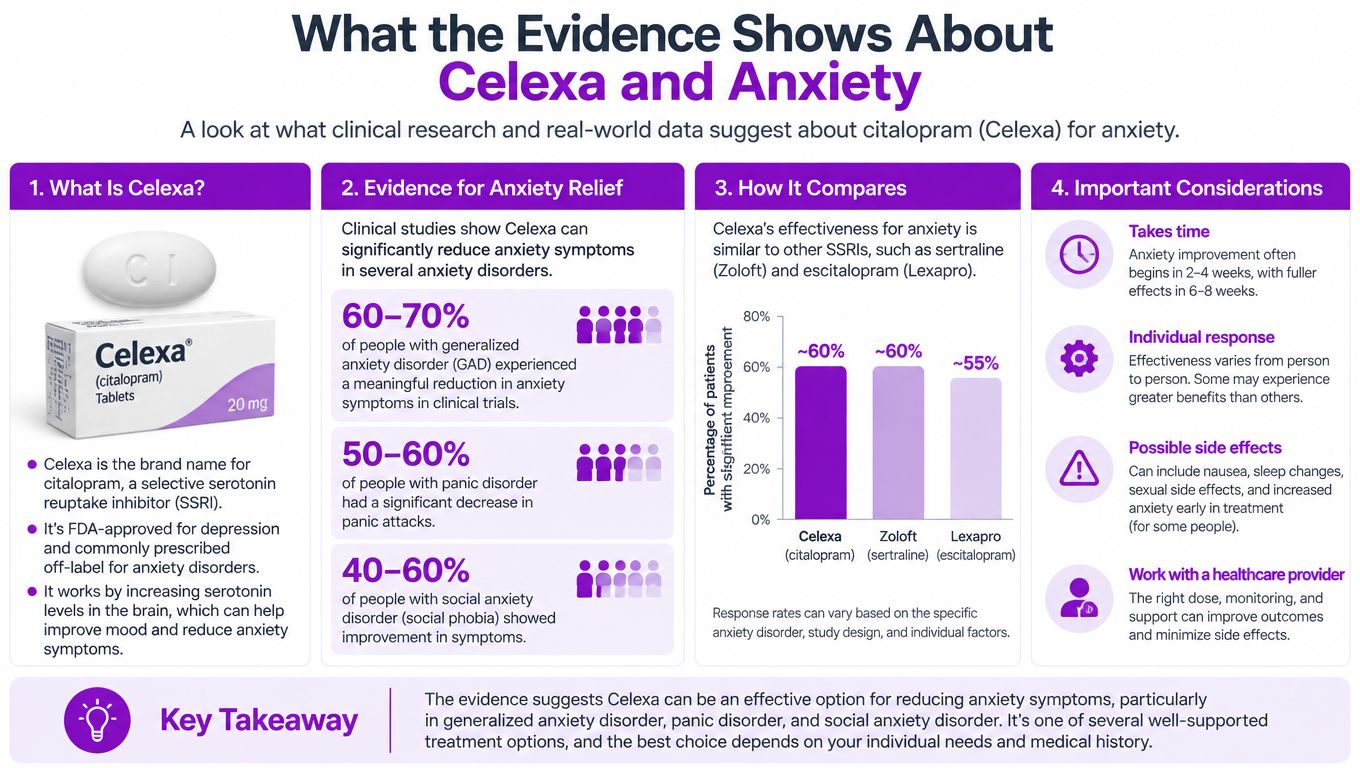
The evidence is more persuasive for possible benefit than for Celexa being the leading evidence-based choice across all anxiety disorders. A recent review notes randomized controlled trial support for citalopram versus placebo in generalized anxiety disorder, while a guideline review found insufficient evidence to rank it among first-line agents for anxiety in general populations. That distinction is clinically meaningful. A medication can help some patients without being the option with the deepest or most consistent evidence.
Where panic disorder fits
Citalopram's position may be clearer in panic disorder than in broad generalized anxiety guidance. A peer-reviewed review of panic disorder research describes citalopram as significantly more effective than placebo in a cited study, with both 20 to 30 mg per day and 40 to 60 mg per day ranges outperforming placebo, while the lower range performed better than the higher range in that study. The peer-reviewed panic disorder review provides the source context.
Taken together, the evidence supports a balanced conclusion: Celexa can work, but confidence in its use depends on the anxiety phenotype. Escitalopram, sertraline, and paroxetine often receive more attention in generalized anxiety guidance, while citalopram remains a clinically relevant option, especially when a prescriber believes its expected benefits and tolerability fit the patient.
How Celexa Works and What to Expect
Celexa belongs to the SSRI class. In plain language, it changes how nerve cells handle serotonin, a chemical messenger involved in mood and emotional regulation. The effect isn't like turning off an alarm instantly. It's closer to gradually adjusting an overly sensitive alarm system so that ordinary stress signals produce less intense reactions.
The first part of treatment can feel confusing because side effects may appear before anxiety improves. Citalopram product information notes that early paradoxical anxiety can occur and may settle within the first 2 weeks. Experimental findings after a single dose have also shown increased fear or anxiety signals during threat-processing tasks, which helps explain why early activation doesn't automatically mean the long-term treatment will fail. Citalopram product information describes the rationale for gradual initiation.
Dose changes should be supervised
The FDA label states that Celexa should be started at 20 mg once daily and increased to a maximum of 40 mg once daily only after at least 1 week. Doses above 40 mg per day aren't recommended because of the risk of QT interval prolongation. The FDA Celexa prescribing information gives the labeled dosing and safety limits.
An anxiety-focused plan may still involve cautious titration, particularly when early activation is a concern. Your prescriber may adjust the pace based on symptoms, age, other medications, and medical history. Don't change the dose or stop treatment abruptly without medical guidance.
Improvement usually develops over time rather than after a single tablet. You may first notice that worry feels less physically overwhelming, sleep becomes easier, or avoidance loses some of its grip. A useful explanation of why antidepressant benefits take time is available in this guide to how long antidepressants take to work.
What to monitor early
During the initial period, track both symptoms and tolerability. Note changes in panic, worry, sleep, agitation, mood, and daily functioning. Report marked worsening, troubling restlessness, suicidal thoughts, unusual mood elevation, or other urgent concerns promptly.
Early jitteriness is a reason for contact with the prescriber, not a reason to make an unsupervised decision. A clinician can determine whether the reaction is an expected adjustment effect, a dosing problem, an interaction, or evidence that another treatment would be safer.
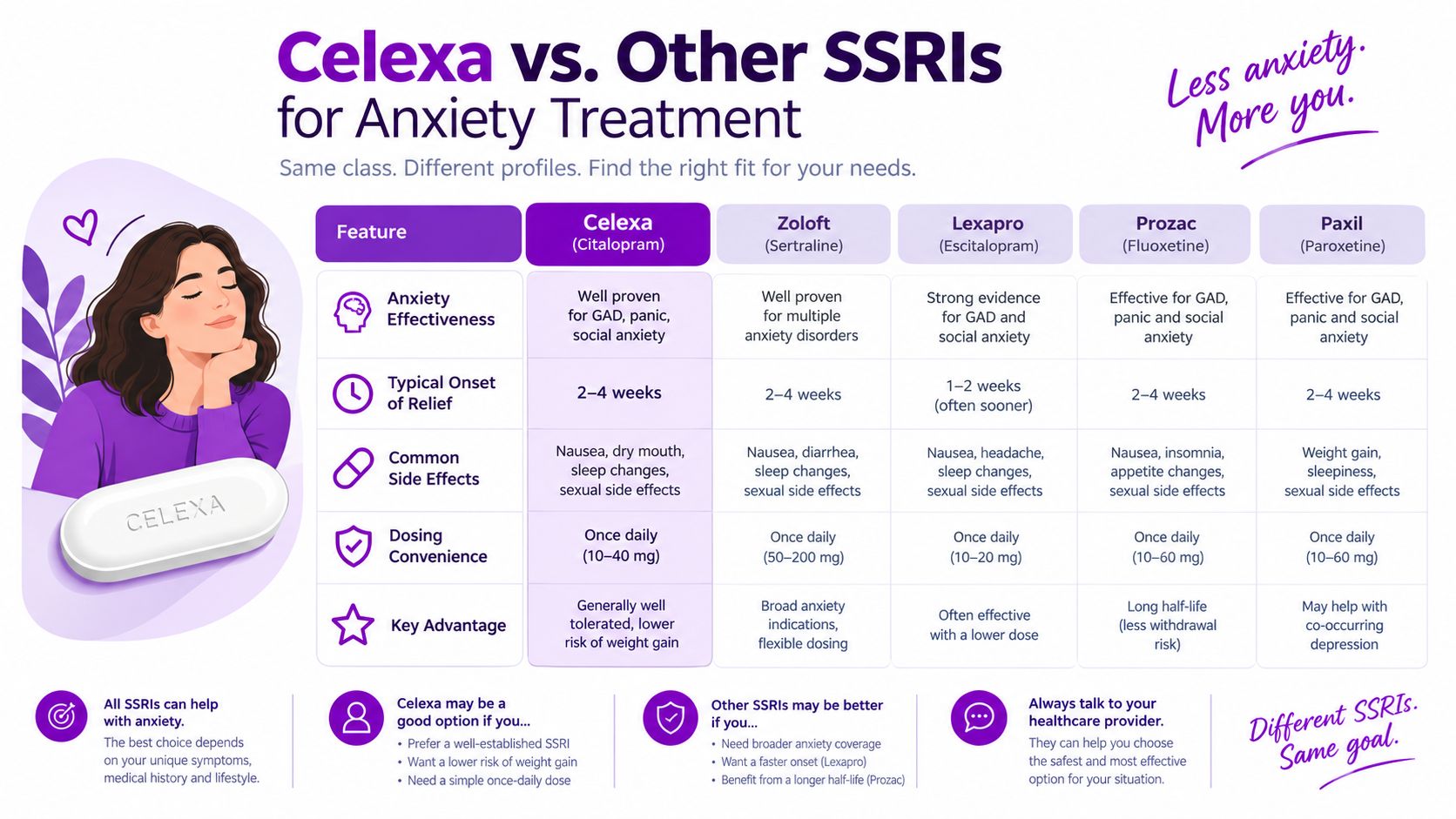
Celexa vs Other SSRIs for Anxiety Treatment
A comparison with other SSRIs helps explain why a prescriber might recommend Celexa even when another medication has a stronger guideline position. Escitalopram is the active enantiomer related to citalopram and has a particularly strong published evidence base for generalized anxiety disorder. The controlled trial discussed above gives clinicians more direct confidence in escitalopram for that condition.
Sertraline is commonly considered for anxiety disorders because it has broad clinical use and appears in modern first-line recommendations. Paroxetine also has an established place in anxiety treatment guidance, although its side-effect profile and individual tolerability can make it less appealing for some patients. These choices aren't automatically superior for every person. Previous response, adverse effects, interactions, pregnancy considerations, and coexisting depression all matter.
| Medication | How clinicians may think about it |
|---|---|
| Citalopram, Celexa | A reasonable option when expected benefit and tolerability fit the patient, with particular attention to cardiac safety and the thinner anxiety evidence base. |
| Escitalopram, Lexapro | Closely related to citalopram, with stronger direct evidence for generalized anxiety disorder. |
| Sertraline, Zoloft | Frequently included among first-line SSRI options for adult anxiety. |
| Paroxetine, Paxil | Supported in anxiety guidance, but the prescriber must weigh its individual tolerability and medical considerations. |
Match the medication to the presentation
For someone with persistent generalized worry, a clinician may lean toward an SSRI with more direct GAD evidence. For someone with panic symptoms, citalopram may remain part of a reasonable discussion because evidence and product information support its use in that area. For social anxiety, the decision should account for avoidance patterns, performance fears, depression, and the patient's prior experience with medication.
There isn't a universal winner. One person may find Celexa manageable and helpful after another SSRI caused intolerable effects. Another may benefit more from escitalopram or sertraline because the evidence and symptom fit are stronger. A focused comparison of Celexa and Cymbalta can help frame a conversation about SSRI and SNRI options, but it shouldn't replace individualized prescribing.
The most useful question for an appointment is not “Which drug is best?” Ask instead: “Which anxiety pattern are we treating, what evidence supports this choice, and how will we judge whether it's helping?”
Safety Considerations and Important Warnings
A common assumption is that an SSRI is automatically low risk because it isn't a sedative or habit-forming medication. Citalopram requires a more careful discussion, particularly because it can affect the heart's electrical rhythm in a dose-dependent way.
The FDA states that Celexa causes dose-dependent QT interval prolongation and has been associated with torsades de pointes, ventricular tachycardia, and sudden death. The FDA advises against its use in people with congenital long QT syndrome, bradycardia, low potassium or magnesium, a recent myocardial infarction, or uncompensated heart failure. The FDA's Celexa safety clarification explains these warnings.
What to tell your prescriber
Before starting citalopram, disclose:
- Heart history: Include rhythm problems, fainting episodes, heart failure, prior heart attack, and known long QT syndrome.
- Current medicines: Some prescription drugs and supplements can affect heart rhythm or interact with serotonin.
- Electrolyte risks: Low potassium or magnesium can increase concern and may require medical evaluation.
- Age and general health: These factors can change the balance between expected benefit and risk.
- Past medication reactions: Prior activation, mood changes, or severe side effects should shape the plan.
The prescribing limit also matters. The FDA label does not recommend exceeding 40 mg per day, and a higher dose does not mean better anxiety control. A clinician may choose a different medication rather than pushing citalopram beyond a safe range.
Anxiety subtype still matters for safety
The diagnosis affects more than expected effectiveness. Someone with panic symptoms and an unrecognized cardiac condition needs a different evaluation from someone with generalized worry and no cardiovascular risk factors. Similarly, a person whose anxiety worsens sharply after starting an SSRI may need slower titration, closer follow-up, or a different strategy.
Seek urgent help for fainting, severe palpitations, chest symptoms, a serious allergic reaction, severe agitation, or thoughts of self-harm. Don't discontinue prescribed treatment independently, but contact a qualified clinician promptly when warning symptoms appear.
Combining Medication with Therapy for Anxiety
Medication can lower the intensity of anxiety, while therapy helps a person change the habits that keep anxiety active. Someone with panic disorder may use medication to reduce the frequency or force of attacks while learning to reinterpret bodily sensations and gradually face avoided situations. Someone with generalized anxiety may combine symptom relief with cognitive techniques that challenge catastrophic predictions and scheduled worry exercises that prevent rumination from taking over the day.
Therapy also gives the prescriber better information. A patient who can describe which situations remain difficult, which thoughts trigger panic, and which behaviors reinforce avoidance provides a clearer basis for adjusting medication. Conversely, reduced anxiety can make it easier to participate fully in exposure work, trauma treatment, or skills practice.
Medication can make the alarm quieter. Therapy helps you learn which signals deserve action and which ones don't.
The choice isn't always medication versus therapy. Some people prefer to begin with psychotherapy, while others need medication because anxiety is disrupting sleep, work, relationships, or basic functioning. Some benefit from both, with the plan reviewed as symptoms and goals change. This comparison of therapy and medication for anxiety offers another way to think through that decision.
At reVIBE Mental Health, therapists and psychiatric professionals can coordinate talk therapy, EMDR, psychiatric evaluation, and medication management when those services fit a person's needs. The practical advantage of collaborative care is continuity. The team can consider the anxiety diagnosis, medication response, coping skills, and treatment goals together instead of treating each concern in isolation.
Finding the Right Support at reVIBE Mental Health
A person who has spent months researching Celexa may need a clear next step more than another medication list. reVIBE Mental Health offers therapy and psychiatry with medication management, including in-person and secure online appointments, and accepts most major insurance plans. For broader perspectives on care, readers can also review Vancouver anxiety treatment options while considering which type of support fits their situation.

The practice has five Arizona locations and offers flexible access across the Phoenix area:
- Chandler: 3377 S Price Rd, Suite 105, Chandler, AZ
- Phoenix Deer Valley: 2222 W Pinnacle Peak Rd, Suite 220, Phoenix, AZ
- Phoenix PV: 4646 E Greenway Road, Suite 100, Phoenix, AZ
- Scottsdale: 8700 E Via de Ventura, Suite 280, Scottsdale, AZ
- Tempe: 3920 S Rural Rd, Suite 112, Tempe, AZ
Call (480) 674-9220 to discuss care options and find a location that works for you.
If anxiety is interfering with your daily life, reVIBE Mental Health offers psychiatric medication management, therapy, EMDR, and coordinated support to help clarify whether Celexa or another approach fits your symptoms. Visit reVIBE Mental Health to explore appointment options and take the next step toward personalized care.