
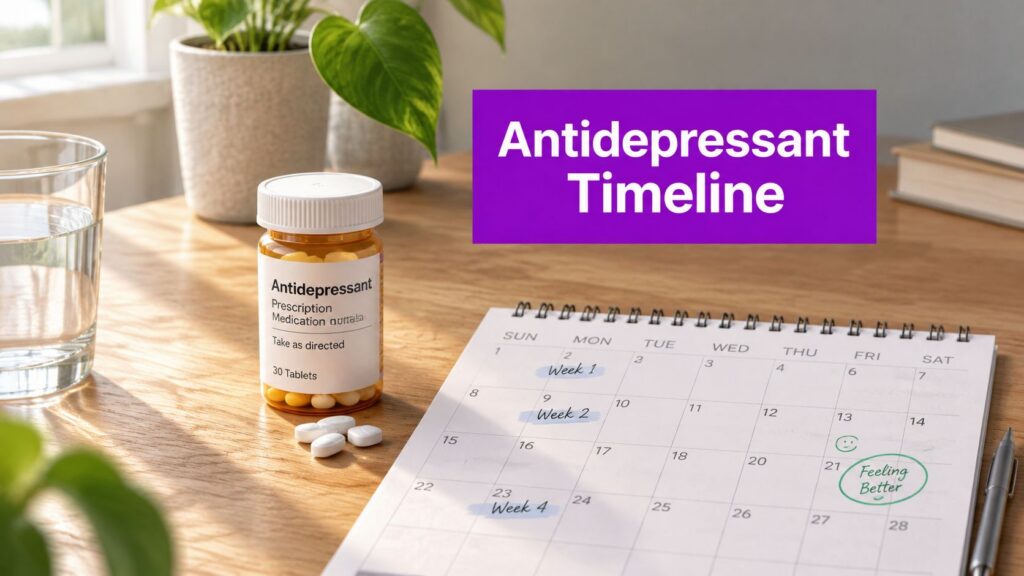
Many patients see measurable improvement in the first 1 to 2 weeks, but full benefit usually takes 4 to 8 weeks, depending on the medication, dose, diagnosis, and individual biology. If you've just filled your first prescription, feeling no dramatic change tomorrow doesn't mean the treatment has failed.
You might be checking your sleep, appetite, anxiety, or energy several times a day, wondering whether every sensation is meaningful. Perhaps you're also noticing nausea, fatigue, restlessness, or a change in sleep before your mood has improved. That pattern can be confusing, but the early days are better understood as a monitoring window than a final judgment.
Starting a New Antidepressant and Wondering What Comes Next
Maria, 34, picked up her first sertraline prescription yesterday. By the time she got home, she was already searching her phone: Should I feel different by tomorrow? What if it doesn't work at all? Why does the medication information say it may take weeks?
Those questions are reasonable. Starting an antidepressant asks you to take action now while waiting for a benefit that may develop gradually. Maria also wants to know what “working” will feel like. She expects a sudden lift in mood, but early progress may look less dramatic, such as sleeping more consistently, eating breakfast, feeling slightly less overwhelmed, or having enough energy to answer a message.
A practical way to read the timeline is through three checkpoints:
- Week 1: Watch for changes in sleep, appetite, anxiety, and physical tension. These may shift before depression feels better.
- Week 2: Look for small gains in energy, concentration, or motivation. Improvement can be partial and easy to miss if you only measure mood.
- Weeks 4 to 6: Mood, hopelessness, and motivation often become clearer treatment targets. This is also an important period for reviewing dose and tolerability with the prescriber.
Clinical guidance commonly places noticeable improvement around 2 to 4 weeks, while full benefit may take longer. The NHS antidepressant guidance advises that improvement often begins within 4 weeks and that full effects can take 6 to 8 weeks, with early reviews to assess response and adverse effects.
Practical rule: Don't ask only, “Do I feel happy yet?” Ask, “Is one part of the illness becoming slightly easier?”
Your first follow-up may occur around 2 to 4 weeks, depending on the medication and your situation. Use the week-by-week guide below as a reference map, not a verdict. A flat week doesn't erase a better day, and an uncomfortable first week doesn't predict the final outcome.
Why Antidepressants Take Time to Work
An antidepressant can begin changing brain chemistry quickly, but the brain's response to that change develops more slowly. SSRIs, including sertraline, block serotonin reuptake within hours. That increases serotonin availability between nerve cells, but the immediate chemical shift isn't the same as a completed mood response.
Over time, nerve cells adjust how they receive and process those signals. Researchers describe changes involving receptor sensitivity, protein production, neuroplasticity, and stress-response circuits. These adaptations can affect networks involved in mood, attention, sleep, and threat detection. The adjustment generally unfolds over days and weeks rather than in a single moment.
A useful analogy is adjusting to a new time zone. Your watch changes as soon as you land, but your sleep, appetite, alertness, and daily rhythm need time to recalibrate. Antidepressants can work similarly. The medication may be active before the brain has fully adapted to its new signaling pattern.

Why early symptoms can change first
Sleep, appetite, anxiety, and physical agitation may respond before depressed mood. That doesn't guarantee the medication will be effective, but it gives you useful information to record. A person may notice fewer nighttime awakenings before feeling hopeful, or regain some appetite before wanting to socialize.
Clinical guidance often uses a 2 to 4 week window for noticeable benefit, while major depression may require 4 to 8 weeks for a fuller clinical response. Individual biology, dose, diagnosis, and side effects can shorten or extend that range. The important point is that “nothing dramatic yet” and “nothing is happening” aren't always the same statement.
Typical Timelines by Medication Class
Medication classes share broad timing patterns, but each drug has its own dosing strategy, half-life, side-effect profile, and target symptoms. The ranges below are general clinical expectations, not promises about what one person will experience.
| Medication Class | First Noticeable Changes | Typical Full Response | Common Examples |
|---|---|---|---|
| SSRIs | Often within 1 to 2 weeks, especially in sleep or anxiety | Commonly 4 to 6 weeks | Sertraline, escitalopram, fluoxetine, paroxetine, citalopram |
| SNRIs | Often within 2 to 4 weeks | Commonly 4 to 8 weeks | Venlafaxine, duloxetine, desvenlafaxine |
| Atypical antidepressants | Varies by medication, some physical changes may appear early | Often several weeks | Bupropion, mirtazapine, vortioxetine |
| TCAs | Usually develops over several weeks | Often 4 to 6 weeks | Amitriptyline, nortriptyline |
| MAOIs | Usually develops over several weeks | Often 4 to 6 weeks | Phenelzine, tranylcypromine |
SSRIs and SNRIs
For SSRIs such as sertraline, escitalopram, fluoxetine, paroxetine, and citalopram, early signs may appear during the first 1 to 2 weeks, while mood response is more often judged across 4 to 6 weeks. Paroxetine-specific NHS information explains that little improvement may be noticeable during the first week or two, while fuller benefits commonly take 4 to 6 weeks.
SNRIs, including venlafaxine, duloxetine, and desvenlafaxine, often follow a similar pattern, with early improvement over 2 to 4 weeks and fuller benefit over 4 to 8 weeks. Venlafaxine extended-release may require dose adjustment, so the meaningful trial may depend on when an adequate dose is reached.
For a medication-specific comparison, readers considering duloxetine and citalopram can review this Cymbalta and Celexa comparison.
Atypical medications, TCAs, and MAOIs
Bupropion may produce earlier changes in energy, alertness, or motivation, although the antidepressant effect still develops over several weeks. Mirtazapine may affect sleep and appetite early because of its antihistamine activity, while mood improvement usually takes longer. Vortioxetine generally follows an SSRI-like course.
TCAs often require cautious titration because side effects can limit how quickly the dose increases. MAOIs can be useful in selected situations, but they require careful prescribing and dietary or medication-interaction planning. These class-level timelines help you ask better questions, but your prescriber's dosing plan matters more than a calendar estimate.
A Week-by-Week View of What to Expect
The first useful question isn't always, “Has my depression gone away?” A better question is, “Which symptom, if any, has shifted?” Early response can appear in the body and daily routine before it appears as a clear improvement in mood.
| Timepoint | Early Progress Signs | Mood Improvement | Common Side Effects |
|---|---|---|---|
| Days 4 to 7 | Sleep quality, appetite, anxiety, or physical tension may shift | Often little or no clear change | Nausea, headache, fatigue, activation, sleep changes |
| Week 2 | Small gains in energy, concentration, or willingness to start tasks | Mood may feel slightly less heavy for some people | Digestive symptoms, dry mouth, restlessness, sexual effects |
| Week 4 | More consistent functioning may become easier to identify | Partial mood response may be visible | Side effects should be reviewed if they remain disruptive |
| Weeks 6 to 8 | Benefits may continue consolidating at an adequate dose | Fuller benefit is commonly assessed | Persistent burden may require a medication discussion |
Days 4 to 7
Some people notice better sleep or a change in appetite during the first week. Others notice activation, fatigue, or gastrointestinal discomfort instead. Neither experience proves that the medication will succeed or fail.
Week 2
By the second week, track whether you can concentrate for longer, begin a task with less effort, or experience a small increase in energy. These changes may be subtle. A person who still feels depressed but is showering more regularly or answering calls may be showing meaningful movement.
A 2005 meta-analysis of 76 double-blind, placebo-controlled trials found that 60.2% of total symptom improvement occurred during the first 2 weeks, although improvement continued afterward and early nonresponse didn't definitively rule out later benefit (meta-analysis).
Weeks 4 to 8
Week 4 is a practical checkpoint, not a finish line. A 2022 adult depression cohort found that 56.5% met its early-response threshold at week 4, and early response predicted remission by weeks 8 to 12 (cohort analysis). Low mood, hopelessness, and suicidal thoughts can take longer to improve than sleep or appetite, so worsening symptoms need prompt clinical attention.
Progress rarely moves in a straight line. One difficult day doesn't cancel a better week.
Factors That Speed Up or Slow Down Your Response
The question “how long before antidepressants work” has no single answer because the calendar begins under different conditions for different people. A starting dose may not be the same as a therapeutic dose, and the trial period may need to be reconsidered after a prescriber adjusts the dose.
Dose and consistency
A dose that's too low may not provide enough treatment effect, while increasing too quickly may create side effects that make adherence harder. Take the medication as prescribed and tell your clinician about missed doses instead of restarting, doubling, or changing the schedule.
Consistency matters because irregular dosing can blur the timeline. Your prescriber needs to know the actual pattern of use to judge whether the medication has had an adequate trial.
Biology and diagnosis
Metabolism can affect blood levels, duration, and tolerability. Genetic differences involving enzymes such as CYP2D6 and CYP2C19 may contribute to faster or slower medication processing, although testing doesn't replace clinical observation.
Age, anxiety, substance use, thyroid disorders, sleep quality, and other medical conditions can also complicate the picture. Atypical depression and melancholic features may respond differently, and severe depression with psychotic features often calls for a broader strategy than antidepressant monotherapy.
Sleep routines, regular movement, and reducing alcohol or recreational drug use can support recovery, but they don't substitute for medication review when symptoms are severe. These variables explain why two people taking the same prescription can follow different timelines. They don't mean you've failed treatment.

When to Talk With Your Presriber About a Change
Consider a representative patient taking sertraline 50 mg for four weeks. She has fewer panic sensations and is sleeping somewhat better, but her mood remains low and she's still missing work. That's not automatically a failure. It may be a partial response, meaning the medication appears to be helping some symptoms but not enough overall.
At the appointment, the prescriber reviews adherence, side effects, diagnosis, sleep, substance use, and whether the dose has been adequate for long enough. Depending on those findings, the options may include increasing the dose, switching within the same class, switching to another class, or adding another treatment. A psychiatrist's role in medication and mental health care includes helping weigh those choices rather than making a decision from one difficult day.
The NHS monitoring guidance for antidepressant switching identifies 4 to 6 weeks without benefit as a point when treatment should be reviewed, while recognizing that some benefit may be felt earlier. That review doesn't mean you must switch. It means the treatment plan deserves a careful look.
Useful phrases include:
- “My sleep is better, but my mood hasn't changed.”
- “I'm taking it consistently, but the side effects are interfering with work.”
- “What dose and duration would count as an adequate trial for me?”
- “If we switch, how will we taper or transition safely?”
If anxiety feels unusual or may have a medical contributor, a clinician may also discuss related evaluation options, including this resource about finding an anxiety blood test. It shouldn't replace a psychiatric assessment.

Call promptly rather than waiting if suicidal thoughts worsen, agitation is new or intense, or severe insomnia begins. Never stop an antidepressant abruptly without medical guidance.
Early Side Effects and What They Actually Mean
Early side effects can arrive before benefits, which makes people understandably suspicious that the medication is wrong. Nausea, headache, dry mouth, mild insomnia, fatigue, or a temporary increase in anxiety can occur during adjustment. Their presence doesn't predict whether the antidepressant will eventually help.
Many nuisance effects are most noticeable early and may ease as the body adapts. Record when each symptom starts, how severe it feels on a 1 to 10 scale, what seems to trigger it, and whether it affects eating, sleeping, driving, or work.
| Effect | Usually Fades During Days 3 to 14 | Call Your Prescriber Promptly |
|---|---|---|
| Nausea or stomach upset | Mild symptoms may settle with continued monitoring | Persistent vomiting, dehydration, or inability to keep medication down |
| Headache or dry mouth | Often becomes easier to manage | Severe or worsening symptoms |
| Mild insomnia or fatigue | May improve as dosing and routine are adjusted | Severe insomnia that disrupts functioning |
| Temporary nervousness | Can occur during early activation | Racing thoughts, extreme agitation, or unsafe behavior |
| Mood fluctuation | Requires observation | New or worsening suicidal thoughts |
| Rash | Not something to dismiss | A spreading rash, swelling, breathing difficulty, or other allergic symptoms |
Early activation can feel like worsening anxiety because alertness, restlessness, and physical tension may increase before mood regulation improves. That's why a same-week call is appropriate for marked agitation, racing thoughts, severe sleep loss, suicidal thinking, serotonin syndrome symptoms, rash, or persistent vomiting. A routine follow-up may be suitable for mild nausea or manageable dry mouth, but you don't need to wait if a side effect is disrupting daily life.
Your Follow-Up Checklist and When to Reach Out Sooner
Treat follow-up as part of the medication, not as an optional appointment.
- Around day 7 to 10: Review tolerability. Note nausea, sleep, appetite, anxiety, activation, fatigue, and whether you can take the medication consistently.
- At about week 4: Review the dose, sleep, appetite, energy, concentration, anxiety, and mood. Bring a simple symptom log rather than relying on memory.
- Around weeks 6 to 8: Assess the broader mood response and whether the current dose has had enough time to work. Discuss adjustment if improvement remains limited or side effects outweigh benefits.
Your log can be simple. Write down medication name and dose, missed doses, sleep hours, appetite changes, energy, mood, and side effects. A short daily note such as “slept better, still low, nausea 3/10” gives your prescriber more useful information than a general statement that you feel the same.
Read more about medication management for depression if you're looking for ongoing support with monitoring and treatment adjustments.
Call sooner if depression is worsening, suicidal thoughts appear or intensify, agitation is new, an allergic reaction develops, or a side effect disrupts work or sleep for more than a few nights. Timely contact isn't an overreaction. It gives your care team the information needed to keep treatment safe and responsive.

reVIBE Mental Health provides psychiatric medication management alongside therapy, including support for monitoring early response, side effects, and dose decisions. If you're in the Phoenix metro area, visit reVIBE Mental Health or call (480) 674-9220 to discuss care at a nearby location in Chandler, Phoenix Deer Valley, Phoenix PV, Scottsdale, or Tempe.