You're searching late at night, waiting for a therapy appointment, or trying to help someone you love without making the situation worse. An online group can seem like the easiest next move: you can type instead of speak, stay anonymous, and find people who understand the strange combination of fear, shame, exhaustion, and isolation that eating disorders create.
That convenience cuts both ways. Some eating disorder online support groups offer recovery-focused connection and practical encouragement. Others normalize restriction, purging, compulsive exercise, body checking, or competitive illness while using the language of belonging. The important question isn't just which group should you join. It's whether the group is safe, what role it should play beside professional care, and how you'll recognize when it's making recovery harder.
Why People Look for Eating Disorder Support Online
At 11:40 p.m., a college student may be scrolling through posts after an uncomfortable dinner, wondering whether anyone else feels panicked by ordinary food. A parent may be waiting for an assessment and searching for guidance on how to respond without turning every meal into a confrontation. An adult between appointments may want support now, not after the next available opening.
Online communities meet that immediate need. Typing can feel less exposing than saying the same words aloud. An anonymous username may make it easier to admit, “I'm scared,” or “I don't know whether this counts as serious.” A scheduled video group can also create a regular point of contact when transportation, work, caregiving, geography, or cost make in-person support difficult.
Historically, online eating-disorder communities have done more than provide casual conversation. A 2008 analysis of 273 messages in online eating-disorder support groups found informational support was the most common category at 29.7%, followed by emotional support at 27.8%, network support at 21.2%, practical support at 11.7%, and esteem support at 9.5%. The same study found that sharing experiences made up 51.9% of support-seeking messages, while requesting information accounted for 25.4% and self-deprecating comments for 15.4% (Journal of Computer-Mediated Communication).
The useful question isn't “Can I find a group?” It's “Will this group move me toward recovery, or deeper into the disorder?”
You'll need to make three decisions. First, choose the format that matches your current need. Second, vet the space instead of trusting its label. Third, keep peer support next to therapy, nutrition care, psychiatry, or a higher level of treatment when those services are needed.
This guide won't lecture you for wanting connection. It will help you use online support with clear eyes.
What an Online Eating Disorder Support Group Actually Is
An online eating disorder support group is a recurring digital gathering where people affected by eating disorders share encouragement, information, coping ideas, and lived experience. It might meet through scheduled video, operate as a text chat, or use an asynchronous forum where people post and respond on their own schedules.
Think of it as a weekly table at a quiet recovery café. People arrive with different histories, but the table has a shared purpose and rules designed to keep conversation useful. That's different from a lecture hall, where one professional teaches, and different from a crowded cafeteria, where anyone can say anything without meaningful oversight.
The format changes the experience
A synchronous group meets at a set time. Video can create familiarity and accountability, while live chat may feel more private for someone who isn't ready to be on camera. An asynchronous forum gives members time to write carefully, but delayed responses can be difficult during an acute crisis.
Groups may be peer-led, clinician-led, or moderated by trained volunteers. Some use rolling admission, meaning new members can join as space allows. Others build continuity through a stable cohort. Strong groups explain their purpose, establish content boundaries, identify crisis procedures, and tell members what the group can and can't provide.
A support group generally offers connection and shared understanding. It isn't automatically therapy, medical monitoring, meal planning, psychiatric treatment, or emergency intervention. Even when a licensed professional facilitates it, the group may still be designed as support rather than individualized treatment.
The distinction matters because eating disorders can carry medical and psychiatric risk that peers can't assess through a post or screen. A supportive conversation may reduce shame, but it can't determine whether someone needs urgent medical evaluation or a more intensive level of care.
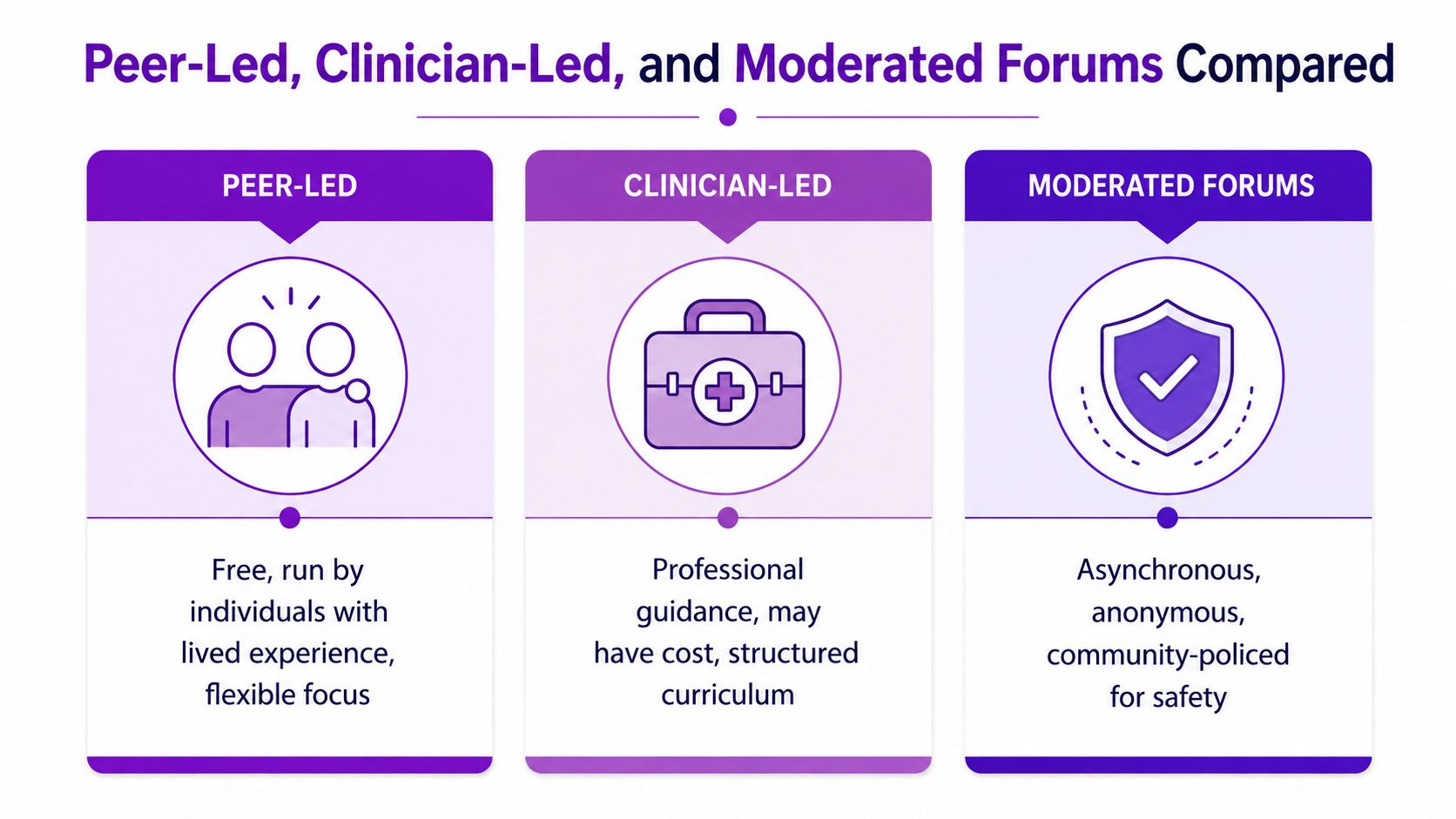
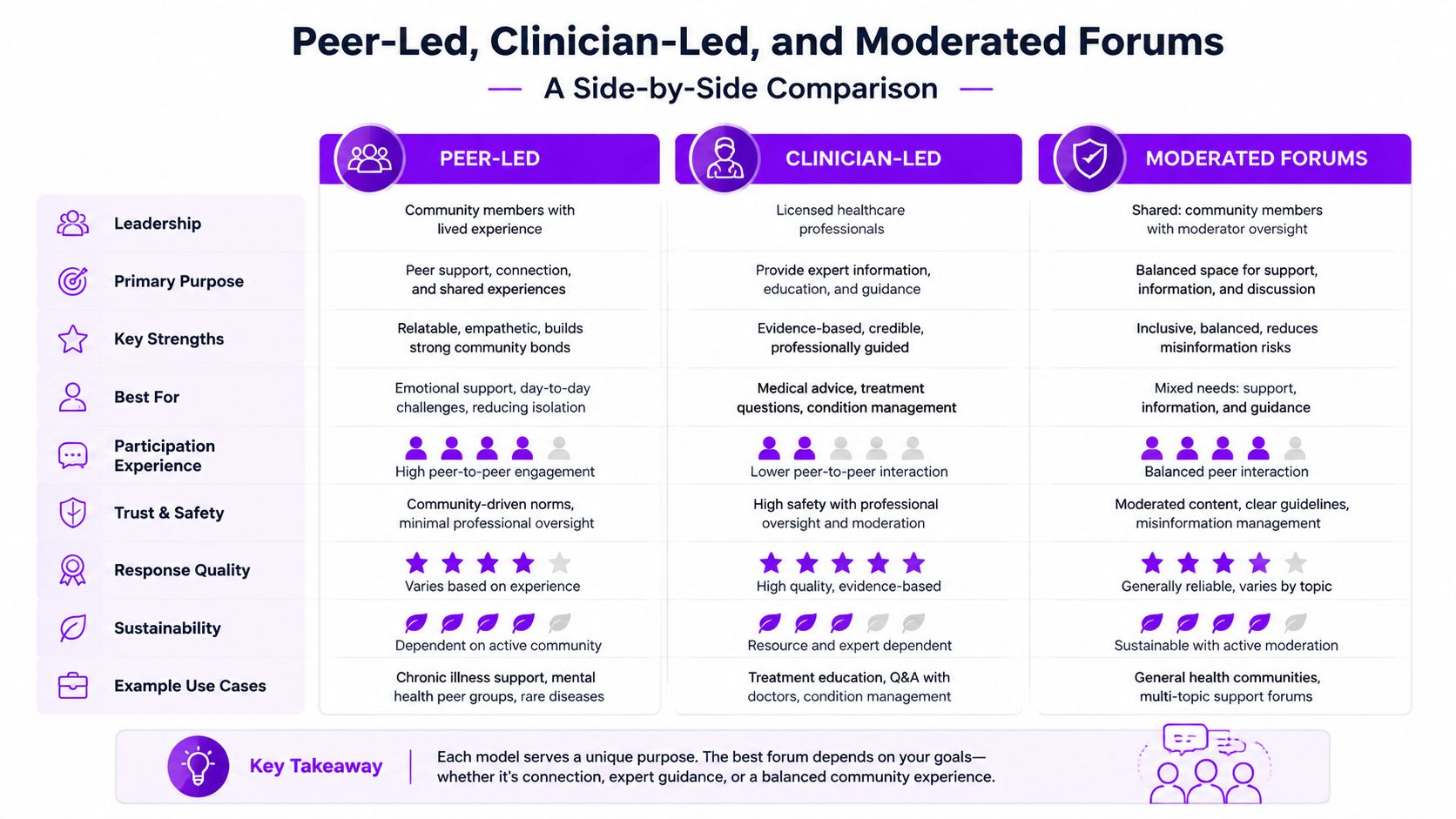
Peer-Led, Clinician-Led, and Moderated Forums Compared
No single group type wins for everyone. The best choice depends on whether you need belonging, clinical structure, caregiver education, a place to practice recovery language, or support while you're waiting for formal treatment.
Three Archetypes of Online Eating Disorder Support Groups
| Group type | Who runs it | Typical cost | Best for |
|---|---|---|---|
| Peer-led | Volunteers or people with lived experience | Often free | Encouragement, connection, and reducing isolation |
| Clinician-led | A therapist, dietitian, or other qualified professional | May be free or paid | Structured support and psychoeducation alongside care |
| Moderated forums | Trained moderators, volunteers, or an organization | Often free or membership-based | Flexible, anonymous conversation with safety rules |
Peer-led groups can feel immediately validating. A college student between therapy sessions may want to hear from someone who understands the anxiety around eating with friends, not receive another clinical explanation. Peer support can strengthen self-efficacy, wellbeing, social connection, and the perceived impact of an eating disorder for young people, although the quantitative evidence base remains limited, with a recent review identifying only 11 quantitative studies of peer support in clinical eating-disorder populations (Journal of Eating Disorders research).
Clinician-led groups add clearer boundaries and deliberate psychoeducation. A parent whose teenager has just received a diagnosis may benefit from a facilitator who can explain supportive communication, correct misinformation, and identify when a concern belongs with the treatment team. Clinician involvement doesn't eliminate risk, but it can provide more safety scaffolding than an unstructured conversation.
Moderated forums occupy the middle ground. They can be useful for an adult waiting for an intensive outpatient placement who needs flexible contact outside business hours. Their quality depends heavily on moderator training, response speed, enforcement of rules, and whether the organization has a real escalation process.
A large study of free virtual eating-disorder support groups recruited 494 participants and used provider records showing an estimated 30,723 registrations between October 2021 and September 2023. Most participants, 85.5%, reported a professional eating-disorder diagnosis, and 59.3% reported eating-disorder treatment in the past month. Participants attended an average of 2.93 groups in the prior month, supporting the view that these groups often function as an addition to formal care rather than a replacement (PMC study of virtual eating-disorder support groups).
None of these formats should be expected to deliver individualized assessment, medical monitoring, or a complete treatment plan.
Safety and Privacy Questions to Ask Before You Join
Treat a digital support group like a swimming pool. Before you get in, you'd want to know the depth, whether a lifeguard is present, and which rules prevent people from getting hurt. Apply the same standard online.
Ask who is responsible
Start with the moderator. Is the person a trained peer facilitator, a licensed clinician, an organization employee, or the group owner? What training do they have? Can they explain how they handle posts about suicide, self-harm, severe restriction, purging, medication misuse, or medical instability?
A clinician-led study of nine rolling, free online groups found that group design mattered. Moderation, continuity among participants, and explicit psychoeducation shaped whether members received emotional and informational support and engaged with treatment. Attendance alone wasn't the mechanism that made the group useful (study of clinician-led virtual eating-disorder groups).
Look for recovery language, not just friendly language
A group can feel warm and still reinforce the disorder. Recovery-oriented spaces usually prohibit competitive symptom details, calorie or weight comparisons, graphic descriptions of behaviors, and advice that helps someone hide symptoms. They redirect posts that could trigger members and make it clear that eating-disorder behaviors aren't a membership requirement.
Be especially cautious with pro-eating-disorder communities that describe themselves as supportive or accepting. A recent meta-synthesis found that pro-Ana digital groups can create belonging and a perceived safe space while also functioning as an indirect form of digital self-harm (PubMed summary of the meta-synthesis). Belonging alone doesn't make a community safe.
Privacy deserves specific questions. Does the platform collect identifying information? Can posts be found through search engines? Are screenshots prohibited, and how is that rule enforced? “Anonymous” may mean only that members use usernames. It doesn't necessarily mean your information is protected from the platform, other users, or screenshots.
For additional context on what confidentiality does and doesn't mean in clinical care, review confidentiality in therapy. A support forum isn't automatically covered by the same privacy expectations as a therapy relationship.
Non-negotiables: clear moderation, explicit recovery rules, and a crisis plan you can understand before you post.
If a group can't answer those questions directly, don't join it.
How to Find and Vet a Trustworthy Group
Start with a referral, not an algorithm. Ask your therapist, dietitian, physician, or treatment program whether they know a recovery-oriented group. Established eating-disorder organizations and condition-specific nonprofits can also provide starting points. National directories may list options, but listings aren't the same as clinical endorsement, so evaluate each group yourself.
A generic social-media search is a poor first filter. Search results can place recovery communities beside pro-disorder pages, influencer content, and unmoderated discussions. Look for the organization behind the group, a current description, facilitator information, participation rules, and a privacy policy.
Use a short vetting routine
Read the rules before registering. Look for bans on numbers, body comparisons, behavior instructions, and competitive storytelling. Rules should explain how members can discuss difficult experiences without providing a blueprint for symptoms.
Observe before participating. If access allows, read posts or attend before sharing personal information. Notice whether moderators intervene consistently, whether members encourage treatment, and whether conversations leave people more grounded or more activated.
Ask about crisis handling. Send a direct question to the moderator: “What happens if a member says they may harm themselves or is experiencing a medical emergency?” A responsible answer should explain the group's limits and escalation process.
Check data practices. Find the privacy policy, registration requirements, recording policy, and rules about screenshots. Don't share your full name, workplace, address, treatment records, or identifying details until you understand the platform.
Set an exit rule. Decide in advance what would make you pause or leave. Examples include repeated exposure to symptom competition, pressure to disclose, dismissive responses to medical risk, or worsening urges after group contact.
Useful places to begin
The National Eating Disorders Association support-group resource can help you identify possible organizations and formats. ANAD also offers peer-support options, including identity-specific communities described in its LGBTQIA+ mental-health resources. Treat both as starting points to investigate, not automatic endorsements.
A well-run group can help you feel less alone. It still shouldn't become the only place where your eating disorder is discussed.
Pairing Online Support With Therapy and Psychiatry
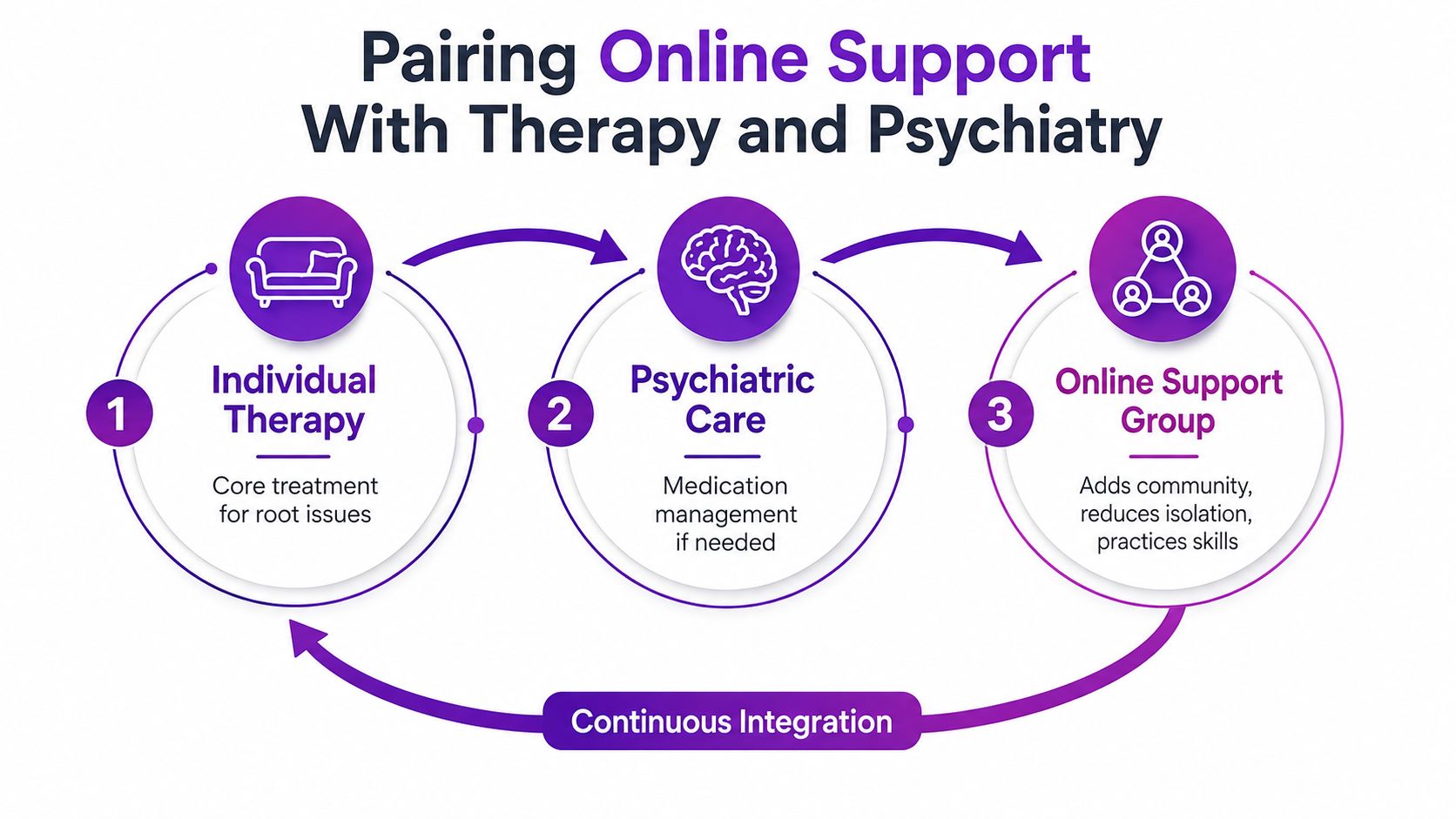
A group can't replace individualized treatment, and pretending otherwise creates avoidable risk. Peer members can share what helped them tolerate a difficult meal or challenge shame. They can't assess your medical status, diagnose a co-occurring condition, tailor exposure work, coordinate with family, or change a treatment plan when your symptoms shift.
The strongest role for an online group is adjunctive support. It provides frequent, lower-pressure contact between appointments, while your therapist and medical providers handle assessment and treatment decisions. Research on virtual eating-disorder groups supports this bridge-to-care model, especially when moderation, continuity, and psychoeducation are built into the format.
Make the roles explicit
Tell your therapist which group you joined. Bring back themes, not identifying details about other members. You might say, “The group helped me notice how much I avoid eating with coworkers,” or “A discussion about exercise left me more preoccupied.” That gives your clinician useful information without turning the group into a second treatment plan.
Agree on boundaries before problems arise:
- Share what affects your symptoms. Report triggers, new behaviors, increased urges, or advice you're considering.
- Keep clinical decisions in treatment. Don't change medication, supplements, meal goals, or exercise plans because a group member recommends it.
- Coordinate with psychiatry. If a group conversation leads you to consider a supplement, stop a medication, or restart a behavior, tell the prescriber first. A structured medication review from Empire Medical Wellness can also be a useful resource when you need to understand how psychiatric medications fit into a broader care plan.
- Use meal-specific support appropriately. If eating around others is a major barrier, discuss eating-disorder meal support with your treatment team rather than relying on improvised online advice.
If a conversation destabilizes you, pause posting and step away from the thread. Message the moderator, write down what was triggering, and contact your therapist or prescriber. If you're facing an immediate medical or psychiatric emergency, use local emergency services rather than waiting for a group response.
Your Next Step and Local Care Options
Choose one action for the next seven days: identify one group, read its rules, ask about crisis procedures, and discuss it with a clinician or trusted support person. Don't join five communities at once. One carefully screened group will tell you more than a large collection of unexamined links.
Keep the decision simple:
- Choose the format: peer-led for connection, clinician-led for more structure, or moderated forum for flexible participation.
- Vet the environment: confirm recovery rules, moderator responsibility, privacy practices, and crisis boundaries.
- Protect the treatment relationship: use the group to supplement, not replace, therapy, psychiatric care, nutrition support, or a higher level of care.
Caregivers should look for groups designed specifically for family members rather than assuming a patient-focused group will answer their questions. A nonprofit directory such as Recovery Is Freedom's profile on Alignmint may provide another place to research organizations, but apply the same screening process before sharing personal information or relying on advice.
If online support is revealing that you need more than peer connection, consider structured treatment. An intensive outpatient program for eating disorders may provide more consistent therapy, meal support, and clinical coordination than a support group can offer.
For people in the Phoenix metro area, reVIBE Mental Health offers therapist and prescriber matching across five Arizona locations, with appointments available seven days a week and in-person or secure online sessions.
Find a reVIBE Location Near You
There are currently five locations for your convenience. Call (480) 674-9220.
reVIBE Mental Health, Chandler
3377 S Price Rd, Suite 105, Chandler, AZreVIBE Mental Health, Phoenix Deer Valley
2222 W Pinnacle Peak Rd, Suite 220, Phoenix, AZreVIBE Mental Health, Phoenix PV
4646 E Greenway Road, Suite 100, Phoenix, AZreVIBE Mental Health, Scottsdale
8700 E Via de Ventura, Suite 280, Scottsdale, AZreVIBE Mental Health, Tempe
3920 S Rural Rd, Suite 112, Tempe, AZ
reVIBE Mental Health offers therapy, psychiatry, medication management, and eating-disorder support through in-person and secure online appointments, so you can pair professional care with a carefully vetted support group. Visit reVIBE Mental Health to connect with a provider and take the next practical step toward care.