
You notice it in fragments. Your teenager pushes food around the plate, cancels dinner plans, and starts wearing oversized clothing. Your partner disappears after meals, takes up sudden intense exercise, or becomes tense when anyone mentions food. Nothing looks dramatic in isolation, yet the pattern leaves you with a growing sense that something has shifted.
Families often recognize an eating disorder before they can name it. Fear, guilt, confusion, and urgency can arrive together. You may wonder whether you caused this, whether raising the subject will make things worse, or whether you should wait until the signs become impossible to ignore.
Eating disorder support for families begins with a different understanding. The illness thrives in secrecy and isolation, while recovery usually requires coordinated support from loved ones, clinicians, medical providers, and dietitians. Family involvement has a long evidence-based history, and it isn't limited to parents of minors. Partners, siblings, adult children, and other caregivers can also need clear guidance.
This guide focuses on the practical work, including how to step in without overpowering, how to respect an adult's autonomy, how to coordinate care, and how to protect your own mental health. If you're still trying to make sense of what you're seeing, this overview of warning signs of eating disorders can help, as can age-appropriate resources such as adolescent counselling Kelowna. Noticing the change is already the first meaningful act of support.
The Moment a Family Realizes Something Has Shifted
At dinner, Maya's mother notices that Maya cuts her food into tiny pieces and talks through most of the meal. A few days later, Maya cancels a restaurant outing because she says she already ate. Her father sees new workout routines, while her younger brother notices that she goes straight to the bathroom after dinner. The family doesn't have a diagnosis. They have a collection of moments that no longer fit together comfortably.
A partner might notice a similar pattern in an adult loved one. The person skips shared breakfasts, becomes distressed when plans involve food, or changes clothing to hide their body. Irritability around meals can look like ordinary stress. Frequent bathroom trips can seem private rather than concerning. Families often sense the emotional temperature before they understand the behavior.
A useful starting point: Focus on what you can observe, not on proving what the person has.
Avoid turning the first conversation into an interrogation. Instead of saying, “You have an eating disorder,” try, “I've noticed you've been skipping meals and leaving the table quickly. I'm worried about you, and I'd like to understand what support might feel possible.” This approach doesn't minimize the seriousness. It lowers the chance that shame will close the conversation.
Fear and guilt are common, but blame isn't useful
Many caregivers immediately search for a cause. They replay comments about food, family conflict, genetics, school pressure, or a recent life change. That search can become a trap. The more useful question is what the family can do now to improve safety, connection, and access to qualified care.
Recovery isn't a private test of willpower. It often becomes a family project, although the family's role changes with age, risk, consent, and the treatment approach. A parent may provide direct meal support for an adolescent, while a partner may help an adult attend appointments or maintain household boundaries without monitoring every bite.
You don't need perfect language or complete certainty before seeking advice. A calm concern, a medical appointment, or a conversation with an eating disorder professional can create an opening. The goal isn't to win an argument. It's to make isolation less powerful.
What Family-Based Treatment Is
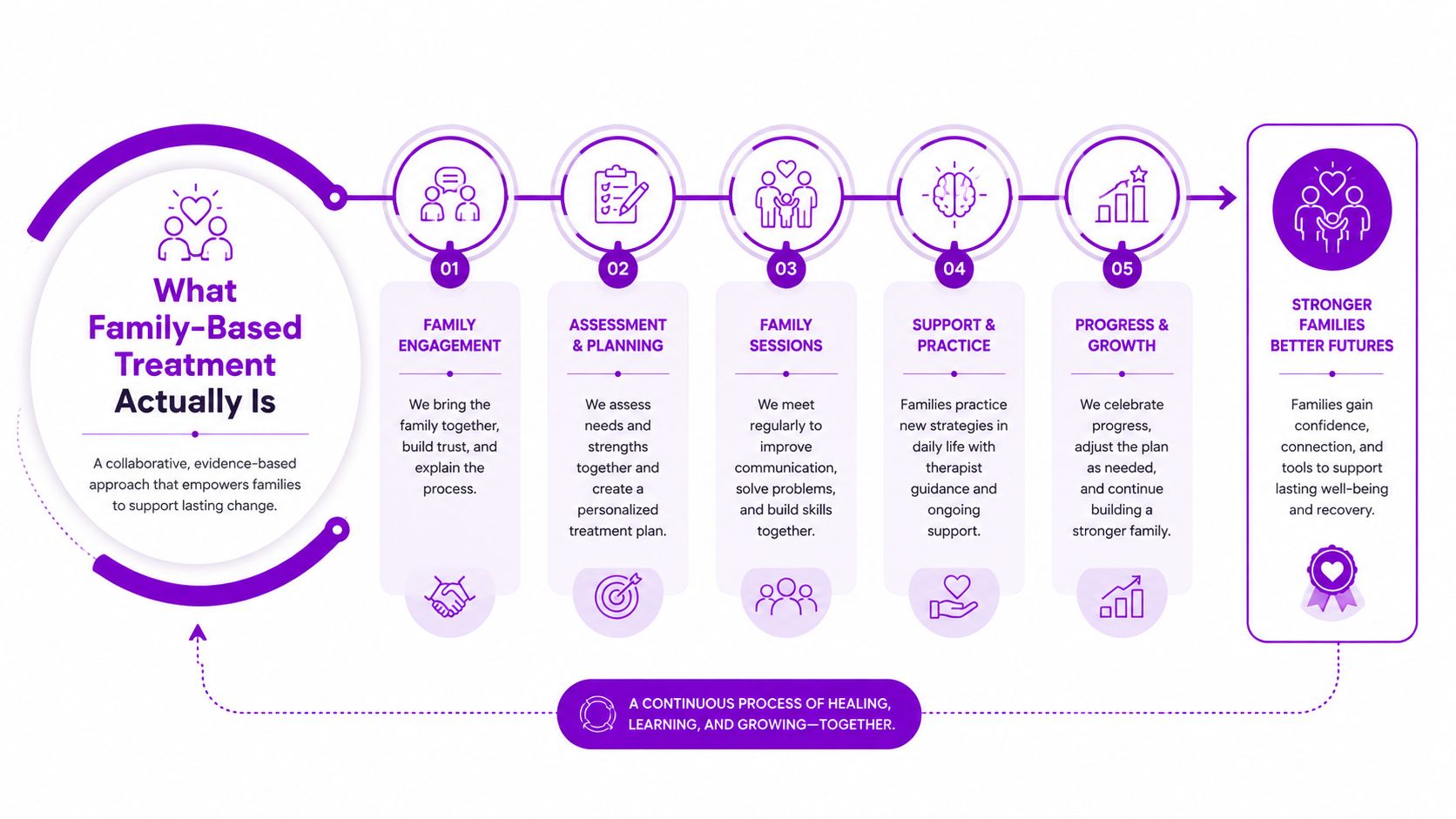
A family may arrive after meals have become tense, health has worsened, and ordinary support no longer seems enough. Family-Based Treatment, or FBT, gives caregivers an active role in recovery. It is also associated with the Maudsley approach, developed in London in the late 1970s and early 1980s by Christopher Dare, Ivan Eisler, Gerald Russell, and colleagues. The approach later became known as FBT and was introduced to the United States through Daniel Le Grange by 1994, according to this history of family involvement in eating disorder treatment.
Treatment can work like helping someone cross a damaged bridge. During the first phase, caregivers temporarily hold the steering wheel. They help provide regular meals, limit opportunities for eating disorder behaviors, and work with the clinical team to restore medical stability. The illness may strongly object. Caregivers do not need to negotiate with it.
As eating and health become steadier, control gradually returns to the individual. The treatment team helps the person practice choices while caregivers stay close enough to support difficult steps. The final phase turns toward life beyond the illness, including identity, relationships, independence, and development that fits the person's age and circumstances. For an emerging adult or adult, that support may involve a partner, trusted relative, or chosen caregiver rather than a parent.
FBT is not generic family counseling
Ordinary family therapy may focus on communication, conflict, grief, or relationship patterns. FBT can address those concerns, but it also gives the family a specific recovery task. The family is part of the therapeutic engine, not a side conversation.
FBT has been studied most extensively with adolescents who have anorexia nervosa. Clinicians have adapted family-oriented approaches for bulimia nervosa, avoidant/restrictive food intake disorder, and older age ranges. The approach must be adjusted to the person, household, consent, and developmental stage. Outpatient treatment is appropriate only when medical and psychiatric needs can be managed safely at that level.
Treatment is often time-limited and coordinated with medical care, nutritional support, and, when necessary, a higher level of care. Families may also benefit from trauma-informed principles that account for safety, trust, and personal history, including resources on trauma care for children. Caregivers deserve support as participants in the work, especially when helping an adult means respecting autonomy while responding to genuine risk.
How the Role of the Family Has Changed
Older eating disorder models sometimes treated the family as the problem. Parents, especially mothers, could be described as overcontrolling, emotionally harmful, or responsible for creating the illness. Other families were treated as enablers or kept outside the treatment room. That history still matters because blame can make caregivers afraid to speak openly.
The shift toward family-based care changed the central question from “What did the family do wrong?” to “How can the family help recovery?” Early randomized trials found that family treatment produced better outcomes than individual supportive counseling for adolescents with anorexia nervosa. Later reviews report that approximately 45 to 50% of adolescents achieve full remission, and up to 80% reach a medically healthy weight within 12 months when treated with family-oriented approaches, as summarized in this review of family support across eating disorder care.
That evidence doesn't mean every family has the same experience or that caregivers can solve the disorder alone. It means family involvement is a mainstream clinical resource, not a fringe idea.
What the reframe means in the room
A contemporary clinician should expect to work with the family, not around it. Caregivers bring knowledge of routines, changes in behavior, safety concerns, and the person's strengths. They also bring stress, fear, habits that may accidentally accommodate the illness, and their own need for coaching.
If someone uses blaming language, you can respond without starting a fight: “We're willing to look at patterns that may be maintaining the illness, but we need a plan that treats us as partners rather than causes.” That sentence protects accountability and dignity at the same time.
The family role is active, defined, and teachable. You aren't expected to arrive knowing how to manage meals, boundaries, or treatment resistance. Those are skills the care team should explain, practice, and adjust with you.
What Caregivers Are Asked to Do Day to Day
Caregivers often accommodate an eating disorder because they're trying to reduce distress. They prepare a separate meal, stop inviting the person to restaurants, avoid foods that trigger fear, weigh the person secretly, police the bathroom, or argue about portions. These actions can feel compassionate in the moment, yet they may give the illness more control over the household.
A systematic review found that carers commonly experience distress, accommodation, and enabling behaviors that can unintentionally maintain the illness. Guidelines therefore support family education, skills training, and carer support alongside the patient's treatment plan, as described in this review of carer experiences and interventions.
Replace illness-led routines with structured support
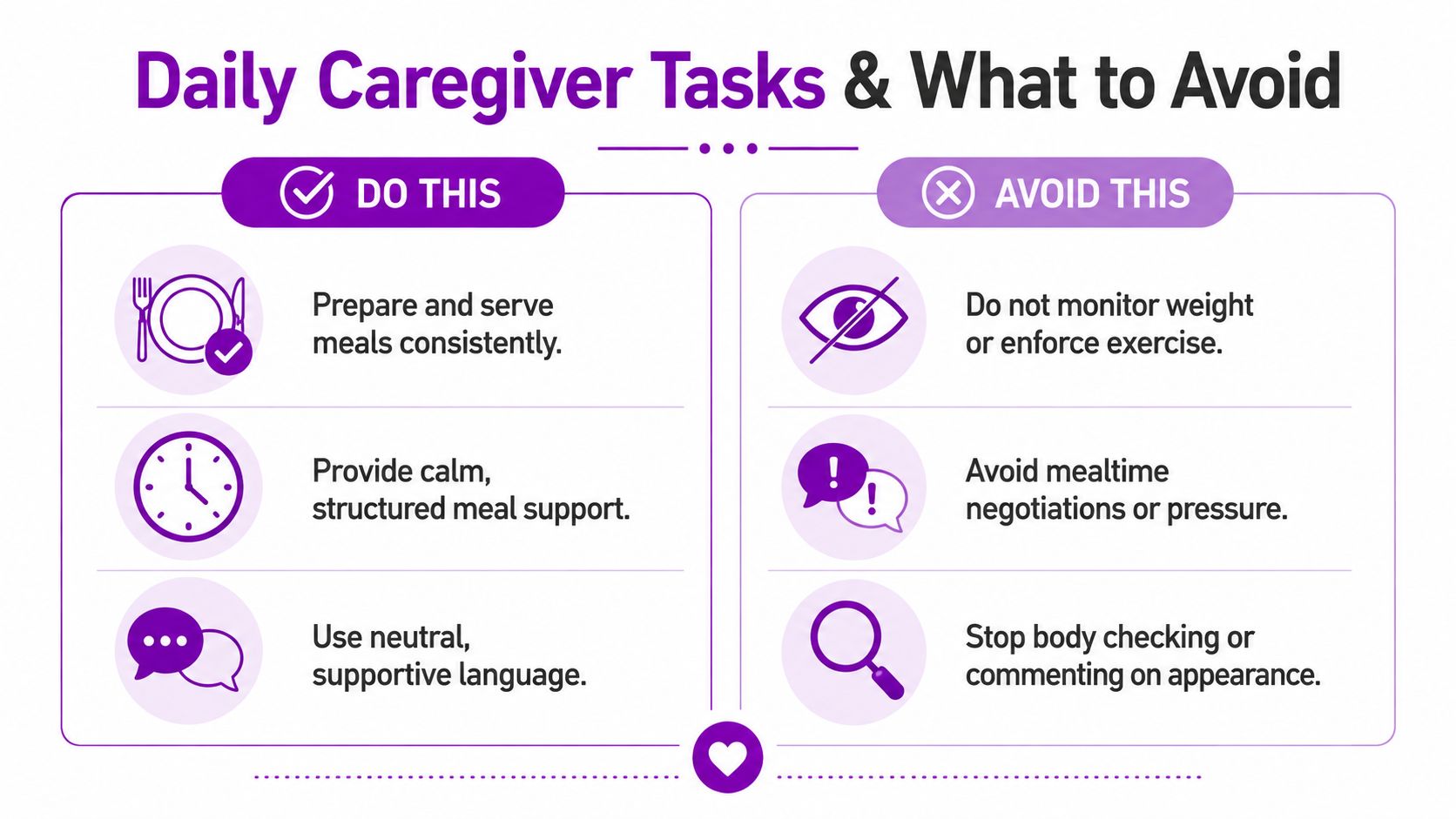
The treatment team may ask you to make several practical changes:
- Meals become predictable. Prepare and serve meals according to the plan, then sit together without turning every bite into a debate.
- Weight stays with the clinical team. Don't make secret weigh-ins or use the scale as a household enforcement tool unless the medical provider has given you a specific safety instruction.
- Bathroom access follows the safety plan. A person may need monitoring after meals in some circumstances, but the plan should come from clinicians rather than improvised surveillance.
- Restaurants become supported practice. Avoiding every invitation can strengthen fear. A clinician or dietitian can help the family choose an appropriate, gradual challenge.
- Exercise boundaries are coordinated. Don't independently enforce or approve activity changes. Ask the medical team what is safe and how to communicate it.
Neutral language matters. Comment on behavior and support, not body size, appearance, calories, or moral labels for food. A calm sentence such as “The plan says your body needs this meal, and I'll stay with you while you work through it” is more useful than a long argument about whether the person looks unwell.
Coordinate rather than carry the whole plan
Day-to-day care usually involves more than one person. Caregivers may record meals, symptoms, compensatory behaviors, medical concerns, and changes in mood, then share those observations with the therapist, dietitian, physician, outpatient program, or residential staff. Ask the team what to track and how information should be shared.
A resource on eating disorder meal support can help families think through the practical side of structured meals. These tasks aren't punishment. They're temporary scaffolding, and the scaffolding should change as the person's health, skills, and independence improve.
Supporting an Adult or Emerging Adult Who Resists Help
An adult child, partner, sibling, or close friend may understand your concern and still refuse treatment. That resistance doesn't mean the illness is harmless. It may reflect shame, fear of losing control, distrust of professionals, or a genuine wish to make personal decisions.
Your role is less about fixing the person and more about staying connected while protecting reasonable boundaries. Recent qualitative work found that emerging adults can experience family involvement as threatening or as part of the problem, while also wanting flexible boundaries and emotionally supportive contact. That tension calls for a more careful approach, described in this research on family support for emerging adults.
Use three steady levers
Name observations without assigning a label. Try, “I've noticed you're skipping meals and feeling distressed after eating,” rather than, “You're in denial about your eating disorder.” Describe the effect on safety and the relationship.
Set ordinary household boundaries. If you share a home, you can agree on kitchen access, grocery responsibilities, shared meals, and what happens when illness-related behavior disrupts others. A boundary might be, “I won't buy food for a ritual that harms you, but I will help you find a dietitian.” That's different from monitoring every item.
Invite conversation instead of forcing agreement. Ask open questions, reflect what you hear, and resist the urge to answer every objection. “What feels frightening about getting help?” can open more space than a list of reasons treatment is necessary.
Autonomy matters, but it isn't absolute when someone is medically unstable or at immediate risk. In those circumstances, urgent medical guidance or emergency intervention may be necessary. Outside an acute crisis, everyday caregiving usually works better through invitation, consistency, and low-conflict engagement.
Ambivalence can last. A steady presence, a clear boundary, and repeated offers of practical help may matter more than one persuasive conversation.
Why Caregivers Need Their Own Support Too
Watching someone you love harm themselves while you're expected to stay calm at the dinner table creates a particular kind of strain. You may sleep lightly, scan for danger, replay conversations, grieve the relationship you had before the illness, and feel guilty whenever you take time for yourself.
Caregivers aren't merely support people standing outside the clinical picture. Research identifies carer mental health, caregiving skills, and relationship type as important predictors of burden. A 2025 analysis also found that nearly a third of carers hadn't used carer support services even though most were interested in them, according to this research on caregiver burden in eating disorders.
A separate 2026 caregiver study reported mild-to-moderate emotional burden and mild-to-severe depressive symptoms among caregivers. A 2026 report summarizing caregiver experience found that 80% felt overwhelmed at least sometimes and 51% struggled with stress and anxiety, with the figures reported in the same research source.
Don't wait for the patient to agree
Caregiver support can begin before the person accepts treatment. You might seek individual therapy, a caregiver group, a hospital-based education program, or peer support through organizations such as F.E.A.S.T. Couples counseling can help partners protect their relationship, while family counseling can address communication, boundaries, and the distribution of care.
Support isn't a reward for doing everything correctly. It helps you remain regulated enough to respond consistently, communicate with clinicians, and avoid making decisions from exhaustion. If you're struggling, that doesn't prove you're failing. It shows that the situation is serious and that your care matters too.
Finding Local, Insurance-Friendly Family Therapy
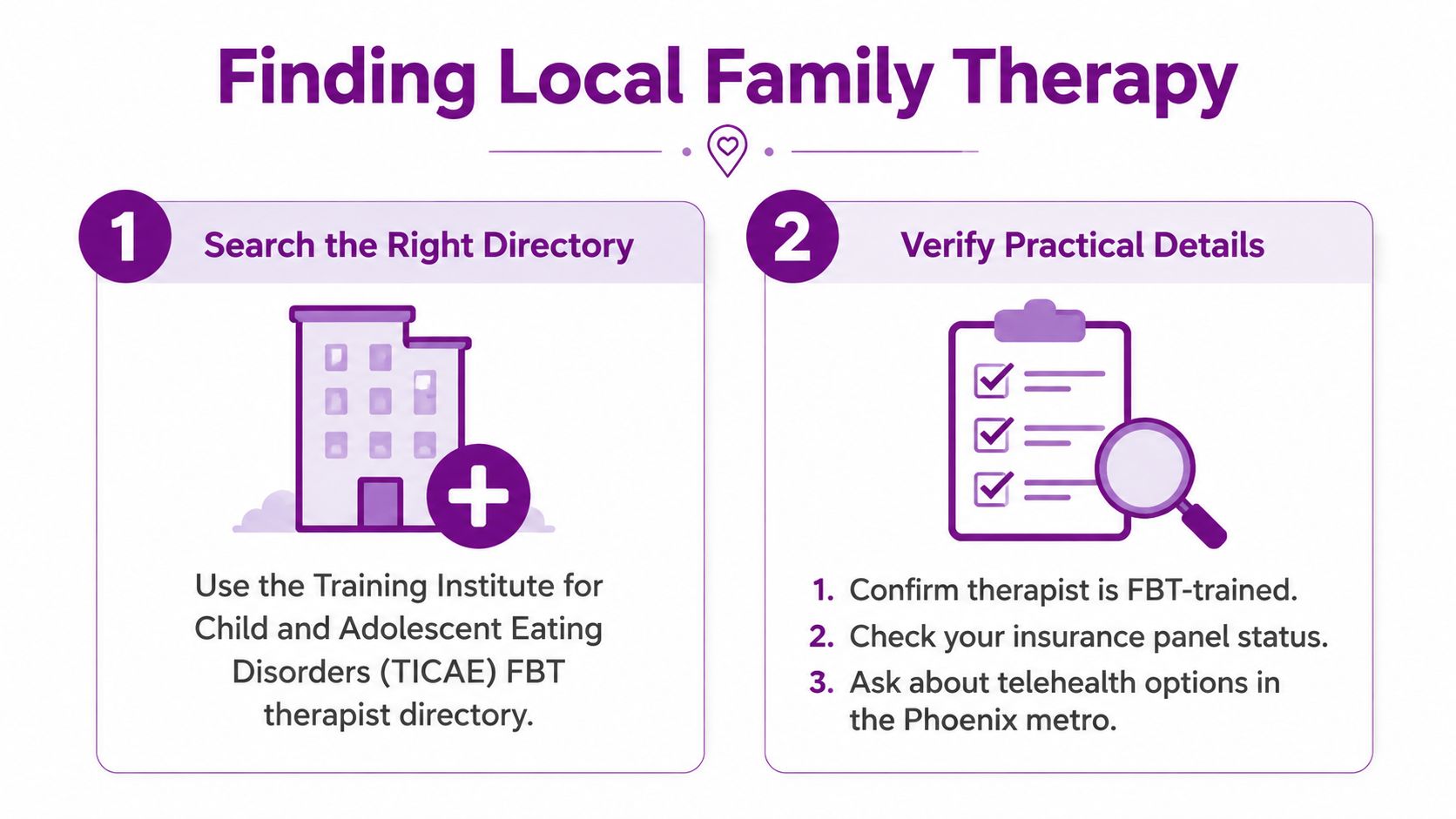
Families in the Phoenix metro can begin with a clinician directory focused on Family-Based Treatment. The Training Institute for Child and Adolescent Eating Disorders offers an FBT-trained therapist directory, which can help narrow a broad search to providers with relevant training. University-based eating disorder programs at ASU and Banner, along with local intensive outpatient providers, are other places to ask about family-informed care and referral pathways.
Insurance searches often fail because families use general terms. Call the behavioral health number on your insurance card and ask specifically about eating disorder treatment, family therapy, and providers trained in FBT. You can also ask whether the plan uses the family therapy codes 90846 and 90847, then verify how the insurer handles them.
Ask about access before scheduling
Arizona parity protections require comparable coverage for eating disorders, but families may still encounter pre-authorization requests and medical-necessity documentation. Ask whether the provider is in network, whether out-of-network benefits apply, whether a sliding scale is available, and whether the practice will consider a single-case agreement when an appropriate in-network specialist isn't available.
Before the intake call ends, write down the answers to these questions:
- Training: Has the clinician completed FBT training, and how often do they use the model?
- Family participation: How frequently are caregivers expected to attend sessions?
- Coordination: Will the therapist coordinate with a dietitian and medical provider?
- Crisis planning: What after-hours crisis access is available?
- Adult autonomy: How does the clinician involve adult clients while respecting consent?
- Format: Are telehealth and in-person appointments available in the Phoenix metro?
- Practical cost: What are the copays, deductibles, authorization requirements, and cancellation policies?
A guide to navigating therapy insurance coverage in Arizona can help you prepare for those conversations. reVIBE Mental Health is one local option that offers family-based eating disorder support, family counseling, therapy, and medication management, with in-person and telehealth services across its Phoenix-area locations.
Find a reVIBE Location Near You!
We currently have five locations for your convenience. (480) 674-9220
reVIBE Mental Health, Chandler
3377 S Price Rd, Suite 105, Chandler, AZ
reVIBE Mental Health, Phoenix Deer Valley
2222 W Pinnacle Peak Rd, Suite 220, Phoenix, AZ
reVIBE Mental Health, Phoenix PV
4646 E Greenway Road, Suite 100, Phoenix, AZ
reVIBE Mental Health, Scottsdale
8700 E Via de Ventura, Suite 280, Scottsdale, AZ
reVIBE Mental Health, Tempe
3920 S Rural Rd, Suite 112, Tempe, AZ
Holding Onto Hope Without Burning Out
Recovery rarely arrives as one decisive moment. There may be stalled progress, difficult meals, a return of symptoms, or a treatment change. None of those experiences automatically erase the work that came before, but they can leave caregivers exhausted.
Compassion fatigue can show up as irritability, numbness, disrupted sleep, sibling neglect, or marital strain. That burden deserves clinical attention, not a reminder to be more positive. Caregivers can protect their capacity by building support into the plan instead of waiting until they reach a breaking point.
Choose practices you can sustain
Schedule respite with trusted relatives or friends, even when the person you love is still struggling. Peer support through organizations such as NEDA or caregiver communities such as F.E.A.S.T. can reduce isolation and provide language for difficult situations.
Keep caregiver-only therapy or a support group on the calendar. A resource focused on child therapy support for parents may also help parents think about their own needs while supporting a young person. Protect basic routines around sleep, movement that is safe for you, meals, medical care, and time away from illness-focused conversations.
Hope is often built through ordinary meals, repeated conversations, and ordinary evenings that the family gets through together.
Family care doesn't mean surrendering every boundary or pretending the illness is easy. It means combining warmth with structure, autonomy with safety, and persistence with rest. The family isn't outside treatment, waiting for the professional to do the essential work. With appropriate guidance, the family becomes part of the recovery environment while each caregiver remains worthy of care in their own right.
If your family is facing eating disorder concerns, contact reVIBE Mental Health to discuss family-based therapy, individual counseling, or coordinated psychiatric support. Visit reVIBE Mental Health to explore in-person and telehealth options across Chandler, Phoenix, Paradise Valley, Scottsdale, and Tempe, and take the next step with a team that can meet your family where you are.