
EMDR, which stands for Eye Movement Desensitization and Reprocessing, is a unique form of therapy designed to help people heal from anxiety and other distressing life experiences. At its core, it helps your brain properly process memories that are the source of anxiety, taking the intense emotional sting out of them.
This process neutralizes their power over your feelings and reactions in the present, offering a path to lasting relief.
So, How Does EMDR Actually Work for Anxiety?
Imagine your brain is like a library. When things are going well, memories are neatly processed and filed away on the correct shelves. But when a traumatic or highly distressing event occurs, that memory can get stuck—it’s like a book being thrown haphazardly in the middle of the floor instead of being properly shelved.
Because this memory is stored incorrectly, your brain treats it as a current, active threat. Anytime something in your daily life reminds you of that event—a certain sound, a place, even just a feeling—it’s like kicking that pile of books on the floor. Your brain, the librarian, panics and sounds the alarm, triggering anxiety, fear, and a state of high alert, even when you're perfectly safe. This is why anxiety can feel so relentless; your brain is literally stuck in survival mode.

Reorganizing Your Brain’s Library
This is where EMDR comes in. It acts like a master organizer for that messy internal library. The therapy uses a core technique called bilateral stimulation (BLS)—which can be guided eye movements, alternating taps on your hands, or sounds played in each ear.
This steady, back-and-forth rhythm helps the different parts of your brain communicate more effectively. It creates the right conditions for your brain to finally access and re-file that stuck, emotionally charged memory. The memory is gently moved from your brain’s emergency response system to its proper long-term storage.
"Think of it like this: the therapy doesn't erase the book, but it finally puts it on the correct shelf. You can still recall the memory, but it no longer triggers an automatic panic response. It becomes just another part of your story, not a trigger for present-day anxiety."
To give you a quick overview, here's a simple breakdown of what EMDR therapy aims to achieve.
EMDR Therapy at a Glance
| Aspect | Description |
|---|---|
| Primary Goal | To reprocess distressing memories so they no longer cause emotional or physical symptoms. |
| Core Technique | Bilateral Stimulation (BLS): Guided eye movements, taps, or tones to activate the brain. |
| Focus | Past memories, present triggers, and future desired responses. |
| Outcome | Reduces anxiety symptoms by resolving the root cause, not just managing the symptoms. |
This table shows how EMDR provides a structured way to help your brain’s natural healing process get back on track.
The Goal of Reprocessing
Ultimately, the point isn’t to make you forget what happened. It’s to change how the memory is stored so it no longer hijacks your emotional state. EMDR is a powerful method for learning how to release stored trauma that often fuels persistent anxiety.
By guiding your brain through this natural healing process, EMDR helps you:
- Reduce Emotional Distress: The overwhelming feelings of fear, panic, and helplessness tied to the memory start to fade.
- Shift Negative Beliefs: Unhelpful beliefs like "I am not safe" or "I am powerless" are often replaced with more realistic ones, such as "That was then, and I am safe now."
- Decrease Physical Symptoms: The physical sensations of anxiety—a racing heart, shortness of breath, tense muscles—lessen as your nervous system learns it can stand down from high alert.
In short, EMDR empowers your brain to finish a processing job it couldn't complete at the time of the distressing event. It restores your own innate ability to heal, helping you move forward with a renewed sense of calm and control.
How EMDR Reprocesses Anxious Memories
To really get why EMDR is such a game-changer for anxiety, we have to look at how our brains file away experiences. The whole idea behind EMDR is built on something called the Adaptive Information Processing (AIP) model. Think of it this way: your brain has a natural, built-in system designed to process information and heal from tough stuff.
Most of the time, this system works beautifully. You go through something, and your brain processes all the sights, sounds, and feelings, then neatly stores it away as a memory. It gets integrated with everything else you know, becoming just another part of your story—something you can learn from. But sometimes, a particularly stressful or traumatic event is just too much for the system to handle.

When Memories Get Stuck
When an event is too overwhelming, the brain's processing system can get overloaded and essentially shut down. The memory—along with all the intense emotions, physical sensations, and negative thoughts attached to it—gets frozen in time. It isn't filed away correctly. Instead, it’s stuck in its raw, unprocessed form.
This "stuck" memory is like a live wire. It's easily triggered by things happening in the present. A certain sound, a smell, or even a familiar feeling can light up the whole memory network, making your mind and body react as if the original event is happening all over again. This is often what’s driving the anxiety—your nervous system is stuck on high alert, reacting to a past danger that feels very, very present.
How Bilateral Stimulation Helps the Brain Get Unstuck
This is where the magic of EMDR happens, using a technique called bilateral stimulation (BLS). It’s a simple, rhythmic, back-and-forth stimulation, usually done with guided eye movements, gentle taps, or tones played in each ear.
Think of BLS as the key that unlocks the brain's stalled processing system. This gentle, rhythmic input gets things moving again. It helps to:
- Connect the Dots in the Brain: BLS encourages communication between the right side of your brain (where emotions and raw sensory info live) and the left side (the logic and language center). This connection helps your brain finally make sense of what happened.
- Turn Down the Alarm: The repetitive nature of BLS has a naturally calming effect on the nervous system. It dials down the "fight or flight" response, creating a safe internal space to look at the memory without feeling completely overwhelmed by it.
- Mimic the Brain's Natural Process: Many experts believe the eye movements in EMDR are similar to what happens during REM (Rapid Eye Movement) sleep. That’s the stage of sleep when our brains are busy sorting through the day's events and consolidating memories.
EMDR doesn't erase a memory. Instead, it kickstarts your brain's own natural healing ability, allowing the memory to be properly "digested" and filed away. The memory transforms from a vivid, painful trigger into a past event that no longer has a stranglehold on your present.
One of the most powerful things about this process is how it physically calms you down. The eye movements seem to activate the parasympathetic nervous system—the part that tells your body to rest and relax. This is a big reason why distress levels often decrease during an EMDR session, making it a much gentler way to work through difficult experiences.
Rewiring Your Core Beliefs
As the memory gets reprocessed, you naturally start to see it from a new, healthier perspective. This creates a profound shift in the negative beliefs that got tangled up with the event, like "I'm not safe" or "I'm not good enough." The goal is to move from a place of fear to a place of empowerment.
With EMDR therapy for anxiety, this mental shift happens organically. You don't have to force yourself to "think positive." The therapy gets right to the root of the problem, and that’s what leads to lasting change. This is central to our philosophy for effective trauma treatment here at reVIBE Mental Health. By helping you resolve these foundational memories, we help you build a stronger, more resilient sense of self.
Who Can Benefit From EMDR Therapy?
While EMDR first made a name for itself as a game-changer for PTSD, its reach extends far beyond that one diagnosis. I’ve seen countless people struggling with different kinds of anxiety find incredible relief with this therapy, especially when their symptoms feel tangled up with past experiences.
It's a powerful option for anyone who feels stuck in a loop of worry or fear. This is particularly true if you’ve tried other therapies and felt like something was missing. EMDR gets to the root of the issue on a neurological level instead of just managing thoughts and behaviors on the surface.
Common Anxiety Conditions Treated with EMDR
Because EMDR helps the brain properly file away distressing memories, it can effectively disarm the triggers that set off different types of anxiety. It’s not about erasing the memory, but about taking the sting out of it.
This makes the therapy a great fit for several specific conditions:
- Generalized Anxiety Disorder (GAD): If you live with a constant, humming sense of worry, EMDR can help process the underlying fears or memories that keep your nervous system perpetually on high alert.
- Panic Attacks: We can target the memories of past panic attacks or the event that first sensitized you. This helps break the vicious cycle of "fearing the fear" itself.
- Social Anxiety: This is so often rooted in past experiences of humiliation, rejection, or feeling foolish. EMDR can reprocess those memories so that being around people no longer feels like a threat.
- Specific Phobias: An intense, irrational fear—whether it's of flying, needles, or speaking in public—is often tied to a single, negative past event. EMDR can desensitize you to that original memory, which significantly dials down the phobia.
A Real-World Example: Meet Alex
To make this less abstract, let’s talk about someone like Alex. A sharp, talented professional, Alex was held back by a paralyzing fear of public speaking. The minute he stood up to present, his heart would hammer, his mind would go blank, and he'd be drenched in a cold sweat.
Working with his therapist, Alex traced this fear back to one specific memory: a high school debate where he stumbled over his words and the whole class laughed. That moment created a deeply ingrained belief: "I'm incompetent and will always fail." Using the bilateral stimulation of EMDR, Alex was able to revisit and reprocess that memory.
He didn't forget what happened, but the emotional charge was neutralized. It was no longer a live wire. The next time Alex had to present, he felt grounded and confident. The old belief had been replaced with a new, more accurate one: "I am knowledgeable and capable."
Is EMDR Always the First Step?
EMDR is an incredible tool, but it's not always the first one we reach for. For some people, especially those with complex trauma histories or who experience dissociation, we need to build a solid foundation first.
Before diving into reprocessing, a good therapist makes sure you have the tools to handle any intense emotions that might come up. This means spending time on stabilization techniques, mindfulness, and grounding exercises to create a real sense of safety.
This initial phase ensures the deeper work is not only effective but also feels safe and manageable. The goal is always to empower you, not overwhelm you.
The flexibility of EMDR is one of its greatest strengths. Its ability to reduce anxiety isn't just for classic trauma cases; it works for situational anxiety, too. For example, research on children undergoing dental procedures showed that EMDR significantly lowered their anxiety about the appointment. This really highlights how EMDR can be applied to a wide range of stressful experiences. If you're interested in the details, you can read the full research on EMDR's impact on situational anxiety.
Your Step-By-Step Journey Through EMDR
Starting a new kind of therapy can feel a bit intimidating, like you’re not sure what to expect. Let's pull back the curtain on EMDR therapy for anxiety and walk through its structured, eight-phase journey. This isn't some mysterious, unpredictable process; it's a clear and collaborative path that you and your therapist walk together, with each step building on the one before it.
The whole framework is designed to make sure you feel safe, prepared, and in control from start to finish. The idea is to take the fear out of the unknown, making the healing process feel empowering instead of overwhelming.
Phases 1 and 2: History Taking and Preparation
The journey doesn't jump straight into the deep end. It begins with connection and getting you ready for the work ahead. In the first phase, your therapist gets to know you and your background. This isn’t about digging up every painful moment of your life, but about understanding what brought you here and pinpointing the specific memories or beliefs that are feeding your anxiety.
From there, you move into the preparation phase, which is all about building your personal toolkit. Your therapist will teach you grounding techniques and coping strategies so you can confidently manage any difficult emotions that might surface.
Think of it as creating your own mental "safe place." You'll establish a calming internal sanctuary you can return to anytime you feel overwhelmed. This phase is non-negotiable—it ensures you have the resources to stay present and grounded while doing the deeper reprocessing work later on.
Phase 3: Assessment
Once you feel prepared and have built a solid, trusting relationship with your therapist, you’ll move into the assessment phase. This is where you work together to pinpoint the specific "target memory" you want to work on first.
This involves zeroing in on a few key pieces tied to that memory:
- The Image: What’s the most vivid mental snapshot of the event?
- The Negative Belief: What unhelpful thing did you decide was true about yourself because of it? (e.g., "I'm not safe," or "I'm powerless.")
- The Positive Belief: What would you rather believe about yourself now? (e.g., "I am safe now," or "I am in control.")
- Emotions and Body Sensations: What feelings and physical sensations bubble up when you recall the memory?
Nailing this down creates a clear, focused starting point for the reprocessing to come.
Phases 4-7: Desensitization, Reprocessing, Installation, and Body Scan
This block of phases is the heart of EMDR, where the active reprocessing really happens. During Desensitization (Phase 4), your therapist guides you to hold the target memory in mind while you engage in bilateral stimulation (BLS)—usually following their fingers with your eyes, or using alternating taps. Your only job is to notice whatever comes up without judgment as your brain starts making new, healthier connections. The aim is to bring the emotional charge of the memory way down until it no longer feels upsetting.
Next up is Installation (Phase 5). Here, you focus on strengthening your desired positive belief until it feels genuinely true and solid. You’re essentially replacing that old, negative self-perception with a new, empowering one.
Then comes the Body Scan (Phase 6), where you check in with your body for any lingering tension or discomfort connected to the memory. If anything is still there, you’ll continue with BLS until your body feels calm and clear. This makes sure the memory is fully processed on both a mental and physical level.
Finally, every session wraps up with Closure (Phase 7). Your therapist will help you return to a state of calm using the grounding techniques you learned in the beginning, ensuring you leave the session feeling stable and centered.
Phase 8: Re-evaluation
Each new session starts right here, with re-evaluation. Your therapist will check in on the progress you made in the last session, making sure the positive changes are sticking around and the old distress hasn't crept back in. This final phase confirms that the work is complete and the results are lasting, solidifying your path toward real, long-term relief from anxiety.
This flowchart shows some of the key conditions that this structured EMDR process is so good at treating.
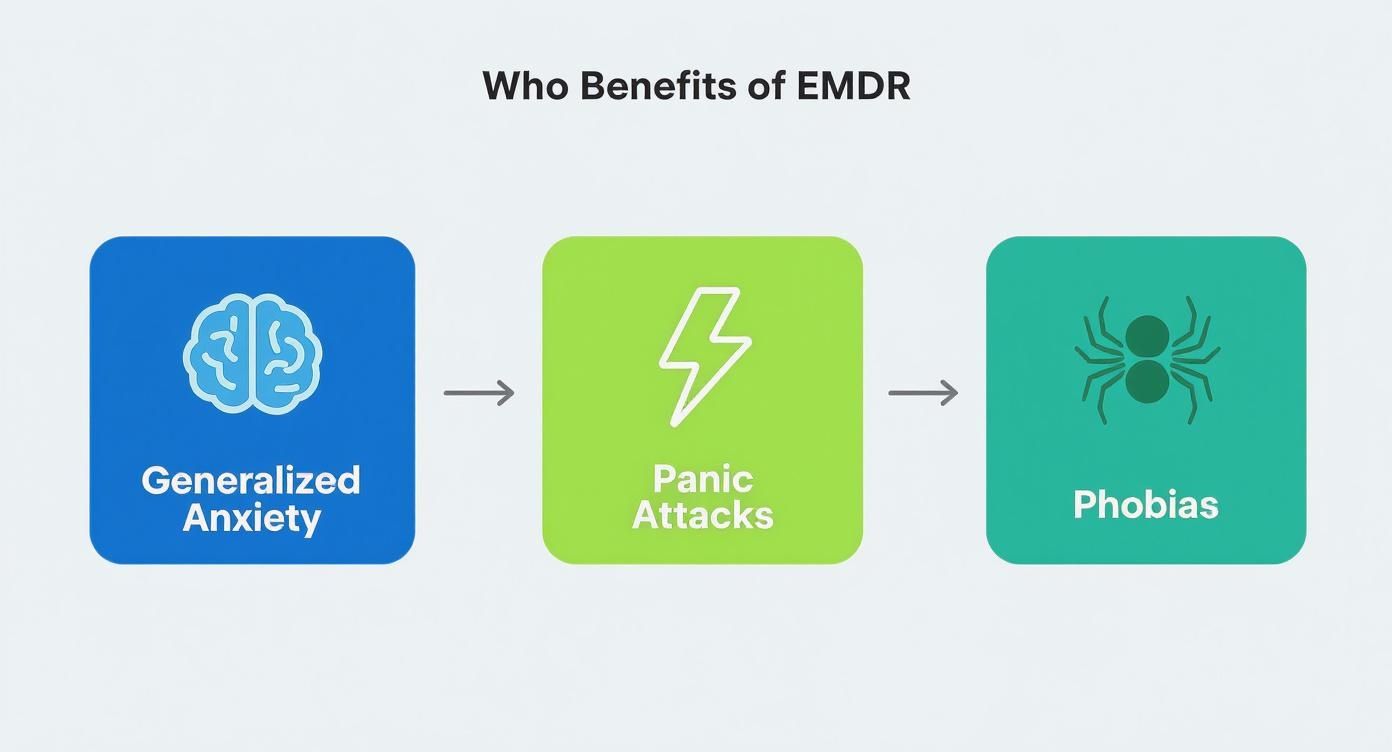
As the visual shows, this eight-phase approach can bring powerful relief to people struggling with generalized anxiety, panic attacks, and phobias by getting to the root memories that fuel them.
Comparing EMDR to Other Anxiety Treatments
When you're looking for help with anxiety, the number of different therapies out there can feel overwhelming. It’s easy to get lost in the jargon. Let's break down how EMDR therapy for anxiety stacks up against other common and effective approaches, like Cognitive Behavioral Therapy (CBT) and traditional talk therapy.
The goal isn't to find the one "best" therapy, but to find the one that’s the right fit for you and what you’re going through.
Different Paths to the Same Goal
The biggest difference comes down to the fundamental approach. Many therapies work by helping you manage your current thoughts and behaviors. EMDR, however, gets right to the root of the problem—the unprocessed memories that are often the fuel for the anxiety you feel today.
Think of it this way: traditional talk therapies, like psychodynamic therapy, help you gain incredible self-awareness by exploring your past and present through conversation. CBT is more structured and hands-on; it gives you a practical toolkit to identify, challenge, and reframe the negative thought patterns that keep your anxiety going.
EMDR takes a completely different path. It works from the idea that your anxiety is a symptom of a memory that got "stuck" in your brain's processing system. Instead of talking about the problem at length or consciously trying to change your thoughts, EMDR uses bilateral stimulation to kickstart your brain's natural healing process, allowing it to finally process the memory and neutralize its emotional power.
EMDR vs. Other Common Anxiety Therapies
Seeing the different approaches side-by-side can really help clarify things. Here’s a quick look at how EMDR compares to CBT and talk therapy when it comes to treating anxiety.
| Feature | EMDR Therapy | Cognitive Behavioral Therapy (CBT) | Talk Therapy (Psychodynamic) |
|---|---|---|---|
| Primary Focus | Reprocessing past memories that fuel present anxiety. | Identifying and changing current negative thought patterns. | Gaining insight into unconscious patterns and past experiences. |
| Main Technique | Bilateral stimulation (eye movements, tapping) to process memories. | Talk-based exercises, journaling, and behavioral "homework." | Open-ended dialogue and interpretation. |
| Patient's Role | Focuses internally on memories while the brain does the work. | Actively practices new cognitive and behavioral skills. | Explores feelings and thoughts through conversation. |
| Homework | Minimal; processing often continues subconsciously between sessions. | Typically involves worksheets or behavioral exercises. | Usually none; the work is contained within the session. |
Each of these therapies is powerful in its own right, but they shine in different situations. The key is matching the method to the person and the problem.
Finding the Right Fit for You
One of the biggest advantages of EMDR is that it doesn’t require you to describe a traumatic event in exhaustive detail, which can be a huge relief for many people. It also often works more quickly for single-incident traumas than other methods.
Of course, it's always good to be informed about your options. Understanding other highly effective treatments like Cognitive Behavioral Therapy for OCD and Anxiety can help you make a confident choice.
The best choice really comes down to what feels right for you. If you have a sense that your anxiety is deeply tangled up with specific things that have happened in your past, EMDR could be a game-changer. If you’re looking for practical, in-the-moment tools to manage anxious thoughts, you might find that exploring our other anxiety therapy options, like CBT, provides the kind of structure you need.
The evidence for EMDR’s effectiveness just keeps growing. In a recent study comparing it to virtual reality exposure therapy (VRET) for specific phobias, researchers found EMDR was equally effective. Both therapies led to a significant drop in anxiety symptoms, showing just how robust EMDR is for tackling powerful anxiety triggers. You can read more about these compelling findings here to see how well EMDR holds its own.
Ready to Start Healing? Here’s How to Begin at reVIBE
Learning about EMDR therapy for anxiety is a great first step, but the real change happens when you decide to take action. We know that making the first call can feel like the biggest hurdle, so our team at reVIBE focuses on making the process as straightforward and supportive as possible. Our whole job is to connect you with a skilled, compassionate EMDR therapist who gets you.
It all starts with a simple, confidential phone call. One of our care coordinators will listen to what’s going on and help match you with a therapist who’s a good fit. This is your chance to ask questions and get a sense of how we work, so you can feel confident and comfortable right from the get-go.
We believe that the connection you have with your therapist is the most important part of the healing process. Our main goal is to create a welcoming, non-judgmental space where you feel heard, respected, and empowered.
How to Prepare for Your First Appointment
To make the most of your initial consultation, it can be helpful to think about a few things beforehand. You don't need to have everything figured out—not even close—but a little reflection can help get things moving.
- Your Goals: What do you hope to get out of therapy? Are there specific fears or situations you want to work on?
- Your Questions: What are you curious about? This could be about EMDR itself, the therapy process, or your therapist's background.
- Your Story: Think a little about when your anxiety started and any major life events that might be tied to it.
Just remember, this is a partnership. Your therapist is there to meet you exactly where you are and move at a pace that feels right for you. There’s never any pressure to dive into anything you’re not ready for.
The most important part of this first step is simply showing up for yourself. Acknowledging that you are ready for a change is a powerful act, and our team is here to honor that by providing a supportive and professional space for your healing to begin.
Find a reVIBE Location Near You!
We currently have five locations for your convenience. (480) 674-9220
reVIBE Mental Health – Chandler
3377 S Price Rd, Suite 105, Chandler, AZ
reVIBE Mental Health – Phoenix Deer Valley
2222 W Pinnacle Peak Rd, Suite 220, Phoenix, AZ
reVIBE Mental Health – Phoenix PV
4646 E Greenway Road, Suite 100, Phoenix, AZ
reVIBE Mental Health – Scottsdale
8700 E Via de Ventura, Suite 280, Scottsdale, AZ
reVIBE Mental Health – Tempe
3920 S Rural Rd, Suite 112, Tempe, AZ
You can also learn more about our team and find the best office for you when you choose your clinic on our website. We look forward to talking with you.
Your EMDR Questions, Answered
It's completely normal to have a few questions floating around even after learning the basics. Deciding to start therapy is a big step, and you deserve to feel confident and clear about the process.
Let's walk through some of the most common questions we hear about using EMDR for anxiety.
Is This Some Kind of Hypnosis?
That's a very common question, but no, EMDR is not hypnosis. You are awake, alert, and fully in control the entire time.
Think of your therapist as a guide on a hike—they know the trail, but you are the one walking it. You can stop or pause whenever you need to. The goal is to process old memories while staying completely grounded in the here and now.
How Fast Will I See Results?
This really depends on your unique story. For someone whose anxiety is tied to a single, distinct event, it's possible to feel a major shift in as few as 3 to 6 sessions.
If your anxiety is rooted in more complex or prolonged experiences, it will naturally take a bit longer. Your reVIBE therapist will create a plan that fits your specific needs, ensuring you move at a pace that feels safe and supportive for you.
One of the biggest reliefs for many people is that you don't have to talk in detail about the painful memory. The focus is on letting your brain do the reprocessing work, not on reliving the story out loud.
Do I Have to Talk About My Trauma in Detail?
Absolutely not. This is one of the most powerful aspects of EMDR. While you'll need to bring the memory to mind to get started, you will not be forced to give a minute-by-minute account of what happened.
The healing comes from the internal processing your brain does with the help of the bilateral stimulation, not from having to talk extensively about the event itself.
Are the Results Permanent?
Yes, the effects of EMDR are designed to be permanent. By helping your brain properly file away the distressing memory, the therapy effectively neutralizes its emotional power for good.
You're not just managing symptoms; you're addressing the root cause. Follow-up studies have shown time and again that the benefits hold up long after the therapy sessions have ended, offering lasting relief.
Ready to explore if EMDR could be the right path for you? The compassionate team at reVIBE Mental Health is here to answer any other questions you have and help you get started. Schedule your initial consultation today and take the next step.