
You got the referral, the name sounds credible, and now you're staring at a feed of EMDR therapy reviews trying to decide whether to book. Some people describe fast relief and a therapist who finally “got it,” while others sound frustrated about pacing, cost, or feeling rushed through something emotionally heavy. In Phoenix, that mix can feel especially high-stakes, because the therapist you choose may be the difference between a careful, structured process and a disappointing first attempt.
EMDR sits in a strange place in public conversation. It's widely discussed, often praised, and also often misunderstood. The clinical record says it's an established trauma therapy, but the review pages you read usually mix the modality itself with the skill of the individual clinician, and those aren't the same thing.
Why EMDR Therapy Reviews Matter When You're Choosing a Provider
A lot of Phoenix readers end up in the same spot. A friend recommends EMDR after trauma, a primary therapist mentions it, or a search for “EMDR therapy reviews” turns up a long list of names in Scottsdale, Tempe, Chandler, or Phoenix. The five-star stories are tempting, but the cautious ones matter too, because they often reveal how a therapist handles pacing, emotional safety, and the parts of treatment that patients don't fully understand until they're in the room.
That's why reviews deserve more than a quick skim. They're not just consumer chatter, they're a rough window into how a real person experienced the session structure, the therapist's style, and whether the process felt organized or improvised. For readers trying to vet care, that matters. A useful framing from the reviews literature on online reputation is find out why online reviews matter now, because the same logic applies here, but with higher clinical stakes.
Modality reviews and clinician reviews aren't the same thing
A review of EMDR as a method is really about whether the person felt symptom relief, safety, and momentum. A review of an individual clinician is about whether that therapist had enough training, explained the process clearly, and matched the client's pace. Those are related, but they're not interchangeable.
Practical rule: If a review says the therapist was “warm” but never mentions preparation, closure, or what happened when processing got intense, it tells you more about bedside manner than EMDR quality.
That distinction matters because the clinical evidence shows EMDR can work, but outcomes still depend on who delivers it and how carefully it's done. Reviews help you spot whether a clinician appears to use the full model or just brand ordinary trauma therapy as EMDR. In the end, reviews should guide your questions, not decide the case for you.
How EMDR Actually Works and What a Session Looks Like
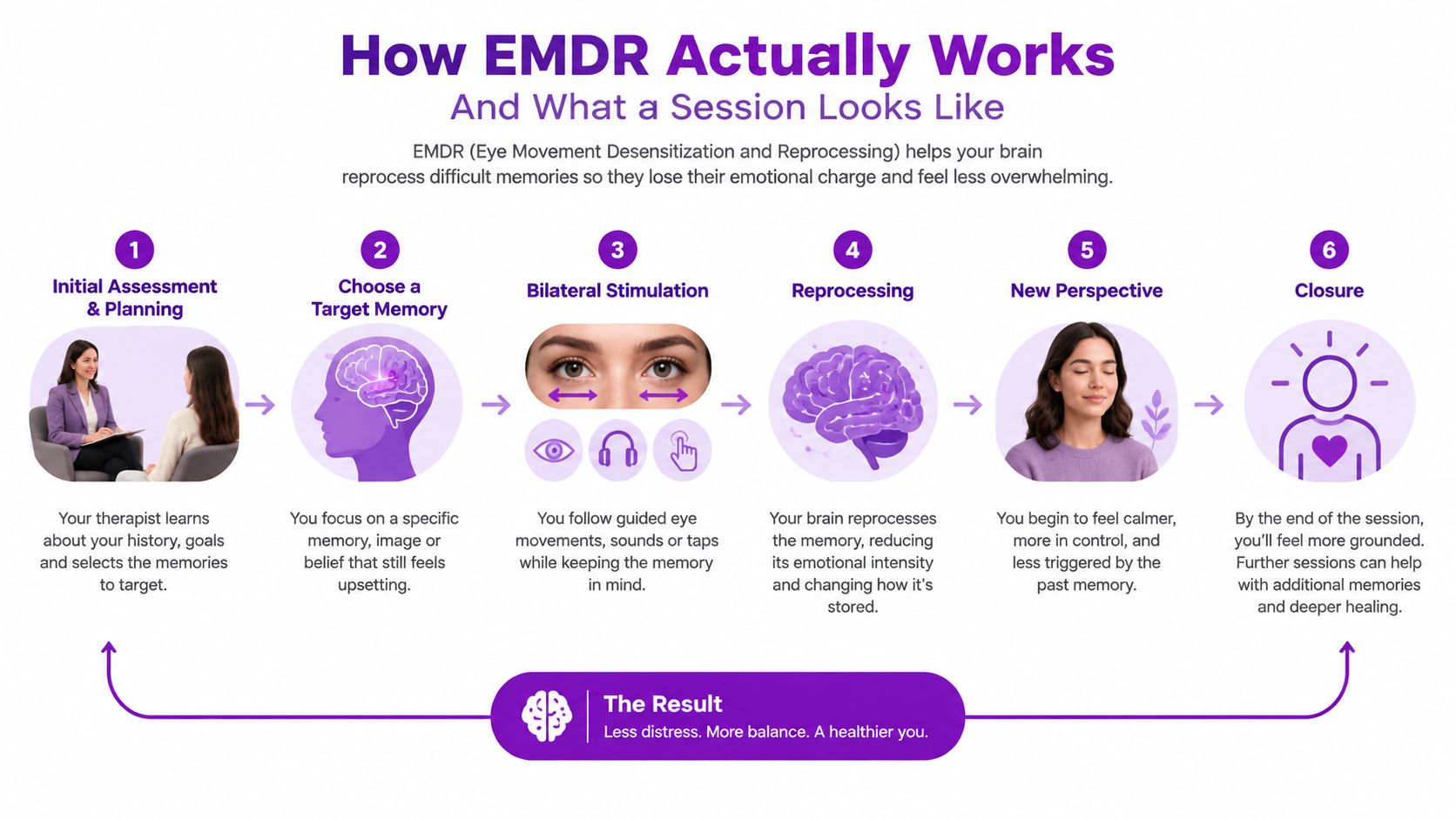
The easiest way to understand EMDR is to think about a cluttered filing system. A memory that still feels raw isn't gone, it's just stored in a way that keeps getting reopened every time a cue shows up. EMDR aims to help the brain refile it so the memory stays factual, but stops hijacking the present.
The eight phases in plain English
The first phase is history-taking, which is like intake paperwork plus a careful map of what you want to work on. The second is preparation, where the therapist teaches grounding and makes sure you've got the emotional tools for the work ahead. The third is assessment, where you and the therapist decide which memory or belief is getting opened first.
The fourth phase is desensitization, the actual filing work. Bilateral stimulation, usually eye movements, sometimes taps or tones, helps keep you present while the memory is processed. In a typical session, you don't need to narrate every detail out loud, which is one reason some people who dread retelling trauma find EMDR easier to tolerate than open-ended talk therapy.
The fifth phase is installation, where the therapist reinforces a more adaptive belief. The sixth is a body scan, a final check for lingering tension, and the seventh is closure, which is the emotional equivalent of packing the folder away for the day. The eighth is reevaluation, when the therapist checks what stayed stable between sessions.
Here's the practical part: EMDR sessions are often about 60 to 90 minutes, with six to 12 sessions being a common range for a single-incident trauma presentation, though complex histories can take longer, according to Harvard Health's overview of the method. For a Phoenix reader comparing providers, that's useful because it tells you what kind of time commitment you're asking for.
If you want a provider-level overview, this explanation of how EMDR therapy works is a good companion to the clinical picture. The main thing to remember is that a well-run EMDR session should feel structured, not improvised.
What the Clinical Research Really Says About EMDR
A Phoenix reader skimming EMDR therapy reviews can easily get pulled in two directions. Some reviews make EMDR sound unusually fast. Others make it sound overpromised. The research sits between those extremes, and the difference matters when you are deciding which provider to trust.
The strongest part of EMDR's evidence base is PTSD. A 2024 expert review in the Journal of Traumatic Stress described EMDR as an evidence-based psychotherapy for PTSD supported by more than 30 published randomized controlled trials, with evidence in adults and children (Journal of Traumatic Stress review). That is a solid foundation, but it does not mean every favorable review reflects a therapist who uses the method well.
Strong for PTSD, not clearly superior to other top therapies
A major 2020 systematic review and meta-analysis of 76 EMDR trials found a large pooled effect versus control conditions for PTSD outcomes, with Hedges' g = 0.93 and 95% CI 0.67 to 1.18, but also high heterogeneity, I² = 72% (2020 meta-analysis). That combination points to real benefit, while also showing that results vary across studies and settings.
The same review found no clear advantage over other active psychotherapies in low-risk-of-bias studies. A later Psychological Medicine systematic review and individual participant data meta-analysis reached a similar conclusion, finding no significant difference between EMDR and other psychological therapies for PTSD severity, response, remission, or dropout (Psychological Medicine meta-analysis). For readers comparing clinicians, that means EMDR is a credible trauma treatment, not a uniquely dominant one.
What that means in practice
The practical takeaway is straightforward. EMDR appears to work about as well as other established trauma-focused therapies for PTSD, so provider quality may matter more than branding. A careful therapist, a clear treatment plan, and good pacing can matter as much as the modality itself. If you want a focused look at outcomes and what shapes them, see our analysis of EMDR therapy success rates.
For readers judging reviews, the right question is not whether EMDR has evidence. It does. The better question is whether a given therapist is using it with enough structure, consent, and clinical judgment for your history.
| Source / Year | Study Type | Sample Size | Reported Effect | Guideline Status |
|---|---|---|---|---|
| WHO and APA guideline history summarized in later reviews | Guideline-based recognition | Not specified in source | EMDR recognized as established for trauma | Evidence-based |
Common Themes in Patient Reviews of EMDR Therapy
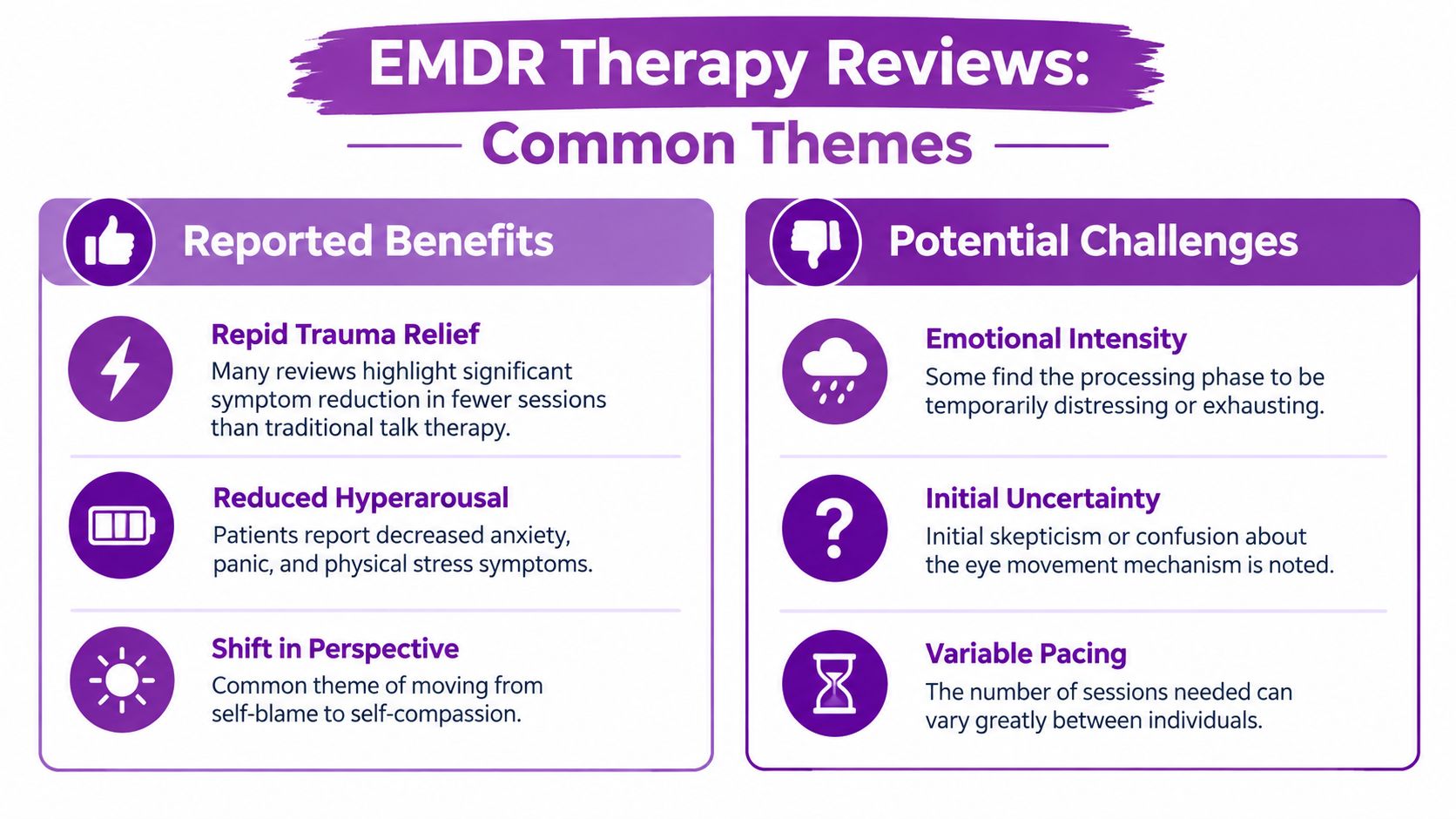
Patient reviews tend to cluster around the same few experiences, and that pattern tells you a lot. When people feel EMDR worked, they usually describe a drop in intrusive memories, less hyperarousal, better sleep, and a sense that something finally loosened. When they feel disappointed, the complaints usually center on emotional intensity, fatigue, or a therapist moving too fast.
What people praise
The most consistent praise is for rapid relief. That doesn't mean instant healing, but it does mean many people are surprised by how quickly the emotional charge around a memory changes once the process gets going. Another common theme is that EMDR feels easier to start than therapies that require repeated verbal retelling.
Reviews also often mention a shift from shame or self-blame toward a more stable, self-protective perspective. That lines up with how EMDR is designed, because the therapist isn't just reducing distress, they're also helping the person install a more adaptive belief.
What frustrates people
The negative reviews are just as informative. Some people describe the processing phase as exhausting, emotionally intense, or draining between sessions. That's not automatically a sign of failure, because the protocol is designed to touch material that has been stuck. It does mean the therapist should have prepared the client well.
Practical rule: Complaints about feeling “rushed” often point to a therapist who skipped the preparation phase, not to EMDR itself.
Other frustrations are more practical, especially around cost and package-style commitments. In some reviews, the issue isn't whether EMDR helped, but whether the provider explained the time commitment, handled pacing well, and made room for unfinished processing. Those details matter more than star ratings because they tell you whether the therapy was delivered with structure.
The one place patient sentiment can overreach is outside PTSD. Reviews may sound enthusiastic for anxiety, depression, or burnout, but the evidence is more mixed there, so the patient experience should be read as a clue, not a conclusion.
EMDR Beyond PTSD and What the Evidence Shows
EMDR's non-PTSD reputation is growing faster than the evidence is tightening. That's not a criticism, it's just where the field is right now. Reviews and overviews suggest it may help with anxiety, depression, OCD, pain, addiction, personality disorders, and comorbid symptoms, but the certainty level varies a lot by condition and by what EMDR is being compared against (PubMed overview of recent reviews).
Where the evidence looks stronger
For depression, a 2024 meta-analysis reported a significant reduction with EMDR, with Hedges' g = 0.75, and noted stronger effects in people with more severe baseline depression (Frontiers meta-analysis). That does not make EMDR a universal depression treatment, but it does suggest it may have practical value when depressive symptoms are tightly linked to distressing experiences.
For anxiety-related concerns, the literature is broad but uneven. Trauma-related anxiety seems more plausible as an EMDR target than generalized worry without a clear memory anchor. For OCD and pain, the evidence is more promising than definitive, and the clinical question usually becomes whether EMDR is treating a linked traumatic or distressing memory rather than the diagnosis alone.
What to call emerging rather than settled
Recent review summaries point to use in grief, burnout-related distress, and other emotional problems, but those are better described as emerging applications than established indications. That's especially important for Phoenix readers scanning reviews for help with non-PTSD concerns, because the most polished marketing language often runs ahead of the evidence.
| Condition | Evidence Strength | Key Finding |
|---|---|---|
| PTSD | Strong evidence | Large, established research base and consistent symptom reduction |
| Depression | Moderate evidence | Meta-analysis found significant symptom reduction, with stronger effects in more severe cases |
| Anxiety | Moderate to emerging evidence | Likely more useful when anxiety is trauma-linked or symptom-specific |
| OCD | Emerging evidence | Promising, but not yet a clearly settled first-line choice |
| Chronic pain | Emerging evidence | Small studies and reviews suggest benefit, but certainty remains limited |
| Grief and burnout-related distress | Emerging evidence | Commonly discussed, but evidence is still developing |
The practical conclusion is simple. If your main concern is PTSD, EMDR has a strong case. If your concern is depression, anxiety, pain, or a mixed picture, it may still be a sensible option, but you should judge the therapist's explanation more carefully than the marketing headline.
How to Read EMDR Therapist Reviews and Verify Credentials
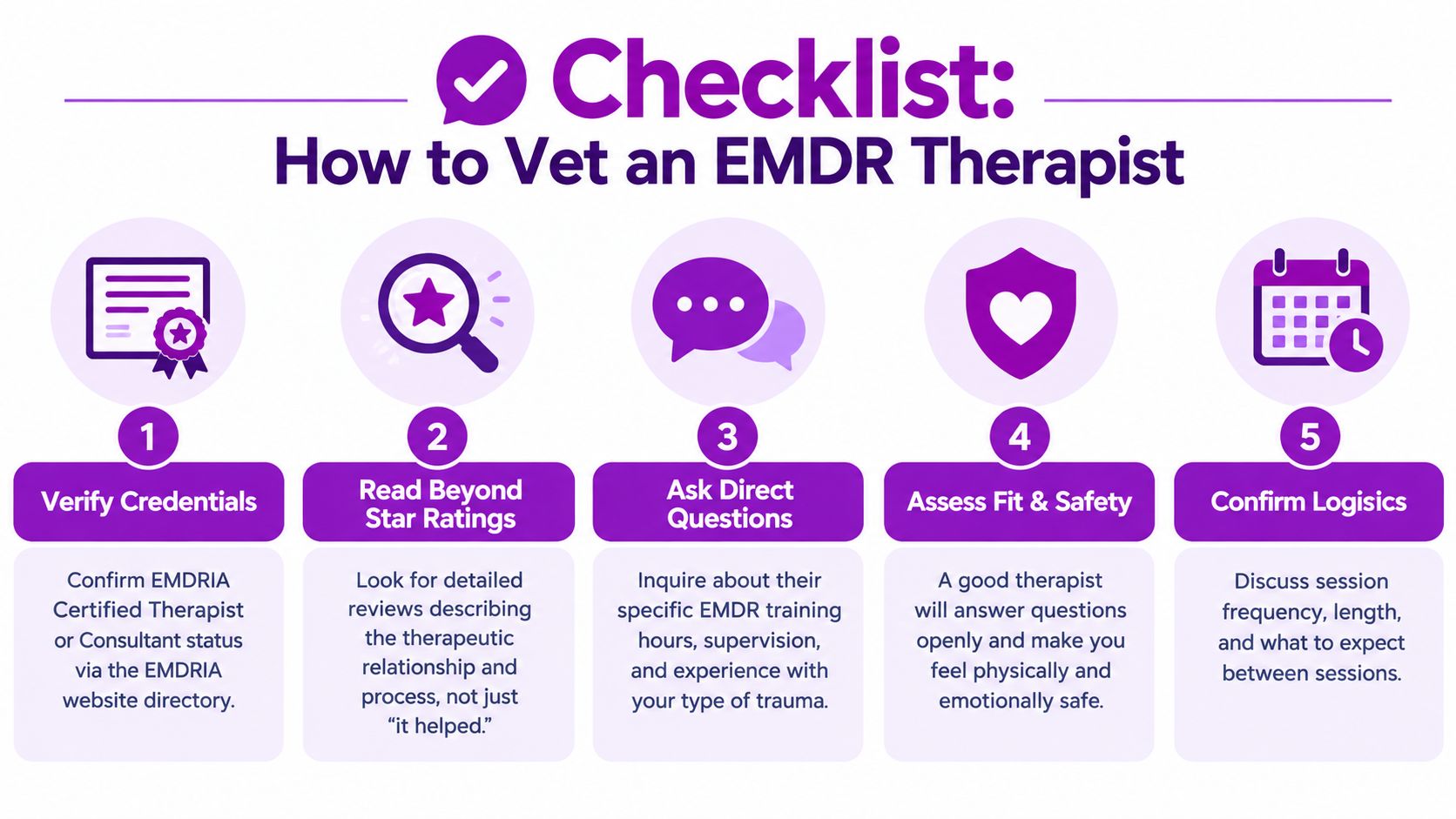
Start with the review text, not the star count. A good EMDR review usually gives you clues about whether the therapist followed a real protocol, especially if the reviewer mentions preparation, body work, closure, or follow-up between sessions. A vague “changed my life” review may be sincere, but it doesn't tell you much about whether the therapist is trained in EMDR.
What to verify before you book
First, check whether the therapist is listed in the EMDRIA directory and whether they hold basic or consultant-level certification. Then confirm active licensure with the Arizona Board of Behavioral Health Examiners. You also want to know whether they completed an EMDRIA-approved basic training, which requires minimum 50 hours.
Ask direct questions during the consultation:
- Training level: “Did you complete EMDRIA-approved basic training, and are you certified or still working toward certification?”
- Consultation status: “How many consultation hours have you completed toward certification?”
- Session structure: “What does a typical EMDR session look like with you?”
- Safety planning: “What happens if we start processing and the material isn't fully resolved?”
- Fit for my concern: “Have you treated clients with concerns like mine?”
Red flags that should slow you down
Watch for providers advertising “EMDR-style” work without clear training. Be cautious if a therapist can't explain preparation and closure, or if reviews never mention those parts of the protocol. Pressure to prepay for expensive session packages before you've had a real consultation is another warning sign.
A qualified clinician should be able to explain what they do, what they don't do, and how they decide whether EMDR is appropriate for you.
If you're comparing reviews, weight process-focused comments more than personality praise. Warmth matters, but structure matters more. In EMDR, the most credible reviews are usually the ones that describe both.
Finding EMDR Therapy in Phoenix and What to Do Next
Phoenix-area searches work best when you combine reviews with geography and logistics. If you live in the East Valley, the practical question isn't just who offers EMDR, it's whether the provider is reachable from Scottsdale, Tempe, Chandler, Phoenix, Mesa, or Gilbert, whether they take your insurance, and whether they offer telehealth on days when commute or heat makes an in-person visit unrealistic. A provider search like EMDR therapy near me is useful only if you pair it with verification.
What to prepare before you call
Have three things ready. First, name the concern you want help with, whether that's trauma, anxiety, depression, grief, or something mixed. Second, summarize any prior therapy or medication context, because that affects how EMDR is introduced. Third, be honest about your timeline hopes, because a provider can only talk realistically about pacing if they know what you're expecting.
A credible first response usually includes clear answers about training, session format, insurance, and whether the therapist thinks EMDR is a fit for your symptoms. If someone jumps straight to a package sale or avoids your questions, that's not a good sign.
One practical next step
If you want a local option that offers EMDR alongside other mental health services, reVIBE Mental Health serves the Phoenix metro area with locations in Chandler, Phoenix Deer Valley, Phoenix PV, Scottsdale, and Tempe. Their team can help you compare therapy fit, insurance details, and whether EMDR is appropriate for your concern, which is exactly the kind of first conversation a cautious EMDR shopper should have. If you're ready to narrow the field, contact them, ask about availability, and use the consultation to find out whether the therapist's pace, training, and approach match what you need.
If you're sorting through EMDR therapy reviews right now, don't stop at the stars. Review the clinician's training, ask how they handle preparation and closure, and compare that to what you need for PTSD, anxiety, or depression. If you want a local starting point, visit reVIBE Mental Health to ask about EMDR, therapy fit, and the next available consultation.