
If finding your shine means becoming more positive, what happens on the days when positivity doesn't help? You can feel anxious, exhausted, or uncertain and still take meaningful care of yourself. A more useful approach turns an encouraging phrase into actions you can practice, check, and adjust, including knowing when to ask for professional support.
Finding Your Shine at a Glance
Finding your shine means noticing and using your strengths, answering yourself with kindness, and asking for help when a struggle grows larger than self-directed effort. It's less about maintaining a bright mood and more about observable habits.
The distinction matters because feelings aren't assignments you can complete. You can't always choose confidence, but you can choose to speak openly despite doubt or contact someone when you're struggling.
Five markers of finding your shine
| Dimension | What It Looks Like | Weekly Marker | Common Trap |
|---|---|---|---|
| Strengths | You name a personal strength and use it on a hard day | You can name at least one strength and have used it this week | Treating strengths as proof you should cope alone |
| Confidence | You act on your values even while doubt is present | You made at least one choice this week despite doubt | Believing confidence means never feeling anxious |
| Self-compassion | You speak to yourself the way you would speak to a friend | You caught harsh self-talk and reworded it at least once a day | Using kindness as a way to skip hard tasks |
| Resilience | You recover from setbacks within days rather than months | Sleep, work, and relationships return to normal within a week of a bad patch | Bouncing back alone while symptoms keep returning |
| Help-seeking | You ask for support before a struggle becomes a crisis | You can name one person or service you would contact this week | Waiting until you feel you've earned help |
Treat these markers as reflection prompts, not clinical standards. Recovery doesn't follow a uniform timetable, especially after loss or trauma.
What the markers look like
Using patience with a difficult coworker is a strength in action. Asking for clarification despite embarrassment demonstrates confidence, while replacing an insult toward yourself with a fair description demonstrates compassion.
Resilience might mean adjusting your workload after a setback rather than pretending nothing happened. Help-seeking could mean telling a trusted person that you're having difficulty sleeping and want support.
Confidence doesn't require the absence of doubt. Resilience doesn't require coping alone.
Score each row yes or no against your last two weeks. Several no answers, particularly around resilience or help-seeking, are a reason to prioritize the professional-support check in When Self-Reliance Is Not Enough, rather than adding another self-improvement demand.
Why Strengths Build Your Shine
A strength is useful when you can put it to work under pressure. Persistence might help you return to a difficult task, curiosity might help you question an anxious prediction, and humor might give you enough distance to approach an uncomfortable conversation.
You don't need to describe yourself as an unusually optimistic person. A strength-based approach starts by identifying resources you already have and connecting them to a specific difficulty.
Journaling can help make that connection visible.

What the evidence supports
A meta-analysis of positive-psychology interventions included 347 studies involving more than 72,000 participants across 41 countries, reported improvements in well-being (Hedges' g = 0.39) and strengths (g = 0.46), and described interventions averaging approximately 10 sessions over six weeks, with benefits maintained at three-month follow-up.
These are generally small to moderate effects, not evidence that a positive attitude can resolve every mental-health concern. The studies examined structured interventions, not repeating an encouraging slogan.
An effect size describes an average difference across groups. It doesn't tell you how much better you personally will feel, and it isn't a percentage improvement or a guarantee.
Turn a trait into a coping behavior
Consider a teacher who recognizes persistence as a strength. Rather than deciding to become more positive about a difficult class, she chooses to return calmly to her lesson plan after an interruption and records her mood and avoidance that evening.
Her target is observable: did persistence help her stay engaged without pushing past her limits? If she completed the lesson but spent the evening overwhelmed, she might also need firmer boundaries, practical assistance, or clinical support.
A useful strengths record separates:
- The resource: Persistence, patience, honesty, curiosity, or another identifiable quality.
- The application: What you did in a difficult moment.
- The result: Whether your mood, avoidance, or ability to function changed.
Expect gradual learning over several weeks rather than an overnight transformation. Sometimes you'll discover that a strength needs adjustment, such as pairing persistence with permission to stop.
Strengths practice complements assessment and treatment for anxiety, depression, or trauma. It doesn't replace them. The purpose is to expand your options, not prove that you should manage everything yourself.
How Self-Compassion Quiets the Inner Critic
What do you say to yourself right after a mistake? A parent misses a work deadline after a difficult evening at home. Instead of reviewing what went wrong, they turn the miss into a verdict on their character and spend the night replaying it.
A compassionate response acknowledges that the situation was hard and names something repairable tomorrow. The deadline still matters. The parent just doesn't have to attack themselves to take responsibility for it.
Kindness without avoidance
Self-compassion means responding to distress with kindness, recognizing that struggle is part of being human, and noticing emotions without letting them define the whole situation. It isn't self-indulgence, forced reassurance, or permission to skip hard tasks.
Harsh self-criticism works like a smoke alarm that never switches off: loud, draining, and no longer useful. It feeds rumination and shame, while a fairer response leaves room for practical action, such as updating a supervisor, changing an unrealistic plan, or discussing the pattern in therapy.
A useful test: Does your response help you face the next necessary task, or does it help you avoid it?
A meta-analysis of self-compassion interventions covering 36 randomized controlled trials and 2,960 participants found a medium reduction in depressive symptoms immediately after treatment (standardized mean difference = 0.44; 95% confidence interval, 0.31–0.57), with a smaller but still significant benefit at follow-up (0.38; 0.14–0.61).
Those numbers describe modest average gains across groups. They support steady practice, not rapid relief, and your circumstances, symptoms, and treatment needs still shape what the practice can do for you.
Make your response believable
The parent names the disappointment, describes the missed deadline without a character judgment, and sends a realistic update. They can also bring the recurring self-criticism into therapy rather than hiding it.
If supportive language feels unnatural, these examples of positive affirmations can offer a starting point. Adapt the wording until it is honest enough to believe, rather than insisting that everything is fine.
When exhaustion makes reflection difficult, you can explore rest and autonomic recovery as supplementary reading about rest. It is not a substitute for evaluating persistent symptoms.
One honest threshold applies here. If you practice a kinder response for several weeks and the inner critic still runs every hard moment, self-reliance has likely run its course, and bringing the pattern to a professional is the next compassionate step.
How to Practice Finding Your Shine Step by Step
Use a notebook or a simple note on your phone. Run this routine during a week, then repeat it so you have something more informative than your memory of the hardest day.
This is a personal practice, not a validated screening tool. Keep it small enough that recording your experience doesn't become another exhausting responsibility.
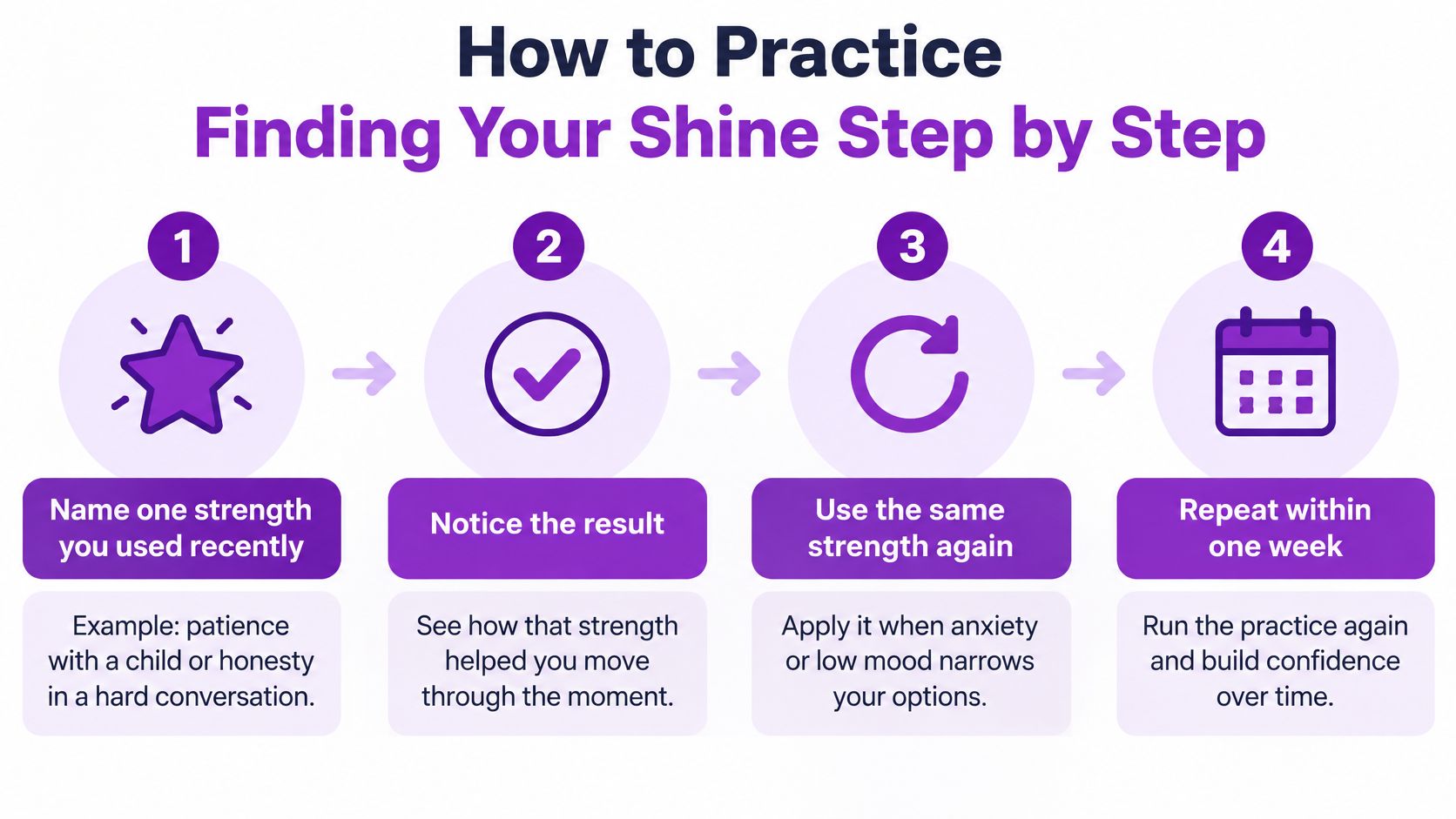
The visual summarizes the strengths-practice loop.
Set up the week
Name a strength you used recently. Identify a behavior, such as patience with a child or honesty during a hard conversation, because a strength you can recognize is easier to use deliberately. Avoid vague labels such as being good, which don't tell you what to do.
Choose a small difficult situation coming up this week, such as replying to an uncomfortable message rather than repairing an entire relationship. A bounded task gives you a clear opportunity to practice; the common slip is choosing a problem too large to finish.
Name the emotion and separate facts from judgments. Write anxious, disappointed, or angry, then describe what happened in plain language so you can distinguish the event from your interpretation. Avoid turning a fact, such as receiving no reply, into a verdict that nobody respects you.
Write what you'd say to a trusted friend in the same position, including both understanding and a realistic responsibility. The aim is a fair response that supports engagement, not reassurance that lets you skip the hard task.
Choose a feasible action to complete within 24 hours. Send the clarification email, prepare what you need for an appointment, or ask for practical help so the exercise produces behavior rather than reflection alone. Don't stack several tasks together and call them a single action.
Record the result and review it
Each evening, record mood on a 0 to 10 scale, avoidance as yes or no, and a functional measure such as sleep quality or work completed. These are personal tracking choices, not diagnostic cutoffs; avoid collecting so much information that you stop recording altogether.
Review the log after two weeks. Look for direction in mood, avoidance, and functioning, and move to a professional-support check if you're not improving or symptoms persist. Don't treat a bad day as proof the practice failed, or use a good day to dismiss an otherwise difficult pattern.
For example, your entry could record patience used during a tense conversation, anxiety afterward, no avoidance, and completion of a necessary work task. Another evening might show lower mood but improved follow-through, which is useful information even if it doesn't feel like success.
If movement is your chosen action, keep the habit practical. The workout habit advice from Strive Workout Log offers supplementary ideas for consistency, but exercise shouldn't become a test of whether you deserve to feel better.
A useful week leaves evidence of an effort you can repeat, not proof that you've perfected self-care.
A good week might include a strength used deliberately, a kind reframe, an action completed, and a log showing direction. Missing an entry doesn't erase the practice, and struggling with the routine is information to consider, not another personal failure.
When Self-Reliance Is Not Enough
Trying harder can become a way of postponing care. Being able to work, care for others, or appear composed doesn't tell you whether you're coping sustainably.
According to Mental Health America's access-to-care reporting, in the 2023 National Survey on Drug Use and Health, 70.5% of U.S. adults who didn't receive needed mental-health treatment said they believed they should have been able to handle their mental health, emotions, or behavior on their own; among adults with an unmet need in New York City, 48% cited the same barrier.
Use functioning and safety as decision points
You don't have to determine whether you have burnout, anxiety, depression, or a trauma-related condition before making contact. Describe what's happening and how it affects your life.
Self-directed practice or professional support
| Situation | Self-Directed Practice | Seek Professional Support When |
|---|---|---|
| Stress from a deadline or conflict | Use strengths, short breaks, and a conversation with a friend | Stress lasts several weeks and blocks sleep or work |
| Low mood after a loss or change | Keep a routine, add daily movement, and write compassionate notes | Low mood lasts two weeks or more most days, or you withdraw from people |
| Constant worry that is hard to switch off | Name the worry, write it down, and plan one action | Worry triggers panic, avoidance of daily life, or physical symptoms |
| Memories of a frightening event | Use grounding, rest, and support from people you trust | Flashbacks, nightmares, or avoidance persist for a month or more |
| Thoughts of self-harm or not wanting to live | Reach out to someone nearby right away | Seek immediate support, without waiting for a duration threshold |
These durations are common clinical guidance, not a diagnosis or a required waiting period. Significant impairment deserves attention earlier, and you don't need to reach a particular level of distress to ask for an assessment.
For any thoughts of self-harm or not wanting to live, call or text 988 in the United States or contact local emergency services immediately. If you might act on those thoughts or can't stay safe, contact emergency services and ask someone to stay with you.
Recognize when the task has changed
If the main difficulty is following through on a manageable goal, Pretty Progress offers ways to turn goals into consistent follow-through. Accountability can support an action plan, but it isn't an answer to persistent impairment, trauma symptoms, or safety concerns.
Use these signs you need therapy to help describe your concerns. Bring concrete examples, such as missed work, disrupted sleep, canceled plans, or places you've begun avoiding.
At reVIBE, we offer personalized matching to help clients find a therapist or psychiatric care provider who specializes in their needs and fits their preferences. A professional check begins with a conversation, not a requirement to explain yourself perfectly.
Book Your First Step at reVIBE
Choose a row from the opening table that you marked no, and take an action on it this week. If help-seeking was the difficult row, your action can be making contact and describing what you need.
We built reVIBE Mental Health to honor the courage it takes to ask for help and make support easier to access. We're one route among several, and an initial inquiry is an opportunity to understand fit, not an obligation to commit.
Make contact with a concrete concern
Start with what you've noticed rather than searching for the correct clinical label. You might explain that worry is affecting your sleep, that you're withdrawing from people, or that your usual coping strategies aren't helping.
Our Phoenix PV location page lists five Phoenix metropolitan-area locations and our main phone number, (480) 674-9220.
- Call or use our website contact form: A team member responds and helps find the best fit.
- Name your concern and closest location: Describe the difficulty you want help with and where you'd prefer to attend.
- Clarify what applies to you: Ask our team which services fit your concern and confirm the practical details before booking.
You don't need to prepare a complete personal history for that first contact. A brief description of what has changed and what feels hardest gives the conversation a starting point.
Find a reVIBE Location Near You!
We currently have five locations for your convenience. Our main line is (480) 674-9220.
reVIBE Mental Health locations
| Location | Address |
|---|---|
| reVIBE Mental Health – Chandler | 3377 S Price Rd, Suite 105, Chandler, AZ |
| reVIBE Mental Health – Phoenix Deer Valley | 2222 W Pinnacle Peak Rd, Suite 220, Phoenix, AZ |
| reVIBE Mental Health – Phoenix PV | 4646 E Greenway Road, Suite 100, Phoenix, AZ |
| reVIBE Mental Health – Scottsdale | 8700 E Via de Ventura, Suite 280, Scottsdale, AZ |
| reVIBE Mental Health – Tempe | 3920 S Rural Rd, Suite 112, Tempe, AZ |
This article doesn't list specific services, scheduling hours, or insurance details. Confirm those directly with our team before booking so you can make an informed choice.
Our getting-started process has three steps: find the right provider, book an appointment, and then live a vibrant life. That describes the direction of care, not a promise that symptoms will disappear after an appointment or that progress will always feel straightforward.
A client, Mel V., describes their experience this way:
“I've been able to reframe my mindset and find hope, giving me the strength to power through good and bad days.”
That's an individual experience, not a guaranteed result. Your goals may begin with something quieter, such as sleeping more consistently, understanding a recurring reaction, or feeling able to discuss a difficult experience.
Finding your shine is a series of small, checkable steps. Asking for help early can be one of them, and you can begin by gathering information without pressure to commit.
reVIBE Mental Health offers personalized matching with therapists and psychiatric care providers to help you find support that fits your needs and preferences. If your weekly check-in shows that self-directed effort isn't enough, visit reVIBE Mental Health and use the contact form to share your concern and preferred location.