
You've tried therapy, adjusted medications, and waited for improvement that never quite arrives. After another difficult week, you search for ketamine therapy Phoenix and find clinics promising rapid relief, but the details feel harder to compare: Is IV ketamine the same as Spravato? Will insurance help? How long does the benefit last? What safety standards should a Phoenix-area clinic follow?
Ketamine therapy can be an important option for some adults with treatment-resistant depression, especially when conventional approaches haven't provided enough relief. It also isn't a universal solution or a guaranteed long-term fix. The most useful decision includes four questions: what the evidence supports, which formulation is being offered, how the clinic manages safety, and whether the treatment is financially sustainable.
This guide translates those questions into practical language for adults in the Phoenix metro area. You'll learn why ketamine can act quickly, how IV ketamine differs from intranasal esketamine, who may or may not be an appropriate candidate, what happens during a supervised session, and how Arizona rules shape administration and home prescribing. You'll also find a provider checklist so your next consultation is based on informed questions rather than marketing language.
Introduction to Ketamine Therapy in Phoenix
A Phoenix adult with persistent depression may reach ketamine therapy after months of trying standard antidepressants and attending therapy. The person may still be working, parenting, or caring for family, but ordinary tasks feel heavy, sleep and motivation have shifted, and another medication change feels discouraging. A search for local care brings up IV infusions, intramuscular treatments, compounded products, and Spravato, each with different oversight and practical requirements.
That confusion is understandable. Ketamine itself has not been approved by the FDA for any psychiatric disorder, while esketamine, marketed as Spravato, is a ketamine-derived nasal spray with psychiatric approvals. The FDA approval history and distinction between ketamine and esketamine matter because “ketamine therapy” can describe treatments with different approval statuses, monitoring expectations, and payment pathways.
Interest increased after a major regulatory milestone in 2019, when the FDA approved intranasal esketamine as an augmentation treatment for treatment-resistant depression. That approval created a regulated pathway for a fast-acting antidepressant approach and helped move ketamine-derived treatment from an experimental intervention toward a more established clinical option in major U.S. markets, as described in a systematic review of ketamine for mental health and substance-use disorders.
The balanced view is important. Ketamine may produce rapid symptom relief, but the effect can be transient. A strong initial response still needs psychiatric follow-up, a plan for ongoing depression care, and attention to therapy, sleep, safety, and the stressors affecting daily life. Phoenix residents should evaluate a clinic by its medical assessment and continuity of care, not by how quickly it promises results.
How Ketamine Therapy Works and Why It Acts Quickly
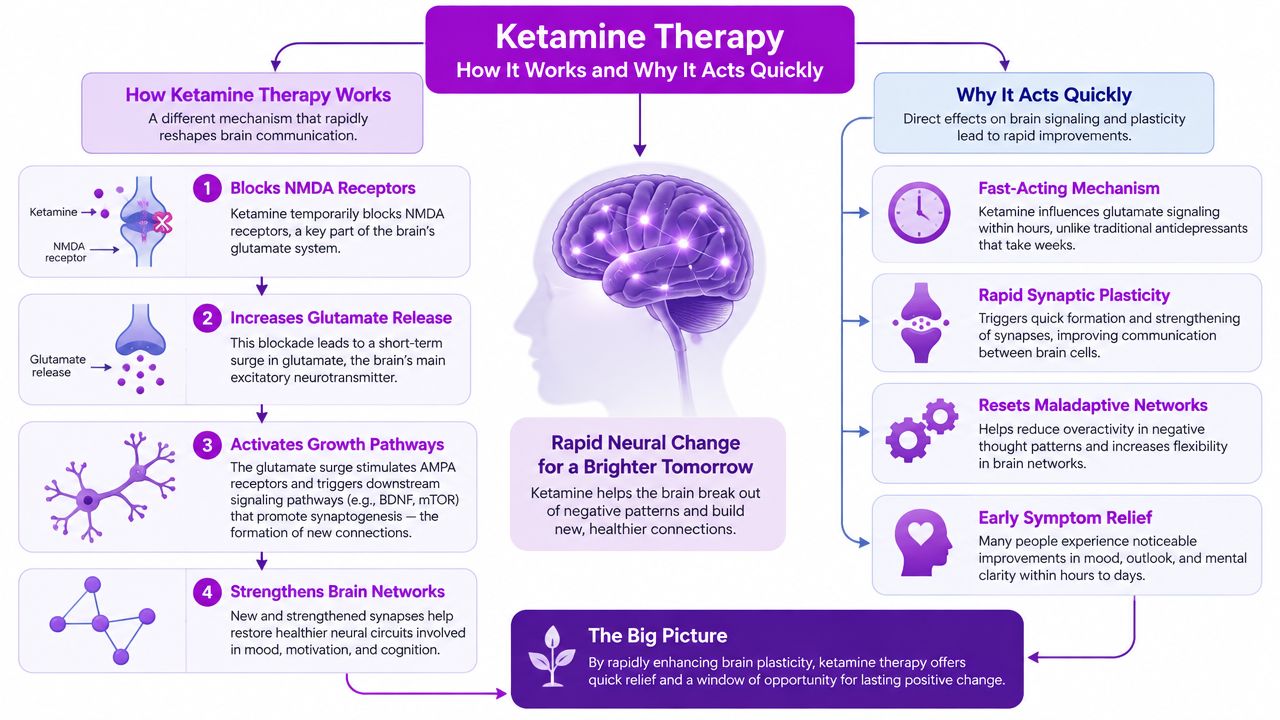
An adult in Phoenix may have tried several antidepressants, waited weeks for changes, and still feel unable to work, sleep, or connect with others. Ketamine attracts attention because it acts through a different brain pathway and may ease symptoms sooner than conventional medications. Faster relief, however, does not automatically mean lasting recovery.
Traditional antidepressants often gradually adjust signaling involving monoamine neurotransmitters such as serotonin and norepinephrine. Ketamine influences glutamate, a major excitatory neurotransmitter that helps nerve cells communicate. The difference resembles transportation planning: standard medications may adjust traffic signals over time, while ketamine may help open alternate routes when familiar roads are congested.
That activity may support synaptic plasticity, the brain's ability to strengthen or reorganize connections. It does not erase painful experiences or remove every cause of depression. Instead, it may create a period when improved mood, motivation, or emotional flexibility makes it easier to participate in therapy, rebuild routines, maintain relationships, and address ongoing stress.
Why speed changes the treatment conversation
Timing matters for someone who has waited weeks for a conventional medication to help. A 2022 systematic review and meta-analysis of 36 randomized controlled trials found better end-of-treatment response and remission outcomes with ketamine or esketamine than with placebo. The analysis reported a response relative risk of 2.14, a remission relative risk of 1.64, and a depression-severity effect size of d = -0.63 (review and meta-analysis).
These are group-level findings, not a forecast for one Phoenix patient. They also do not settle the question of durability. Some people maintain improvement, while others experience symptoms returning after the initial benefit.
Practical rule: Treat rapid relief as an opportunity to build a durable care plan, not as proof that depression has permanently resolved.
Ketamine's antidepressant effect is often rapid but temporary. Maintenance treatment may be appropriate for some patients, while others may need a different intervention when improvement fades. Follow-up helps clarify what changed, what remains difficult, and how to use a period of relief without relying on treatment sessions alone. For Phoenix adults comparing clinics, the relevant question is not only how quickly a provider expects improvement, but also how it will monitor safety, plan follow-up, and address the cost and long-term care needs that rapid-relief claims can obscure.
Types of Ketamine Treatment Available in Phoenix
A Phoenix clinic may offer more than one route of administration, but these options aren't interchangeable. Intranasal esketamine is the only ketamine-related treatment with FDA approval for psychiatric use, while IV ketamine remains off-label and isn't FDA-approved for psychiatric indications. Compounded ketamine delivered through other routes may also be used off-label under appropriate medical supervision.
| Treatment Type | FDA Status and Typical Protocol |
|---|---|
| Intranasal esketamine, Spravato | FDA-approved for adults with treatment-resistant depression and for major depressive disorder with acute suicidal ideation or behavior. A structured protocol commonly starts at 56 mg on day 1, followed by 56 to 84 mg twice weekly during weeks 1 to 4, then weekly or every one to two weeks depending on response and tolerability. Details are described in this clinical review of esketamine and ketamine treatment. |
| IV ketamine | Ketamine itself has no FDA psychiatric approval. Consensus guidance commonly begins at 0.5 mg/kg infused over 40 minutes, with dosing determined by the treating clinician and patient response. |
| IM ketamine | Off-label psychiatric use may involve intramuscular administration in a supervised setting. The clinic should explain the prescribed dose, monitoring, recovery process, and alternatives rather than treating IM therapy as automatically equivalent to IV treatment. |
| Oral or sublingual ketamine | These routes may be compounded and used off-label. The prescribing clinician should establish individualized instructions, informed consent, emergency planning, and clear limits around home administration. |
The largest practical difference is regulatory structure. Spravato is administered through a certified setting under a safety program, while IV and other ketamine protocols depend on clinician judgment, state requirements, clinic policies, and the quality of monitoring. A person comparing programs should ask which medication is being used, who prescribes it, where administration occurs, and whether the clinic's protocol is designed for induction, maintenance, or both.
For a closer look at supervised Spravato care, review reVIBE's Spravato management service. The right choice depends on diagnosis, medical history, prior treatment response, access, cost, and the clinician's assessment. A nasal spray isn't automatically safer for every patient, and IV treatment isn't automatically more effective for every patient.
Who May Benefit and Who Should Avoid Ketamine Therapy
Ketamine therapy is most often considered for adults whose depression has remained significant despite standard treatment attempts. It may also enter urgent psychiatric discussions when major depressive disorder includes acute suicidal ideation or behavior, particularly when a structured, medically supervised option is appropriate. Eligibility still depends on an individualized assessment, not on the label “treatment-resistant.”
A clinician should review the person's diagnosis, previous medications, therapy history, current symptoms, physical health, and goals. The evaluation should also consider cardiovascular status, blood pressure, history of psychosis or mania, substance-use history, pregnancy-related concerns when relevant, and the person's ability to follow recovery and transportation instructions. Ketamine can cause dissociation and other changes in perception, so the provider needs to determine whether the expected benefit outweighs the risks.
Questions that shape candidacy
A useful consultation often includes questions such as:
- What diagnosis is being treated? Ketamine may be discussed for conditions beyond depression in some settings, but the strength of evidence and regulatory status can differ.
- What happened with earlier treatments? Bring a medication and therapy history, including benefits, side effects, and reasons for stopping.
- Could my medical history increase risk? Cardiovascular problems, uncontrolled blood pressure, psychosis-spectrum symptoms, and substance-use concerns require careful clinical judgment.
- What happens if I don't respond? A reputable provider should explain stopping criteria and alternatives before treatment begins.
- How will you address suicidal risk? Ketamine isn't a substitute for crisis planning, emergency assessment, or ongoing psychiatric care.
People should be cautious about any program that promises universal success, skips a full psychiatric and medical intake, or frames ketamine as a cure. Recent comparative evidence suggests IV ketamine may produce faster and somewhat larger short-term depression-score reductions than intranasal esketamine, but a 2025 review describes the head-to-head evidence as mostly observational and calls for large randomized trials to clarify durability and comparative effectiveness (comparative evidence discussion). The honest conclusion is that ketamine can be impressive for acute relief, while important questions remain about who benefits most, how long benefits last, and which formulation fits a particular patient.
What to Expect During and After a Ketamine Session
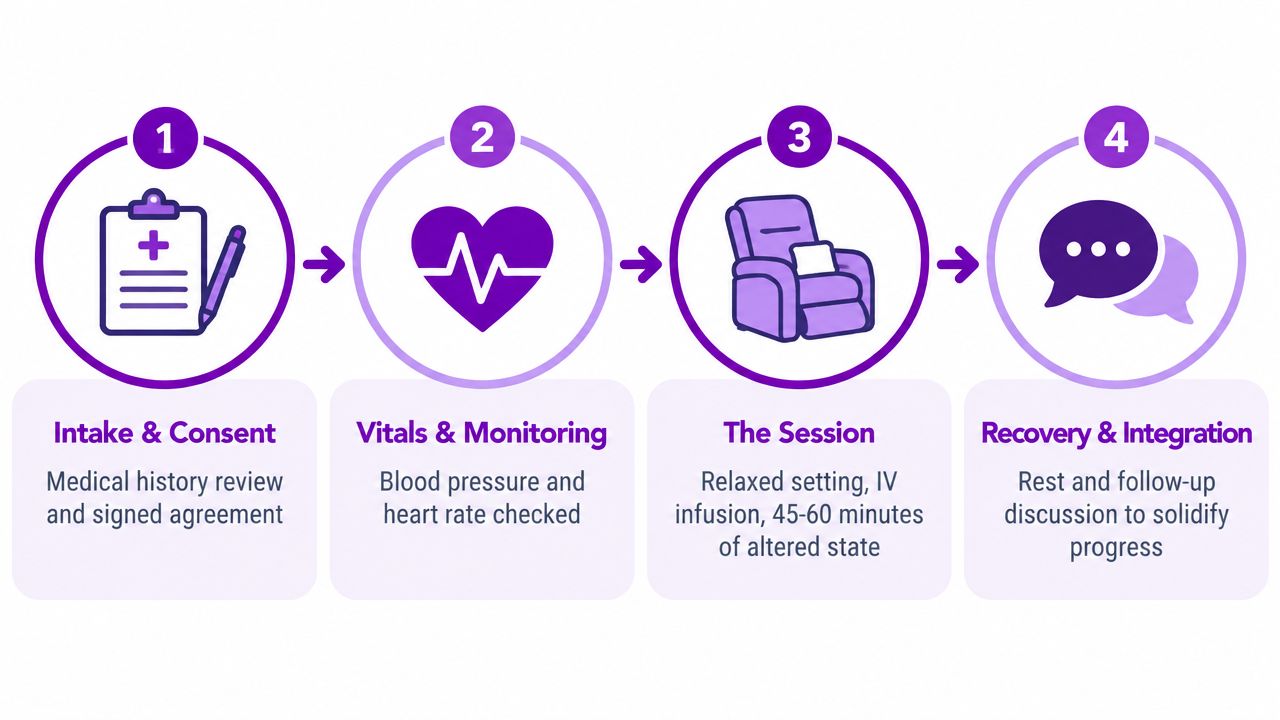
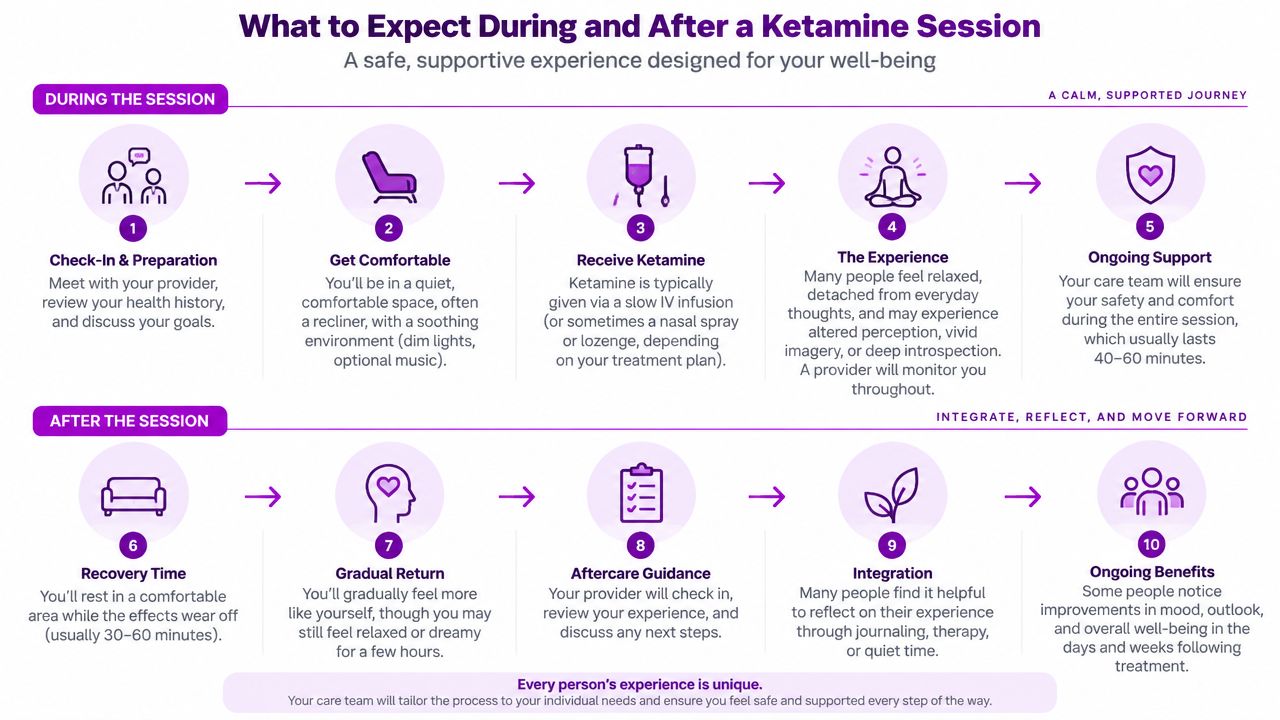
If you arrive expecting instant relief, the appointment may feel more like a carefully supervised medical procedure than a quick mood reset. A safe session starts before medication is given. The team should confirm your treatment plan, review informed consent, check relevant medical history, and record baseline vital signs. Ask which medication and route you will receive, what sensations may occur, who will monitor you, and what must be true before discharge.
During IV treatment, a clinician may use a controlled infusion, commonly beginning with the consensus approach of 0.5 mg/kg over 40 minutes. Esketamine uses a nasal-spray protocol. Either experience can involve dissociation, dizziness, sedation, altered perception, or a temporary rise in blood pressure. Cardiorespiratory monitoring and assessment of dissociative or psychotomimetic effects should continue throughout care, while symptom response should be reviewed across treatment rather than assumed from one session (safety and administration guidance).
Recovery is part of treatment
For esketamine, protocols require a minimum two-hour observation period after each session. Staff should discharge you only when you are clinically stable, alert enough, and physically able to leave safely. Arrange transportation, and follow the clinic's instructions about driving, work, childcare, alcohol, and other activities.
The emotional effects may continue after you leave. Some patients report unusual perceptions or meaningful emotional material during dissociation. Others feel tired, unsettled, or unchanged. Integration therapy can help you examine the experience without treating every sensation as a hidden message. A therapist or psychiatric provider can connect short-term mood changes with practical goals, such as resuming routines, communicating with family, or addressing trauma-related patterns.
Durability requires a review plan, not just an encouraging first response. For IV treatment, when there is no meaningful improvement after four to six treatments, clinicians often consider nonresponse and whether to stop, change the plan, or pursue another intervention. That decision point can prevent repeated costly sessions without a measurable reason to continue. Ask how symptoms will be tracked, what improvement counts, and why maintenance care would be recommended.
Costs Insurance and Arizona Safety Regulations
Cost can determine whether ketamine therapy is realistic, even when the treatment appears clinically promising. Spravato and generic ketamine don't follow the same coverage pathway. Spravato has FDA psychiatric indications and a structured administration model, while IV ketamine for psychiatric care is off-label and is often offered as self-pay. Coverage depends on the insurance plan, diagnosis, authorization requirements, certified treatment setting, and the specific service being billed.
Ask a clinic for a written estimate before beginning. The estimate should distinguish the medication from psychiatric evaluation, administration, monitoring, observation, follow-up, and any therapy or integration services. Maintenance care can create a larger financial commitment than an initial consultation, so ask how the provider reviews response before recommending ongoing sessions. Insurance and mental health coverage guidance can help Phoenix patients organize questions about benefits and verification.

Arizona rules that protect the care process
The Arizona State Board of Nursing states that sub-anesthetic ketamine administration falls within the scope of a Registered Nurse for IV, IM, oral, sublingual, subcutaneous, and intranasal routes. The same advisory distinguishes this from IV ketamine for anesthesia, which isn't within RN scope, and says IV ketamine orders must be individualized. Minimum monitoring includes pulse oximetry, vital signs, level of sedation, and checks for adverse reactions, according to the Arizona nursing advisory on ketamine administration.
Home use raises separate concerns. Arizona Board of Nursing guidance says APRNs prescribing ketamine for home administration must follow state and federal controlled-substance rules, remain within their population focus and competency, obtain thorough assessment and informed consent, and plan for emergency access. The guidance also states that prescribing IV ketamine outside a healthcare setting isn't within the standard of practice (Arizona APRN prescribing guidance). Ask exactly where treatment occurs and how the clinic handles urgent symptoms.
How to Choose a Reputable Ketamine Provider in Phoenix
Start with the provider, not the advertised route. A reputable Phoenix program should explain whether it offers FDA-approved esketamine, off-label ketamine, or both. For Spravato, ask whether the setting is certified under the required safety program, how the clinic handles observation, and who remains responsible for psychiatric follow-up.
Use this checklist during consultations:
- Clinical evaluation: The provider reviews diagnosis, prior treatment, medical history, substance-use history, and current suicide risk before recommending treatment.
- Monitoring: Staff track vital signs, oxygenation, sedation, dissociation, and adverse reactions, with emergency procedures that they can explain plainly.
- Treatment goals: The team defines how it will measure meaningful improvement and what it will do if response is limited.
- Continuity: Medication management and therapy remain available when appropriate, rather than treating each session as an isolated procedure. A psychiatric medication management provider can help coordinate the broader treatment plan.
- Financial clarity: You receive an explanation of insurance verification, self-pay charges, observation costs, and potential maintenance care before starting.
- Location and access: The clinic offers a practical schedule and setting that you can reach consistently from home or work.
The clinic environment matters because dissociation can feel vulnerable. You should have privacy, respectful staff, clear instructions, and enough time for recovery rather than pressure to leave quickly. You should also understand who to contact between sessions and what symptoms require urgent help.
If you're experiencing immediate danger, severe agitation, or thoughts of harming yourself, call or text 988 for the Suicide and Crisis Lifeline, or call 911 for an emergency. Ketamine appointments shouldn't replace urgent crisis care.
Find a reVIBE Location Near You!
We currently have five locations for your convenience. (480) 674-9220
reVIBE Mental Health – Chandler
3377 S Price Rd, Suite 105, Chandler, AZ
reVIBE Mental Health – Phoenix Deer Valley
2222 W Pinnacle Peak Rd, Suite 220, Phoenix, AZ
reVIBE Mental Health – Phoenix PV
4646 E Greenway Road, Suite 100, Phoenix, AZ
reVIBE Mental Health – Scottsdale
8700 E Via de Ventura, Suite 280, Scottsdale, AZ
reVIBE Mental Health – Tempe
3920 S Rural Rd, Suite 112, Tempe, AZ
If you're weighing ketamine therapy in Phoenix, reVIBE Mental Health offers structured, supervised SPRAVATO treatment for eligible adults at its Scottsdale and Tempe locations, alongside psychiatric care and therapy coordination. Visit reVIBE Mental Health to review your options, verify coverage, and request a personalized consultation.