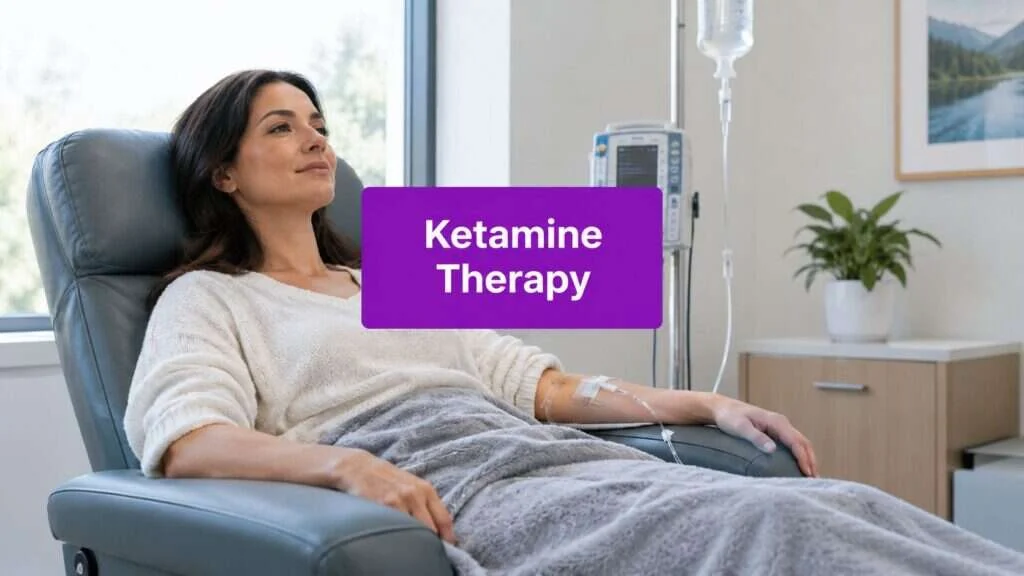
You've probably had the same thought more than once, usually late in the day when the usual meds still haven't touched the heaviness. You've tried therapy, you've tried antidepressants, and maybe you've even had a brief window of relief before everything slid back again. Ketamine treatment for depression gets attention because it can feel different from the standard waiting game, but the question is simpler, what happens after the first headline, and is it something a cautious patient can use in real life?
For a Phoenix-area reader, that question often comes with practical concerns too. Is this only for people in crisis, is it only IV, is it safe, and what happens if the benefit fades? At reVIBE Mental Health, ketamine-related care is best understood as part of a larger plan that includes assessment, medication management, psychotherapy, and thoughtful follow-up rather than a one-time rescue. The goal is to help you understand the treatment clearly enough to ask better questions at a visit, not to push you toward a decision you're not ready for.
Introduction to Ketamine Treatment for Depression
A person may come to ketamine after months of trying medication changes, therapy, and waiting for something to ease the heaviness. By that point, the appeal is clear. Ketamine treatment for depression is often discussed because it can work faster than standard antidepressants, which matters when symptoms have already stretched patience thin.
Early clinical attention grew from a landmark 2000 randomized, placebo-controlled crossover trial at Yale, which reported that a single subanesthetic dose could improve major depression quickly, with change seen within 24 hours (Smithsonian history of ketamine in depression). That result helped shift attention toward glutamate and neuroplasticity as part of the depression story. It also made ketamine feel less like a novelty and more like a treatment that deserved careful study.
Why hopeful patients still need a careful map
Fast relief can be reassuring, but it can also be confusing. A treatment may help quickly and still wear off, so the question becomes what a good next step looks like after the first response. That includes maintenance decisions, whether the form of treatment matches the person's needs, and how to combine medication with psychotherapy rather than treating mood symptoms in isolation.
For a Phoenix-area patient, that usually means asking practical questions in plain language. How long do benefits tend to last. What happens if symptoms return. Which formulation is being offered, and why. At reVIBE Mental Health, ketamine-related care fits into a broader plan that includes assessment, medication management, psychotherapy, and follow-up, because durable improvement usually depends on more than the infusion or dose itself.
What Ketamine Is and How It Works for Depression
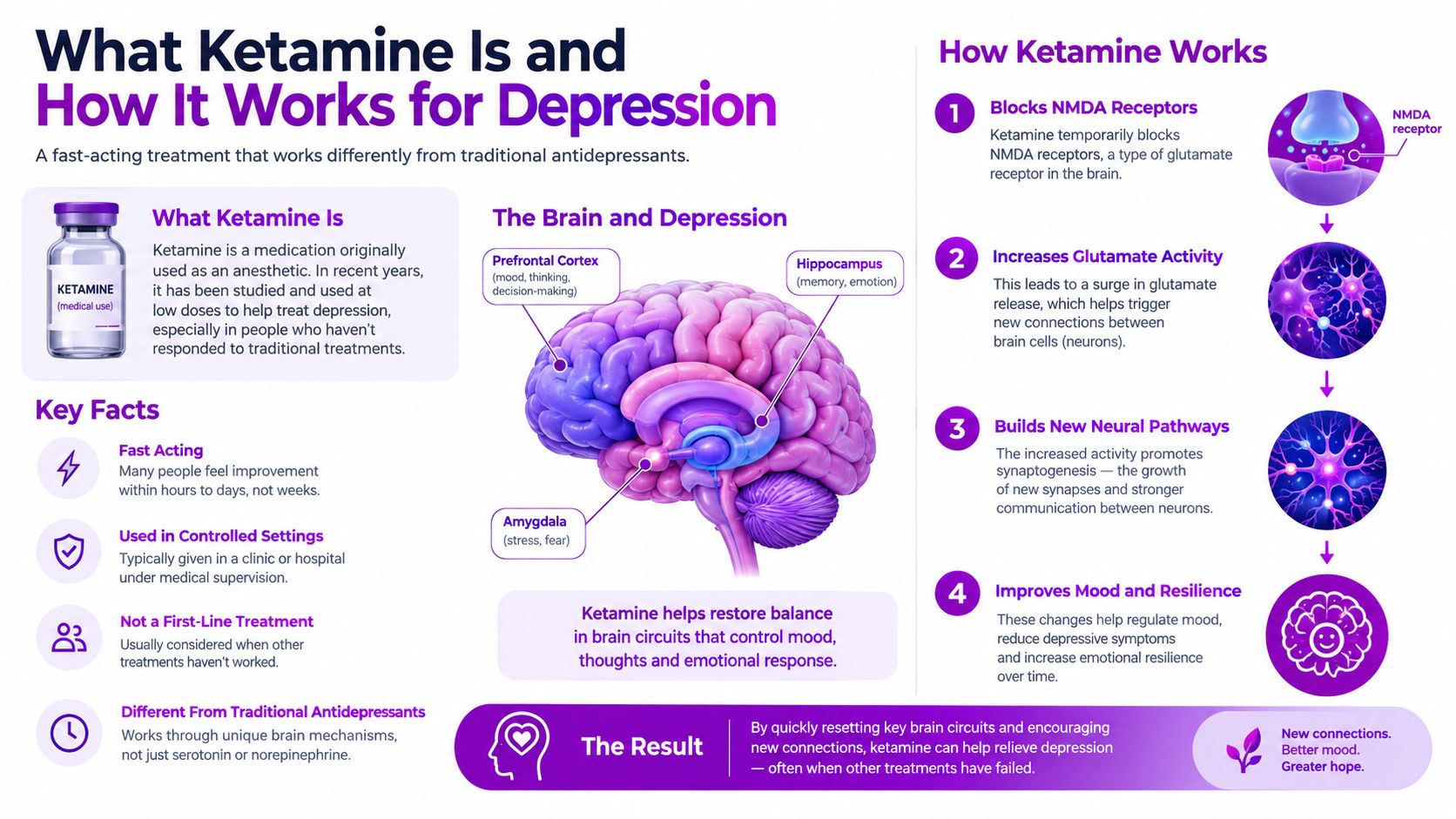
A patient often meets ketamine after several other treatments have already been tried. That context matters, because ketamine did not begin as a depression medicine. It was first used in anesthesia, then later researchers and clinicians noticed that lower, subanesthetic doses could affect mood in ways standard antidepressants often do not, as described in a brief history of ketamine's use in depression.
The easiest way to understand it is as rewiring rather than refueling. Traditional antidepressants mainly work through monoamine pathways and usually need time to build effect. Ketamine works through different biology, which helps explain why some people notice change within hours or a day instead of waiting weeks.
The brain mechanism in plain language
Ketamine is a non-competitive NMDA receptor antagonist. In simpler terms, it reduces NMDA activity on GABA interneurons, which lifts a brake on glutamatergic neurons and produces a glutamate surge. That surge then appears to increase AMPA signaling, BDNF release, and mTOR-linked synaptogenesis (mechanism review). The practical meaning is that ketamine may help the brain form and strengthen connections more quickly than standard antidepressants do.
That difference also helps explain durability. The benefit is not just about ketamine remaining in the bloodstream. It seems to start a plasticity process that can outlast the immediate drug effect, so relief may persist for days or longer after a dose. A good mental model is a small repair crew that starts clearing space and reconnecting wires, rather than a pill that tops off a low chemical level.
Why history still shapes how clinicians use it
History keeps expectations grounded. Ketamine has a long medical track record, but depression treatment with ketamine remains a specialized psychiatric use, not a general wellness product. That matters for practical decisions about maintenance, formulation choice, and pairing treatment with psychotherapy.
For a person considering care in Phoenix, the key question is not only whether ketamine can help quickly. It is also how the treatment fits into an ongoing plan, including follow-up, symptom tracking, and therapy. At reVIBE Mental Health, ketamine-related care is approached as part of that broader plan, so the first response can be turned into a more durable one.
Types of Ketamine Treatments and How They Compare
A common source of confusion is treating ketamine as one single intervention. It is not. The route, setting, and level of monitoring shape what a patient can expect, and the right choice usually depends on whether the priority is evidence strength, access, or convenience.
The strongest evidence sits with intravenous ketamine and intranasal esketamine for treatment-resistant depression (major consensus guidance). Intranasal esketamine is the S-enantiomer of ketamine. The FDA cleared it on March 5, 2019 for adults with treatment-resistant depression, and it is used together with an oral antidepressant rather than alone (esketamine overview, FDA-cleared esketamine coverage).
| Comparing Ketamine Formulations for Depression | Evidence Strength | Setting and Monitoring | Key Consideration |
|---|---|---|---|
| Intravenous ketamine | Strongest evidence in TRD (major consensus guidance) | Clinic-based monitoring | Fast, well-studied, but usually requires an infusion center |
| Intranasal esketamine | Strong evidence in TRD (major consensus guidance) | Certified clinical setting under REMS (REMS overview) | FDA-approved, paired with an oral antidepressant |
| Subcutaneous ketamine | Coherent randomized short-term evidence in newer reviews (2026 review) | Can be clinic-based or telehealth-supported in emerging models | Access is expanding, but the evidence base is still smaller |
| Oral ketamine | Limited but supportive small-trial evidence | More variable monitoring depending on program | Less well-supported and more uncertain than IV or esketamine |
Practical rule: if someone says “ketamine didn't work,” the first question is often, which formulation, in what setting, and with what monitoring?
Why route changes the clinical conversation
Recent reviews note that the evidence is uneven across delivery methods. Subcutaneous ketamine has coherent randomized evidence for short-term use, oral ketamine remains limited but somewhat supportive, and compounded intranasal forms have weaker, more mixed data (2026 review). That matters because access and convenience are real-world issues, not just academic ones.
A newer telehealth-supported at-home subcutaneous study reported feasibility and symptom reduction in depression, anxiety, and PTSD. That does not make at-home treatment interchangeable with a certified clinic model, but it does show where care may be heading.
The tradeoff is straightforward. More evidence usually means more structure, while more convenience often means less certainty. Patients do best when they compare those tradeoffs directly, instead of assuming every ketamine route has the same level of support.
At reVIBE Mental Health in Phoenix, that comparison also includes how treatment fits with follow-up, symptom tracking, and psychotherapy, so the first response can be turned into a plan that lasts.
How Effective Is Ketamine and How Long Do Benefits Last
A first response to ketamine can feel striking, especially for someone who has spent months trying standard antidepressants without much relief. The part patients usually care about next is whether that lift holds. The honest answer is yes for some people, but the benefit is often time-limited, so planning for what comes after the first improvement is part of good care.
A ketamine research summary reported that a 2025 review of 12 systematic reviews and meta-analyses found 30% to 76% of patients reached at least a 50% symptom reduction. The same summary noted a retrospective infusion study with a 60.6% response rate and 32.4% remission rate after a six-infusion series among people who completed treatment. Those figures do not predict an individual outcome, but they explain why ketamine remains part of the discussion for difficult depression.
The response can be quick, so follow-up has to be quick too
Major consensus guidance says meaningful improvement may appear within 1 to 2 days, with the strongest evidence for intravenous ketamine and intranasal esketamine in TRD. That early window matters. If a treatment works like a small spark lighting dry kindling, clinicians need to check early enough to see whether the fire is catching or fading.
The same guidance notes that long-term durability for intravenous treatment is still not well established. In practice, that means a person who feels better after one session still needs a plan for the next step, because symptoms can return once dosing stops if nothing else is in place.
Maintenance is part of the treatment plan
The central question is usually how long the benefit lasts and what supports keep it going. A single infusion may help briefly, while repeated dosing can extend the effect, according to the maintenance evidence summary and the same consensus guidance. That is why a careful clinician talks about continuation before the first dose, not after the response fades.
The FDA label for Spravato gives a practical boundary. For major depressive disorder with acute suicidal ideation or behavior, benefit beyond 4 weeks with an oral antidepressant has not been systematically evaluated (FDA label). That does not make the treatment unhelpful. It tells patients and clinicians where the evidence is strong and where follow-up judgment still matters.
At reVIBE Mental Health in Phoenix, that conversation also includes symptom tracking, psychotherapy, and follow-up planning, so the first improvement can be turned into a treatment path that is more likely to last.
Who May Benefit Risks Side Effects and Safety Monitoring
A person who has cycled through standard antidepressants and still feels stuck is often the first place to start. Treatment-resistant depression usually means poor response to at least two antidepressants, and ketamine is considered in that narrower setting rather than as a first-line option. People with severe symptoms, including suicidal depression under close supervision, may also be evaluated, but only after a full medical and psychiatric review.
Safety shapes the setting. Esketamine is dispensed under a Risk Evaluation and Mitigation Strategy because of concerns such as sedation and dissociation, so it is given in certified clinics rather than sent home like a routine prescription (REMS overview). That structure is there to reduce avoidable risk and to make sure staff can respond if a reaction is stronger than expected.
Self-check questions to bring to an evaluation
A good evaluation starts with honest answers, not a guess.
- Have I tried at least two antidepressants adequately? That is the usual threshold for treatment-resistant depression.
- Do I have any history of psychosis or uncontrolled substance use? Those are important cautions because ketamine can worsen certain conditions.
- Do I have heart, blood pressure, or other medical concerns? Screening helps the clinician decide whether the risk is acceptable.
- Am I expecting this to replace all other care? It should not. Ketamine usually fits into a broader plan.
The practical guide for clinicians by Orange Neurosciences is a useful reference if you want to see how structured screening is approached before treatment. It can help patients and families understand why clinicians ask so many questions before the first dose.
What side effects usually look like
Common effects include dissociation, sedation, nausea, dizziness, and temporary blood pressure changes. These reactions are one reason observation matters during and after each session. A patient should not have to wonder whether a sensation is expected or unsafe, the team should explain that in advance and stay close during the visit.
The FDA-approved esketamine model is used with an oral antidepressant rather than by itself (esketamine overview). That points to the larger clinical idea, ketamine treatment is usually part of managed care, not a stand-alone switch. At reVIBE Mental Health in Phoenix, that often means pairing medication planning with ongoing depression medication management, symptom tracking, and psychotherapy so the response can be watched and maintained instead of fading without a next step.
What to Expect During and After Treatment With Therapy Integration
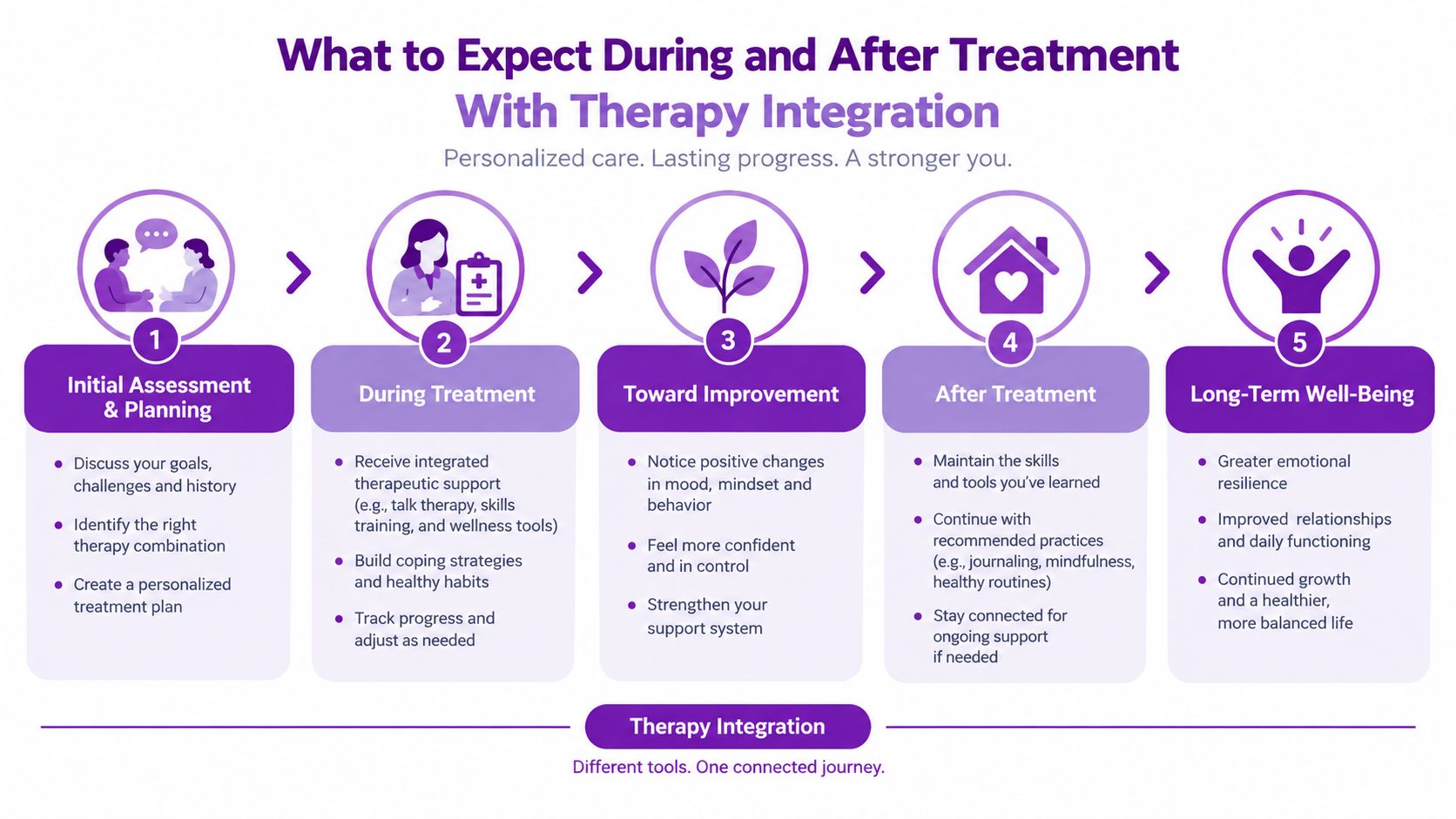
A treatment visit often starts more normally than people expect. Screening comes first, then the medication is given in a monitored setting. During the session, the dissociative window can feel detached, dreamy, or strangely quiet, which is why the team stays close until you are ready to leave.
What the first few hours can feel like
Benefit can appear quickly, sometimes within 1 to 2 days, but the first session is mainly about safe observation and clear expectations. The clinician's job is to keep you physically stable, explain what may be happening, and help you notice the difference between an expected treatment effect and something that needs attention.
That is why symptom tracking belongs in the first 24 to 72 hours. If you feel better, worse, activated, or just different, the team needs that information soon enough to adjust the plan. Early follow-up works like checking the weather after a storm, not waiting until the roof has already leaked.
Why integration therapy matters
Ketamine can open a window for learning, but it does not do the psychological work by itself. Psychotherapy, medication management, and structured follow-up help turn a temporary shift into something usable in daily life. At reVIBE Mental Health, that may include talk therapy, EMDR, and medication management so the response is reinforced instead of left to drift.
For patients who want to see how ongoing care is organized, the practice's medication management for depression page explains one part of that process, and the process in therapy page shows how sessions support meaning-making and behavior change. Integration is less about interpreting every sensation and more about asking, “What changes at home, at work, or in relationships should follow this treatment?”
Clinical shortcut: if ketamine brings relief but nothing in daily life changes, the benefit is more likely to fade. If therapy begins right away, the window can be used more fully.
What happens after the session
A single IV infusion may help for a short time in some patients, while repeated dosing may extend benefit (maintenance evidence summary). That is why the days and weeks after treatment matter just as much as the visit itself.
Sleep, safety planning, therapy attendance, and medication follow-up all help preserve the effect while the brain is still responsive. Patients often do best when ketamine is treated like the start of a broader plan, not a one-time reset.
Cost Insurance and Finding Care in the Phoenix Metro Area
Cost and coverage are part of the decision, not an afterthought. Coverage can differ for FDA-approved esketamine versus off-label ketamine, so verification matters before you commit to a plan. reVIBE Mental Health provides insurance guidance through its insurance and mental health information, and the practice states that it accepts most major plans.
For readers comparing local options, it can also help to see how other markets discuss affordability and access. A practical overview like finding affordable ketamine therapy in LA can give you a sense of the questions people ask before booking, even though Phoenix coverage and clinic logistics are still their own separate decision.
reVIBE Mental Health serves the Valley with five locations, Chandler, Phoenix Deer Valley, Phoenix PV, Scottsdale, and Tempe, and it offers in-person and secure online sessions seven days a week. If you're deciding whether to pursue an evaluation, the simplest next step is to ask which formulation, which monitoring model, and which insurance path fit your situation before you schedule anything. You can also call (480) 674-9220 to ask about location fit and appointment options.
reVIBE Mental Health also lists these Valley offices for patients who want a local starting point, 3377 S Price Rd, Suite 105, Chandler, AZ, 2222 W Pinnacle Peak Rd, Suite 220, Phoenix, AZ, 4646 E Greenway Road, Suite 100, Phoenix, AZ, 8700 E Via de Ventura, Suite 280, Scottsdale, AZ, and 3920 S Rural Rd, Suite 112, Tempe, AZ.
If you're ready to talk through whether ketamine treatment makes sense for your depression, reVIBE Mental Health can help you sort out the options, the monitoring, and the role of psychotherapy and medication management together. Visit reVIBE Mental Health to take the next step with a clinician who can help you decide what's appropriate for your situation.