The wedding is over. The photos are beautiful. Thank-you notes are still sitting on the counter. And somewhere between combining calendars, figuring out whose family gets which holiday, and realizing your partner loads the dishwasher in a way that feels personally offensive, a strange thought shows up.
“We love each other. So why are we arguing about such small things?”
That question is more common than most newlyweds expect. Early marriage often brings a mix of joy, closeness, stress, and adjustment. Two people who may have dated well are now building a daily life together. That's different from romance alone. It asks for skills, not just feelings.
Marriage counseling for newlyweds can help before resentment sets in. Think of it less like emergency repair and more like relationship pre-hab. Athletes don't wait for a major injury to strengthen their joints. Couples don't have to wait for a major rupture to strengthen communication, trust, and teamwork.
Building Your Marriage Beyond the Wedding Day
A lot of couples enter the first year of marriage with good intentions and genuine love, then feel blindsided by ordinary friction. One partner wants a detailed budget. The other likes flexibility. One expects daily check-ins with extended family. The other wants more privacy. Neither person is wrong, but they're suddenly negotiating a real shared life.
That's where counseling can be surprisingly grounding. It gives couples a place to slow down and understand what's happening beneath the surface. Instead of arguing about dishes, money, or schedules as if those are isolated problems, you start seeing the deeper pattern. Maybe one of you feels controlled. Maybe the other feels alone in carrying responsibility.

Modern couples therapy gives many couples real reasons for hope. Marriage counseling demonstrates a proven success rate of approximately 70%, with nearly 90% of couples who complete therapy reporting an increase in emotional well-being, according to these marriage counseling statistics.
Why early support isn't a sign of failure
Some newlyweds hesitate because therapy sounds too serious. They think counseling is only for couples on the edge of separation. In practice, many healthy couples use it to build habits they were never taught.
Practical rule: Go to counseling when you still like each other, not only when you're exhausted by each other.
That mindset shift matters. Proactive support can help you learn how to repair after conflict, ask for reassurance clearly, and protect emotional intimacy before small hurts pile up. If you're also planning meaningful time away together, ideas like book your luxury honeymoon with Explore Effortlessly can support connection outside the therapy room too. For couples who want to strengthen closeness in everyday life, this guide on building emotional intimacy can be a helpful next read.
What newlywed counseling often feels like
It usually feels less like being judged and more like being translated. A good therapist helps each partner say what they mean in a way the other can hear. That can be a huge relief.
Many couples leave early sessions saying some version of, “That's the first time I felt understood without us turning it into a fight.”
Why I Do Can Lead to We Need to Talk
Marriage changes the container around a relationship. Even when nothing dramatic happens, the meaning of everyday decisions gets heavier. Spending, chores, boundaries, sex, future plans, and family expectations stop being private preferences. They become shared negotiations.
Newlyweds often feel confused by this. They'll say, “We talked about all of this before the wedding.” Usually, they did. But talking in theory isn't the same as living it on a Tuesday night when you're tired, annoyed, and trying to decide whose career move takes priority.
The five stress points that often show up first
Some themes appear again and again in the newlywed phase:
- Merging finances: One partner may think budgeting means safety. The other may hear restriction or criticism.
- In-law dynamics: Marriage creates a new primary unit, and not every family adjusts to that smoothly.
- Communication style differences: One person wants to talk things through immediately. The other needs space first.
- Household roles: Couples can carry very different assumptions about chores, planning, and mental load.
- Long-term goals: Questions about children, home ownership, career direction, or where to live start feeling urgent.
These aren't signs that you married the wrong person. They're signs that two histories are trying to become one household.
Why these problems often appear after the wedding
Dating can hide structural differences. You may spend quality time together without facing the repetitive, unglamorous parts of partnership. Marriage exposes routines. It also stirs up identity. People start asking themselves, “What kind of spouse am I?” and “What do I need from a marriage to feel secure?”
That's why small arguments can feel larger than they seem. The fight about whose parents to visit may be a fight about loyalty. The conflict over saving versus spending may really be about control, fear, or trust.
Newlywed conflict is often less about the topic and more about the meaning attached to it.
Why waiting tends to make things harder
Couples often hope tension will settle on its own. Sometimes it does. But repeated unresolved conflict can harden into a pattern. One person pursues. The other withdraws. One criticizes. The other shuts down. Over time, each partner starts expecting the worst from the other.
That's why the timing of help matters. Research suggests that couples wait an average of 6 years after problems begin before attending counseling. Communication problems are the primary driver, accounting for 35% of cases, followed by infidelity at 25% and financial stress at 20%, according to these counseling statistics for married couples.
Here's the encouraging part. Newlywed couples are in a strong position to intervene before these patterns become ingrained. The earlier you name the cycle, the easier it is to change it.
A useful way to think about early tension
A rough start in marriage doesn't mean the marriage is weak. It often means the relationship is moving from chemistry into craftsmanship.
That's a good thing. Craftsmanship can be learned.
Your Guide to Common Therapy Approaches
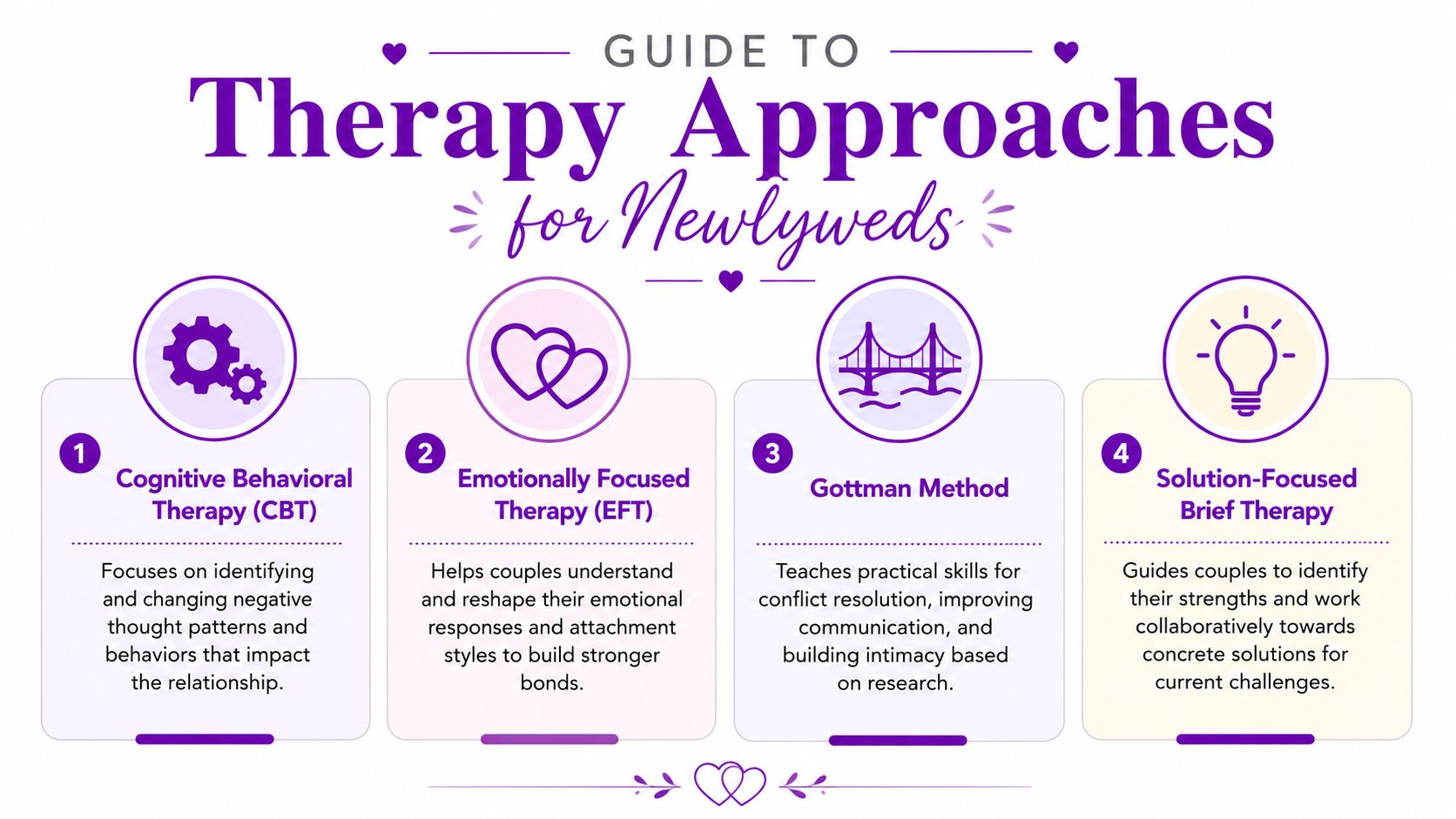
Not all couples therapy looks the same. If you're searching for marriage counseling for newlyweds, it helps to know what different approaches are trying to change. Some focus on emotional bonding. Some teach practical conflict tools. Some target thought patterns. Some help when past trauma is spilling into the present relationship.
A side by side view
| Approach | Simple way to think about it | Often helps with |
|---|---|---|
| Gottman Method | Building a sturdy house | Conflict skills, friendship, repair after arguments |
| Emotionally Focused Therapy | Learning each other's emotional language | Distance, insecurity, repeated pursue-withdraw cycles |
| Cognitive Behavioral Therapy | Catching the thought loop that drives the reaction | Misinterpretation, reactivity, rigid beliefs |
| EMDR in a couples context | Clearing old pain that keeps getting activated | Trauma triggers, past experiences affecting present connection |
Gottman Method
The Gottman Method often feels concrete and skill-based. If your marriage were a house, this model would focus on the foundation, structural supports, and repair tools. Couples learn how to soften harsh start-ups, manage conflict without contempt, and build friendship on purpose.
This approach can be especially useful for newlyweds who say, “We love each other, but our arguments escalate fast,” or “We don't know how to solve disagreements without someone shutting down.” It gives language and routines to moments that used to feel chaotic.
Emotionally Focused Therapy
Emotionally Focused Therapy, or EFT, is often a strong fit when the underlying issue isn't the surface argument but the attachment fear underneath it. One partner protests because they feel abandoned. The other retreats because they feel like they can't get it right. The pattern repeats, and both people feel alone.
EFT helps couples identify that cycle and respond differently. Instead of attack and defense, the goal becomes vulnerable honesty. “I'm not mad that you were late. I felt unimportant and panicked.” That kind of shift can transform a conversation.
Clinical research on EFT indicates a 70 to 75% recovery rate from relationship distress, with 90% showing significant improvement in emotional responsiveness, as described in this overview of how successful Emotionally Focused Therapy can be.
Some couples don't need better debate skills first. They need help feeling emotionally safe enough to stop debating for survival.
Cognitive Behavioral Therapy
CBT looks at the link between thoughts, feelings, and actions. In couples work, that can be powerful. A missed text might trigger the thought, “I'm not important to you,” which triggers anger, which leads to criticism, which triggers defensiveness in return.
A CBT-informed therapist helps you slow that sequence down. You learn to identify assumptions, challenge unhelpful interpretations, and choose a more useful response. If that style sounds helpful, this overview of what Cognitive Behavioral Therapy is explains the model in plain language.
EMDR when past pain enters the marriage
Sometimes a current conflict isn't only current. A partner who seems “overly sensitive” to withdrawal may have a history of abandonment. A spouse who becomes intensely activated during disagreement may carry unresolved trauma from childhood or a prior relationship. In those cases, couples work may include EMDR for the individual partner, alongside relationship counseling.
That doesn't mean the marriage is the wrong focus. It means the relationship is brushing against older wounds that deserve care.
When trust has been broken
If your newlywed season includes betrayal, dishonesty, or digital secrecy, the therapy task changes. The work has to include stabilization, truth-telling, accountability, and a plan for rebuilding safety. For couples in that situation, this guidance on therapy post-infidelity discovery can help you understand what recovery often requires.
The best modality depends on the pattern, not on which approach has the best marketing. A good therapist should be able to explain why they're using a method and how it fits your specific relationship.
What to Expect in Your First Few Sessions
Starting therapy can feel vulnerable, especially if neither of you has done it before. Most newlyweds are relieved once the process begins because the first steps are usually structured, practical, and much less intimidating than they imagined.
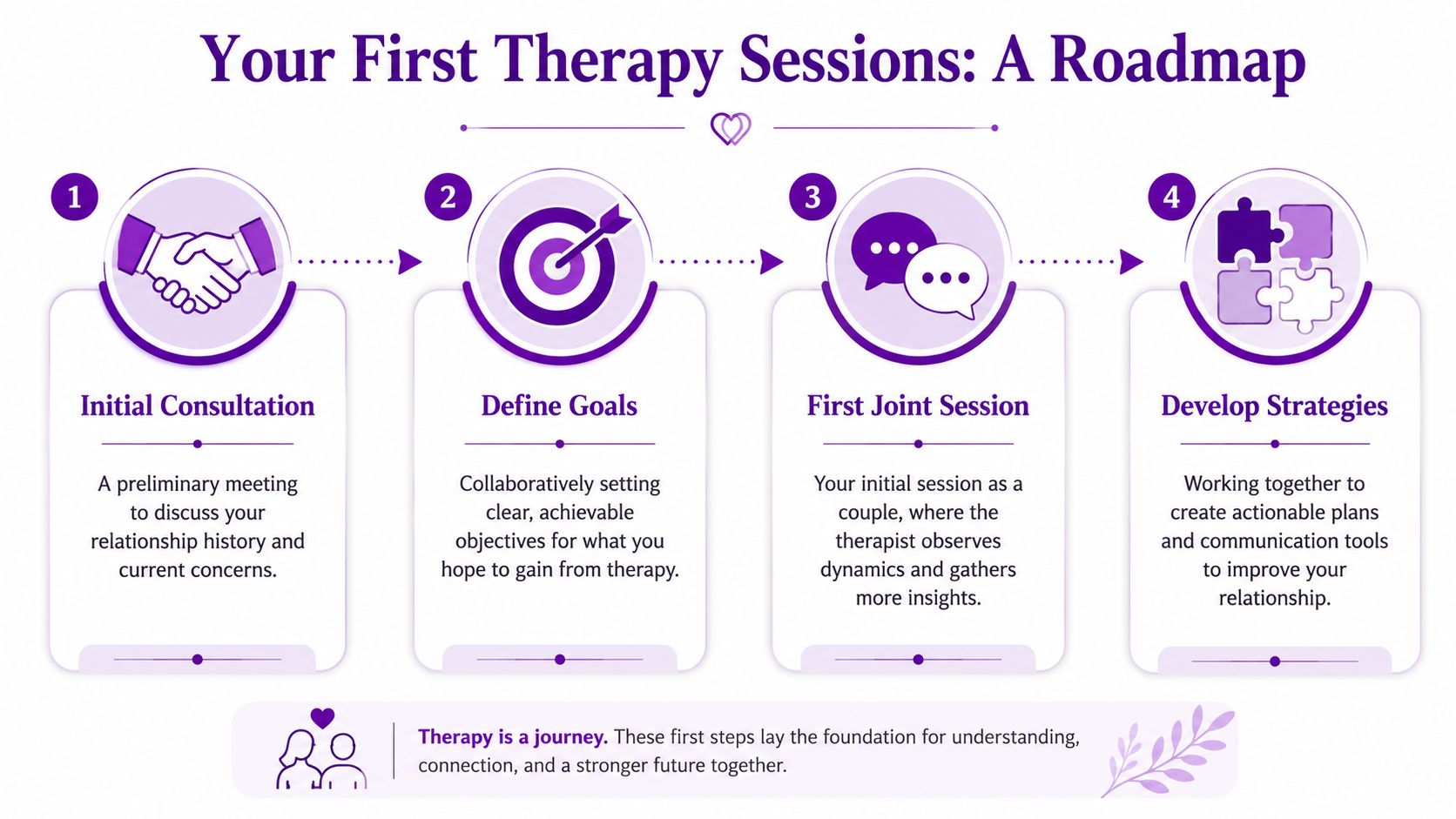
The first call and intake
The first contact is often a brief call or online request form. You'll usually be asked why you're seeking help, whether there are urgent concerns, and what kind of scheduling or format you need. The office may also ask about insurance, availability, and whether you want in-person or online sessions.
You do not need a perfect explanation of your marriage to make this call. “We keep having the same argument and don't know how to get unstuck” is enough.
The first session
The first appointment is usually about understanding the relationship, not fixing everything in one hour. The therapist may ask how you met, what brought you in now, how conflict tends to go, and what each of you hopes will be different.
Some therapists meet with both of you together first and may later schedule individual check-ins as part of assessment. That doesn't mean they're taking sides. They're gathering context.
A strong first session often ends with more clarity than relief. That's still progress.
The next few sessions
Early sessions usually focus on mapping the cycle. The therapist listens for the repetitive pattern underneath your arguments. Who pursues? Who withdraws? What triggers defensiveness? What happens right before one of you shuts down?
Then you start building goals. Those goals might include speaking without criticism, handling money talks without escalation, improving affection, rebuilding trust, or creating better boundaries with family.
A therapist may also give you simple between-session practices, such as:
- Pause before problem-solving: Learn to settle the nervous system before finishing a hard conversation.
- Track the cycle: Notice how the same dance starts, even when the topic changes.
- Use clearer bids for connection: Replace mind-reading with direct requests.
- Debrief conflicts gently: Focus on what happened and what each person needed.
How to tell if counseling is working
Many couples expect progress to feel dramatic. Usually it's subtler at first. You interrupt each other less. Fights end sooner. You recover faster after tension. One person says what they feel before exploding. The other stays present instead of disappearing emotionally.
There's also a concrete marker worth knowing. Newlyweds should expect measurable shifts in conflict resolution, with effective therapy aiming for a 30 to 40% reduction in negative interaction cycles within the first quarter, according to this discussion of marriage counseling and early progress markers.
What matters most is not whether you never disagree. It's whether the relationship starts feeling safer, clearer, and more workable.
Signs It's Time for Help and How to Prepare
Some couples wait because they think their problem has to become severe before counseling is justified. It doesn't. If your relationship feels stuck, strained, or harder than it needs to be, that's enough reason to get support.
Signs that deserve attention
You might benefit from marriage counseling for newlyweds if any of these feel familiar:
- The same fight keeps replaying: The topic changes, but the emotional outcome is always the same.
- You feel more like roommates than partners: Daily logistics have replaced warmth, play, or affection.
- Conflict gets avoided instead of resolved: One or both of you would rather go silent than risk another bad conversation.
- Small issues create big reactions: The intensity of the argument feels out of proportion to the moment.
- Family boundaries feel blurry: Decisions about parents, siblings, or holidays create repeated pressure.
- You want a stronger foundation before bigger life changes: Moving, children, career shifts, or buying a home can magnify weak spots.
None of those signs automatically mean there's a major problem. They mean the relationship could benefit from guidance.
How to get ready for the first appointment
Preparation doesn't have to be complicated. It just needs to be honest.
- Talk about your shared goal: Try to identify one or two things you both want. “Fight less” is okay. “Feel like a team again” is even better.
- Come with your own side, not your courtroom case: Therapy goes better when each person arrives curious, not prepared to prove a point.
- Expect discomfort, not disaster: Vulnerability can feel awkward at first. That doesn't mean therapy is going badly.
- Remember the therapist's role: A good couples therapist isn't a referee deciding who's right. They're a neutral guide helping both of you understand the pattern.
- Write down real examples: Think of one recent argument, one moment you felt close, and one thing you wish your partner understood.
A helpful mindset: “I'm here to understand my part, not just explain yours.”
What helps the most
The couples who gain the most aren't the ones who say everything perfectly. They're the ones willing to slow down, hear something uncomfortable, and practice a different response after the session ends.
That's the heart of pre-hab. You're not waiting for the marriage to fall apart. You're investing in how it will function for years to come.
Navigating Insurance and Online Counseling
Practical barriers stop many couples before they start. Cost, coverage, and scheduling can feel confusing, but most of the confusion gets easier once you know which questions to ask.
What to check with insurance
When you call your insurance company, ask whether behavioral health visits are covered, whether you need a referral, what your copay is per visit, and whether you have to meet a deductible before coverage begins. It's also wise to ask whether telehealth sessions are covered the same way as in-person visits.
If you're unsure how to sort through those details, this page on online counseling services that take insurance gives a useful overview of what to look for.
Why a flexible format can help newlyweds stay consistent
New marriages are busy. Work schedules, commutes, children from prior relationships, travel, and family obligations can make attendance harder than motivation. That's one reason telehealth has become such a practical option for couples care.
Counseling that includes both in-person and secure online sessions achieves a 30% higher client retention rate and 25% better adherence to treatment plans, according to this review of flexible counseling formats and participation.
A simple decision rule
If one format keeps you showing up, it's the better format for this season of life. A great session you can attend is more helpful than the ideal session you keep rescheduling.
For many newlyweds, the most effective plan is the one that removes friction and supports consistency.
Find Your Path Forward with reVIBE Mental Health
For Phoenix-area couples, getting help shouldn't feel like another source of stress. If you've been thinking about marriage counseling for newlyweds, the most important step is to begin. Early support can help you turn repeated friction into understanding, stronger communication, and a more dependable sense of partnership.
reVIBE Mental Health offers a welcoming option for couples who want practical, compassionate care. The practice provides both in-person and secure online sessions, offers appointments seven days a week, and accepts most major insurance plans. That combination can make it much easier for newlyweds to start care and stay with it.
Find a reVIBE Location Near You
We currently have five locations for your convenience. Call (480) 674-9220.
| Location Name | Address |
|---|---|
| reVIBE Mental Health – Chandler | 3377 S Price Rd, Suite 105, Chandler, AZ |
| reVIBE Mental Health – Phoenix Deer Valley | 2222 W Pinnacle Peak Rd, Suite 220, Phoenix, AZ |
| reVIBE Mental Health – Phoenix PV | 4646 E Greenway Road, Suite 100, Phoenix, AZ |
| reVIBE Mental Health – Scottsdale | 8700 E Via de Ventura, Suite 280, Scottsdale, AZ |
| reVIBE Mental Health – Tempe | 3920 S Rural Rd, Suite 112, Tempe, AZ |
Why many couples start here
Some couples want help with communication and emotional distance. Others need support around anxiety, trauma, family stress, or individual concerns that affect the marriage. reVIBE's integrated team includes therapists and licensed psychiatric professionals, which can be helpful when relationship work overlaps with broader mental health needs.
The environment matters too. Many people feel nervous reaching out for therapy, especially for the first time. A calm, non-judgmental setting can make it easier to have honest conversations and stay engaged with the process.
The best time to strengthen a marriage is often before the strain feels unmanageable.
If you're local to Scottsdale, Tempe, Chandler, Phoenix, or Paradise Valley, there's a clear next step available close to home.
If you're ready to strengthen your relationship with thoughtful, compassionate support, reVIBE Mental Health offers in-person and secure online care for couples across the Phoenix metro area. Reach out to find a provider who fits your goals, schedule, and insurance, and take the first step toward a stronger start to married life.