
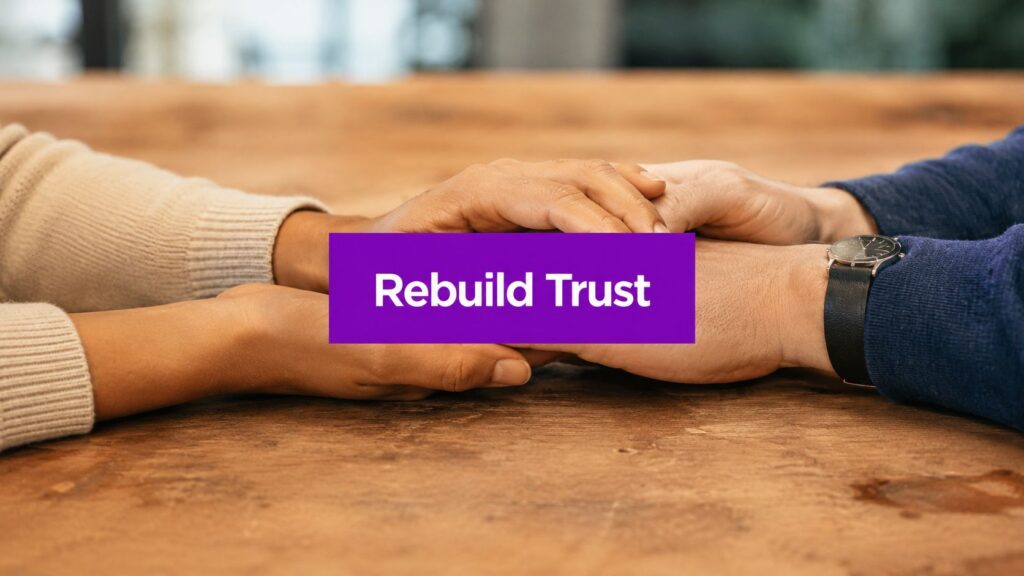
You're lying awake next to someone you care about, replaying a small moment from earlier. Their tone changed. They took a little longer to answer your text. They turned their phone face down at dinner. Part of you says, “Maybe it's nothing.” Another part says, “Don't be naive.”
That inner split is exhausting. It can make you question your partner, your judgment, and even your own stability.
Relationship trust issues usually aren't just about being “too sensitive” or “bad at relationships.” They often grow from something real. Sometimes that “real” thing is current and external, like betrayal, secrecy, or repeated inconsistency. Sometimes it's internal and older, shaped by attachment patterns, past hurt, or a nervous system that learned to stay alert. Very often, it's some combination of both.
What Are Relationship Trust Issues Really
Trust isn't only a decision. It's also a felt sense of safety. You can love someone and still not feel safe with them. You can also be with a basically trustworthy person and still feel on edge because your body and mind learned, long ago, that closeness can become pain.

That's where many people get confused. They treat all distrust as the same problem. It isn't. Some relationship trust issues are a rational response to current evidence. If your partner has lied, hidden messages, broken agreements, or made you doubt your reality, distrust may be your mind trying to protect you.
Other trust issues show up as an internal pattern. A person may feel unsafe even when there isn't a clear present-day violation. In that case, old learning can color new situations.
Two questions that change everything
When people come to therapy, I often want to slow the process down and ask:
- What happened in this relationship: Has trust been damaged by deception, betrayal, or chronic inconsistency?
- What happens inside you: Do you quickly expect abandonment, rejection, or hidden danger even when the evidence is mixed?
Those are not the same question. They lead to different kinds of healing.
Research helps make this distinction clearer. A study on distrust, jealousy, and attachment found that distrust can activate jealous thinking regardless of attachment style, but more disruptive behaviors such as partner surveillance were mainly associated with distrust among people with anxious attachment in this peer-reviewed article on distrust and attachment. In plain language, two people can both say “I have trust issues,” but one may be reacting to a real relationship problem, while the other is getting pulled into anxious self-protection.
A useful reframe: Trust issues are not one single flaw. They're often a mix of evidence, history, interpretation, and coping.
What trust problems often look like
Sometimes distrust sounds like, “I can't relax unless I know exactly where they are.”
Sometimes it sounds like, “I don't need anyone. I just won't let myself depend on them.”
Both are forms of protection. One reaches and checks. The other pulls back and shuts down. Neither means you're broken. It means your system is trying to keep you from being hurt again.
The Roots of Distrust Where Do Trust Issues Come From
Distrust rarely appears out of nowhere. Individuals often trace it to a set of experiences that taught them closeness wasn't fully safe, fully stable, or fully honest.

Betrayal changes how people scan for danger
Infidelity is one example, but it's not the only one. Hidden spending, double lives, emotional affairs, repeated broken promises, and manipulative half-truths can all injure trust. After that kind of rupture, the injured partner often becomes more alert. They may notice timing, wording, gaps, and inconsistencies that they would have brushed past before.
This is one reason deception is so destabilizing. It doesn't just hurt feelings. It makes ordinary moments feel uncertain. In situations involving serious misrepresentation, legal concerns can overlap with emotional fallout. If that applies to your story, this Tampa family law perspective on catfishing gives a practical view of how deception can affect a relationship beyond the emotional level.
Early family experience becomes a blueprint
Many adults with relationship trust issues grew up watching closeness and conflict happen side by side. Some learned that love could disappear. Others learned that people say one thing and do another.
A 2023 preliminary study of 117 adults found that people whose parents were married scored significantly higher on the Dyadic Trust Scale, with μ=5.65, SD=1.86, than those whose parents had divorced, who had a mean of μ=4.54, in this study on trust, attachment, and family of origin. The same study found that anxious and avoidant attachment styles explained 42% of the variance in trust, while relationship beliefs explained another 25%. That matters because it shows trust isn't only a reaction to one event. It's also shaped by expectations and emotional patterns built over time.
If you're trying to understand your own pattern, it can help to learn more about insecure attachment in psychology.
Beliefs quietly steer reactions
People often think trust is only about the other person's behavior. But private beliefs matter too. Beliefs like these can make distrust stronger:
- “If I relax, I'll get blindsided.”
- “People always leave once I need them.”
- “If I were enough, I wouldn't feel this insecure.”
Those beliefs usually didn't appear randomly. They were learned in painful contexts, then repeated until they felt like facts.
Sometimes healing starts when a person realizes, “My reactions make sense.” Shame drops. Curiosity comes in. That's when change gets easier.
Recognizing the Signs in Yourself and Your Partner
Trust issues are easier to address when you can name them clearly. Vague distress keeps people stuck. Specific patterns create options.
Behavioral signs
Some signs are active and visible. Others are quiet.
- Checking and monitoring: looking through a phone, scanning social media, asking repeated follow-up questions, or needing ongoing location updates
- Testing: setting traps, withholding affection to see whether a partner notices, or asking loaded questions to catch inconsistency
- Avoiding vulnerability: not sharing needs, staying emotionally guarded, or keeping one foot out of the relationship
- Reassurance loops: asking “Are we okay?” over and over, then feeling only briefly relieved
These behaviors often make sense in the moment. They're attempts to reduce uncertainty. But they can also feed the problem.
WebMD notes that relationship trust issues are linked to measurable behavioral patterns such as increased monitoring and testing of a partner, and that this can create a feedback loop in which ambiguous cues are interpreted as threats, leading to more verification and more conflict, as described in WebMD's discussion of signs of trust issues.
Emotional and mental signs
A person doesn't need to monitor a partner to be struggling with distrust. Sometimes the pain stays mostly inside.
Common internal signs include:
- Persistent anxiety: a steady sense that something is off
- Jealousy: not just dislike of a rival, but fear of being replaced
- Resentment: carrying old hurt into new interactions
- Emotional numbness: caring a great deal but feeling shut down
- Worst-case thinking: assuming delay means rejection, distance means disloyalty, or conflict means the relationship is ending
The feedback loop that keeps distrust alive
Here's how the cycle often works:
- Something ambiguous happens. A slower text reply. A canceled plan. A vague answer.
- Your brain fills in the blank. “They're hiding something.” “I'm about to be hurt.”
- You seek certainty. You check, question, test, or withdraw.
- The relationship gets strained. Your partner feels accused or distant. You feel even less safe.
What to watch for: If your coping method gives brief relief but creates more tension afterward, you may be in a distrust loop rather than solving the problem.
A helpful self-check is this: Am I responding to evidence, or am I trying to escape uncertainty? Sometimes it's both. Even naming that difference can lower confusion.
How to Start the Conversation About Trust
Talking about trust is hard because both people usually feel exposed. One person fears sounding needy, controlling, or irrational. The other fears being blamed, judged, or trapped in a conversation they can't “win.”
A better goal isn't to force a confession or prove a case. It's to create enough safety for honesty.
Before you bring it up
Timing matters. Don't start this conversation in the car, before work, late at night, or in the middle of another argument. Pick a calm window when neither of you is rushed.
Try to identify what you're asking for. Do you want clarification, accountability, reassurance, a behavior change, or a fuller conversation about the state of the relationship? Those are different requests.
What to say instead of blame
Blame usually sounds like an accusation. Honest vulnerability sounds more like information.
You can try language like:
- “I've noticed I've been feeling on edge, and I want to talk about it without attacking you.”
- “When plans change suddenly, I feel unsettled. I think part of that is old hurt, but I also need more consistency.”
- “I don't want to keep checking or overthinking. I'd rather talk directly about what helps me feel safe.”
- “There's a difference between me being triggered and there being a real issue. I'm trying to sort that out with you, not against you.”
Conversation Do's and Don'ts
| Do | Don't |
|---|---|
| Speak from your experience. Use “I feel” and “I notice” language. | Lead with accusations. “You always lie” usually shuts the door fast. |
| Name specific moments. Bring up concrete examples instead of a long history of grievances. | Dump every hurt at once. Too much at once becomes noise. |
| Ask for one clear change. For example, more direct communication about schedule changes. | Demand mind reading. Your partner can't fix what you haven't clearly stated. |
| Pause if either person gets flooded. Taking a break can protect the conversation. | Push through escalation. Staying in it while angry often creates fresh damage. |
| Listen for understanding. Your goal is clarity, not victory. | Treat defensiveness as proof of guilt. Some people get defensive because they feel scared or ashamed. |
“I want us to talk about trust in a way that helps us understand the problem, not become the problem.”
If your partner responds poorly
Sometimes the first conversation goes badly. That doesn't automatically mean the relationship is doomed. It may mean the topic is bigger, more painful, or more loaded than either of you realized.
But if your partner repeatedly denies obvious facts, mocks your concerns, flips the issue back onto you, or uses your vulnerability against you, that's important information. In that case, the problem may not just be your trust. It may be the relationship environment itself.
Evidence-Based Pathways to Healing and Rebuilding
Healing usually starts with one clarifying question: are you trying to recover from a real breach of trust, or are you reacting to a threat your nervous system has learned to expect? Those two experiences can look similar on the surface. Both can bring checking, fear, doubt, and arguments. But they do not respond to the same kind of help.

A peer-reviewed review in the International Journal of Indian Psychology found that trust problems in romantic relationships often grow out of trauma, betrayal, or ongoing communication breakdowns, and it identifies CBT, Emotion-Focused Therapy, EMDR, and the Gottman Method as common approaches in this review of trust issues in romantic relationships.
That distinction matters. If your partner has lied, hidden things, or broken agreed-upon boundaries, your mistrust may be a reasonable alarm. If your partner is generally consistent but uncertainty still feels unbearable, an older attachment pattern may be getting activated. Some couples are dealing with both at once, which is why healing often feels confusing.
Individual therapy when your alarm system stays on
Individual therapy helps when the trust problem is partly happening inside your interpretation of events. That does not make your pain less real. It means your mind and body may be reacting to present-day ambiguity as if it carries the weight of earlier hurt.
A simple way to picture it is this: your internal alarm may be too sensitive, or it may be accurately responding to smoke. Therapy helps you sort out which is which.
Different approaches help in different ways:
- CBT helps you identify thought habits that intensify fear, such as assuming the worst, filling in missing information with suspicion, or treating uncertainty as proof.
- EMDR can help if betrayal or earlier trauma still feels unfinished, so your body reacts as though the event is happening again.
- Attachment-focused therapy helps you understand your default moves under stress, such as clinging, testing, shutting down, or pulling away.
Couples therapy when trust has been damaged between you
Couples therapy is useful when the relationship itself has become the source of threat. The work is less about winning the argument and more about changing the pattern that keeps injuring both people.
In practice, that often means slowing the cycle down enough to study it. What triggers the doubt. How each person responds. Which behaviors create safety, and which ones keep reopening the wound. If you want a practical overview of that process, how to rebuild trust in marriage explains common repair steps.
Approaches such as Emotion-Focused Therapy and the Gottman Method are often used here because they help couples do more than apologize. They help partners recognize injury, respond with accountability, and build new experiences of reliability over time. reVIBE Mental Health offers couples counseling, along with modalities such as EMDR and psychiatry support when anxiety or depression are also part of the picture.
Medication can reduce the noise
Medication does not rebuild trust. It can, however, lower the volume of panic, depression, trauma symptoms, or constant hypervigilance so therapy has room to work.
That matters because a flooded nervous system struggles to tell the difference between intuition and fear. If your body is in alarm all day, even a healthy conversation can feel dangerous. Psychiatric support can help some people get enough steadiness to think clearly, set boundaries, and respond to what is happening in the relationship.
Healing works best when the plan matches the problem. A betrayal injury, an attachment wound, and an unsafe relationship can produce similar symptoms, but they call for different kinds of repair.
Practical Strategies for Rebuilding Trust on Your Own
Trust grows from repeated experience. People often want one big conversation, one heartfelt apology, or one promise that settles everything. That rarely works for long. Most nervous systems need consistency they can observe.
One therapist-oriented source describes trust rebuilding as a sequence: safety first, then connection, then clearer thinking and problem solving. The same source emphasizes “proof of work,” meaning small, repeated, verifiable follow-through, such as calling at the promised time, in this article on dealing with trust issues.
Small actions matter more than dramatic reassurance
If you're the person rebuilding trust, focus on what can be seen and confirmed.
- Keep small promises. If you say you'll call at six, call at six.
- Be plain, not polished. Honest answers build more trust than carefully managed ones.
- Offer transparency without contempt. Openness helps. Acting annoyed that your partner needs clarity usually doesn't.
- Stay consistent across time. A good weekend doesn't erase months of confusion.
If you're the hurt partner, your work is different but just as important.
- Ask for specific behaviors. “Be more trustworthy” is too vague. “Tell me if plans change” is workable.
- Notice when you're seeking certainty instead of information. Those are not the same thing.
- Use self-soothing before confrontation when possible. Slow breathing, a brief walk, journaling, or delaying a reactive text can keep fear from taking over.
- Watch for change over time. Don't rely only on promises, but don't ignore steady follow-through either.
A simple weekly reset
Some couples benefit from a short check-in once a week. Not an interrogation. Just a predictable time to ask:
- What felt connecting this week?
- What felt unsettling?
- Did either of us break an agreement, even in a small way?
- What would help next week feel safer?
Safety often returns quietly. It shows up in fewer mental rehearsals, less urge to check, and more ability to believe what you consistently observe.
Trust repair doesn't require perfection. It requires enough stability, honesty, and responsiveness that the relationship starts producing new evidence.
Find Support for Relationship Trust Issues in Phoenix
You check your partner's tone, their timing, the pause before they answer. By the end of the day, you still do not know whether your alarm system is picking up real danger or reacting to an old injury. That kind of uncertainty is exhausting, and it is one reason many people wait too long to get help.

Support can help you sort out the question that matters most. Is your distrust a reasonable response to betrayal, an attachment pattern that gets activated under stress, or a mix of both? It is hard to answer that alone when every conversation feels loaded. A good therapist helps you slow the process down, look at the evidence, and tell the difference between a red flag and a fear response.
In the Phoenix area, some people do best in individual therapy, especially if trauma, anxiety, or earlier relationship wounds are shaping how they read closeness and conflict. Others need joint support because the relationship itself has become the trigger, and both partners are stuck in the same painful loop. If emotional distance and physical closeness are part of the struggle, these steps to improve relationship intimacy may also help you understand how trust and intimacy affect each other.
If you want structured help with communication, repair, and clearer agreements, you can explore couples counseling near you in Arizona.
Find a reVIBE location near you by calling (480) 674-9220:
reVIBE Mental Health – Chandler
3377 S Price Rd, Suite 105, Chandler, AZreVIBE Mental Health – Phoenix Deer Valley
2222 W Pinnacle Peak Rd, Suite 220, Phoenix, AZreVIBE Mental Health – Phoenix PV
4646 E Greenway Road, Suite 100, Phoenix, AZreVIBE Mental Health – Scottsdale
8700 E Via de Ventura, Suite 280, Scottsdale, AZreVIBE Mental Health – Tempe
3920 S Rural Rd, Suite 112, Tempe, AZ
If relationship trust issues are wearing you down, reVIBE Mental Health offers practical support for couples and individuals. Whether you are trying to make sense of betrayal, attachment-driven anxiety, trauma, or repeated conflict, the goal is the same. Get clear about what is happening, and choose your next steps from a steadier place.