
Your teen shuts the bedroom door after dinner, and the house goes quiet. You can tell something is wrong, but every question gets a shrug, a short answer, or “I'm fine.” When finding an in-person appointment feels impossible, a secure video visit can offer a starting point without asking your teen to sit in a waiting room before they're ready.
Why Telehealth Psychiatry Matters for Today's Teens
Teen mental health care often begins at home, in the small moments parents notice before a diagnosis exists. A drop in school engagement, constant irritability, panic before leaving the house, sleeplessness, or a teen who stops answering friends can all signal a need for support. Telehealth psychiatry gives families another way to reach a qualified clinician when transportation, scheduling, stigma, or discomfort with a clinic creates friction.
For some adolescents, a bedroom or quiet study feels less intimidating than an office. Smartphones, school tablets, and video appointments have also made remote communication familiar. That familiarity can help a teen participate, but comfort with a screen doesn't automatically mean video care is clinically appropriate.
Telehealth can support evaluation and treatment for concerns such as anxiety, depression, ADHD, trauma, obsessive-compulsive symptoms, and mood changes. The American Psychiatric Association describes child and adolescent videoconferencing research that includes pre-to-post studies and randomized trials, generally with small samples, while also reporting high satisfaction among parents, teens, and referring professionals. The APA's child and adolescent telepsychiatry overview supports video care as a legitimate option, provided the clinician considers the young person, the clinical concern, technology, and setting.
The question isn't, "Can we do this appointment online?" It's, "Can this teen be assessed safely, speak openly, and receive the level of care they need from this location?" Families may also want practical guidance on monitoring device access and emergency communication. A resource such as SOS and privacy controls explained can help parents think through household technology boundaries, but it shouldn't replace a clinician's confidentiality and safety plan.
This guide is for parents and teens deciding whether video psychiatry is a good first step, how to protect privacy, what treatment can look like through a screen, and when in-person or higher-acuity care is safer.
How a Teen Telehealth Psychiatry Session Actually Works
Telehealth psychiatry is a clinical appointment delivered through a secure video platform. It isn't a casual online conversation. The clinician still gathers history, assesses symptoms and safety, discusses treatment options, and documents a plan.
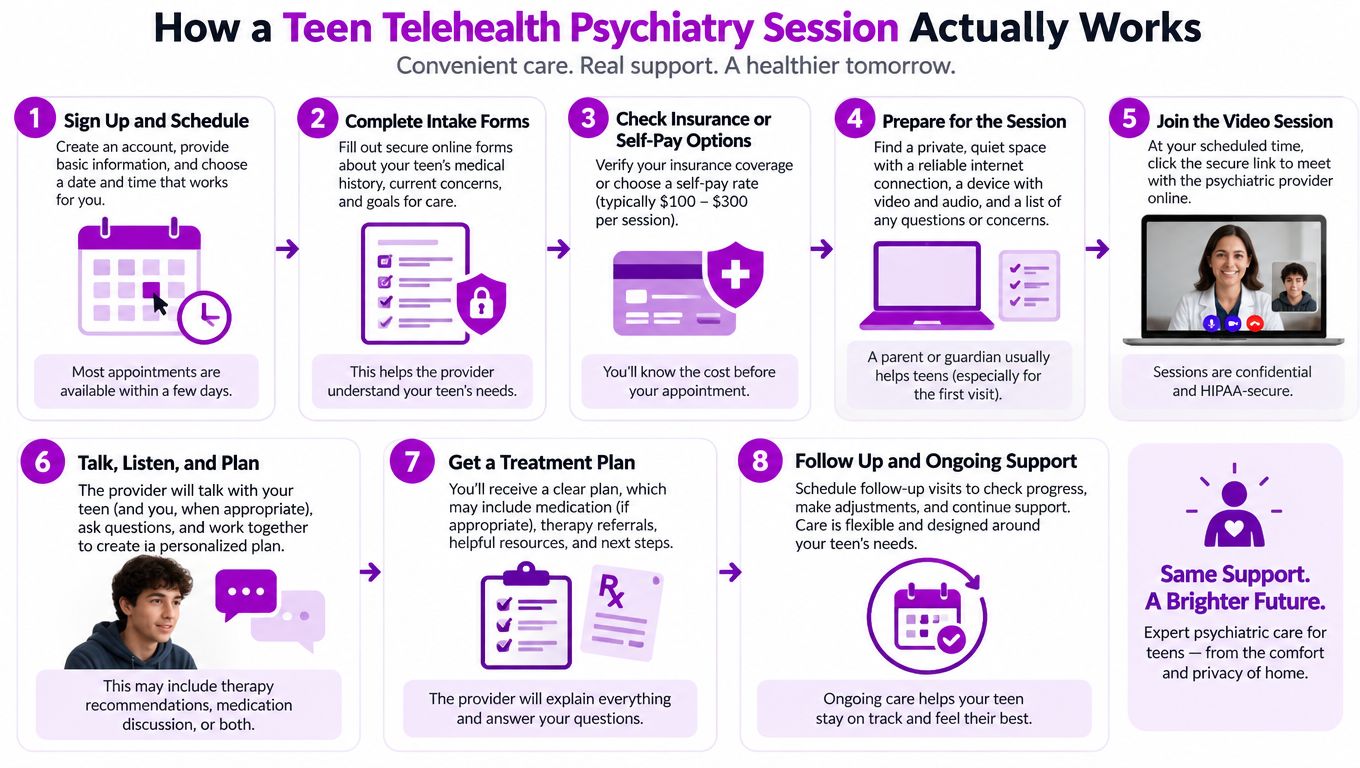
A typical visit follows a predictable rhythm:
- Before login: Confirm the appointment time, test the device, use a private room, and keep the teen's current medications and relevant medical information nearby.
- Opening checks: The practice verifies identity, confirms where the teen is physically located, checks who is present, and reviews consent and confidentiality.
- Private conversation: The clinician may invite a parent or guardian to provide background, then spend part of the visit alone with the teen when clinically and legally appropriate.
- Assessment: The discussion may cover mood, anxiety, attention, sleep, appetite, trauma, substance use, school, relationships, and safety. Rating scales can be completed before or during the appointment.
- Treatment planning: The clinician explains options such as therapy, medication, family support, school coordination, or a higher level of care.
- Follow-up: The family receives prescriptions, lab orders, referrals, portal instructions, and a plan for what to do if symptoms worsen.
Therapy visits usually focus on the teen's thoughts, feelings, behavior, relationships, and practice between sessions. A psychiatric medication visit may be shorter or structured differently, with attention to symptom response, side effects, adherence, sleep, appetite, functioning, and information from caregivers or other providers. A video clinician may order labs or request an in-person assessment when physical information is necessary.
For example, during a first intake, a clinician might begin with the parent describing a recent change in sleep and school attendance. The parent may then leave the room while the teen explains panic, bullying, or thoughts they haven't shared at home. The clinician brings the family back together to discuss immediate safety, possible treatment paths, and the next appointment.
Families exploring teen mental health treatment via telehealth should ask how the provider handles crisis planning, family participation, portal messages, refills, lab work, and coordination with a pediatrician or school. Before the appointment, review the practice's virtual waiting room instructions so login problems don't consume clinical time.
What the Evidence Says About Telehealth for Teen Mental Health
The evidence supports a careful conclusion: telehealth psychiatry can work well for some adolescents, but effectiveness depends on diagnosis, clinical stability, therapeutic quality, privacy, and follow-up.
A cited study of 28 youths aged 8 to 14 with depression found that eight sessions of cognitive-behavioral therapy delivered through interactive videotelevision produced improvement in depressive symptoms comparable to in-person treatment, as summarized by the American Academy of Child and Adolescent Psychiatry's telepsychiatry evidence summary. The same summary describes a 31-youth obsessive-compulsive disorder study in which videoconferencing produced superior results on primary measures and a larger proportion of participants meeting remission criteria than in-person treatment.
A 2025 systematic review found better depression outcomes with telepsychiatry than waitlist care, with a moderate effect size of Hedges' g = 0.54, 95% CI, 0.23 to 0.85, while the finding for anxiety was not statistically reliable, with Hedges' g = 0.50, 95% CI, -0.09 to 1.10. Those figures come from the 2025 systematic review in the Journal of Child Psychology and Psychiatry. They support a diagnosis-specific approach rather than the claim that every teen and every condition responds equally well online.
| Concern | Telehealth evidence | Recommended first step |
|---|---|---|
| Depression | Supportive evidence, including video CBT with comparable improvement in the cited adolescent study | Consider a structured video assessment and measurement-based follow-up |
| OCD | Supportive evidence from a small videoconferencing study | Ask about exposure and response prevention experience, privacy, and symptom tracking |
| ADHD | Supportive evidence for a community-based telepsychiatry intervention compared with primary-care management after teleconsultation | Clarify school and caregiver input, medication monitoring, and any need for physical assessment |
| Anxiety | Evidence is mixed, with the cited review not finding a statistically reliable advantage over comparison care | Match treatment intensity to severity and monitor response closely |
| Acute psychosis, severe suicidal risk, or unstable mania | Evidence is limited, and remote assessment may not provide enough safety or clinical information | Seek urgent in-person or higher-acuity evaluation |
| Eating-disorder medical instability | Video cannot replace needed vital signs, laboratory tests, or physical examination | Combine psychiatric care with appropriate in-person medical monitoring |
Practical rule: A video screen isn't a lower-intensity treatment by definition. A poorly matched or poorly monitored plan is the problem.
The literature remains uneven. Many studies involve small samples, pre-to-post designs, or limited randomized evidence, and long-term effects on relapse prevention, medication monitoring, and safety escalation remain less clear. Telehealth works best as one layer of stepped care, with a defined path to in-person assessment when the teen's symptoms, privacy, technology, or physical health require it.
Consent, Confidentiality, and Safety Before the First Visit
Parents often assume that signing a telehealth form answers every legal and ethical question. It doesn't. The family needs separate conversations about caregiver consent, adolescent assent, private time, information sharing, and emergency exceptions.
The American Academy of Pediatrics states that caregiver consent should be established when an adolescent is younger than 18 unless an applicable exception allows the minor to consent independently. AAP and Bright Futures also recommend private time between clinician and patient beginning as early as age 11, including through telehealth when feasible. The AAP's guidance on adolescent telehealth explains why consent and confidential communication must be planned rather than assumed.
HIPAA compliance isn't the same as minor-consent law. A secure platform protects the transmission of health information, but state law and practice policy determine who can consent, what parents can access, and how sensitive services are documented. Privacy can also be affected by patient portals, electronic medical records, shared devices, insurance statements, and billing communications sent to the home.
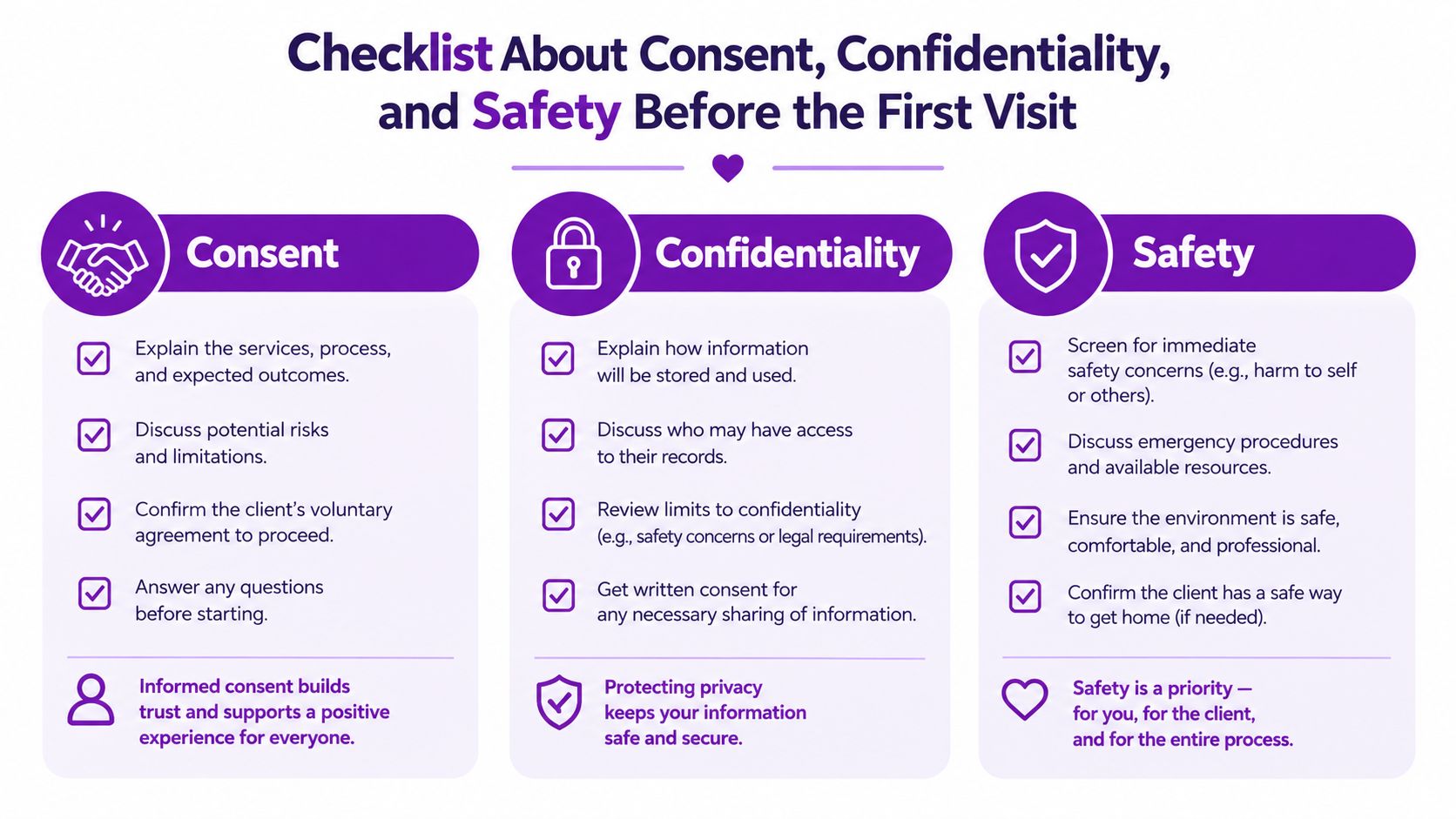
Before the first visit, agree on a protocol:
- Choose the space: Identify a room where the teen can speak without being overheard.
- Confirm who is present: The clinician should ask this at the start of each session.
- Use headphones when safe: They can reduce accidental disclosure, but the teen should still have a way to signal if someone enters.
- Create a privacy backup: Decide whether the teen will switch rooms, pause video, use a prearranged phrase, or message the clinician if privacy disappears.
- Set the emergency contact: Confirm the teen's physical location, a nearby trusted adult, and the local emergency resources before care begins.
- Explain exceptions: Serious risk of self-harm, harm to someone else, or suspected abuse can require the clinician to involve caregivers or emergency services.
A parent might say: “I'll help you get connected and stay nearby, but I won't listen unless you ask me to. Your clinician will explain what stays private and what must be shared for safety. If you lose privacy, use our agreed signal, and we'll follow the plan.”
The AAP's safety guidance recommends reviewing confidentiality limits at the beginning of visits and establishing how help will be reached if serious suicidal intent or plans emerge. Families can also review practical safety information from Luno: Self Care, while recognizing that an app cannot replace clinical assessment or emergency support. For a plain-language explanation of therapy privacy, review confidentiality in therapy.
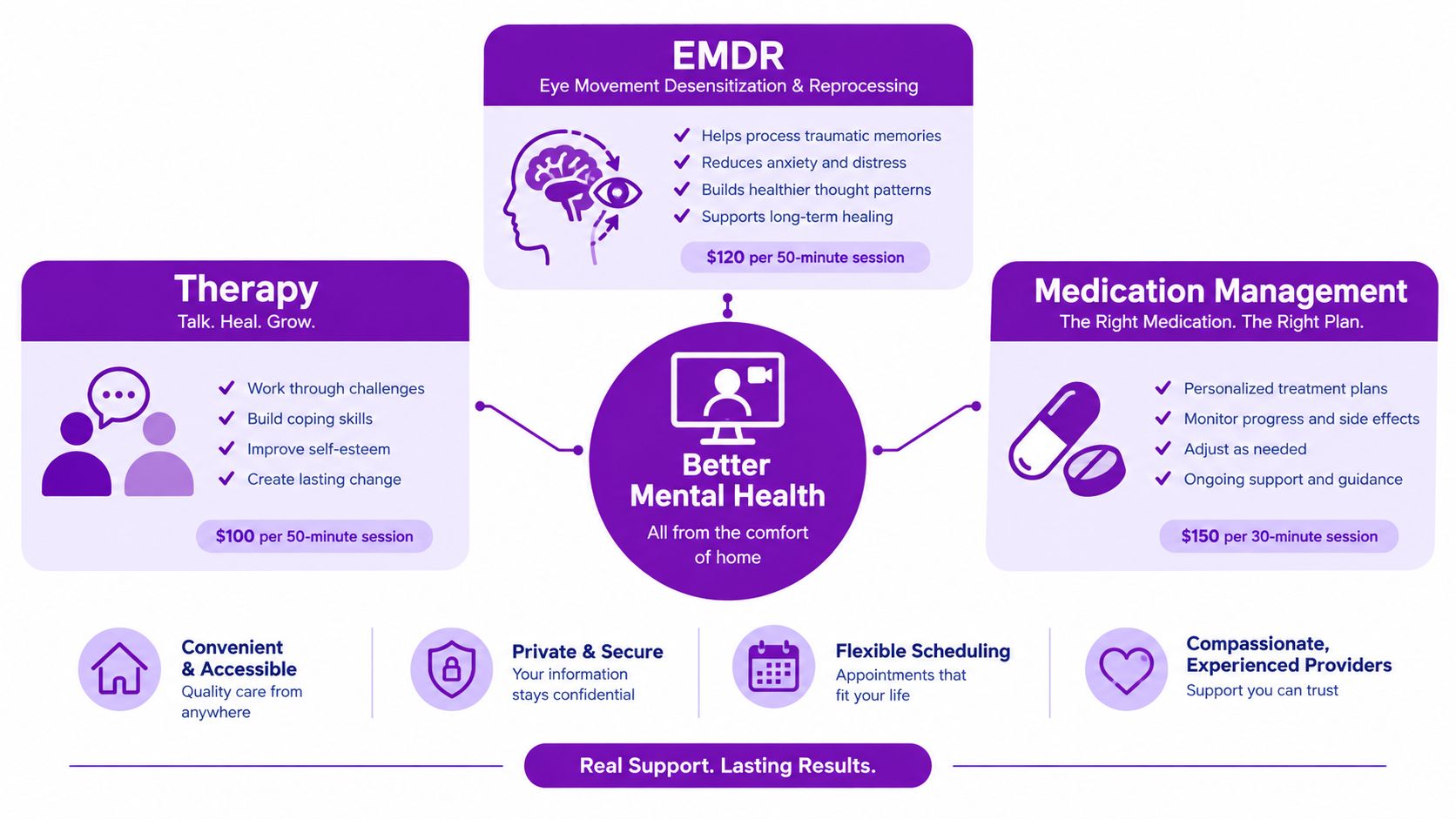
Therapy, EMDR, and Medication Management Over Video
Different services require different kinds of clinical attention. Matching the modality to the teen's concern matters more than choosing video because it is convenient.
Talk therapy often translates well to a screen. The therapist can ask about the week, observe facial expression and behavior, review homework, practice coping skills, and involve caregivers when appropriate. The teen may need to move the camera so the therapist can see enough of their face and upper body, and the clinician may need to pause if poor bandwidth makes communication unreliable.
EMDR requires more deliberate preparation. A clinician may use on-screen visual cues, therapist-guided hand movements, or handheld bilateral-stimulation tools. Remote EMDR can be reasonable when the teen has enough emotional stability, privacy, reliable technology, and grounding skills to remain oriented between sessions. A teen with severe dissociation, active safety concerns, or difficulty returning to the present may need in-person stabilization before trauma processing begins.
Medication management involves more than asking whether a prescription helped. The psychiatric clinician may review symptom scales, sleep, appetite, school functioning, side effects, adherence, caregiver observations, and other medications. The clinician may request lab work, coordinate with primary care, or recommend an in-person examination if vital signs, physical findings, or observed medication administration matter.
A parent may worry that a complicated case can't be handled through video. Sometimes that concern is correct. Video cannot provide every physical observation, and it may be unsafe when a teen is acutely suicidal, psychotic, manic, medically unstable, or unable to speak privately. In other cases, a stable teen may benefit from regular video follow-up combined with periodic in-person care.
A responsible clinician doesn't force every treatment into the format that is easiest to schedule. They adjust the format when the teen's needs change.
An integrated team can coordinate therapy and prescribing when each clinician has appropriate consent to share information. Ask how notes, rating scales, medication changes, school concerns, and caregiver updates move between providers. The goal is a coherent plan, not separate appointments that leave the family responsible for connecting every detail.
Preparing Your Teen for Successful Sessions
Preparation reduces the pressure on a teen who already feels exposed. Treat the appointment like a real clinical visit, even when the clinician appears on a laptop.
The night before, charge the device, confirm the appointment time, and ask your teen one low-pressure question: “What would you like the clinician to understand?” They can write a note, type a message, or bring up the issue during the appointment.
A few minutes before login:
- Protect privacy: Use a closed room, headphones when appropriate, and a backup location.
- Remove interruptions: Silence notifications and keep pets, siblings, and visitors away when possible.
- Keep basics nearby: Have water, medication information, and any requested forms available.
- Respect the camera boundary: Parents should stay out of view unless the clinician or teen invites them in.
- Use a warm-up prompt: A teen who freezes can begin with “The hardest part of this week was…” or read from a short note.
If the connection drops, follow the provider's backup plan instead of repeatedly restarting without contact. If someone enters the room, the teen should use the agreed signal and tell the clinician. If the teen dislikes the clinician, raise that concern early. A poor fit doesn't mean therapy has failed.
Afterward, try a brief debrief: the parent shares one takeaway, and the teen shares one takeaway, without demanding private details. Keep a family safety plan with crisis contacts, trusted adults, and the nearest emergency department. Preparation usually becomes easier over the first three to five sessions, as the teen learns the routine and the family identifies what supports honest participation.
Insurance, Scheduling, and When In-Person Care Is the Better Call
A telehealth appointment is only useful if the family can attend it, afford it, and use it safely. Before booking, ask the insurer whether outpatient psychiatry and therapy have separate benefits, whether video visits require a specific provider network, and what the family may see on an Explanation of Benefits. An EOB or portal notification can reveal that services occurred to someone who shares the household or insurance account.
Ask the practice to verify coverage and explain expected costs before the first visit. Telehealth parity rules vary by plan and location, so don't assume that online care has identical coverage or requirements. Scheduling matters, too. After-school windows, weekend availability, and appointments offered seven days a week can reduce missed sessions, but convenience never overrides clinical safety.
Use this decision matrix as a starting point:
| Scenario | Best fit | Why |
|---|---|---|
| Stable anxiety, depression, ADHD, or OCD with privacy and reliable technology | Telehealth or hybrid care | Conversation, rating scales, and follow-up may be completed effectively by video |
| Symptoms are improving but medication or physical monitoring needs review | Hybrid care | Video can support regular contact while in-person visits provide needed assessment |
| Active suicidal intent with a plan or immediate danger | Emergency or urgent in-person care | A routine video visit cannot provide the needed level of protection |
| Recent medication change with concerning physical or behavioral effects | In-person assessment or clinician-directed urgent evaluation | Hands-on assessment, vital signs, or labs may be necessary |
| Complex trauma with severe dissociation | In-person stabilization or carefully selected hybrid care | The clinician may need more support for orientation and safety |
| Eating-disorder medical instability | In-person medical monitoring with psychiatric coordination | Vital signs, laboratory tests, and physical assessment may be required |
| Psychotic symptoms or acute mania | Urgent in-person or higher-acuity support | The teen may need rapid evaluation and protection beyond outpatient video care |
A 2025 review also identified limited research on long-term telepsychiatry effects among low-income and rural youth, including sustained engagement and connection with community services. The review's findings reinforce the need to ask what happens between visits, not just whether the first appointment is available.
Getting Started With a Provider in the Phoenix Metro
Before booking, answer three questions with your teen:
- Is the concern suitable for video right now?
- Will consent, privacy, and safety be handled clearly?
- Does my teen have meaningful choice in the process?
That third question can change the entire experience. A teen may not choose the diagnosis or need for care, but they can often choose whether to begin with therapy or psychiatry, whether a parent joins part of the visit, which room feels safest, and how they want difficult topics introduced.
In the Phoenix metro, reVIBE Mental Health offers therapy and psychiatry with medication management through secure online sessions, alongside in-person appointments. Families can ask about talk therapy, EMDR, psychiatric evaluation, insurance verification, and a treatment match based on the teen's goals and preferences. The practice serves multiple Arizona communities:
- reVIBE Mental Health, Chandler
3377 S Price Rd, Suite 105, Chandler, AZ - reVIBE Mental Health, Phoenix Deer Valley
2222 W Pinnacle Peak Rd, Suite 220, Phoenix, AZ - reVIBE Mental Health, Phoenix PV
4646 E Greenway Road, Suite 100, Phoenix, AZ - reVIBE Mental Health, Scottsdale
8700 E Via de Ventura, Suite 280, Scottsdale, AZ - reVIBE Mental Health, Tempe
3920 S Rural Rd, Suite 112, Tempe, AZ
The shared phone number is (480) 674-9220. During an initial conversation, ask about the main concern, insurance, preferred modality, privacy at home, and whether secure video or an in-person first appointment makes more sense. Families comparing options can also review psychiatrist services near you before calling.
You don't need a perfect plan before reaching out. One phone call can clarify fit, availability, consent questions, and the safest next step. For a teen who has been struggling, starting that conversation is already meaningful progress.
reVIBE Mental Health offers secure online psychiatry with medication management, therapy, and EMDR for teens and families who need flexible support in the Phoenix metro. Visit reVIBE Mental Health to ask about insurance, appointment availability, and whether telehealth, in-person care, or a hybrid plan fits your teen's needs.