
Some nights end with a lunchbox still unwashed in the sink, a child calling for you from the hallway, and your own mind still running through work emails, school forms, and the conversation you wish had gone better at dinner. You may look calm from the outside while feeling stretched thin on the inside.
That state is common. It's also treatable.
Many parents assume therapy is only for a breaking point. In practice, therapy for parents often works best much earlier than that. It can help you understand why you're snapping faster, feeling numb, worrying constantly, or struggling to enjoy family life even when you love your children deeply. It can also help you respond with more steadiness, repair conflict sooner, and feel more like yourself again.
If you're carrying too much, that doesn't mean you're failing. It usually means your system needs support.
The Unspoken Weight of Modern Parenting
Parenting today asks for emotional stamina, planning, patience, and flexibility, often all before 8 a.m. You may be managing child care, school issues, work demands, money stress, sleep loss, and the invisible labor of remembering everything for everyone. A lot of parents wonder why this feels so hard.
It feels hard because it is hard.
Many parents judge themselves for feeling irritable, disconnected, or overwhelmed. They tell themselves they should be more grateful, more patient, or more organized. Therapy can interrupt that cycle. Instead of asking, “What's wrong with me?” it helps you ask, “What am I carrying, and what would help?”
You don't need to be in crisis to benefit from support. You just need to be tired of doing this alone.
Sometimes practical support and emotional support need to happen together. If your stress is tied to the daily juggle of caregiving and work, these tips for working moms can help reduce day-to-day pressure while you also consider deeper support for your own mental health.
What therapy changes for a parent
Therapy doesn't make parenting effortless. It does make it easier to notice your patterns and respond with more intention.
- It builds a pause: You learn how to slow down before reacting.
- It gives language to stress: Burnout, grief, resentment, anxiety, and overload stop feeling like one giant blur.
- It creates room for you: Many parents spend years caring for others without a place to say, “I'm not okay.”
That shift matters. A more supported parent is often a more present parent.
Why So Many Parents Are Seeking Therapy
A growing number of parents are reaching the same conclusion. They need support that goes beyond pushing through.
Approximately 63% of parents in the United States have sought a therapist for themselves, their children, or their entire family unit, reflecting a significant normalization of family-centered mental health care, according to this report on the OnePoll survey conducted on behalf of LifeStance.
That number makes sense when you look at what parents are facing. The issue usually isn't a lack of love. It's the accumulation of stress without enough recovery, reflection, or help.
The pressures that bring parents in
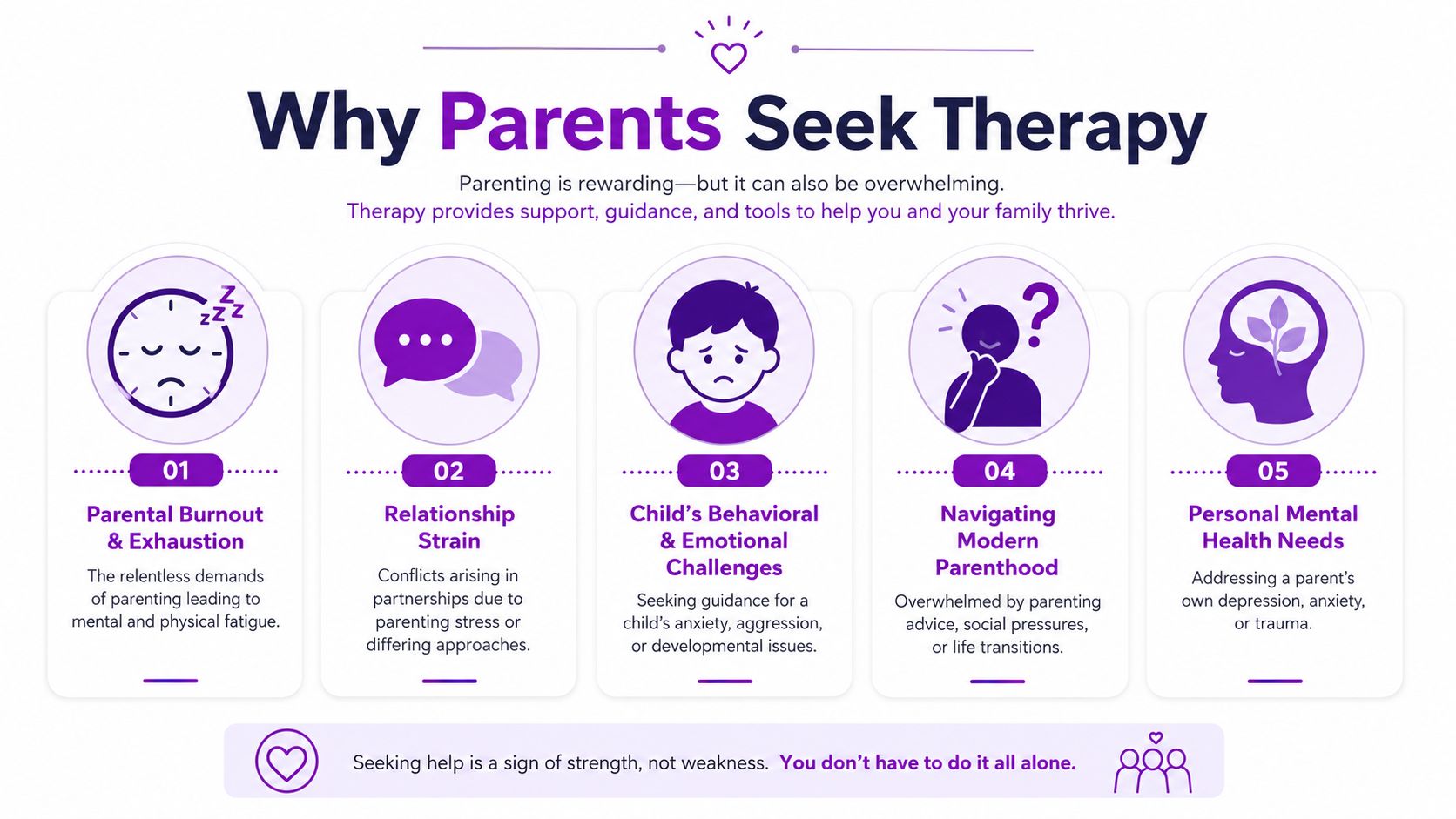
Some parents seek therapy because they feel depleted all the time. Others come in after a child's diagnosis, a marital strain, postpartum anxiety, or the resurfacing of their own childhood wounds. The doorway varies. The need underneath is often similar. They want more steadiness, more clarity, and less reactivity.
A few common reasons show up again and again:
- Burnout and exhaustion: You keep functioning, but everything feels harder than it used to.
- A child's emotional or behavioral struggles: Anxiety, defiance, school refusal, or big feelings can leave parents unsure how to respond.
- Relationship strain: Parenting stress often exposes differences in communication, discipline, and expectations.
- Life transitions: A new baby, divorce, relocation, blended family changes, or teen years can unsettle the whole household.
- Personal mental health needs: Depression, anxiety, trauma, grief, or chronic stress don't disappear when someone becomes a parent.
Why this matters clinically
When parents have a place to process their own stress, they often become more effective in the daily moments that matter most. They can set limits more calmly, read a child's behavior more accurately, and recover faster after conflict.
For parents who want a broader foundation for understanding how mental health shows up in family life, this Parents' guide to child mental health gives helpful background in plain language.
You may also find that practical coping tools help while you decide whether ongoing care makes sense. These stress management techniques for parents are a good starting point when your nervous system feels constantly “on.”
Practical rule: If your stress is affecting your patience, sleep, relationship, or ability to enjoy your child, it's enough reason to seek therapy.
Therapy for parents is becoming more common because the need is real, not because parents are weaker than before. In many cases, they're finally giving themselves permission to get support instead of waiting until everyone is struggling.
The Parent-First Approach A Healthier Family
A lot of parenting advice starts with the child's behavior. That makes sense on the surface. If your child is melting down, refusing school, acting aggressively, or withdrawing, that problem is right in front of you.
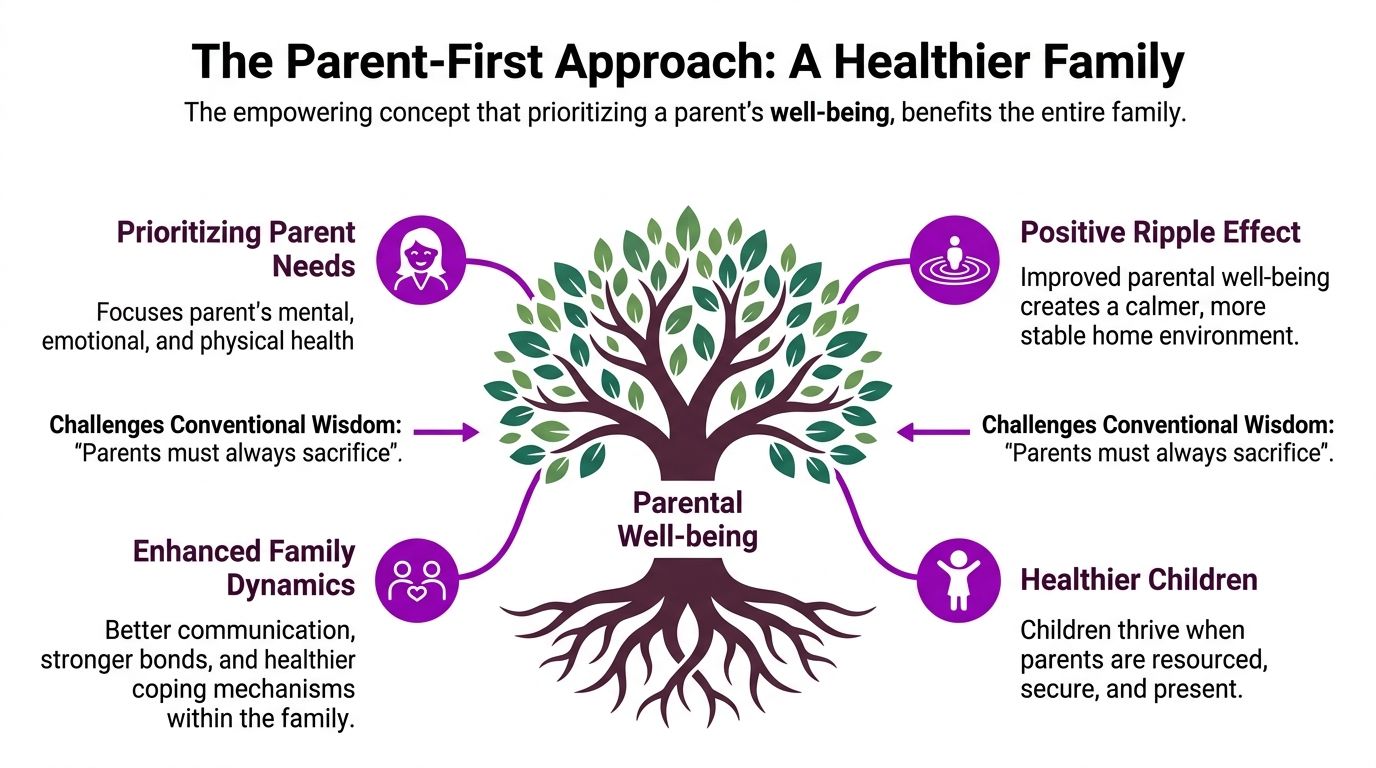
But there's another path that often gets overlooked. Start with the parent.
Research has highlighted an important gap in how this topic is usually discussed. Most existing content focuses on parent-focused therapy as a tool to manage child behavior, but rarely addresses the data showing that parental psychopathology is a risk factor that makes it harder for parents to engage in their child's treatment unless their own needs are met first, as discussed in this review on parental mental health and child outcomes.
Why parent-first isn't selfish
If a parent is depressed, highly anxious, traumatized, or emotionally exhausted, that affects everything. It can affect consistency, patience, follow-through, sleep, conflict repair, and even the energy needed to schedule and attend a child's appointments. A parent-first model treats that reality seriously.
Think of it this way. If your hands are already full, adding more parenting strategies may not help until someone helps you put some of the load down.
This approach doesn't ignore the child. It recognizes that children live inside a family system. When the most overloaded person in that system gets support, the climate in the home often changes.
What the ripple effect can look like
A parent who begins therapy might notice changes like these:
- Less reactive discipline: Yelling becomes less frequent because the parent has more capacity to pause.
- Better interpretation of behavior: A child's clinginess or anger looks less like disrespect and more like a sign of stress or need.
- More emotional availability: Small moments of connection return, even in a busy week.
- Greater follow-through: Appointments, routines, and boundaries become easier to maintain.
When a parent feels safer and more regulated, children often respond to that shift long before they can explain it.
That's one reason therapy for parents can be such a powerful intervention. It doesn't only produce insight. It changes the emotional environment children grow up in.
When this approach is especially useful
The parent-first model can be a strong fit when:
| Situation | Why parent-first helps |
|---|---|
| A parent is dealing with anxiety or depression | Their own symptoms may be driving tension, avoidance, or exhaustion at home |
| A child is in treatment but progress feels stalled | The parent may need support to fully participate and apply what's being taught |
| Family conflict keeps repeating | The parent may need help identifying triggers and patterns that fuel the cycle |
| A parent feels guilty for needing help | Therapy reframes self-care as part of responsible parenting |
Many parents feel relief when they hear this. You do not have to disappear for your family to thrive. Sometimes caring for yourself is the most direct way to care for them.
Exploring Your Therapy Options as a Parent
Once you accept that support could help, the next question is usually practical. What kind of therapy are we talking about?
The answer depends on the problem you want to solve. Therapy for parents isn't one service. It's a set of options.

Individual therapy for the parent
This is often the best place to begin if you're struggling with anxiety, depression, burnout, trauma, grief, anger, or a constant sense of overload. The focus stays on you. Your therapist helps you understand your patterns, calm your nervous system, and make room for healthier responses at home.
If parenting feels hard because your internal world feels chaotic, individual therapy usually fits better than jumping straight into family work.
Couples counseling for the parenting team
Sometimes the main problem isn't one parent's mental health. It's the way two adults are getting stuck together. You may argue about discipline, feel unsupported, resent the division of labor, or struggle to stay connected while raising children.
Couples counseling can help you improve communication, clarify roles, and reduce the “you always” and “you never” fights that wear down a household.
Family therapy when the pattern belongs to everyone
Family therapy can be useful when one person seems to be carrying the symptom, but the tension affects the whole family. A child may be acting out, but the larger issue may involve conflict, avoidance, grief, or unclear boundaries across the household.
This kind of therapy looks at interaction, not blame.
Parent-based interventions for child behavior concerns
Some treatments are built around the parent as the change agent. That's especially important for certain childhood conditions. Parent-based interventions are the first-line recommended treatment for managing ADHD symptoms in children and teens, demonstrating superior efficacy compared to child-only approaches and consistently reducing disruptive behaviors like aggression and defiance, according to this overview from the Baker Center for Children and Families.
That can sound surprising at first. Parents sometimes worry it means they're being blamed. It doesn't. It means they have influence.
A simple way to choose
Think about the main source of pain right now.
- If your thoughts and emotions feel unmanageable, start with individual therapy.
- If you and your partner are clashing, couples counseling may help fastest.
- If the whole family gets pulled into the same conflict cycle, family therapy makes sense.
- If your child has ADHD or another behavior pattern that responds to coaching, parent-based work may be the clearest fit.
If you're unsure, a good provider can help sort through the options. This guide on how to find the right therapist for you can make that decision less overwhelming.
And if getting to an office feels difficult, many parents begin with comprehensive online mental health care so they can access support without adding another commute or child care problem to the week.
The best therapy model is the one that matches the actual problem in front of you, not the one that sounds most familiar.
Specialized Treatments for Specific Challenges
Some family situations need more than general talk therapy. They need a treatment designed for a very specific kind of pain.

When trauma is part of the story
Consider a parent whose child has nightmares after a frightening event. The child starts treatment, but the parent also becomes more jumpy, protective, and emotionally flooded. In that situation, the parent's own trauma response can shape the child's recovery.
That's one reason trauma-focused care can be so important for the whole family. When parents receive trauma-focused therapy alongside their child's EMDR treatment, the child's trauma symptom reduction accelerates by an average of 2.5 weeks, with 65% of families achieving full symptom remission within 12 sessions versus 18 for child-only protocols, according to this cited therapist profile discussing those findings.
EMDR is often used to help people process distressing experiences that continue to feel “stuck.” For parents, that may involve their own past trauma, a recent medical scare, birth trauma, or the emotional shock of something that happened to their child.
When symptoms are making daily life harder
Another parent may say, “I know what I should do, but I can't get myself there.” They may be sleeping poorly, crying often, struggling to focus, or feeling on edge all day. In those cases, psychiatry and medication management can be part of the plan.
Medication isn't the answer for every parent. But for some, reducing the intensity of anxiety or depression creates enough stability to use therapy well, return to routines, and reconnect with family life. The goal isn't to change your personality. It's to reduce the symptoms that are blocking you.
Specialized care works best when treatment matches the problem closely. General support is helpful. Targeted support is often what moves things forward.
When eating disorders affect the whole household
Families coping with an eating disorder often feel frightened and confused. Meals become tense. Parents may not know when to comfort, when to set structure, or how much to monitor.
Family-Based Treatment, often called FBT, is designed for this exact scenario. It actively involves parents in helping restore safety and structure around eating. For many families, that clarity alone reduces panic. Parents stop feeling like helpless bystanders and begin acting as part of a coordinated treatment plan.
A useful way to think about specialty care
General therapy helps with broad emotional strain. Specialized treatments are more like using the right tool for a particular job. If trauma, eating disorders, or severe mood symptoms are part of what's happening, a more precise approach often makes the process feel less confusing and more effective.
How to Find and Start Therapy in Phoenix
Starting therapy can feel bigger in your head than it does once you begin. Most parents don't need more motivation. They need a clear path.
Step one is naming the real problem
Try to describe the issue in one sentence. “I'm anxious all the time.” “My child's behavior is wearing me down.” “My partner and I keep fighting about parenting.” “I think my own childhood is showing up in how I parent.”
That sentence helps narrow the type of care you're looking for. It also gives you something concrete to say when you make the first call.
Step two is deciding on format
Some parents do best in person because it gives them a dedicated place to focus. Others need telehealth because it's the only realistic way to fit therapy into family life. A hybrid option can work well if your schedule changes week to week.
The right format is the one you'll use consistently.
Step three is asking practical questions early
A first contact call doesn't need to be perfect. You're gathering fit information.
Here are smart questions to ask:
- What concerns does this therapist commonly treat?
- Do they offer individual, couples, or family therapy?
- Are telehealth sessions available?
- Do they accept my insurance plan?
- What does the first appointment usually look like?
If you want a simple checklist, these steps for therapy can help you prepare without overthinking it.
Step four is preparing for the first session
Most first sessions involve getting the story straight. Your therapist may ask what brings you in, how long it's been going on, what you've tried already, and what you want to feel different. You do not need a polished explanation.
A useful way to prepare is to jot down three notes:
- What feels hardest right now
- What you want more of
- Any past therapy or medication history that matters
That's enough to start.
A few Phoenix-specific realities
Parents in the Phoenix area often balance long drives, packed calendars, heat, school logistics, and limited time windows. That makes convenience matter. Session availability, location, online access, and insurance compatibility aren't side details. They're often the difference between getting support and putting it off for another six months.
The process gets easier once you stop trying to solve everything at once. You only need the next step.
Find a reVIBE Location Near You
If you're ready to take that next step, it helps to know exactly where to go and how to reach someone.
We currently have five locations for your convenience. Call (480) 674-9220.
| Location Name | Address |
|---|---|
| reVIBE Mental Health – Chandler | 3377 S Price Rd, Suite 105, Chandler, AZ |
| reVIBE Mental Health – Phoenix Deer Valley | 2222 W Pinnacle Peak Rd, Suite 220, Phoenix, AZ |
| reVIBE Mental Health – Phoenix PV | 4646 E Greenway Road, Suite 100, Phoenix, AZ |
| reVIBE Mental Health – Scottsdale | 8700 E Via de Ventura, Suite 280, Scottsdale, AZ |
| reVIBE Mental Health – Tempe | 3920 S Rural Rd, Suite 112, Tempe, AZ |
Whether you prefer care close to home or close to work, having multiple locations can make therapy easier to sustain.
Your Questions About Parental Therapy Answered
Parents usually don't need more reasons to get help. They need help getting past the barriers.
How can I make time for therapy when I'm already overwhelmed
This is one of the most common concerns, and it's real. Recent developments highlight that telehealth and hybrid models are critical solutions for the 32% of parents who cite competing demands and time commitments as reasons for not seeking help, allowing them to access care while managing child care duties, based on this review of barriers to parent engagement.
That means therapy doesn't always require travel, extra child care, or a major schedule overhaul. Some parents meet during a lunch break, while a child is at school, or from a parked car before pickup.
What if my partner refuses to participate
You can still start.
A parent doesn't need a fully cooperative spouse to benefit from therapy. If you're the one reading this, your own support can help you manage conflict better, set clearer boundaries, and reduce how much the family gets pulled into repeating arguments. Sometimes one person's change shifts the tone at home. Sometimes it helps that person suffer less.
Start with the willing person. In many families, that's enough to begin changing the pattern.
Will my child's therapist also be my therapist
Often, no. That separation can protect trust, clarity, and confidentiality. A child needs a therapist who can stay focused on the child's experience. A parent needs space to speak freely about frustration, guilt, fear, or resentment without worrying about how that will land in the child's treatment.
In some settings, different providers can still coordinate care when that's clinically helpful and when the right permissions are in place.
What if I don't know what kind of help I need
That's normal. You don't have to arrive with the correct therapy vocabulary. You can say, “I'm not doing well,” or “I think parenting has brought up more than I expected.” A good intake process helps sort out whether individual therapy, family work, couples counseling, trauma treatment, or psychiatry makes the most sense.
Is therapy for parents only about helping my child
No. Your child may benefit, but your life matters too.
Many parents have spent so long organizing everyone else's needs that they struggle to name their own. Therapy gives that part of you somewhere to land. Better parenting may follow, but you don't need to justify your care only through what it does for someone else.
What if I'm worried therapy means I've failed
Usually it means the opposite. It means you noticed something important before it hardened into a deeper crisis. It means you care enough to look openly at what's happening and ask for support.
That's not failure. That's responsible care.
If you're ready to explore support for yourself or your family, reVIBE Mental Health offers therapy, EMDR, and psychiatry with medication management across the Phoenix metro area, with in-person and secure online sessions, help with insurance verification, and a compassionate team that works to match you with the right provider.