
Your six-year-old won't talk about the new school, but keeps making toy animals hide behind the couch. A teacher mentions that your child avoids group play. Meanwhile, your toddler has become clingy since the family moved, and you're wondering whether something more than reassurance would help.
These situations don't automatically call for the same treatment. Some children need room to express themselves without another adult directing them. Others need a therapist to teach coping skills through games, or a caregiver beside them practicing a different way to connect.
The most useful way to compare types of play therapy is to ask who leads the session and how much structure the child receives. A tray of sand, a puppet, or a board game doesn't identify the treatment by itself. What matters is how the therapist uses it, why they chose it, and what changes you're working toward.
Start with the child, not the toy. Enjoying an activity matters, but so does whether the approach addresses your child's needs.
Good care also includes clear communication with parents. Tools such as AI documentation for therapy practices concern the recordkeeping side of treatment; they don't replace the clinician's assessment, relationship with your child, or explanation of progress.
1. Child-Centered Play Therapy (CCPT)
The child leads; the therapist provides an accepting relationship and clear safety limits. Your child chooses the materials and direction of play, while the therapist notices actions, reflects feelings, and supports decision-making without turning the session into a lesson.
Virginia Axline adapted Carl Rogers's person-centered principles for children, publishing Play Therapy in 1947, as described in the historical overview of play therapy. The approach emphasizes the child's capacity for growth within a warm, empathic, nonjudgmental relationship.
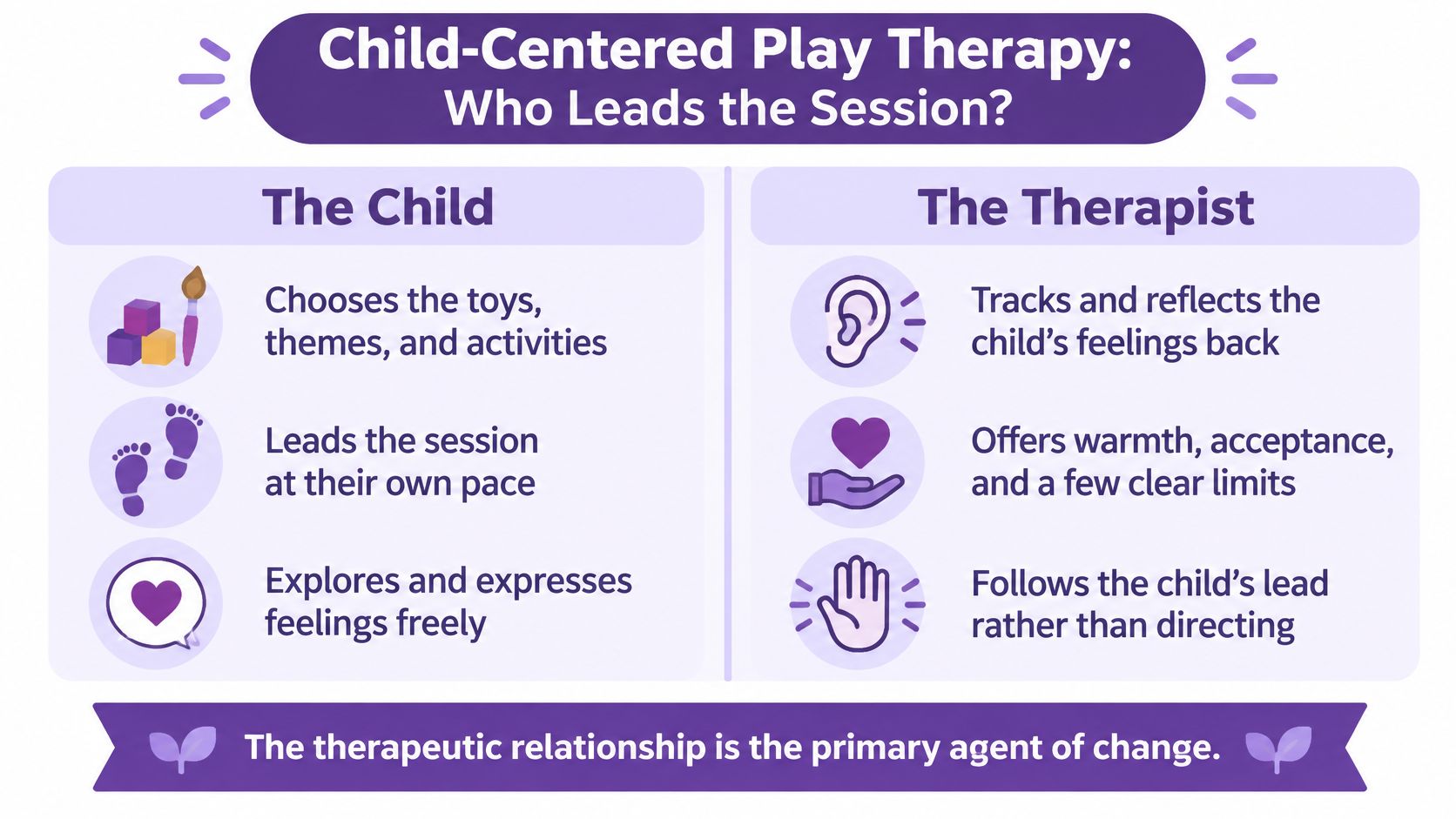
Say a child feels unsettled after a move and repeatedly places dollhouse figures outside the house. The therapist might acknowledge the uncertainty in the play without declaring that the figures represent the family. Play isn't a code with a fixed translation.
When less direction helps
CCPT is worth considering when a child resists direct questioning, needs emotional space, or becomes overwhelmed by adult-led tasks. It can be used around anxiety, grief, family changes, and behavior concerns, but it isn't a substitute for assessing what's driving those difficulties.
A meta-analysis indexed by the American Psychological Association examined 52 controlled outcome studies and estimated a moderate treatment effect of 0.47. Outcomes varied, so that average isn't a prediction for an individual child.
After sessions, avoid interrogating your child about what the toys meant. Offer attention without requiring a report, and discuss broader goals with the therapist separately.
Our play therapy for kids includes child-centered options, with care adapted to the child and collaboration with caregivers.
2. Directive Play Therapy
A therapist brings out a board game, explains the rules, and pauses when a character becomes frustrated. Your child practices noticing body tension, choosing a calming action, and trying again. The therapist leads the activity because there's a specific skill to practice.
Directive play therapy uses selected games, stories, art, or role-play to address defined emotional or behavioral goals. It can provide a useful starting point for children who struggle to enter open-ended play or want to know exactly what will happen.
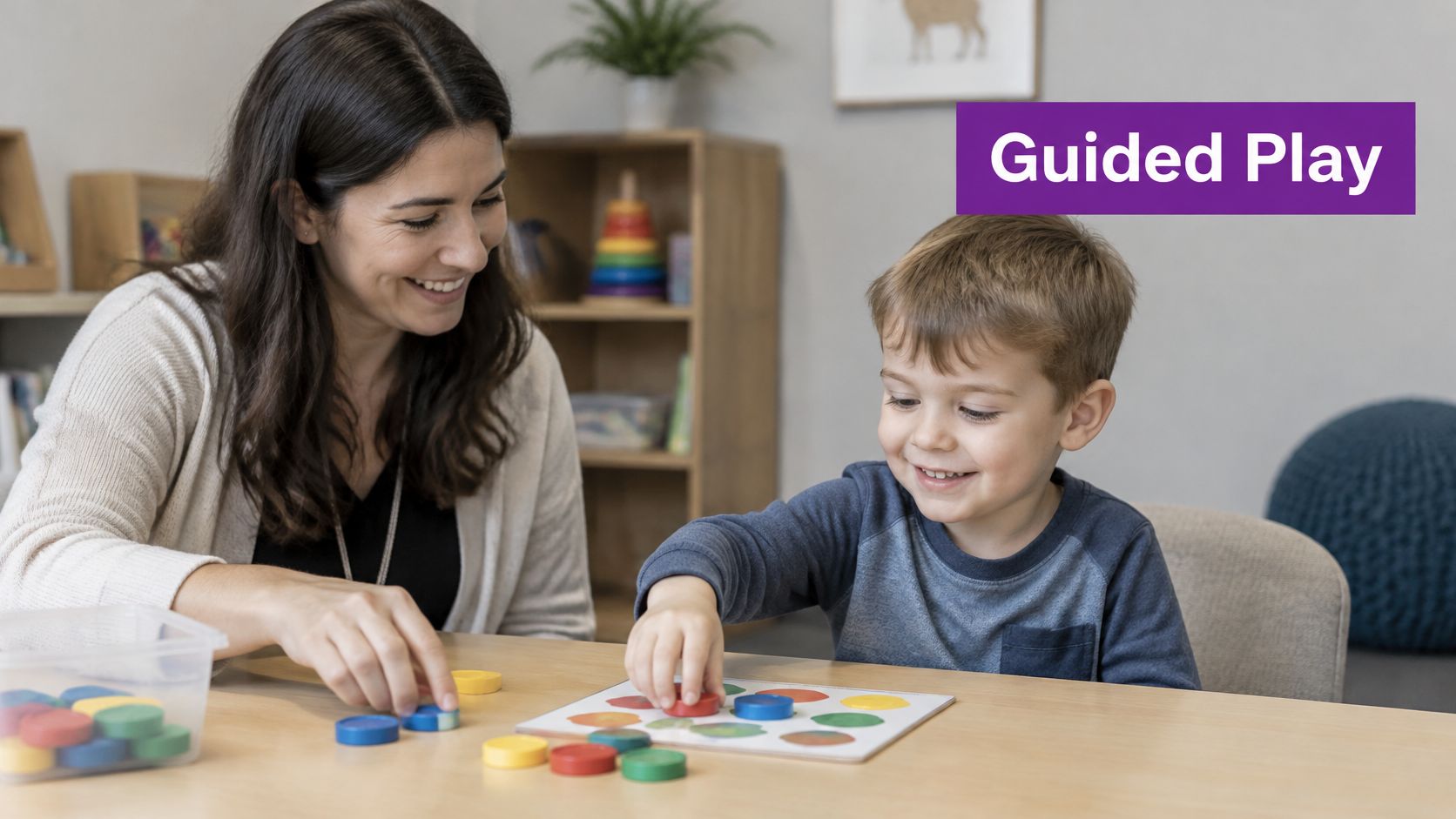
A systematic review of individual play therapy identifies directive and nondirective approaches as broad categories and notes that some models combine them. That flexibility matters: a child may need guided practice during part of a session and more choice during another part.
Structure should support, not control
For a child who grabs materials from classmates, the therapist might use a cooperative game to rehearse requesting a turn and tolerating a delay. The meaningful outcome isn't winning the game. It's using the skill outside the office.
- Good fit: A child who benefits from predictable steps, demonstration, and immediate practice.
- Potential mismatch: A child who experiences repeated adult direction as pressure and becomes less communicative.
- Home practice: Use the same brief coping language during ordinary routines, rather than adding another elaborate assignment.
A therapeutic game needs a therapeutic purpose. If sessions look busy but nobody can explain what the child is learning, the treatment plan needs clarification. Structure also needs adjustment when a task exceeds the child's language, sensory, or developmental abilities.
3. Filial Therapy
In filial therapy, the caregiver becomes the play partner, with the therapist providing teaching and coaching. The play itself is child-centered, but the parent learns a deliberate way of tracking actions, reflecting feelings, accepting emotional expression, and setting limits.
Bernard and Louise Guerney developed the model to bring therapeutic play into the parent-child relationship. Unlike being told to spend more time together, parents receive support in how to respond when play becomes frustrating, repetitive, or emotionally charged.

For example, a child knocks down a parent's block tower after a difficult family transition. Rather than immediately correcting the behavior or asking why, the parent practices acknowledging frustration while protecting people and materials. The therapist helps the parent distinguish accepting a feeling from allowing every action.
A review of play therapy approaches describes filial therapy as caregiver training that extends play-based communication beyond the clinic. That's its practical advantage: the relationship being strengthened continues at home.
Consider the commitment honestly
This approach suits caregivers who want an active role and can protect regular, distraction-free play time. It can be especially relevant when conflict, disconnection, or family changes are central concerns.
A missed home session isn't proof that a parent doesn't care. It's information about whether the plan fits the family's actual capacity.
Filial work is a poorer starting point when a caregiver can't participate safely or consistently without additional support. It also shouldn't turn a parent into the child's investigator or diagnostician.
When discussing child-parent relationship therapy, be direct about scheduling pressures, disagreements between caregivers, and what makes play difficult. A workable plan matters more than an ambitious one.
4. Theraplay
Theraplay places the caregiver-child relationship at the center, with the therapist actively organizing shared experiences. Compared with filial therapy's child-led play, Theraplay usually involves more adult-led interaction and a clearer sequence.
The model emphasizes structure, engagement, nurture, and challenge. Activities might include reciprocal games, songs, rhythmic movement, or a manageable shared task, adapted to the child's developmental abilities and comfort.
For a child adjusting to a new caregiver, a session might begin with a predictable greeting and a simple back-and-forth game. The therapist watches whether the child can stay engaged, accept support, and recover when something feels difficult, rather than pushing for closeness.
Connection must remain voluntary
Theraplay may be worth exploring when trust, attachment, or shared regulation is the main concern. A foster or adoptive family might consider it, but family history alone doesn't establish that this is the right model.
- Caregiver participation: The adult needs to attend, practice, and tolerate feedback about their own responses.
- Sensory preferences: Movement, proximity, songs, and touch need adaptation rather than automatic inclusion.
- Consent and assent: A child's refusal, withdrawal, or distress should change the activity, not become an obstacle to overcome.
Physical closeness isn't the same as emotional safety. A child who dislikes touch may connect through a predictable rhythm game or shared visual task instead.
Look for specific training in Theraplay rather than assuming any playful parent-child session uses the model. If the relationship includes ongoing fear or unsafe behavior, the clinician needs to address those conditions first. Playful interaction can support relationship work, but it can't make an unsafe situation safe by itself.
5. Sandplay Therapy
A child places a castle in the sand, surrounds it with animals, and leaves a figure outside the boundary. The therapist stays attentive without demanding an explanation. The child leads the symbolic scene; the clinician protects the space for exploration.
Sandplay uses sand, miniature figures, and objects to express experiences that may be difficult to describe directly. In the Jungian and Kalffian tradition associated with Dora Kalff, the therapist avoids rushing to interpret the scene.
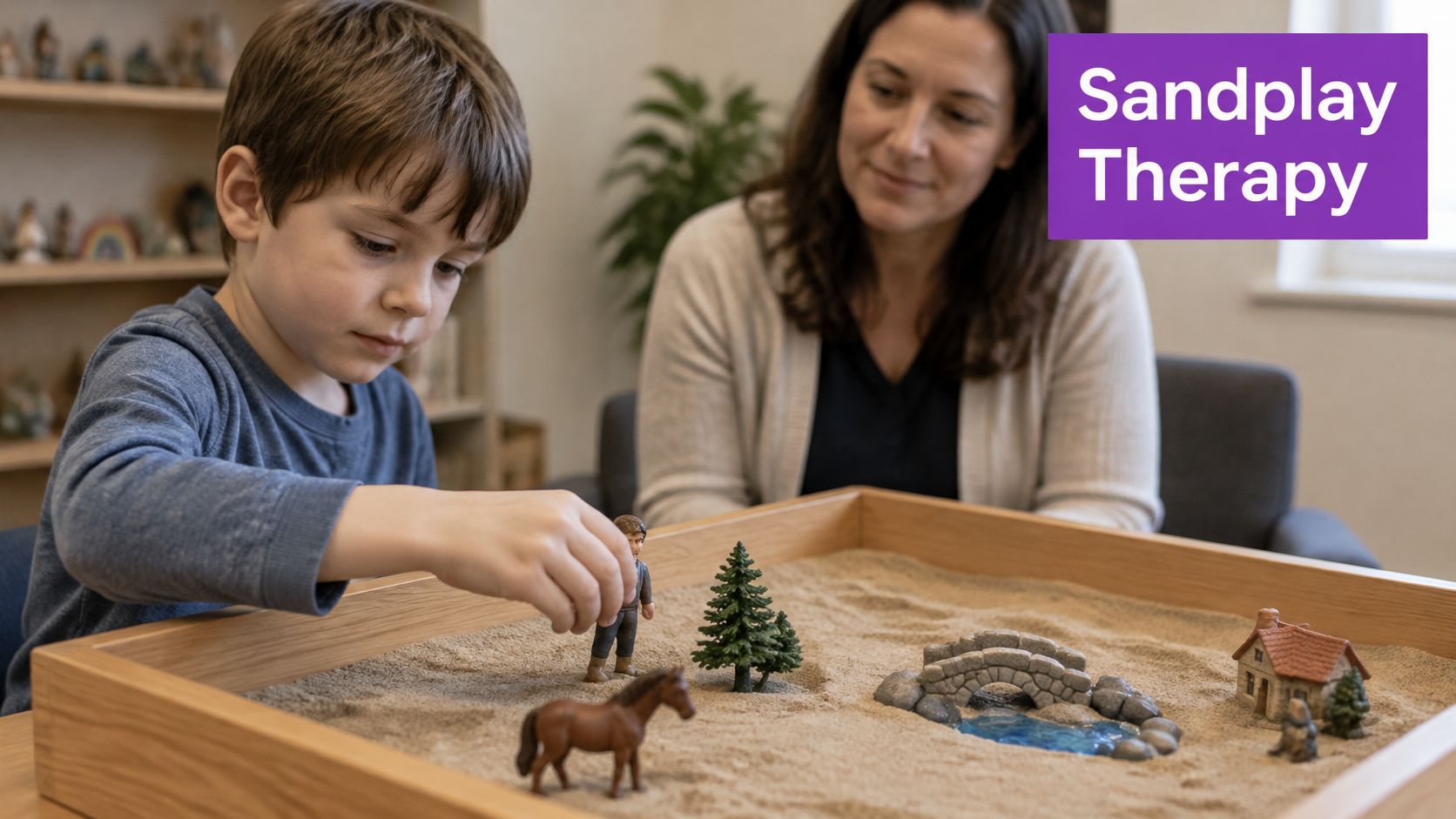
Sandplay and sand tray therapy aren't interchangeable labels. A clinician may use a sand tray within a directive treatment, asking a child to build a safe place or represent a difficult school day. Traditional sandplay follows a different theoretical framework and usually allows more freedom.
Useful expression, not a diagnostic shortcut
This approach may appeal to children who prefer visual or tactile expression and find face-to-face conversation demanding. Adolescents and adults may also prefer creating a scene to answering direct questions about grief or other painful experiences.
It's less suitable when the child dislikes sand, finds the miniatures inaccessible, or feels pressured to produce a meaningful scene. Alternative materials should remain available.
Interpretation boundary: A soldier, fence, or isolated figure doesn't prove trauma, aggression, or loneliness. Meaning belongs to the person creating the scene.
Say a grieving child repeatedly creates scenes with separated figures. The therapist can remain curious about the child's experience without announcing what separation must mean.
Progress should include everyday functioning, not just changing scenes. A more open arrangement may invite discussion, but it doesn't independently establish that anxiety or grief has improved. Parents should receive an understandable account of treatment goals without having every private image decoded.
6. Cognitive Behavioral Play Therapy (CBPT)
CBPT is therapist-guided play with a clear learning target. Puppets, drawings, stories, and games help children connect thoughts, feelings, body sensations, and actions, then rehearse a more useful response.
The difference from directive play therapy is the specific cognitive-behavioral framework. A game isn't included only to practice cooperation; it may help a child notice an anxious prediction, test it safely, or build a step-by-step coping plan.
For example, a child worried about school separation draws a worry creature that predicts the caregiver won't return. The therapist helps the child identify that prediction, develop a more balanced response, and rehearse the school transition through role-play.
Practice matters more than positive slogans
CBPT can suit a child who enjoys concrete activities and benefits from explicit coaching. It's worth considering when worry, avoidance, or rigid interpretations are prominent, provided the clinician assesses the underlying concern.
- Name the skill: Use consistent language for noticing worry, checking a prediction, and choosing a coping action.
- Practice outside sessions: Rehearse during manageable situations, not only when the child is overwhelmed.
- Praise effort: Recognize approaching a difficult task and using support, rather than requiring perfect calm.
A systematic review of play therapy outcomes found that cognitive-behavioral and Adlerian approaches can reduce internalizing and externalizing problems, while findings for executive functioning and memory were inconsistent. That doesn't establish CBPT as the best choice for every diagnosis.
CBPT isn't about telling a child to think positively. It also shouldn't challenge realistic fears as though they're mistaken beliefs. When a child faces bullying, instability, or another ongoing threat, adults need to change the circumstances alongside helping the child cope.
7. Trauma-Focused Play Therapy
Safety comes before retelling. Trauma-focused play work uses developmentally appropriate activities to help a child regulate distress, express experiences, and regain a sense of agency without being pushed into disclosure.
The phrase describes an emphasis, not a single standardized treatment. Clinicians may integrate play into Trauma-Focused Cognitive Behavioral Therapy or other trauma treatment, but a session with toys isn't automatically a trauma-specific intervention.
Say a child repeatedly crashes toy cars after an accident. The therapist might notice rising distress, help the child pause, and practice grounding before deciding whether to continue. The purpose isn't to make the child reenact the event until an adult believes it has been processed.
What parents should expect
A clear plan addresses present safety, coping skills, caregiver support, and the conditions under which trauma material will be explored. Discussion of child trauma symptoms should include changes in sleep, avoidance, mood, behavior, and daily functioning, not just what appears in play.
- At home: Keep routines predictable and respond calmly without repeatedly questioning the child about events.
- Across settings: Discuss whether coordination with the school, pediatrician, or other treating professionals is needed.
- When distress increases: Tell the clinician about worsening nightmares, shutdown, aggression, or avoidance so the plan can be reassessed.
Play therapy may be part of treatment rather than the whole treatment. Severe depression, significant functional decline, or safety concerns warrant broader assessment and potentially additional care.
A child who remains exposed to violence or abuse needs protection, not only emotional coping strategies. If there's immediate danger, seek emergency help rather than waiting for a scheduled therapy appointment. Trauma work also needs a clinician with relevant training, not enthusiasm alone for expressive activities.
8. Adlerian Play Therapy
A child who argues over every game rule may be trying to avoid feeling incapable, gain influence, or secure attention. Adlerian play therapy explores those possibilities without treating them as established facts.
Grounded in Alfred Adler's emphasis on belonging and significance, and developed into a practical play therapy framework by Terry Kottman, this approach combines relationship-building with purposeful guidance. The therapist observes play, considers the child's beliefs about themselves and others, and encourages more effective ways to connect.
Unlike strictly nondirective work, the clinician may move from following play to introducing an activity or rehearsing a different response. Parents may participate to understand patterns and change their own contributions to conflict.
Encouragement without excusing harm
Consider a child who disrupts class whenever classmates receive praise. The therapist might explore whether the child expects to be overlooked, then practice ways to seek involvement and contribute. The parent and teacher can reinforce participation without removing reasonable boundaries.
The useful question is what the child is trying to accomplish, not which negative label fits. That perspective can help with cooperation, discouragement, self-esteem, and recurring power struggles.
Encourage contribution and persistence. A child needs to experience belonging without having to win, perform perfectly, or control everyone else.
The trade-off is that a clinician can overinterpret behavior if they become too certain about a child's motives. Apparent defiance may also reflect pain, sensory overload, language differences, learning difficulty, or an unsafe environment.
Adlerian work should leave room for those explanations and for the child's own account. At home, offer meaningful choices within clear boundaries, acknowledge effort, and avoid treating every disagreement as manipulation. Family participation is useful when adults can practice the same respectful, consistent responses.
How the 8 Types of Play Therapy Compare at a Glance
| Item | Who Leads the Session | Typical Age Range | Best Suited For | Caregiver Role |
|---|---|---|---|---|
| Child-Centered Play Therapy (CCPT) | Child leads; therapist follows | Ages 3–12 | Children with anxiety, behavior concerns, grief, or low self-esteem | Offers support; typically does not direct play |
| Directive Play Therapy | Therapist guides activities toward specific goals | Ages 3–12 | Children who benefit from structure or targeted skill-building | Can reinforce session skills at home |
| Filial Therapy | Parent leads play sessions at home, with therapist coaching | Ages 3–12 | Families seeking stronger parent-child connection and active caregiver involvement | Conducts regular play sessions and practices skills |
| Theraplay | Therapist guides interactive play with child and caregiver | Infancy through adolescence | Children with attachment, self-regulation, or social connection challenges | Participates actively in sessions and practices activities at home |
| Sandplay Therapy | Client creates scenes; therapist observes and supports | Children, adolescents, and adults | People who find verbal expression difficult or want symbolic exploration | Observes themes, supports safety, and helps connect symbolic play to everyday feelings |
| Cognitive Behavioral Play Therapy (CBPT) | Therapist guides play-based CBT activities | Ages 3–12 | Children with anxiety, depression, OCD symptoms, or trauma reactions | Often joins parent sessions and reinforces skills at home |
| Trauma-Focused Play Therapy | Therapist guides play at a careful, child-paced pace | Ages 3–12 | Children coping with trauma who need safety and emotional regulation | Often participates and supports safety and stability at home |
| Adlerian Play Therapy | Therapist collaborates with and encourages the child | Ages 3–12 | Children with behavior, cooperation, social, or self-esteem challenges | Helps understand behavior and practice supportive responses |
Use the leadership column first. A child who shuts down under too many questions may do better with child-led work. A child who wants clear practice, such as naming feelings or trying a new response, may need more structure. That is the practical trade-off: too little direction can feel aimless for some children, while too much direction can reduce ownership for others.
Caregiver participation is another decision point. Filial therapy and Theraplay ask adults to become part of the work, which fits families willing to practice between sessions. CCPT usually keeps the parent supportive but less directive. Sandplay can give a child room to show inner thoughts through symbols when words are hard, and the caregiver role is more observational and supportive than instructional.
For concerns tied to thinking patterns, CBPT uses play to help children recognize and change negative thoughts. For trauma reactions, Trauma-Focused Play Therapy keeps the pace careful and child-paced, with safety and regulation guiding the work. Directive Play Therapy is useful when a specific behavior or emotional concern needs structured therapist guidance. Adlerian Play Therapy fits children whose behavior, cooperation, or self-esteem concerns improve through encouragement and supportive adult responses.
Matching the Approach to the Child and Next Steps for Your Family
Start with the concern, then consider how your child handles choice, adult guidance, and shared activity. A child caught in anxious predictions may benefit from CBPT; a child who needs safety and regulation after trauma may need trauma-focused treatment. When strengthening the caregiver bond is central, filial therapy or Theraplay may be worth discussing.
No single approach wins for every child. A review summarized by the National Library of Medicine found a statistically significant overall effect of d = 0.44 across 100 studies, but also reported limited study quality. Broad evidence of benefit doesn't make different models interchangeable or guarantee an individual result.
Make progress concrete
Discuss what improvement would look like outside the playroom: entering school with less distress, recovering from frustration, sleeping more comfortably, or asking for help. Agree on how caregiver updates, school observations when appropriate, and clinical measures will inform decisions about continuing or changing treatment.
Access and cultural fit belong in that conversation. A scoping review of play-based interventions for children with disabilities in low- and middle-income countries found that only 40% of studies described cultural or contextual adaptations. Familiar toys alone aren't enough; language, disability access, sensory preferences, family values, and caregiver participation need attention.
Online care also requires a practical assessment of privacy, available materials, and caregiver boundaries. If your child can't participate without being overheard or needs support that's difficult to provide remotely, discuss in-person care.
Find a reVIBE Location Near You!
We currently have five locations for your convenience. Call (480) 674-9220 to discuss provider matching and your family's needs.
- reVIBE Mental Health – Chandler: 3377 S Price Rd, Suite 105, Chandler, AZ
- reVIBE Mental Health – Phoenix Deer Valley: 2222 W Pinnacle Peak Rd, Suite 220, Phoenix, AZ
- reVIBE Mental Health – Phoenix PV: 4646 E Greenway Road, Suite 100, Phoenix, AZ
- reVIBE Mental Health – Scottsdale: 8700 E Via de Ventura, Suite 280, Scottsdale, AZ
- reVIBE Mental Health – Tempe: 3920 S Rural Rd, Suite 112, Tempe, AZ
Appointments are available seven days a week, with in-person and secure online sessions. When you call, describe the main concern, your child's communication style, and any sensory or accessibility needs rather than feeling you must choose a modality first.
The right starting point is an understandable plan that fits your child and family. You should know who leads, how you'll participate, what you're working toward, and when the clinician will reassess the approach.
At reVIBE Mental Health, we offer play therapy designed for children's emotional and behavioral needs, with caregiver collaboration to support progress beyond sessions. Visit us or call (480) 674-9220 to discuss your child's concerns and get matched with a provider who fits your family's goals.