About 1 in 10 bereaved adults develops grief that stays intense and impairing, rather than grief that gradually adapts. A 2017 systematic review and meta-analysis of 14 studies estimated a pooled prolonged grief disorder prevalence of 9.8% (95% confidence interval 6.8% to 14.0%). Higher mean age was tied to higher prevalence, so older adults after the loss of a spouse, family member, or close friend need particular attention. That figure is a clinical threshold, not a claim that ordinary grief is an illness. Most bereaved adults do not need therapy.
Grief counseling for adults is a way to sort adapting grief from grief that has stalled. Timing, daily functioning, and the kind of loss matter more than how sad a hard day feels.
Types of Grief That Counseling Can Address
A man in his late fifties loses his spouse in a sudden medical emergency. A year later he still cannot open her side of the closet, return to a full workweek, or accept dinner invitations. Friends call it "just grief." Suddenness, avoidance, and a collapsed routine place this closer to traumatic and prolonged grief than to ordinary adaptation. Six weeks out, still working, with crying that comes in shorter waves, the same loss would fit ordinary grief. Counseling then is optional support.
Grief behaves like weather after a storm. Some systems move through. Some stall over the same town. Naming which pattern you are in changes what help is for.
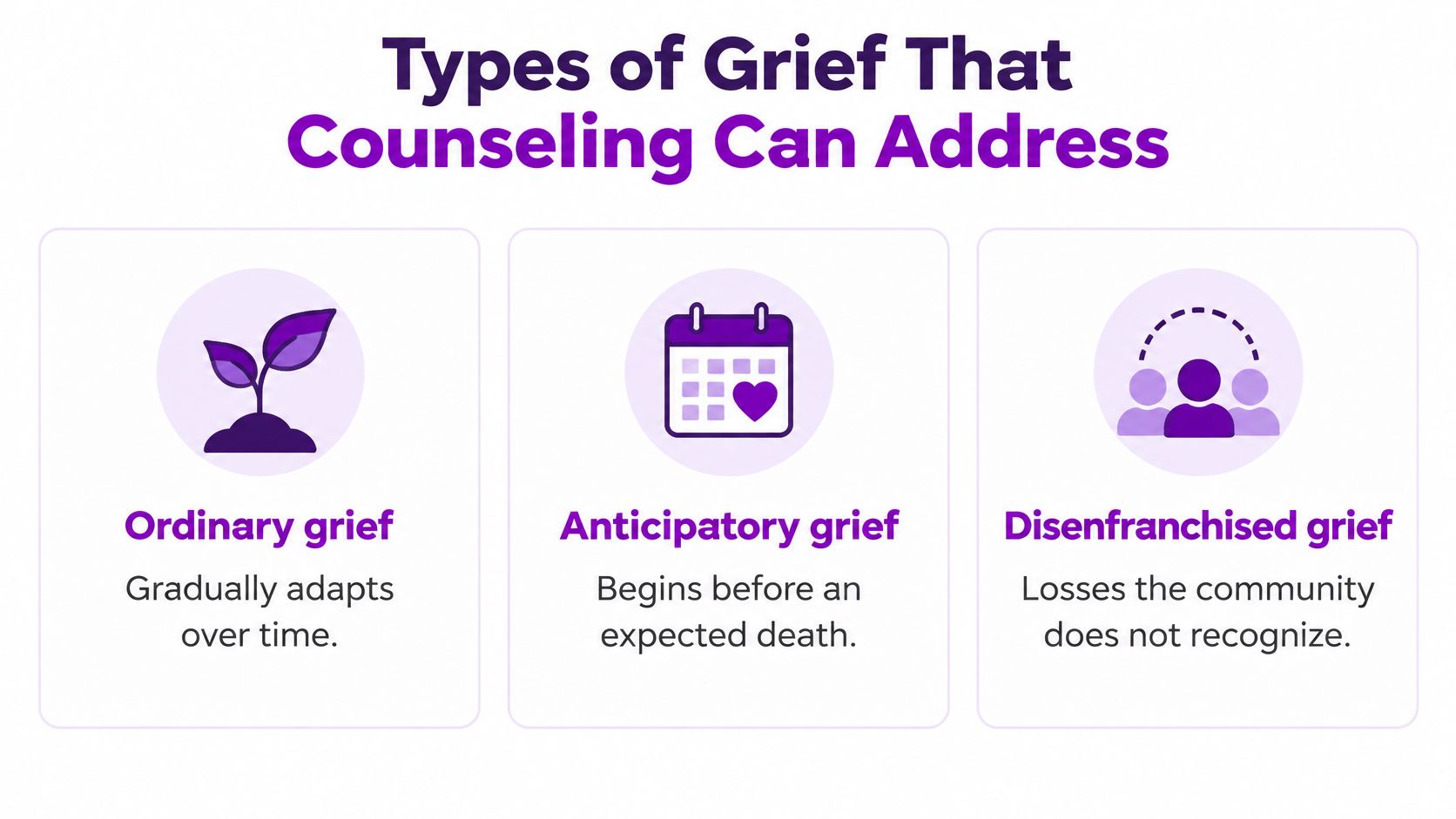
Ordinary grief is waves of yearning, sadness, and fatigue that gradually ease. Work, meals, and relationships return in imperfect form. This is the common path, and it does not require treatment.
Anticipatory grief begins before an expected death, during a long illness or hospice care. People often feel guilty for grieving someone who is still alive.
Disenfranchised grief is a loss the surrounding community does not treat as real. An ex-partner, a miscarriage, or a pet can hurt as much as a publicly mourned death, with less permission to say so.
Traumatic or sudden loss follows a crash, a suicide, or a death with no warning. Intrusive images and hypervigilance can sit beside yearning, and the picture overlaps with post-traumatic stress disorder (PTSD).
Prolonged grief is yearning and preoccupation that stay severe and block daily roles well past the period you, and your culture, would have expected.
Most bereaved adults adapt without therapy. Screening still matters because a minority do not. A 2025 systematic review reported prolonged-grief-disorder prevalence estimates of 9.8% to 34.3% in bereaved populations, with higher risk after traumatic or sudden losses. The wide span reflects different samples and definitions. It is a reason to look closely after a violent or unexpected death, not a prediction that you will become stuck.
Ordinary grief that is still moving does not need treatment. Counseling is for grief that has stopped you from living.
Before you book, write one sentence that names your category: ordinary, anticipatory, disenfranchised, traumatic, or prolonged. Then ask three questions. How long has it been, and has daily life stalled past what your culture treats as expected? Will this counselor take the loss seriously if others have not? If distance or a rural location makes an office hard to reach, can you meet by video or phone?
Telling Ordinary Grief From Prolonged Grief Disorder
Two manuals time the same grief with different clocks. One starts at six months. The other waits until a year. The gap is a diagnostic threshold, not a judgment that your grief is wrong.
The World Health Organization's ICD-11 describes prolonged grief disorder as persistent grief for an atypically long period, at least 6 months, with symptoms that clearly exceed culturally, socially, or religiously expected responses. The DSM-5-TR recognizes the disorder in adults only when the death occurred at least 12 months earlier.
Shared indicators include intense yearning or persistent preoccupation with the deceased, difficulty accepting the death, identity disruption, disbelief, emotional numbness, intense loneliness, emotional pain, avoidance of reminders, and trouble reintegrating into life. Symptoms must cause clinically significant distress or impairment in daily, social, occupational, or other important functioning, and the reaction must exceed what that person's culture expects. Early bereavement does not automatically call for intensive psychotherapy or antidepressants.
Grief after a death works like soreness after a fracture. Limited movement is expected while healing starts. Care becomes relevant when the limb stays unused long after that point, or when pain blocks sleep, work, and contact with other people. Loud grief can still be ordinary grief.
Time since death and what it means for counseling
| Time since death | Typical picture | What it means for counseling |
|---|---|---|
| Under 6 months | Acute grief with waves of yearning that gradually ease | Support first. Seek counseling if daily functioning collapses or safety concerns arise |
| 6 months to 12 months | Persistent, severe yearning or preoccupation beyond cultural norms | ICD-11 prolonged grief threshold met if impairment is present. Assess for depression and PTSD |
| 12 months or more | Persistent disabling grief symptoms with avoidance or difficulty reintegrating | DSM-5-TR criteria can be met. Grief-focused treatment is indicated |
Walk the row that matches your calendar, then test functioning. Under six months, practical help and a few trusted people are usually enough. Between six and twelve months, ask whether yearning is still severe and whether culture, faith, and family would still expect this level of shutdown. At twelve months or more, disabling symptoms can meet the adult DSM-5-TR time rule, and a structured plan is worth discussing.
Before you book, ask three concrete questions. Will this clinician treat your faith, family customs, and community mourning timeline as the baseline rather than a problem to correct? If you live far from a clinic, can sessions happen by secure video or phone as well as in an office? Will the first visit record months since the death, daily functioning, and safety before anyone suggests intensive therapy or medication?
A structured intake should record time since death, grief-specific symptoms, functioning, trauma exposure, mood and anxiety, medication history, and suicide or self-harm risk. When prolonged grief sits with depression or PTSD, both need a plan. Medication is sometimes discussed when mood or trauma symptoms are also severe. Later visits should track specific symptoms, not only a vague sense of feeling a bit better.
A short self-check
- Belongings: A year later, do you still avoid the person's clothes, chair, or route home?
- People: Have you stopped seeing friends, or do you leave every gathering early because it feels unbearable?
- Roles: Are work, parenting, or basic meals still failing most days?
- Meaning: Does life feel permanently emptied, not just painfully changed?
- Safety: Are you drinking to sleep, or having thoughts of not wanting to be here?
Practical rule: Persistent impairment, not the calendar alone, is the signal to seek counseling.
A hard anniversary can hurt and still be ordinary grief. A life you cannot re-enter is the clearer reason to seek care.
Grief Counseling Approaches Compared
Four approaches show up most often. Match them to symptoms, not to a brand name.
| Approach | Best suited for | Core method | Format |
|---|---|---|---|
| Grief-focused CBT (GF-CBT) | Persistent yearning, avoidance, guilt or self-blame | Cognitive restructuring, gradual return to avoided activities and reminders, processing death-related memories | Individual or group, in person or online |
| Complicated grief therapy (CGT) | Prolonged grief disorder with impaired daily life | Structured work on the loss story, reconnecting with life and relationships, and rebuilding meaning | Individual, structured sessions |
| EMDR | Grief linked to traumatic or sudden death, intrusive images | Bilateral stimulation while recalling distressing memories of the loss | Individual, in person or online |
| Supportive counseling | Early or ordinary grief that is gradually adapting | Empathic listening, coping support and normalizing reactions | Individual or group |
A systematic review and meta-analysis of psychological interventions for bereaved adults included 31 randomized controlled trials. The pooled effect on grief symptoms was significant right after treatment (Hedges' g = 0.41 across all 31 trials) and still significant at follow-up (g = 0.45 across 18 trials). Counseling for persistent grief is an evidence-based option, not only a place to talk. The review looked at psychological care, not medication alone.
How symptoms point to a method
Persistent yearning, avoidance, and guilt point toward grief-focused CBT or complicated grief therapy. Intrusive images after a sudden or violent death point toward EMDR, which you can read about in our overview of EMDR therapy for grief. Depression, crushed sleep, or inability to function point toward combined care, with psychiatric review when symptoms are severe. Supportive counseling fits early grief that is already easing. It is a weak match for grief that has been impairing for a year.
Clinicians often combine methods after assessment, not before it. At reVIBE Mental Health, therapy types include Accelerated Resolution Therapy, Acceptance and Commitment Therapy, CBT, couples work, DBT, EMDR, family, group, and individual therapy, Internal Family Systems, medication management, and sand tray therapy, among others. Sand tray and family sessions can matter when words are thin or the loss reorganized a household.
Take the symptom list and the timing row you already chose. Find the single table row that fits. That row is what you ask about when you call.
What Happens in Your First Grief Counseling Sessions
Sessions can be in person or by secure video or phone. The sequence is similar either way. Knowing the order keeps the first hour from feeling like an interrogation.
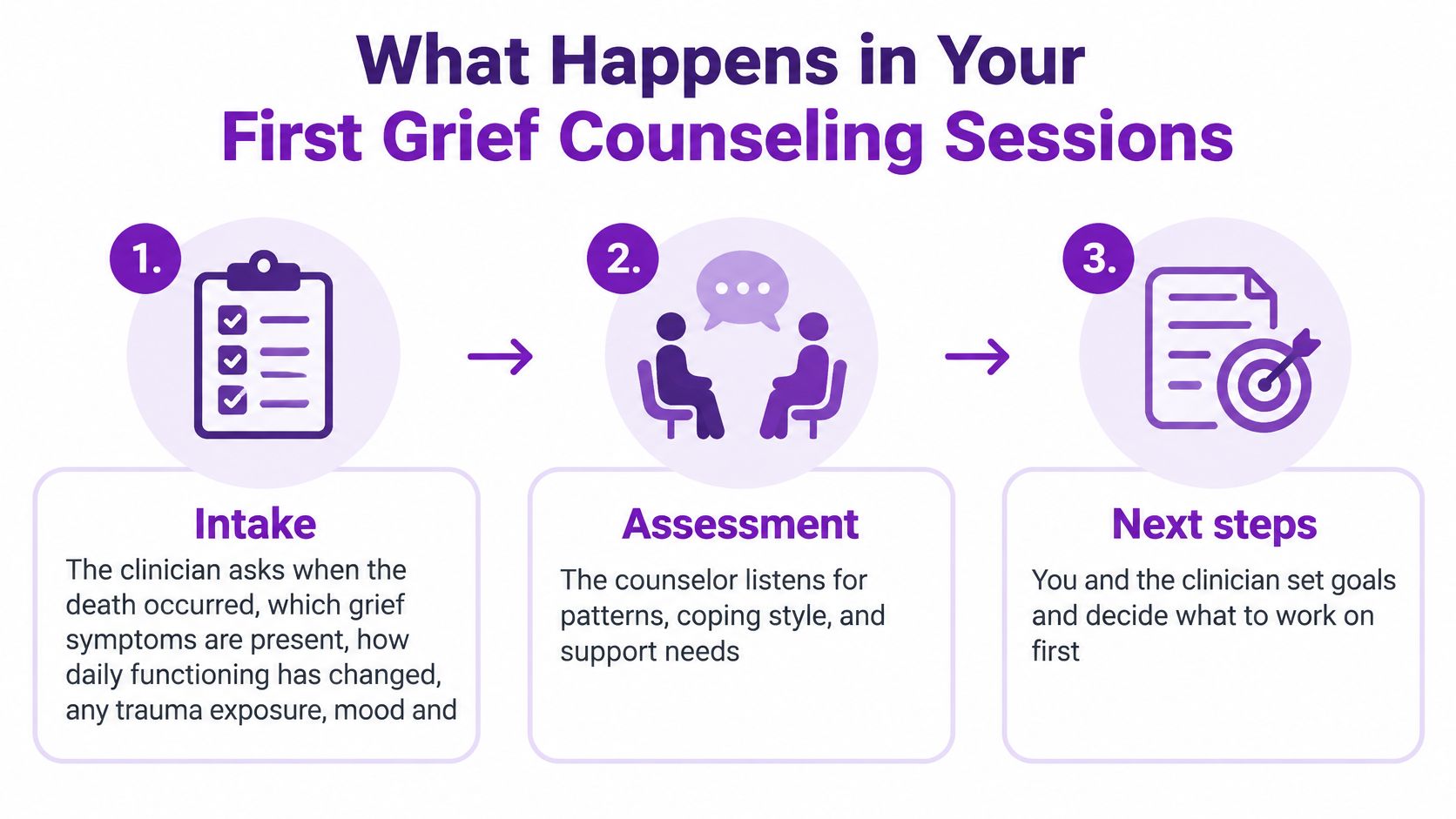
- Intake. The clinician asks when the death occurred, which grief symptoms are present, how daily functioning changed, any trauma exposure, mood and sleep, medication history, and current safety. Many people feel relief at being asked directly, and also a lump in the throat.
- Baseline measures. Short standardized questionnaires for grief, depression, and PTSD set a starting score. You may feel oddly clinical filling in boxes about someone you love. Those scores are how later change gets seen.
- Goal setting. You name two or three concrete goals, such as returning to work three days a week, sleeping through the night, or visiting the grave without panic. Vague goals like "feel normal" are hard to steer by.
- Treatment plan. The clinician recommends an approach from the comparison you just read and explains why. You should leave knowing the method, not only the appointment time.
- Middle sessions. The work follows that method, with check-ins on the same measures. Recounting the death can leave you tired for the rest of the day. Plan a quiet evening after those sessions.
- Review and closing. Scores are compared with baseline. If impairment is still high, the plan changes. If goals are met, sessions space out. Ending is a decision, not a disappearance.
You do not have to tell the whole story in hour one. Say what you can. A good intake leaves room for the rest.
How Grief-Focused Therapy Changes Avoidance and Distress

Grief that is never approached stays as loud as the first week, the way a sore muscle stiffens when it is never moved. A widow who will not open her late husband's side of the closet is not "being strong." She is protecting herself from a spike of panic, and the protection keeps the spike intact.
What the work actually does
Cognitive restructuring takes a belief such as "I should have been there" and tests it against what was possible that day. The goal is a fairer sentence, not a cheerful one. Gradual engagement means planned contact with avoided reminders. She might open one drawer a week, then sort a shelf, until the closet no longer triggers panic. Restoring routines and relationships puts meals, work, and one friend back on the calendar. Continuing bonds can include talking to the deceased or keeping a small ritual. Treatment is not training you to forget.
Some adults also need structured contact with the story and memories of the death. In a randomized trial, adults who received group CBT plus four individual exposure sessions, focused on the story and memories of the death, had greater reductions in grief and depressive symptoms, fewer negative appraisals, and better functioning than adults who received group CBT plus four supportive-counseling sessions.
A meta-analysis of 22 studies involving 2,602 bereaved adults found a medium post-treatment effect on prolonged grief symptoms (Hedges g = 0.65) and a large effect at follow-up (g = 0.90). The same analysis found post-treatment effects on PTSD (g = 0.74), depression (g = 0.53), and anxiety (g = 0.35). Inconsistency in the evidence means these numbers should be read as a typical range of benefit, not a guarantee for every person. In a separate trial within that review, both grief-focused CBT and mindfulness-based cognitive therapy reduced grief, and grief-focused CBT produced a larger drop six months later (mean PG-13 difference 7.1 points).
If impairment is still high after a full course, the next step is reassessment for PTSD, major depression, or safety concerns. More of the same supportive conversation is not the automatic answer. Our team treats anxiety, depression, trauma, and grief, and can add EMDR, psychiatry, or medication management when those problems travel with the loss.
Coping Strategies You Can Use Between Sessions
These are supports, not a substitute for care when grief has stopped your life. Start with the ones that take the least effort.
- Keep a steady sleep and meal schedule. Exhaustion turns ordinary sadness into something that feels unmanageable.
- Set a daily or weekly window for remembering. A planned twenty minutes keeps reminders from ambushing you at your desk.
- Write letters or keep a memory journal. Put on paper what you would have said. You do not have to show it to anyone.
- Plan anniversaries and holidays in advance, with a clear exit. Decide the dish, the guest list, and the hour you may leave.
- Accept one small social invitation a week. A walk counts. A party does not have to.
- Join a grief support group if peers who know this loss would help. Group therapy brings people with similar challenges together under a therapist's guidance.
- Limit alcohol and sedatives. They can deepen low mood and wreck the sleep you are trying to protect.
For a death the people around you may minimize, outside resources help. If you are mourning an animal, you can find support after losing a pet through Heartstrings Pet Hospice and In-Home Euthanasia, alongside any counseling you choose. More day-to-day ideas sit in our guide to ways to cope with grief.
When self-care is not enough
A clinical review of bereavement interventions found only a small immediate benefit for people who did not necessarily meet prolonged-grief criteria (mean effect size 0.16), and no significant benefit at follow-up. The same evidence base reports moderate support for grief-focused CBT over other psychotherapies when prolonged grief disorder is present. Early support can steady you. Persistent, impairing grief needs a structured plan.
Get urgent help if there is no improvement after several months, you cannot work or care for children, drinking has become heavy, or you have any thoughts of harming yourself. In the United States, call or text 988 for the Suicide and Crisis Lifeline, or local emergency services if you are in immediate danger.
Log which strategies you try for two weeks. Bring that record to a clinician so the session starts from what you already tested.
Choose a Provider and Book Your First Session
A warm first hello is a poor test of fit. Fit shows up in whether the clinician can match the plan to how long grief has lasted and how much it still blocks work, sleep, or relationships. Ordinary grief after a death often eases with time, routine, and people who stay close. It does not automatically need treatment. Counseling earns its place when distress stays high, avoidance takes over daily life, or you cannot tell whether what you feel is expected mourning or something that needs a structured plan.
The booking call works like a locksmith's key. Each question has to turn, or the door stays shut.
Ask about timing and severity in plain language. How long have these symptoms been this intense? Do they still stop you from working, sleeping, or staying in relationships? Will the clinician separate ordinary grief from a disorder, and refuse to rush you to “move on”? What method fits that picture: grief-focused CBT, complicated grief therapy, EMDR, or supportive care? If depression or sleep loss is severe, is psychiatric support and medication management part of the same plan? reVIBE Mental Health clinicians are trained for anxiety, depression, trauma, grief, PTSD, and related conditions, and medication management is available when it belongs in the plan.
Measurement belongs in that same conversation. Scores over time beat an impression that you “seem better.” Ask how long a typical grief-focused course runs, how progress will be measured, and whether insurance or self-pay is confirmed before the first visit.
Culture and distance are booking questions, not afterthoughts. A 2025 mixed-methods study identified cultural sensitivity, diversity, and underserved populations as major gaps in bereavement support. Participants also said counseling and grief events were scarce in remote areas, where people may depend on statewide virtual services.
Ask three access questions out loud. Can family or community members join when grief is shared, even if the session is yours? Is a clinician available who understands your language, faith, cultural background, or immigration history? How does the practice handle grief tied to migration, racism, violence, or a death the surrounding community does not recognize?
For adults who cannot find culturally responsive local care, video or phone sessions from home are a practical route. Online care should still fit language, family decision-making, faith, disability access, and privacy. A clinician who can screen for prolonged grief, depression, trauma, and suicide risk offers a different service from a generic self-guided app.
Find a reVIBE Location Near You!
We currently have five locations for your convenience. (480) 674-9220
reVIBE Mental Health – Chandler
3377 S Price Rd, Suite 105, Chandler, AZ
reVIBE Mental Health – Phoenix Deer Valley
2222 W Pinnacle Peak Rd, Suite 220, Phoenix, AZ
reVIBE Mental Health – Phoenix PV
4646 E Greenway Road, Suite 100, Phoenix, AZ
reVIBE Mental Health – Scottsdale
8700 E Via de Ventura, Suite 280, Scottsdale, AZ
reVIBE Mental Health – Tempe
3920 S Rural Rd, Suite 112, Tempe, AZ
We offer therapy in person or online, including grief among the concerns our clinicians treat. After the first sessions, use our free guide, 5 Ways to Know You've Found a Good Match with Your Therapist, to judge whether the fit is real. Call (480) 674-9220 or book online, and bring the symptom list and the timing notes you wrote while reading this.
reVIBE Mental Health provides grief counseling for adults in the Phoenix area and by secure video or phone, including CBT, EMDR for traumatic loss, and psychiatry when depression or trauma needs more than talk therapy. If your grief is still blocking work, sleep, or relationships, bring your notes and talk with a clinician who will match the plan to the severity. Visit reVIBE Mental Health to choose a location or request an appointment.