Do you need to be on the verge of breaking up before couples therapy makes sense? No. If you're wondering how to know if you need couples therapy, look at the patterns you can't change together, not just how dramatic your arguments become. Many couples wait too long because they mistake a tolerable problem for one they should keep tolerating.
Therapy Is Not Only for Relationships in Crisis
The crisis-only assumption is simple: couples counseling is for affairs, constant fighting, or a relationship about to end. That's too narrow. You can care about each other and still need help with the way you share responsibilities, handle differences, or respond to hurt.
Unequal household labor, recurring misunderstandings, sexual difficulties, and parenting disagreements all deserve attention. So does uncertainty about staying together. A relationship doesn't have to look troubled from the outside for someone inside it to feel lonely or exhausted.

A review in the Journal of Family Therapy reports that evidence-based couples therapy helps approximately 60–80% of distressed couples, while about half maintain treatment gains two years later. Those findings support seeking meaningful help, but they don't promise a particular outcome for your relationship.
Therapy can also provide structure when both partners want help making a decision, rather than automatically committing to saving the relationship. Staying together isn't the only question worth exploring thoughtfully.
A useful threshold: You don't both have to agree that the relationship is struggling for one person's distress to deserve attention.
If you feel unheard while your partner thinks everything is fine, that difference is itself worth discussing. When a pattern has lasted months and either of you feels stuck, looking into support is reasonable.
Warning Signs and How Urgent Each One Is
Start with the pattern that shows up most often in your relationship. Then consider its impact: does it leave you disappointed, prevent important decisions, or make you afraid?
The timing below is a practical recommendation, not a validated diagnostic cutoff. Don't wait for a calendar milestone when a problem is already causing significant distress.
Relationship signs and suggested response
| Sign | Typical duration to act on | Suggested next step |
|---|---|---|
| Same argument repeats without resolution | 2+ months | Book one consultation |
| One partner withdraws from talks | 1–2 months | Raise it and suggest a single session |
| Roommate-like distance with little affection | 3+ months | Start a skills-based session |
| Persistent resentment over chores or money | 2+ months | Schedule therapy soon |
| Contempt, sarcasm or eye-rolling in arguments | Any duration | Seek help promptly |
| Infidelity or broken trust | Any duration | Confirm safety, then joint sessions with a trained therapist |
| Disagreement about children or family roles | 1+ months | Consider family-focused couples work |
| Unresolved sexual difficulties | 2+ months | Seek a therapist who addresses intimacy |
| Feeling unheard by partner | 2+ months | Begin individually or as a couple |
| Fights that escalate to threats or fear | Any duration | Prioritize a safety assessment first |
Read urgency before counting signs
A single sign isn't a verdict on your relationship. As a practical rule, though, two or more patterns persisting for several months justify a conversation about counseling. Threats and fear override that rule completely.
Notice what happens after conflict, too. Can you return to the subject, understand each other better, and follow through on an agreement? Or do you apologize, avoid the topic, and repeat the same exchange?
Say you agree to divide household tasks, but one person still has to notice, assign, and remind. The problem isn't solved just because you stopped arguing about it. Therapy can help turn a vague agreement into clear responsibilities and accountability.
Another useful decision rule: if you've tried to change the same pattern three or four times without meaningful improvement, get support. You don't need another failed attempt to prove you've tried hard enough.
Check Safety Before Choosing Joint Sessions
Fear, coercive control, and violence change the recommendation. They aren't just more intense communication problems. Standard joint counseling can be unsafe when one partner controls what the other can say or do.
GoodTherapy's guidance on getting help for domestic violence explains that traditional couples therapy may be ineffective or harmful when abuse is present. Disclosures can become material for retaliation, and a person who fears consequences can't participate freely.
Use a safety-first sequence
- Seek a private assessment. Speak individually with a therapist about threats, intimidation, stalking, forced sex, financial control, or fear of your partner. Use a device and setting you can access safely.
- Build a safety plan. With confidential professional support, identify an emergency contact, a safe place to go, and ways to obtain help. For online care, discuss privacy and what to do if someone interrupts or an argument escalates.
- Pause joint work when free participation isn't possible. Each person must be able to disagree, decline treatment, and speak without punishment afterward. An agreement to attend doesn't establish safety.
- Use specialized domestic-violence support. An advocate can help assess risks and options without requiring you to confront your partner or make an immediate relationship decision.
If separation is being considered, the same concern extends beyond therapy. The Law Office of John P. Sherman, PLLC explains power imbalances that undermine mediation, a useful resource for understanding why a joint process isn't automatically a fair process.
Focus on behavior, not a label
You don't need to diagnose your partner to describe what's happening. If you're considering couples therapy with a narcissistic partner, begin by identifying specific behaviors and whether you can safely set boundaries.
Specialized clinicians may consider violence-focused joint treatment in selected circumstances, but that's not a decision to make from a checklist. Couples therapy never replaces emergency services or individual advocacy. If danger is immediate, contact local emergency services when it's safe to do so.
Any fear of your partner is a reason to start individually.
What Research Says Couples Therapy Can Change
Couples therapy aims to improve communication, resolve conflicts, and strengthen connection. Useful progress is concrete: you can discuss a difficult subject without humiliating each other, make workable agreements, and respond differently when familiar tensions return.
A systematic review and meta-analysis of interventions for marital distress found a statistically significant overall benefit, Cohen's d = 0.85, 95% confidence interval 0.56–1.14, P < 0.001, alongside improvements in communication, relational functioning, relationship satisfaction, depression, and anxiety. These are group-level findings, not a forecast for an individual couple.
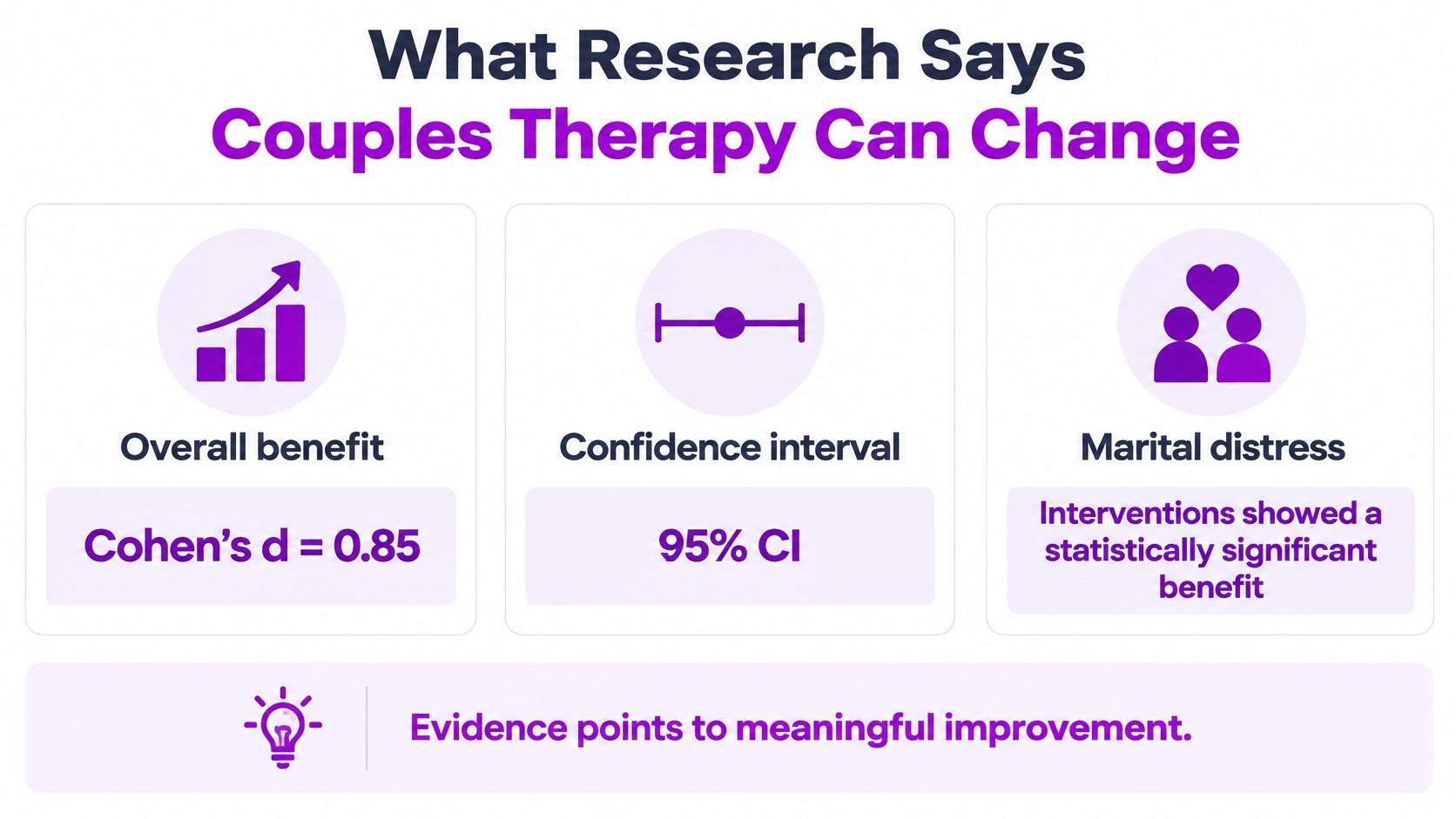
A randomized controlled trial's review of prior evidence reports effect sizes of d = 0.56–0.82 compared with control conditions and notes that Integrative Behavioral Couple Therapy remained effective for up to five years in one follow-up study. Cohen's d describes the size of a difference between groups; these findings indicate moderate-to-large improvements, not a percentage of couples cured.
Define improvement in everyday terms
Ask what you'd notice outside the therapy room. Perhaps you'd stop avoiding money conversations, feel comfortable asking for affection, or make parenting decisions without undermining each other.
Our overview of couples counseling benefits can help you translate broad hopes into goals. At reVIBE Mental Health, our couples therapy supports partners navigating infidelity, trust issues, or major life changes, as well as those seeking premarital counseling or long-term relationship guidance.
Don't wait until separation feels inevitable to test whether help is useful. Both partners' engagement matters, especially their willingness to practice different responses. A consultation lets you explore that willingness without committing to an entire course of treatment.
Matching Couples Approaches to Your Goals
Choose an approach that fits what you want to change, rather than selecting a method because its name sounds familiar. Partners who need practical conflict skills may want a different emphasis from partners who struggle to feel emotionally close.

Couples therapy approaches compared
| Approach | Core focus | Best fit |
|---|---|---|
| Gottman Method | Friendship, conflict management, shared meaning | Couples wanting structured skill-building |
| Emotionally Focused Therapy | Negative cycles and emotional bonding | Couples stuck in pursue-withdraw patterns |
| Integrative Behavioral Couple Therapy | Emotional acceptance and communication | High-conflict couples |
| Premarital or transition counseling | Expectations and planning | Engaged, newly married or changing-life couples |
Match the work to the problem
Gottman Method work emphasizes building friendship, managing conflict, and creating shared meaning. A useful goal might be handling disagreements respectfully while making more deliberate time for connection.
Emotionally Focused Therapy, or EFT, helps partners identify negative cycles and create lasting emotional bonds. For example, one person may press for reassurance while the other retreats, leaving both feeling rejected. The aim is to change that interaction, not decide which partner has the more acceptable emotional needs.
Integrative Behavioral Couple Therapy, or IBCT, combines acceptance with change. The Department of Veterans Affairs' relationship health guidance describes emotional acceptance, communication, and secure emotional connection as central goals, including for high-conflict relationships.
Premarital and transition counseling describe the purpose of treatment rather than a single method. The work might involve expectations about money, caregiving, family boundaries, or parenting before those differences become entrenched.
Consider fit and access together
Our therapists have diverse training, including Gottman Method and EFT training, and individual styles. Comparing types of relationship therapy can help you prepare questions about which approach fits your goals and how progress will be assessed.
In-person appointments provide a separate setting for difficult conversations. Secure telehealth removes the commute, but you still need privacy, reliable technology, and protected time. Choose the format you can attend consistently and participate in safely.
What to Expect and How to Choose a Therapist
Early sessions generally involve gathering each partner's perspective, discussing relationship history, assessing safety, and agreeing on goals. Ask how the therapist handles private information before disclosing something individually that you expect them to keep from your partner.
The therapist should help you put complicated experiences into words and practice listening without immediately defending yourself. They're a facilitator, not a judge deciding who wins. They should still address harmful behavior directly rather than treating every action as equally acceptable.
Vet the clinician and the process
- Confirm credentials and couples training. Check that the clinician holds a current license appropriate to your state and has specific preparation for relationship work.
- Clarify financial arrangements. Our team can help with insurance verification. You can also ask your therapist about sliding scale fee options during the initial consultation.
- Ask about the method. Request a plain-language explanation of how sessions will address your concern and how you'll review progress.
- Understand individual-session policies. Ask whether separate meetings are part of the process and how confidentiality works.
- Check safety procedures. Find out how the clinician screens for abuse before joint work and responds if either partner feels unsafe.
Between appointments, a therapist may suggest a structured conversation, a written agreement, or practice making a specific request. An assignment should be clear enough that you know what to try and what to report back.
A good fit doesn't mean you're never challenged. It means you understand the purpose of the challenge and feel able to respond honestly.
Use the consultation to assess whether both perspectives receive careful attention. Treat snap judgments or taking sides before understanding the situation as warning signs. That's different from a therapist setting firm limits around intimidation or abuse.
Agree on a review point so treatment doesn't become an indefinite conversation without direction.
How to Start When Your Partner Is Reluctant
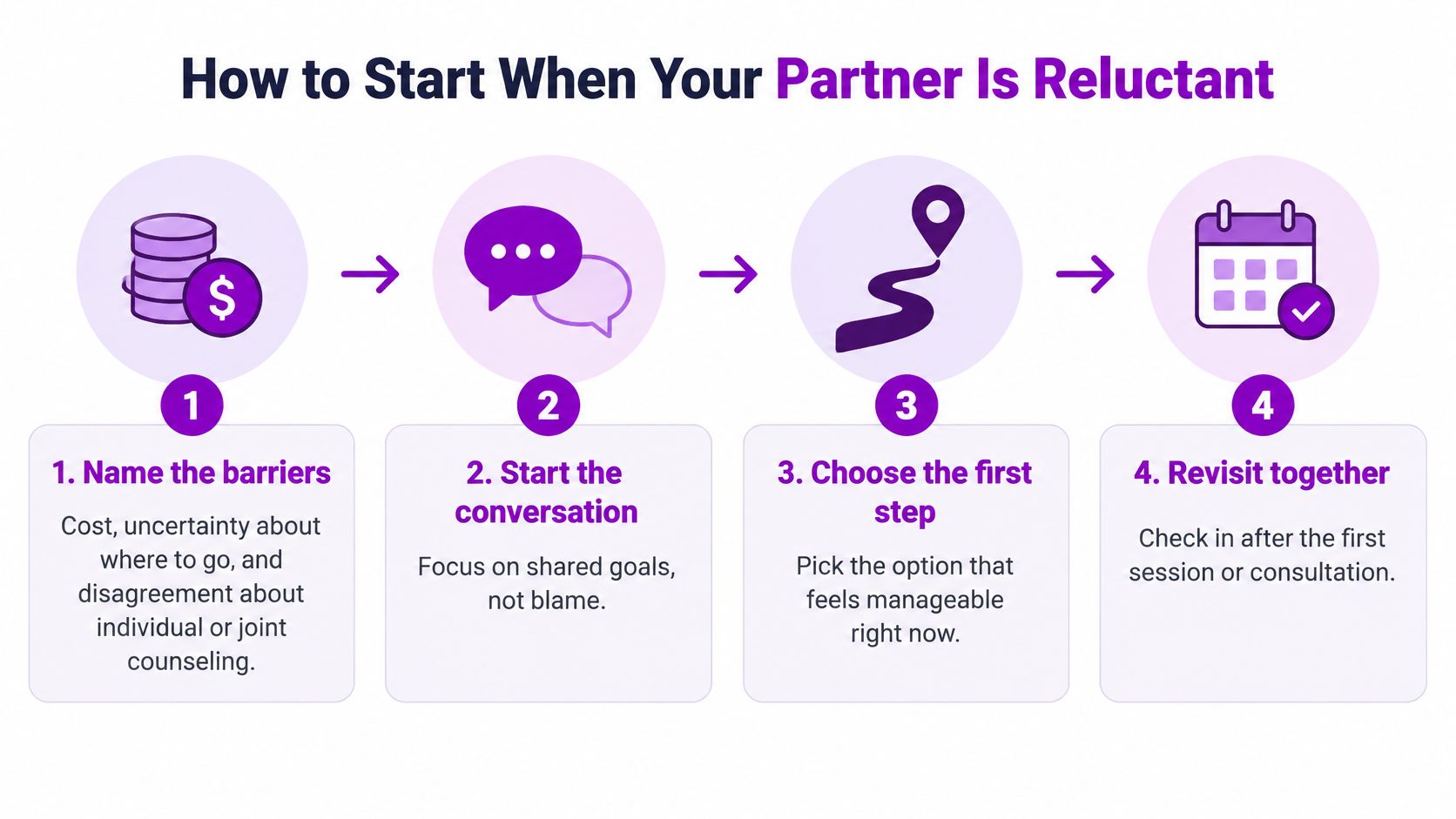
Cost, uncertainty about where to go, and disagreement about individual versus joint counseling can stop a conversation before it starts. Don't assume reluctance means your partner doesn't care. Ask what concerns them, and listen before offering a solution.
You might discover that they expect blame, worry about affordability, or don't understand what would happen in the room. Respond to the actual concern rather than giving a speech about why therapy is good.
Make the invitation manageable
- Name one pattern. Focus on a shared difficulty rather than presenting a case against your partner. For example: I've noticed we keep ending up in the same argument about money, and I feel stuck. Would you try one session with me to see if it helps?
- Ask what would make participation feel safer. They might want a clear goal, an explanation of the process, or agreement that a trial appointment isn't a long-term commitment. Don't promise the therapist will agree with either of you.
- Keep individual support available. You can begin alone to clarify goals, practice boundaries, and decide what you want to do. If anxiety, depression, trauma, or substance use is driving the conflict, individual treatment may also need its own attention.
- Set a proposed review point. Suggest checking in after three sessions to discuss whether you both feel heard and whether the work is useful. That's a shared planning choice, not a required treatment length.
State the change you want
Aim for a request such as being able to make a spending decision without accusations, rather than making your partner admit they're wrong. Our therapists have different specialties and styles, so fit is a legitimate concern to discuss.
One person's willingness can start the process. It can't guarantee the other person will join, and it shouldn't become a campaign to pressure them.
Decide and Book Your First Session
Make the decision practical: check safety first, identify persistent signs, use a concrete example with your partner, and book a consultation this week if joint work is appropriate. If it isn't safe, arrange confidential individual support instead.
Bring two or three specific examples and write down what each person hopes to change. Describe what happened, how you responded, and what you wish had gone differently. That gives the therapist something more useful than a list of grievances.
Find a reVIBE Location Near You!
We currently have five locations for your convenience, with in-person and secure online appointments. Our team can help with insurance verification before your first visit.
reVIBE Mental Health locations in Arizona
| Location | Address |
|---|---|
| reVIBE Mental Health – Chandler | 3377 S Price Rd, Suite 105, Chandler, AZ |
| reVIBE Mental Health – Phoenix Deer Valley | 2222 W Pinnacle Peak Rd, Suite 220, Phoenix, AZ |
| reVIBE Mental Health – Phoenix PV | 4646 E Greenway Road, Suite 100, Phoenix, AZ |
| reVIBE Mental Health – Scottsdale | 8700 E Via de Ventura, Suite 280, Scottsdale, AZ |
| reVIBE Mental Health – Tempe | 3920 S Rural Rd, Suite 112, Tempe, AZ |
Call (480) 674-9220 to discuss getting started, or choose the office closest to you. You don't need a complete explanation of what's wrong before reaching out, just a clear description of what isn't working.
Asking for help early is a sign of commitment, not failure.
reVIBE Mental Health offers individual, couples, and family therapy in person or online to help you address relationship difficulties and choose a workable next step. Visit reVIBE Mental Health or call (480) 674-9220 to explore a consultation, whether you're ready to attend together or need to begin on your own.