
A superbill for therapy is a detailed, coded receipt that lets you request out-of-network insurance reimbursement after paying for a session upfront. Psychotherapy billing is widespread, with 90,900,831 psychotherapy claims identified in a national study covering 2007 through 2017.
You may already know the frustration: you find a therapist who understands your needs, offers a specialized approach, or has an opening that fits your schedule, only to discover they aren't in your insurance network. The alternative may be settling for a provider who isn't the right fit or waiting while your symptoms continue to affect daily life.
A superbill can help close that gap. It doesn't guarantee payment, and it isn't the same as insurance coverage, but it gives your insurer the structured information needed to evaluate an out-of-network claim.
Understanding the Therapy Superbill
A regular payment receipt usually shows the provider, date, service description, and amount paid. A therapy superbill goes further. It identifies the clinical service with billing codes, connects that service to a diagnosis, and supplies the provider and patient information an insurer needs to review reimbursement eligibility.
The process usually looks like this:
- You choose an out-of-network therapist.
- You pay the therapist directly at the time of service.
- The therapist gives you a superbill.
- You submit that document to your insurance company.
- Your insurer reviews the claim under your out-of-network benefits.
The therapist generally isn't sending the claim directly because they don't have a direct billing relationship with your plan. You become responsible for submitting the documentation and tracking the insurer's response. A guide to self-employed therapy insurance help can also help you understand how coverage questions affect independent therapy arrangements.
Why a superbill can expand your choices
Insurance directories can be useful, but they may not include every clinician who could meet your needs. A provider might offer EMDR, trauma-focused therapy, couples counseling, child therapy, or another approach that isn't readily available through your network. In that situation, out-of-network care may give you more choice, provided your plan includes out-of-network behavioral health benefits.
The national psychotherapy claims study counted 73,209,596 adult visits, or 80.5%, and 17,691,235 child visits, or 19.5%, among the identified claims in its analysis of psychotherapy care. The volume of claims helps explain why insurers rely on standardized documentation rather than an informal receipt.
Practical rule: A superbill supports a claim, but your insurance plan decides whether the claim qualifies and how much it will reimburse.
Before scheduling, call the number on your insurance card. Ask whether your plan covers out-of-network psychotherapy, whether you must meet a deductible first, whether prior authorization is required, and whether the insurer has a specific claim form or submission process.
Essential Information on a Valid Superbill
A superbill must contain enough detail for an insurer to identify the provider, patient, service, diagnosis, and charge. Missing information can create delays, trigger a request for correction, or affect the amount the payer considers eligible.
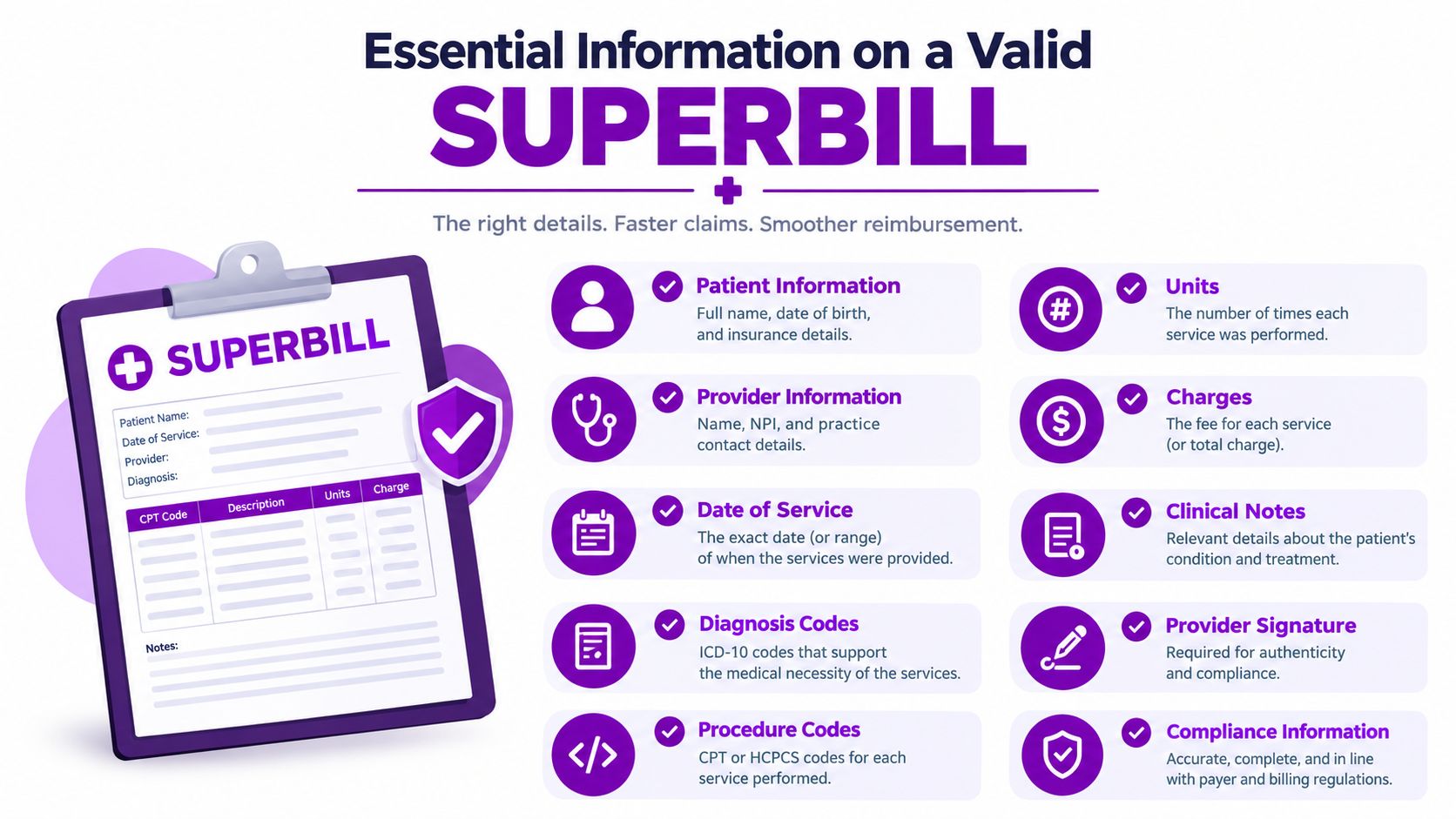
The provider and patient fields
Check that the document identifies the therapist by name and credentials and includes the provider's National Provider Identifier, or NPI, and tax identification number. The patient section should identify you accurately. The document also needs the date of service and the fee charged.
These details let the insurer connect the claim to the correct clinician and member record. A misspelled name, incorrect member information, or missing provider identifier can prevent the payer from matching the document to your account.
The clinical and billing codes
The Current Procedural Terminology, or CPT, code, describes the service provided. For example, CPT 90837 indicates a 53-minute individual psychotherapy session, while CPT 90847 indicates family or couples therapy with the client present. The code needs to match what occurred during the appointment.
The superbill also includes an ICD-10 diagnosis code. This code supplies the diagnosis information used to evaluate whether the service meets the plan's medical necessity requirements. It isn't a narrative of everything discussed in therapy. Instead, it gives the payer a standardized way to connect the service with the covered clinical condition.
Insurers may also use the place-of-service code and any applicable modifier when reviewing the claim. A mismatch, such as an incorrect place of service, missing modifier, or non-specific diagnosis, can delay processing or reduce the amount considered reimbursable.
You can compare a document from your therapist with the details discussed in reVIBE Mental Health's explanation of MultiPlan to become more familiar with insurance network terminology. If something looks wrong, contact the provider before submitting the claim.
Before you upload: Confirm the patient name, date of service, CPT code, ICD-10 code, provider NPI, tax ID, and fee. Fix errors before the insurer receives the document.
Why Patients Choose Out of Network Therapy
Out-of-network therapy requires more work from the patient, but network status isn't the only factor that matters. A therapist's clinical experience, treatment style, availability, location, and ability to work with a specific concern can influence whether care feels useful and sustainable.
Mental health care also has a distinct network pattern. Patients receiving outpatient psychotherapy or therapeutic psychiatric services were more likely to have out-of-network claims than patients overall, with KFF reporting that these claims occurred at more than triple the rate of patients overall in large employer health plans.
Cost is another part of the decision. The same analysis reports that out-of-network therapy can cost up to 174% more, depending on location. It also estimates a national price of $149 for one 60-minute out-of-network session compared with $84 in network. Your own plan may reimburse a different amount, especially if you haven't met the out-of-network deductible or if the insurer applies an allowed amount.
In-Network vs Out-of-Network Therapy
| Feature | In-Network Therapy | Out-of-Network Therapy with a Superbill |
|---|---|---|
| Provider payment | The insurer and provider usually handle claims directly | You typically pay the provider upfront |
| Claim administration | The provider commonly submits the claim | You submit the superbill and claim form |
| Provider choice | Limited to clinicians in the plan's network | May include providers outside the network |
| Upfront cost | You usually pay the plan's copay, coinsurance, or deductible amount | You pay the provider's stated fee before reimbursement |
| Reimbursement | Processed under in-network benefit rules | Processed under out-of-network benefit rules |
| Administrative effort | Usually lower for the patient | You must verify benefits, submit documents, and track the claim |
The financial trade-off becomes more manageable when you know your plan's rules in advance. Ask about the out-of-network deductible, reimbursement calculation, allowed amount, claim deadline, and whether the plan excludes certain services.
For another perspective on planning for care expenses, review reVIBE Mental Health's information about therapy session costs. The key question is not only whether a therapist is in or out of network. It is whether the provider's care, schedule, and expertise justify the cost you may carry before reimbursement.
How to Submit Your Superbill for Reimbursement
You find a therapist who fits your needs, but the provider is outside your insurance network. A superbill gives you a way to request reimbursement instead of limiting your search to in-network directories. You pay the provider, receive the document, and submit it with your insurer's out-of-network claim form, often by mail or through an online portal. This explanation of therapy superbills from GoodRx provides additional background.
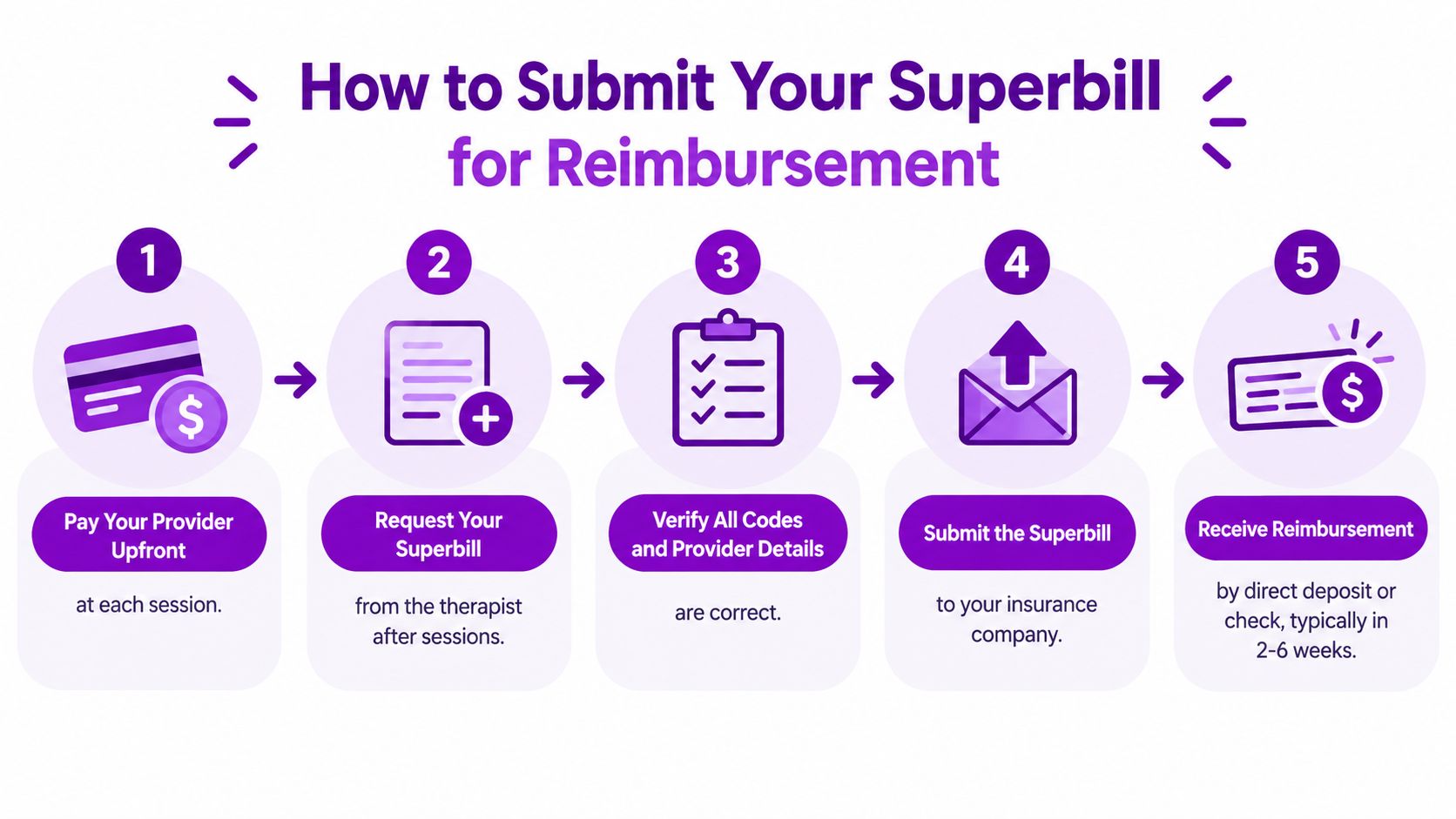
Follow a consistent claim workflow
1. Confirm your benefits before care begins. Call the member services number or check your insurance portal to verify out-of-network mental health coverage. Ask whether the deductible applies, whether prior authorization is required, how reimbursement is calculated, and whether the plan uses an allowed amount. reVIBE Mental Health's guide on how to verify insurance coverage explains how to check these details.
2. Pay the provider and request the document. After your session, request a superbill for that service. The practice may send it through a patient portal or provide a paper copy.
3. Review every field. Compare the document with your appointment records. Check your name, member information, date of service, provider identifiers, CPT code, ICD-10 code, and fee. Ask the therapist's billing team to correct any error before you submit the claim.
4. Complete the insurer's claim form. Your plan may provide a downloadable form, a portal upload option, or a mailing address. Attach the superbill and any requested records. Keep a copy of everything you send.
5. Save proof of submission. Store the superbill, claim form, payment confirmation, upload receipt, and insurer correspondence together. Record the submission date and claim reference number so you can follow up efficiently.
If the claim is delayed or denied
A delayed claim may need more information rather than a permanent rejection. Read the explanation of benefits and identify whether the problem concerns missing details, coding, eligibility, deductible status, or additional records. Contact member services to ask what correction or appeal process applies.
Keep your own file: Insurance portals can change, and mailed paperwork can disappear. A folder for each date of service makes follow-up easier.
Ask the provider whether a corrected superbill was sent and request written confirmation of changes. Track the issue yourself rather than assuming the therapist's office or insurer will resolve it automatically.
Getting Superbills at reVIBE Mental Health
Finding care often involves balancing clinical fit, geography, appointment availability, and insurance logistics. reVIBE Mental Health serves patients through an integrated team of therapists and licensed psychiatric professionals, with care that includes talk therapy, EMDR, psychiatry, and medication management. The practice offers in-person and secure online appointments, which can make it easier to consider a provider based on fit rather than directory proximity alone.
For a patient considering out-of-network care, the administrative conversation should happen before the first appointment. Ask how the practice handles insurance verification, whether it provides a superbill, which information appears on the document, and whether you will submit the claim yourself. Confirming those details early helps you understand the financial process alongside the clinical plan.

Five Arizona locations
You can contact the practice at (480) 674-9220 or look for a location that fits your routine:
- Chandler: 3377 S Price Rd, Suite 105, Chandler, AZ
- Phoenix Deer Valley: 2222 W Pinnacle Peak Rd, Suite 220, Phoenix, AZ
- Phoenix PV: 4646 E Greenway Road, Suite 100, Phoenix, AZ
- Scottsdale: 8700 E Via de Ventura, Suite 280, Scottsdale, AZ
- Tempe: 3920 S Rural Rd, Suite 112, Tempe, AZ
The team works with people experiencing anxiety, depression, trauma, grief, burnout, relationship concerns, family issues, eating disorders, and other mental health needs. A welcoming environment can matter when you're already spending energy deciding whether to begin treatment.
Insurance participation and reimbursement arrangements depend on the specific plan and service. Ask the office to verify your benefits, then call your insurer to confirm the information independently. That two-part check gives you a clearer picture of what the plan may pay and what you may owe before you commit to ongoing sessions.
Key Takeaways for Therapy Reimbursement
A superbill is a claim-ready receipt, not a promise that your insurance company will reimburse you. It gives the payer the structured information needed to assess an out-of-network therapy claim, while your plan's deductible, benefit rules, allowed amount, and coverage requirements determine the result.
Use this checklist before your first out-of-network appointment:
- Verify benefits: Ask whether out-of-network psychotherapy is covered and whether you need authorization or a referral.
- Understand the deductible: Find out whether you must pay the out-of-network deductible before reimbursement begins.
- Ask about the allowed amount: Your plan may calculate payment using its own eligible amount rather than the therapist's full fee.
- Confirm the submission method: Learn whether claims must be uploaded through a portal, mailed, or submitted with a particular form.
- Request the superbill promptly: Make sure it includes the provider's name, credentials, NPI, tax ID, patient information, date of service, CPT code, ICD-10 diagnosis code, and fee.
- Review before sending: Correct coding or identity errors with the provider before submission.
- Keep organized records: Save copies of every superbill, claim form, payment receipt, insurer message, and explanation of benefits.
- Follow up deliberately: If a claim is delayed or denied, ask the insurer for the reason and the next step in writing.
The practical value of a superbill is choice. It may let you consider a therapist whose specialty, approach, schedule, or location fits your needs, while still giving you a way to request reimbursement under your plan. Mental health care shouldn't be reduced to a directory search, but the financial details deserve careful attention.
reVIBE Mental Health offers therapy, EMDR, psychiatry, and medication management through in-person and secure online appointments across its Arizona locations. Visit reVIBE Mental Health to explore care options, request insurance verification, and ask how superbills may fit your out-of-network reimbursement process.