
The most repeated advice about how to find a couples therapist is to open your insurance directory, filter by zip code and specialty, and take the first clinician with a Tuesday opening. That advice fills a slot on a calendar. It doesn't produce a treatment decision.
Two people can spend an evening with three browser tabs open, weighing credentials and driving distances, and close the laptop with nothing booked. The directory told them plenty about licenses and almost nothing about the two questions that decide whether the next six months help: can this clinician hold the room evenly between both of us, and is meeting together even the right format?
A search that works ends with something more useful than a name. It ends with a shortlist you can defend, a script for the first call, a private safety check, and a clear rule for when to stop and choose a different path.
What a Good Search Actually Produces
A directory can help you find clinicians by license, format, and location. It cannot show whether a therapist can stay fair to both partners, whether joint sessions are safe, or whether the treatment plan fits your time and budget.
A useful search produces more than a list of names. It gives you a shortlist of clinicians who work with couples, questions for an initial conversation, a private safety check for each partner, and a clear reason to pause or change course if meeting together feels unsafe. The shortlist is a working decision, not a collection of bookmarks.
Couples may seek help with recurring arguments, infidelity, a decision about staying together, parenting disagreements, or a major life change. Others want premarital counseling or support for a relationship that is already strong. Couples therapy can help partners improve communication, resolve conflicts, and strengthen their bond.
Build the search around four decisions:
- Choose a few possible clinicians. A short list makes comparison manageable.
- Consider safety privately. Each partner should be able to raise concerns about fear, coercion, or violence without the other present.
- Look for a fair process. Ask how the therapist makes space for both partners and what happens when their accounts differ.
- Check practical fit. The plan needs to work with your schedule, budget, and preferred format.
Online sessions can make distance and scheduling easier, but the format should fit the couple and the work. The online counselling guide from Bornbir discusses remote counselling; ask any prospective therapist how video sessions work and whether they are suitable for your situation.
Before comparing names, put the main concern into one sentence both partners recognize. That sentence helps keep the search focused on what you want help changing.
How to Screen Candidates Before You Book
A directory can show a license, location, and whether a therapist offers video sessions. Those details help you build a shortlist, but they cannot tell you whether a therapist can stay fair to both partners or whether the approach, schedule, and cost will work for you.
The American Psychological Association's guidance on psychotherapy recommends checking a psychologist's license, training, therapeutic approach, insurance participation, and fees. It also suggests ways to find names, including referrals from health professionals, state psychological associations, university psychology departments, community mental-health centers, trusted people, and professional directories.
Treat those as starting checks. One focused week can be enough to compare two or three names and arrange a consultation.
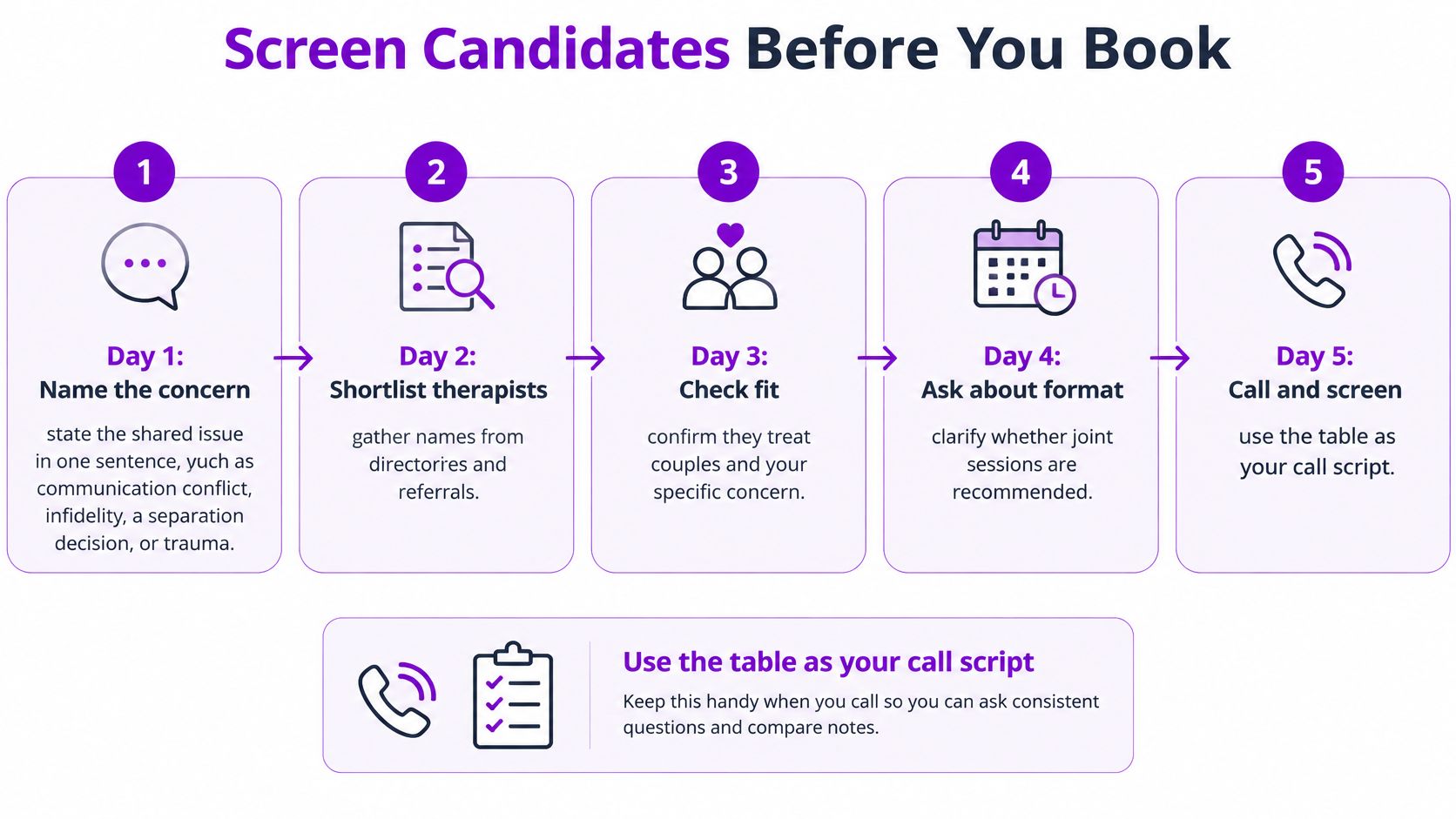
Six moves, in order
- Write down the shared concern. Use one sentence both partners recognize, such as recurring communication conflict, infidelity, a separation decision, or disagreements about parenting. This gives you a practical question to raise with each candidate.
- Choose two or three names. A small shortlist makes comparison manageable without turning the search into a stack of unanswered emails.
- Check the license where you'll attend. For telehealth, ask whether the therapist is licensed where you'll be located during sessions. A license confirms legal eligibility; it does not establish a good fit for your relationship.
- Ask how couples work is structured. Find out whether the therapist regularly sees couples, which approach they use, how often sessions happen, and how progress is reviewed. Ask how they handle information shared by one partner alone.
- Clarify fees and insurance. Ask about the session fee and whether the therapist participates in your plan before sharing a detailed history. Coverage can depend on plan rules and benefits.
- Book one consultation. Use the conversation to judge fit before making a longer commitment.
The questions worth saying out loud
Use the table as a call script. The answers should be specific enough that both partners understand what they are agreeing to.
| Check | Ask this | A pass sounds like |
|---|---|---|
| License | Are you licensed where we'll be seen, including telehealth? | A current license the couple can look up |
| Couples experience | Do you regularly treat couples, or mostly individuals? | A clear answer about their couples work |
| Approach and pace | Which approach do you use, and how often do couples meet? When do you review progress? | A named approach and a clear way to discuss progress |
| Both partners | Will both of us attend? How do you handle something one person shares alone? | A policy explained before intake |
| Between-session concerns | What should we do if a conflict escalates between sessions? | Clear guidance about what to do and whom to contact |
| Fees | What is the fee, and do you participate in our plan? | A direct answer before you share a long history |
Compare the answers, not just the credentials. A therapist who explains their approach and policies clearly gives you something concrete to evaluate; vague answers leave basic expectations unsettled.
Psychotherapy outcome figures describe broad groups, not the likely course for one couple. Use general outcome information as context, not as a timetable or promise. Your consultation should clarify how the therapist would understand your concern and how you would review whether the work is helping.
For more prompts to use during the call, see these questions to ask a couples counselor.
When Joint Sessions Are the Wrong Next Step
If one partner is afraid of the other, is being pushed into therapy, or would answer only without an audience, the first appointment should be individual. Conjoint work can be the wrong format, and the clinician who says so is more useful than the one who books you both without asking.
A room set up for two invites disclosure. It assumes both people can use it.
That assumption fails more often than directory listings suggest. Research published in the Journal of Marital and Family Therapy on pressure to attend found that pressure to attend therapy can weaken the pressured partner's alliance, and can also reduce the other partner's alliance. In a study of 351 couples, those effects were linked to poorer engagement, particularly among men reporting adverse childhood experiences.
More recent research cited in the same source reported that therapists identified violence as a concern in 21% of couple-therapy cases in a 2025 survey. One case in five is not a niche concern. It's a reason to ask every time.
What to ask before you share anything sensitive
- Private screening. Does the therapist screen each partner alone for coercive control, threats, and physical or sexual violence before joint sessions begin?
- Confidentiality limits. What happens if one person discloses danger? What gets shared, with whom, and under what limits?
- Separate hours. Are individual sessions available alongside the joint work, and with the same clinician or a different one?
- Format decisions. When is individual or specialized care safer than meeting as a pair?
The right clinician for a couple in danger is often the one who slows the intake down.
One specific pattern deserves its own questions, and our guide to couples therapy with a narcissist walks through what to ask when one partner's behavior is the reason for the search.
The test is simple. If either partner wouldn't feel safe answering those four questions in the same room, book individual screening first. That isn't a detour away from couples therapy. It's the step that makes couples therapy safe later.
How to Tell the Therapist Can Stay Fair
Ask two people what worries them about couples therapy and the same answer comes back: the therapist will take a side. Directories don't address it. They list credentials, modality, location, and availability, then stop.
A meta-analysis of couple and family therapy alliance research examined 48 studies and found that stronger therapeutic alliances were associated with better outcomes, while split or unbalanced alliances predicted poorer ones. The same work found that a therapist's experience specifically conducting couple therapy, and that therapist's average alliance quality, were meaningful predictors of outcomes. Therapist gender and professional discipline were not significant predictors.
Read that twice, because it upends how many people shop. The named model on a profile page matters less than whether this person can keep two alliances intact at once.
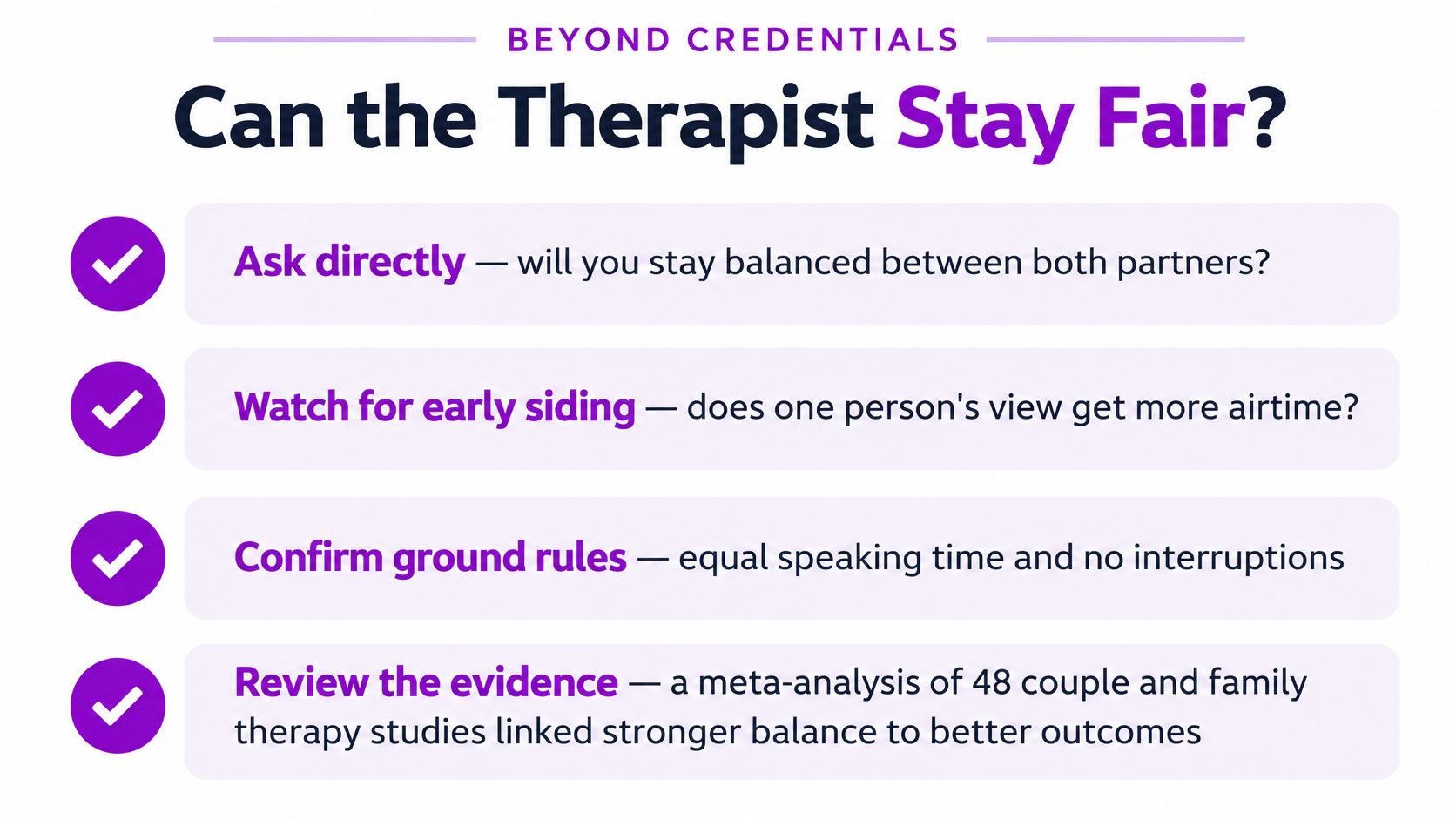
Four questions that expose a leaning
- How do you keep from taking sides? Listen for a procedure, not a promise to be neutral. A good answer describes how they structure turn-taking, how they interrupt, and what they do when one person dominates.
- How do you handle a disclosure only one of us makes? Some therapists hold individual secrets and work with them individually. Others state up front that anything material to the relationship needs to be said in the room. Either rule works if both partners know it before intake.
- How are goals set when we want different things? One partner wants fewer fights, the other wants to decide whether to stay. A therapist who names that gap out loud is doing the job.
- What do you do when one of us feels misunderstood? Vague reassurance is a bad sign. So is a therapist who explains why the feeling is wrong.
Rate the hour, separately
Skip the joint debrief in the parking lot. It's the least honest conversation of the day, because neither partner wants to be the one who spoils it.
The number that matters: after the consult, each partner privately rates three items from 1 to 5, on respected, understood, and equally involved. A 2 sitting next to a 5 isn't a misunderstanding to explain away. It's a reason to book a second name.
A named model is not proof of fairness. Neither is a warm personality. The useful signal is whether both people leave the hour feeling they were in the work together, and whether the therapist's questions landed on both of them rather than on whoever spoke first.
Filters That Knock a Name Off the List
Once the clinical questions are answered, the shortlist usually shrinks for reasons that have nothing to do with skill. Evidence is the first filter. Access is the second.
The 2020 meta-analysis of couple therapy outcomes pooled 58 studies representing 40 unique samples and 2,092 couples. It found a large improvement in relationship satisfaction from before to after couple therapy, a Hedges' g of 1.12, with a 95% confidence interval from 0.92 to 1.31. Couples placed on waitlists barely moved, with a g of 0.12 and a confidence interval from -0.04 to 0.29.
The same analysis reported meaningful effects in communication, emotional intimacy, and partner behavior, and found that gains generally persisted across short- and longer-term follow-up. A separate review summarized by academic researchers estimated that roughly 60% to 80% of distressed couples benefit from behavioral or emotion-focused approaches, although approximately half maintain treatment gains two years later.
Those are population figures, not verdicts. Severity, safety concerns, attendance, motivation, therapist competence, and whether both partners can participate constructively all move the result for a particular couple. Use the numbers to ask sharper questions of a therapist, not to grade your own relationship.
Which gives you three things to ask any name still on the list. Which evidence-based approach do you use? How will we measure progress? What changes if four sessions produce nothing?
The access table
| Filter | What it changes | Question to ask |
|---|---|---|
| In-network rule | The plan may pay only listed clinicians | Are you in network for our specific plan? |
| Visit limits | Benefits can cap sessions in a year | How many couples sessions does this plan cover? |
| Preauthorization | Care can be denied without prior approval | Do we need a referral or an auth code first? |
| Out-of-network pay | You may pay upfront and recover only part | What is the allowed amount and our share? |
| Two plans at home | One policy is usually billed first | Which plan is primary for couples visits? |
| Calendar fit | A covered hour nobody can attend is not care | Can both of us keep this time most weeks? |
A strong clinician the plan won't cover, or who can only meet while one partner is at work, isn't a real option yet. That's not a reason to give up on them. It's a reason to call the plan first and find out what the network and the benefit year allow. Paying a deposit before that call puts the cart in front of the horse.
Where the coverage question gets tangled, our guide to couples therapy covered by insurance walks through verification in order.
Book One Consult at a Valley Office
More names on a shortlist do not make the choice clearer. Book one consultation to test the practical fit, then decide whether to continue. For couples in the Phoenix metro area, reVIBE Mental Health has offices in Chandler, Phoenix Deer Valley, Phoenix PV, Scottsdale, and Tempe. The Phoenix PV location page lists these addresses and the central phone number, (480) 674-9220:
- Chandler, 3377 S Price Rd, Suite 105, Chandler, AZ
- Phoenix Deer Valley, 2222 W Pinnacle Peak Rd, Suite 220, Phoenix, AZ
- Phoenix PV, 4646 E Greenway Road, Suite 100, Phoenix, AZ
- Scottsdale, 8700 E Via de Ventura, Suite 280, Scottsdale, AZ
- Tempe, 3920 S Rural Rd, Suite 112, Tempe, AZ
Hours vary by office, so check the schedule before choosing. The practice website lists hours of 8:00 a.m. to 8:00 p.m. Monday through Friday and 8:00 a.m. to 1:00 p.m. Saturday, with Sunday closed. The Phoenix Deer Valley page lists 9:00 a.m. to 8:00 p.m. weekdays and 9:00 a.m. to 1:00 p.m. Saturday, with Sunday closed. For a couple with an early work start, that later opening may rule out the Deer Valley office.
In-person appointments are not the only option. reVIBE offers couples therapy in person or through secure telehealth sessions. Its locations overview describes in-person and online care across its Arizona service area.
At the consultation, ask how the therapist will work with both partners and what approach they use. reVIBE's therapists are trained in the Gottman Method, which focuses on building friendship, managing conflict, and creating shared meaning, and Emotionally Focused Therapy, which helps partners identify negative cycles and build lasting emotional bonds. reVIBE also offers personalized matching to help couples find a therapist who fits their needs and preferences. A free guide, “5 Ways to Know You've Found a Good Match with Your Therapist,” can help you prepare.
Choose an office or online option that both partners can attend consistently. Call (480) 674-9220 to arrange one consultation, then discuss privately whether the therapist felt fair to both of you before committing to further sessions.
reVIBE Mental Health offers couples therapy at its Arizona offices or through secure telehealth, with therapists trained in the Gottman Method and Emotionally Focused Therapy. One call to (480) 674-9220 or a visit to reVIBE Mental Health can help you arrange a first appointment. You do not need to be in crisis to start.