The popular advice to tap until your anxiety disappears sets the wrong expectation. Feeling calmer after a tapping session can be useful, but it doesn't tell you whether your anxiety is improving outside that moment. Anxiety tapping therapy is best approached as a coping skill to test, not a cure to assume.
You don't have to accept claims about energy pathways to try it. You do need a clear target, a gentle technique, and a way to check whether the benefit carries into sleep, work, relationships, and situations you'd otherwise avoid.
What the Research Shows at a Glance
Key anxiety tapping (EFT) trials and results
| Study | Participants | Comparison | Main result |
|---|---|---|---|
| 2016 systematic review (14 studies) | 658 participants | EFT vs. control conditions | Effect size 1.23 for EFT vs. 0.41 for controls |
| 2025 meta-analysis of RCTs (10 trials) | 774 patients (388 EFT, 386 control) | EFT vs. control conditions | Anxiety mean difference -7.92 points (95% CI -11.01 to -4.83) |
| 2025 review of RCTs (7 trials) | 506 participants | EFT vs. no intervention, breathing, muscle relaxation, and CBT | Better than no intervention; similar to breathing and muscle relaxation; no significant difference from CBT |
These summaries describe different collections of studies, not a single large trial. Their results also use different statistical measures, so you can't compare the numbers directly or add the participant totals together as though everyone belonged to a separate experiment.
The 2025 systematic review and meta-analysis included 10 randomized controlled trials involving 774 patients, with 388 assigned to EFT and 386 to control conditions, and reported an anxiety mean difference of -7.92 points, with a 95% confidence interval from -11.01 to -4.83. The same analysis reported a depression mean difference of -7.41 points.
What those numbers actually mean
An effect size expresses change in standardized units, not points on your personal distress rating. The historical review's larger EFT effect size suggests greater symptom improvement in the tapping groups, but it isn't a percentage of people cured.
A mean difference describes an average difference on the symptom measures used in the analysis. The negative direction favors lower symptom scores with EFT. It doesn't mean an equivalent drop on every anxiety questionnaire, and it certainly isn't a universal percentage reduction.
The confidence interval expresses uncertainty around the pooled estimate. It doesn't predict how much your own anxiety will change.
Results against no intervention answer a narrower question than results against an active treatment. Spending time with a practitioner, following a structured exercise, and expecting relief can all matter when interpreting a treatment comparison.
Why the verdict remains cautious
Several limitations affect how confidently readers can apply these findings:
- Self-reported outcomes: Participants often rated their own symptoms.
- Lack of participant blinding: People generally knew whether they were tapping.
- Small samples: Individual trials offered limited precision.
- Different treatment lengths: Researchers didn't all test the same amount of treatment.
- Limited follow-up: Few trials establish whether gains persist beyond the study period.
These weaknesses don't mean the improvements were imaginary. They mean researchers still need stronger comparisons, consistent methods, and longer follow-up before making broad treatment claims.
The practical verdict is promising short-term benefit, not a proven replacement for established anxiety treatment. A useful coping exercise and a dependable treatment for an anxiety disorder aren't automatically the same thing.
What Anxiety Tapping Is and How It Works
Say you're preparing to speak at a meeting, and your mind keeps returning to the possibility of freezing. Tapping is a little like restarting a phone that keeps freezing on the same app: the intention is to interrupt the loop long enough to respond differently. That's an analogy, not a proven explanation of what happens in the brain.
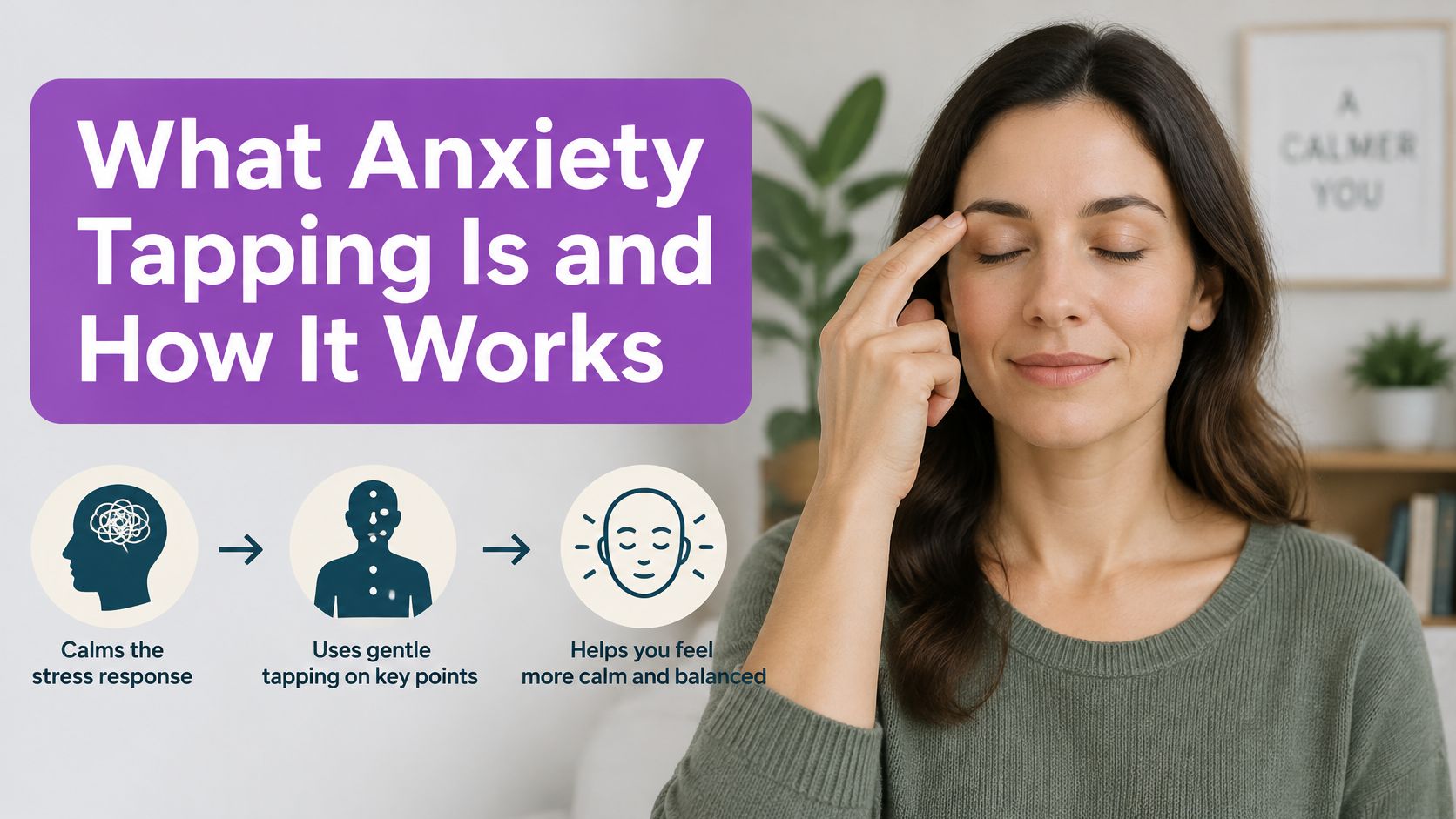
Emotional Freedom Techniques, commonly called EFT or anxiety tapping, combines gentle fingertip tapping with attention to a specific worry and spoken phrases. Common tapping locations include the face, collarbone, side of the hand, and upper body.
The basic ingredients
A simple practice has these parts:
- A problem statement: Identify the specific thought, sensation, or situation you're working with.
- A tapping sequence: Tap gently while keeping that concern in mind.
- A distress comparison: Rate how upsetting the same concern feels before and afterward.
For the meeting example, you'd focus on the fear of forgetting your opening sentence, rather than every concern you have about your career. The words help keep your attention on a manageable target.
Outcomes matter more than the theory
EFT grew out of energy psychology, which includes theories about bodily energy pathways. Those explanations shouldn't be presented as established anatomy or proof of how tapping works.
Researchers have explored whether standard tapping points offer something beyond tapping elsewhere, but findings haven't consistently settled how much the exact locations matter. Attention, repeated contact with a feared thought, verbal framing, and the soothing rhythm of the exercise are possible contributors. It's more accurate to describe these as possibilities than to claim tapping switches off a particular brain structure.
The 2016 systematic review of EFT for anxiety consolidated 14 studies involving 658 participants identified through December 2015, reporting an EFT pre-to-post effect size of 1.23, compared with 0.41 across control conditions. Its historical contribution was to evaluate clinical outcomes, while leaving questions about durability and comparisons with established care unresolved.
You can be open to trying a technique without accepting every explanation offered for it.
One naming detail matters when choosing a provider: Emotional Freedom Techniques isn't the same as Emotionally Focused Therapy, a relationship-focused approach that also uses the abbreviation EFT. Likewise, tapping during EMDR belongs to a different therapeutic method.
For mild, specific anxiety, a careful trial of tapping is reasonable. Treat its proposed mechanism as unsettled, and judge its usefulness by what changes for you.
How to Run a Tapping Session Step by Step
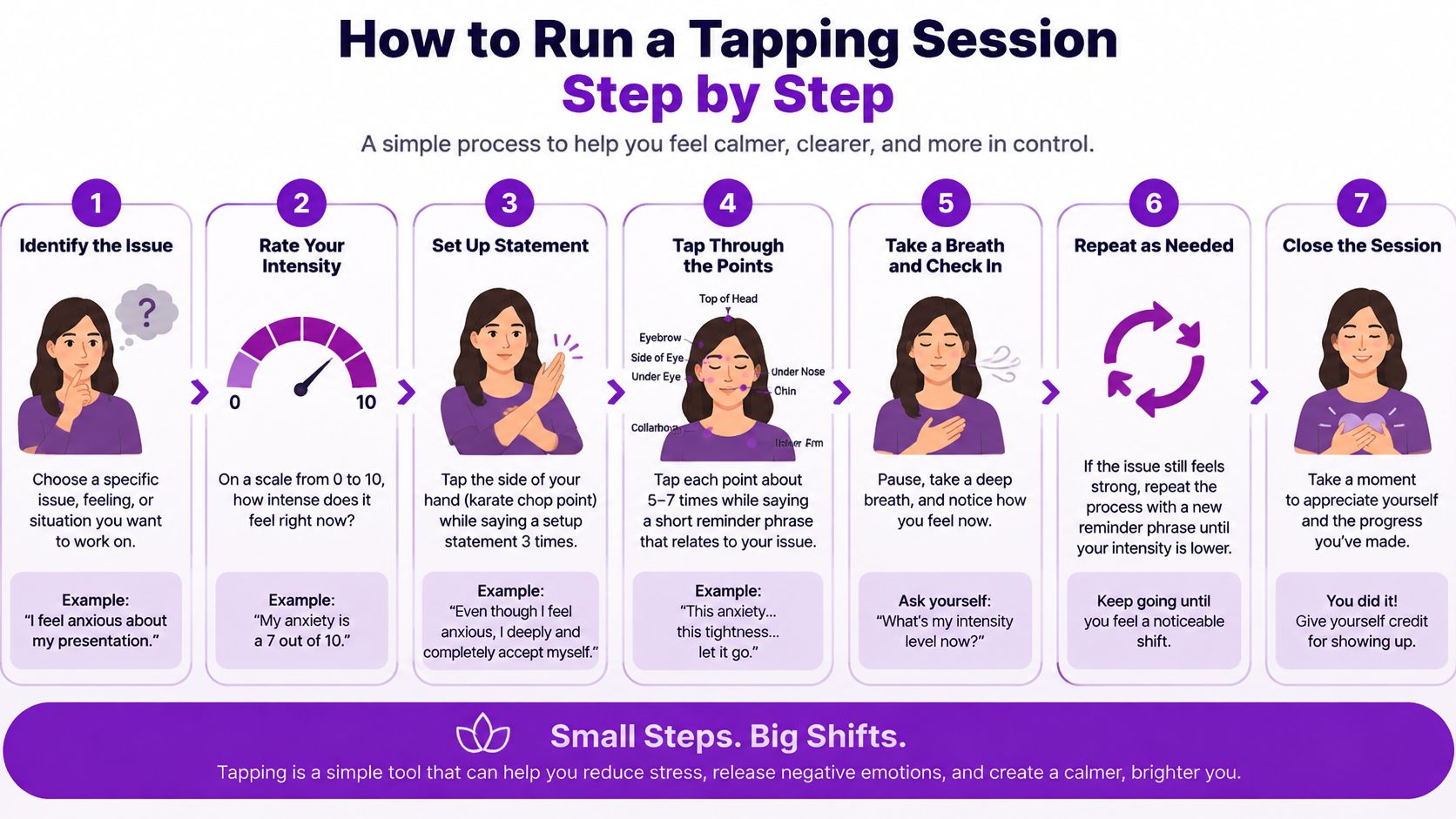
Start with subjective units of distress, often abbreviated SUDS. This is a 0 to 10 rating, where 0 means no distress and 10 means the worst distress you can imagine. You're recording your experience, not diagnosing an anxiety disorder.
Choose somewhere you can sit comfortably and keep your feet supported. Use light fingertip contact, avoid irritated or injured skin, and don't press on your eyeballs. A complete practice can take about 10 to 15 minutes, but this is a practical format, not a required treatment dose.
A gentle practice sequence
Name a specific worry and rate it. Write a sentence such as I'm afraid I'll forget what to say when the meeting starts, then record its SUDS rating, because you need a clear baseline for comparison. Notice whether the distress is mostly a thought, a stomach sensation, or tension in your shoulders.
Use an acceptance phrase while tapping the hand. Gently tap the fleshy outside edge of either hand, often called the karate-chop point, while saying Even though I feel this tightness, I accept how I feel three times, because naming the feeling keeps your attention specific. Acceptance means acknowledging your current experience, not approving of an upsetting situation.
Move through the reminder points. Tap about seven times at each point, following this order: eyebrow, side of the eye, under the eye, under the nose, chin, collarbone, under the arm, and top of the head, because a repeatable sequence makes the exercise easier to follow. These counts are practice cues, not a medically established dose.
Keep the reminder phrase short. At each point, use words such as this fear or this tension, because brief wording helps you stay with the same worry rather than starting a new internal argument. You don't have to replace the fear with a positive affirmation.
Finish the round and pause. Complete one or two full rounds, then take a slow, comfortable breath, because a pause lets you notice your response without rushing into more tapping. Don't force deep breathing if that makes you lightheaded.
Rate the same concern again. Bring the original meeting worry back to mind and record its current intensity, because the comparison is only useful if you're rating the same target. Note whether the sensation changed location, the thought became less convincing, or nothing changed.
Narrow the target if you choose to continue. If your rating is still 4 or higher, and you feel comfortable continuing, try a more specific phrase such as the fear of losing my opening sentence, because a narrower target makes the next comparison easier to interpret. This rating isn't a clinical cutoff, and it's never a reason to push through worsening distress.
The guide below shows the sequence in a format you can keep nearby.
Keep the target small and the pressure low
The most common practical mistake is choosing something too broad, such as my whole life. You can't tell whether a changing score reflects work stress, relationship strain, or exhaustion when the target includes everything.
If acceptance language feels false, use a neutral alternative such as I'm noticing this feeling right now. You don't need to sound confident or persuade yourself that everything is fine.
Stop if you feel increasingly overwhelmed, detached, or drawn into distressing memories. Orient to your surroundings instead. These grounding techniques for anxiety offer ways to reconnect with the present without continuing to focus on the worry.
Tracking Whether Tapping Actually Helps
A quieter body isn't automatically the same as a lasting improvement in anxiety. Stress-system measurements can change without an equivalent change in what a person feels or can do.
The cortisol replication study record describes earlier findings from 83 adults in which a 60-minute EFT session was associated with an average salivary-cortisol reduction of 24.4%, compared with 14.2% after supportive counseling and 0.6% with no treatment; the replication involving 53 participants reported a 43.24% reduction, without equivalent subjective distress improvement.
Cortisol is a stress indicator, not a test of anxiety remission. You don't need home biomarker testing to decide whether a coping practice is useful.
Use ratings as a personal tracking tool
The categories below are practical descriptions, not validated diagnostic bands or rules for determining treatment.
Reading your SUDS rating after a session
| SUDS score | What it typically means | What to do next |
|---|---|---|
| 0 | No distress at all | Note the baseline and continue daily practice if useful |
| 1-3 | Mild and easy to ignore | Tap briefly to maintain if desired, and log the rating |
| 4-6 | Moderate, affecting focus or mood | Run a full session if comfortable and re-rate |
| 7-8 | High and hard to function through | Pair tapping with grounding, and consider a clinician if this repeats |
| 9-10 | Overwhelming or panic level | Stop tapping and use medical or crisis guidance if you feel unsafe |
For example, suppose you rate presentation worry at 8 before practice and 5 afterward, then record comparable post-session ratings of 7, 5, and 4 over the next three sessions. That's a hypothetical pattern worth examining, not a promised response. Record each session's starting score too, so you don't mistake easier starting conditions for a stronger treatment effect.
Measure what changes between sessions
As a practical personal experiment, review your log after four to six sessions across two to three weeks. This is a review schedule, not a scientifically established EFT treatment course.
Alongside the before-and-after ratings, record:
- Sleep: Are you falling asleep more easily or spending less time worrying in bed?
- Avoidance: Did you attend the meeting, make the call, or enter the situation?
- Daily interruption: Is worry disrupting work or conversations less often?
Our guide to how to know if therapy is working offers additional ways to evaluate progress beyond how you feel immediately after an appointment.
Meaningful progress: Look for a consistent downward trend alongside fewer avoided situations, not just a calm evening.
If scores drop only while tapping but daily life remains restricted, bring that distinction to a clinician. The exercise may offer temporary relief without addressing what's maintaining the anxiety.
Tapping Compared With Therapy and Medication
Choosing an approach means matching the intervention to the problem, not finding a technique that wins every comparison. A brief calming routine serves a different purpose from treatment for persistent avoidance, trauma symptoms, or disabling worry.
Anxiety approaches compared on the same criteria
| Approach | Evidence on anxiety | Best suited for | Role alongside tapping |
|---|---|---|---|
| Anxiety tapping (EFT) | Controlled trials show benefit over no treatment and similar results to CBT in one 2025 review | Short-term self-help for mild or situational stress | Practice skill between sessions |
| Cognitive behavioral therapy (CBT) | Well-studied, with the most established evidence base among these options | Persistent worry, panic, and avoidance | Core treatment; tapping can add a calming routine |
| Breathing and muscle relaxation | Similar to EFT in one 2025 review of trials | Physical tension and stress arousal | Calming skills; compare which helps you most |
| Medication management | Evidence and selection are diagnosis-specific and assessed by a psychiatric prescriber | Moderate to severe or impairing anxiety | Prescriber decides; tapping doesn't replace it |
| EMDR | Used for trauma and anxiety-related symptoms | Anxiety linked to distressing memories | Works on memories rather than a calming routine |
The 2025 systematic review of parallel-group randomized trials included seven trials with 506 participants and found EFT generally outperformed no intervention, produced results similar to or better than breathing and muscle relaxation, and showed no significant difference from CBT. Most included studies had risk-of-bias concerns, particularly self-reported outcomes and inability to blind participants.
No significant difference doesn't prove equivalence. It also doesn't establish that tapping is superior to CBT or another established treatment.
Match the role to the need
Tapping can be a between-session skill while CBT addresses worry patterns and avoidance. Breathing and muscle relaxation offer alternative ways to work with physical arousal. You don't have to keep tapping if another calming exercise is easier or more useful.
Medication decisions belong with a psychiatric prescriber who can assess symptoms, medical history, benefits, and adverse effects. Our explanation of therapy versus medication for anxiety can help you prepare for that discussion.
EMDR is used for PTSD, anxiety, and phobias, particularly when distressing memories are relevant. Individual therapy is one-on-one treatment with a licensed therapist to address personal challenges, emotions, and mental health concerns.
At reVIBE Mental Health, our therapists and licensed psychiatric professionals work within one team, with care covering anxiety, depression, trauma, grief, burnout and stress, family and couples therapy, medication management, psychiatry, EMDR, play therapy, and eating disorders.
If you're also considering supplements, you can compare anti stress supplement ingredients using REVETIX's overview as a starting point for a prescriber or pharmacist discussion, not as evidence that a product treats anxiety. Bring the actual ingredient list to that conversation.
Choose care according to severity, impairment, and what drives the anxiety. Tapping can be a low-cost additional skill rather than the foundation of every treatment plan.
When to Skip Tapping and Who to See First
| Situation | First step | Why it matters |
|---|---|---|
| Chest pain, fainting, or shortness of breath during panic | Get a medical evaluation, urgently if symptoms are new, severe, or ongoing | Physical symptoms need checking before they're attributed to anxiety |
| Thoughts of self-harm or suicide | Call or text 988 in the US immediately; use emergency services for immediate danger | Safety comes before any self-help technique |
| Anxiety that stops work, school, or sleep | See a clinician for assessment | Impairment calls for structured treatment, which tapping can supplement |
| Intrusive trauma memories or flashbacks | Ask about trauma-focused therapy such as EMDR | Trauma processing needs a trained clinician |
| Planned change to anxiety medication | Talk to the prescriber first | Changing or stopping medication without guidance can cause harm |
| Mild stress that eases with practice | Continue self-practice with weekly tracking | Reassess if there's no change in four to six weeks |
Tapping is a low-cost skill for stress and mild anxiety, not a substitute for assessment when symptoms are severe. The National Center for Complementary and Integrative Health's anxiety guidance supports caution about replacing established care with complementary approaches.
If you're unsure how physical symptoms overlap, Qaly's explanation can help you compare panic and cardiac symptoms. Don't use an online comparison to rule out a medical emergency or delay care.
Choose the right starting point
- Self-practice: For manageable situational stress, try gentle tapping and keep a SUDS log.
- Combined care: For persistent anxiety, bring your log to an appointment and discuss using tapping between sessions.
- Evaluation first: For disabling symptoms, trauma-related distress, or safety concerns, prioritize professional assessment.
EMDR helps people process distressing memories using bilateral stimulation such as eye movements, taps, or sounds. That therapist-guided process is different from doing an EFT sequence alone.
Our clinicians' training spans anxiety, depression, trauma, grief, eating disorders, addiction, autism, ADHD, gender dysphoria, mood and personality disorders, OCD, panic disorder, phobias, PTSD, sensory processing disorder, and stress, with support for LGBTQ+ clients. You don't need to identify the exact diagnosis before seeking help.
Find a reVIBE Location Near You!
We currently have five locations for your convenience. (480) 674-9220
- reVIBE Mental Health – Chandler
3377 S Price Rd, Suite 105, Chandler, AZ - reVIBE Mental Health – Phoenix Deer Valley
2222 W Pinnacle Peak Rd, Suite 220, Phoenix, AZ - reVIBE Mental Health – Phoenix PV
4646 E Greenway Road, Suite 100, Phoenix, AZ - reVIBE Mental Health – Scottsdale
8700 E Via de Ventura, Suite 280, Scottsdale, AZ - reVIBE Mental Health – Tempe
3920 S Rural Rd, Suite 112, Tempe, AZ
If symptoms persist for more than a few weeks, book a consultation rather than extending self-help indefinitely. Bring your ratings and examples of what anxiety prevents you from doing.
reVIBE Mental Health offers talk therapy, EMDR, and psychiatric medication management through in-person and secure online care. Visit reVIBE Mental Health or call (480) 674-9220 to schedule a consultation and discuss whether tapping belongs alongside a more structured anxiety treatment plan.