

Tackling burnout at work isn't a quick fix. It's a two-step process: first, you need immediate strategies to create some breathing room, like setting firm boundaries. Then, you can build a longer-term recovery plan that actually gets to the root of what's causing the exhaustion.
The most critical part is admitting to yourself that the chronic fatigue, detachment, and sense of just not being good enough anymore is more than just stress. It's a clear signal that something needs to change, and fast.
Why So Many Professionals Feel Burnt Out

That feeling of dread creeping in on a Sunday night? That's not just the "Monday blues." Think of it as a quiet alarm bell, warning you that you're running on empty. If you're constantly emotionally exhausted, cynical about your job, and second-guessing your own skills, you're not just having a bad week—you're very likely experiencing burnout.
It’s crucial to understand that burnout is a different beast from stress. Stress often feels like a sense of urgency and over-engagement; you feel like you're drowning in responsibilities, but there's a part of you that still believes you can get back on top of it. Burnout is the opposite. It’s defined by total disengagement—a feeling of being emotionally drained, detached, and completely out of motivation.
Let’s be clear: this is not a personal failure. It’s a widespread occupational issue. The World Health Organization (WHO) officially recognizes burnout as a syndrome directly resulting from chronic, unmanaged workplace stress. It’s a global problem affecting nearly half of all workers.
The numbers are pretty staggering. Recent data shows that 63% of workers in the UK and 62.9% across the Asia-Pacific region are reporting burnout. Here in the United States, an eye-watering 70% of professionals are dealing with moderate-to-high levels of stress. We see this firsthand in high-pressure sectors across Phoenix, from tech and healthcare to customer service. For a deeper dive, Cigna's detailed report highlights the global impact and economic toll.
Burnout is not a sign of weakness; it is a sign that you have been strong for too long. It's your body and mind's way of saying that the demands placed upon you have exceeded your available resources.
Is It Stress or Is It Burnout?
It can be tough to tell the difference when you're in the thick of it. This table can help you quickly distinguish between the typical pressures of work and the more serious signs of burnout.
| Symptom | Typical Stress | Burnout |
|---|---|---|
| Engagement | Over-engaged, urgent, hyperactive | Disengaged, detached, blunted emotions |
| Emotional State | Heightened emotions, anxiety, irritability | Emotionally drained, feeling empty and numb |
| Motivation | Still motivated to push through challenges | Lack of motivation, feeling helpless or cynical |
| Physical Impact | Energy spikes and crashes, tension headaches | Chronic fatigue, exhaustion that sleep doesn't fix |
| Outlook | A sense that things will improve once the pressure is off | A pervasive sense of pessimism and dread about work |
| Performance | Productivity might dip but can be recovered | Sense of ineffectiveness and reduced accomplishment |
Seeing your own experience reflected in the "Burnout" column is the first step toward validation. It's confirmation that what you're feeling is real, and it empowers you to start taking action.
The Real Face of Burnout
Think about a marketing manager in Scottsdale who used to get a real buzz from crafting creative campaigns. Now, she just stares at her screen, feeling completely disconnected from the projects that once lit her up. Every new email feels like a heavy weight, and team meetings are just something to be endured. That emotional distance is a classic sign.
Or picture a software developer in Chandler caught in an endless loop of tight deadlines and urgent feature requests. He’s working late, skipping lunch, and living with a constant, low-level hum of anxiety. Despite pouring everything he has into his work, he feels like his performance is slipping, which creates a crippling sense of being a failure. He’s physically at his desk, but mentally, he’s checked out.
These real-world examples show the three core components of burnout in action:
- Emotional Exhaustion: A deep, persistent fatigue that a good night's sleep just can't touch.
- Cynicism and Detachment: Losing your passion for the work and adopting an increasingly negative or cynical attitude toward your job and colleagues.
- Reduced Personal Accomplishment: A nagging feeling that you’re ineffective and not achieving anything meaningful in your role.
Recognizing these feelings in yourself is the most important thing you can do right now. It validates your struggle and confirms you're not alone. When you understand what burnout truly is—and what it isn't—you can finally start moving from feeling stuck to finding real, actionable solutions.
Identifying the Red Flags of Burnout
Burnout doesn’t just show up one day with a formal announcement. It’s more of a slow creep—that persistent, bone-deep exhaustion you might brush off as just another tough week. But learning to spot the specific signs is the absolute first step toward figuring out how to deal with burnout at work and, more importantly, how to start feeling like yourself again.
This isn't about just "feeling tired." It’s about taking a hard, honest look at your emotional state, what your body is telling you, and how your behavior at work has shifted. These symptoms are your internal alarm system, screaming that your reserves have hit a critical low.
Emotional Symptoms of Burnout
The emotional toll is often the deepest cut. It's a quiet draining of the positive feelings you once had for your job, slowly replaced by a heavy sense of dread or just… nothing.
Maybe you’ve noticed you’re snapping in meetings or getting completely bent out of shape over minor hiccups. That's not just a bad mood; it’s a classic sign of emotional exhaustion. Think of a project manager who used to love the buzz of collaboration but now finds every conversation draining and actively ducks into an empty office to avoid the breakroom.
Here’s what to look for emotionally:
- A deep sense of cynicism: You’ve started feeling detached and negative about your job and the people around you. That spark you once had is gone, replaced by a "why even bother?" attitude.
- Loss of satisfaction: Big wins and finished projects that used to feel great now just feel… hollow. You finish a massive report and all you feel is relief that it’s over, not a shred of pride.
- Feeling emotionally blunted: You might feel numb or empty, like you just can't summon the energy to care about your work or connect with your colleagues.
Burnout isn't a sign you’ve given up. It’s a sign you’ve been running on an empty tank for far, far too long. That cynicism is your mind's way of protecting itself from being drained any further.
Physical Signs You Cannot Ignore
Burnout isn’t all in your head—it shows up in your body. Your body keeps a running tally of chronic stress, and it will eventually send you the bill in the form of very real health problems.
This goes way beyond normal tiredness. We’re talking about an exhaustion so profound that a full 8 hours of sleep doesn’t even touch it. You wake up feeling just as wiped out as when you collapsed into bed, making the thought of starting the day feel impossible.
Keep an eye out for these physical red flags:
- Chronic Fatigue: A relentless state of exhaustion that makes it hard to function, both at your desk and at home.
- Sleep Disturbances: You can’t fall asleep, you wake up all night with your mind racing about work, or you’re just plain not getting restful sleep.
- Physical Ailments: Are you getting more headaches? Is your neck constantly tense? What about stomach issues or catching every single cold that goes around the office? That's your immune system waving a white flag.
It’s like the check-engine light in your car. You can ignore it for a bit, but sooner or later, something is going to break down. These physical symptoms are your body's dashboard, and the lights are flashing.
Behavioral Changes at Work
How you act is often the most obvious sign of burnout, both to yourself and to others. It’s the shift in your daily habits and performance that shows you’re struggling to keep your head above water.
You might find yourself putting off tasks you used to jump on or missing deadlines that would have been a breeze before. This isn't about being lazy; it's a direct consequence of having zero mental and emotional fuel. It feels like you’re wading through thick mud just to answer an email.
Notice any of these behavioral shifts?
- Social Withdrawal: You actively dodge coworkers, eat lunch alone at your desk, or always keep your camera off during video calls.
- Reduced Productivity: Your performance has taken a nosedive. You can't concentrate, and every single task feels like a monumental effort.
- Increased Absenteeism: You're calling in sick more often, not because you have the flu, but because you simply don't have the mental or physical capacity to face another day.
Seeing yourself in these descriptions isn't a sign of failure. It's an act of self-awareness. It’s what empowers you to finally say, "Enough," and break the cycle. By catching these symptoms, you can start taking back control and begin the real work of recovery.
Immediate Strategies for Burnout Relief

When you’re deep in the trenches of burnout, even thinking about a long-term wellness plan can feel like another exhausting task on your list. Forget the five-year plan for now. What you need is a first-aid kit—small, practical actions you can take right now to create some breathing room and get back a sense of control.
Think of these strategies as circuit breakers. Their entire purpose is to interrupt the cycle of chronic stress and give your nervous system a much-needed break, even if it’s just for a few minutes in the middle of a chaotic workday. The goal isn’t to fix everything at once. It’s about taking one small, manageable step toward feeling human again.
It's a strange paradox of the modern workplace: even the most engaged employees are burning out. A shocking 82% of workers say they're dealing with burnout. The main culprits? Long hours (58%) and overwhelming workloads (35%). This data from a DHR Global report proves that just "pushing through it" isn't the answer. Instead, learning how to deal with burnout at work means taking smarter, more intentional actions.
Triage Your Tasks with the Eisenhower Matrix
When every single task feels both urgent and important, it’s easy to freeze up. The Eisenhower Matrix is a refreshingly simple tool that helps you cut through the noise by sorting your tasks into four clear categories.
This isn't about cramming more into your day; it’s about doing the right things. When you focus your energy on what truly matters, that crushing feeling of being swamped by an endless list of demands starts to fade almost immediately.
Here’s how to put it into practice:
- Urgent & Important: Do these first. Think crises, pressing problems, and hard deadlines.
- Important, Not Urgent: Schedule these. This is where your most meaningful work lives—strategic planning, creative projects, relationship building. Block out time for them before they turn into fires you have to put out.
- Urgent, Not Important: Delegate these if you can. These are often interruptions, some meetings, and other people’s priorities that sidetrack you from your own goals.
- Not Urgent & Not Important: Eliminate these. Be ruthless. This is the busywork, the mindless scrolling—the things that drain your energy for zero reward.
Implement a Hard Stop to Your Workday
The line between "work time" and "my time" has become almost nonexistent for many of us, but reclaiming your evenings is non-negotiable for burnout recovery. A "hard stop" is exactly what it sounds like: a specific time you shut down your computer, turn off work notifications, and mentally clock out. No exceptions.
This one boundary is one of the most powerful tools you have. In fact, research shows that employees who consistently log off on time report 20% less exhaustion. It’s a clear signal, both to yourself and your colleagues, that your well-being matters.
A hard stop isn’t a sign of being less committed to your job. It's about being more committed to your long-term effectiveness and mental health so you can actually show up with the energy you need tomorrow.
Harness the Power of Micro-Breaks
The thought of taking a full hour-long lunch break might seem laughable right now. The good news is, you can get similar restorative benefits from micro-breaks. These are just short, intentional pauses of 5-10 minutes sprinkled throughout your day to step away from your screen.
These tiny resets have a huge impact. Studies have linked taking just a five-minute pause every hour to a 15% gain in productivity. During your micro-break, you can try simple somatic healing exercises like deep belly breathing or a full-body stretch to calm your nervous system.
It’s also helpful to start understanding wellness leave, as it’s becoming a more recognized way to combat burnout. These immediate actions help you manage the acute symptoms, paving the way for a more sustainable, long-term recovery.
Talking to Your Manager About Burnout
Let’s be honest: talking to your boss about burnout can feel incredibly risky. You want to advocate for yourself, but you don't want to sound like you're just complaining or, worse, that you can't handle your job.
The secret is to reframe the entire conversation. Instead of focusing on the problem, you’re going to focus on being a proactive, collaborative partner. You’re there to talk about how you can improve your effectiveness and well-being, which directly benefits the company. This approach shows you're invested, but it also signals that the current pace is simply not sustainable.
Get Your Ducks in a Row Before You Talk
Walking into this conversation unprepared is a recipe for a vague, unhelpful chat that leaves everyone feeling frustrated. Your goal is to be calm, clear, and ready with solutions.
First, take some time to document what’s actually happening. "I'm overwhelmed" is a feeling, not a fact your manager can work with. You need to pinpoint the source of the burnout. Is it a genuinely unmanageable workload? Constantly shifting goalposts? A serious lack of resources or persistent after-hours pings?
Before you schedule that meeting, get specific:
- Outline your core responsibilities. What are you actually supposed to be doing according to your job description?
- Track your real workload for a week. Keep a simple log of all the extra tasks, "urgent" requests, and new projects that land on your plate. This isn't about complaining; it's about collecting data.
- Connect the dots to performance. How is this overload impacting your work? Note any missed deadlines, a slip in quality, or the fact that you have zero time for important strategic thinking.
- Brainstorm a few solutions. Come up with two or three realistic adjustments. Could a smaller project be delegated? Do you need your manager to officially sign off on your top three priorities for the quarter? Would a quick weekly check-in help manage expectations on both sides?
Doing this prep work transforms an emotional appeal into a solid business case for change. You’re not just showing up with a problem—you’re bringing thoughtful solutions to the table.
How to Actually Structure the Conversation
When you ask for the meeting, be intentional. Request a private one-on-one and frame it in a positive, professional way. Something like, "I'd love to schedule some time to discuss my current workload and see how we can optimize my focus on the team's top priorities."
Once you're in the room, follow a clear path to keep the discussion on track.
1. Start with Your Commitment
Always begin by reaffirming your dedication. It sets a positive tone and shows you’re a team player.
- Try this: "First, I just want to say how committed I am to my work here and to helping our team succeed. I'm really proud of what we're accomplishing with [Project X]."
2. State the Problem Clearly and Objectively
Use "I" statements to describe what you're experiencing and connect it directly to your work.
- Try this: "Lately, I've been feeling stretched pretty thin, and I've noticed it's starting to impact my ability to deliver my best work on our key projects. I'm concerned the quality of my output on [Specific Task] isn't where I want it to be because of all the competing demands."
3. Bring in Your Data
This is where your preparation pays off. Share the specific examples you gathered.
- Try this: "For example, last week I had three urgent requests come in that weren't planned, and they took priority over my main goal of finalizing the quarterly report. As a result, the report was delayed, and I had to work over the weekend to get caught up."
4. Propose Collaborative Solutions
This is the most critical step. Offer your ideas, but also ask for their input. Make it a team effort.
- Try this: "I've been thinking about how we might be able to tackle this. I'm wondering if it would be possible to clarify which projects are the absolute top priorities for this month? Or maybe we could explore reassigning [Specific Task] so I can dedicate the focus needed for [Main Project]?"
Talking about your mental health at work is hard. The fear of being judged or seeing it stall your career is very real. But remember this: you are advocating for your long-term value to the company by addressing burnout before it leads to complete disengagement or you walking out the door.
Getting Over the Fear of Stigma
It makes perfect sense to worry about how you'll be perceived. That fear is backed by real data; a NAMI poll found that 42% of employees fear negative career consequences if they disclose mental health challenges. This is a huge reason why only 13% ever tell their managers about work-induced suffering—even though roughly half of U.S. workers are dealing with burnout, depression, or anxiety. If you want to dig deeper into these workplace dynamics, you can explore detailed employee burnout statistics.
To sidestep the stigma, anchor your conversation in professional terms. Keep the focus on workload, efficiency, and outcomes rather than just your feelings.
When you present the issue as a workflow or resource problem, you depersonalize it. That makes it much easier for your manager to engage constructively without feeling like they have to become your therapist. You aren't asking for special treatment; you're asking for the conditions needed to do your job successfully. That’s a completely reasonable and professional request.
Building Your Long-Term Recovery Plan
Those immediate coping strategies are your lifeline, but they won't fix the underlying problem. True, sustainable recovery from burnout is about playing the long game. It means moving beyond quick fixes and building a solid, long-term plan that shores up your defenses so this doesn't happen again.
Think of it as rebuilding your personal energy reserves from the ground up and rediscovering who you are outside of your job title.
Real change comes down to three key pillars: protecting your physical health, setting rock-solid mental boundaries, and actively nurturing your social life. When you intentionally focus on these areas, you create a foundation of resilience that makes you far less vulnerable to the chronic stress that got you here in the first place. This isn't about adding more to your to-do list; it’s about making smart, deliberate choices that actually replenish you.
Protect Your Physical Foundation
Chronic stress takes a massive toll on your body. That’s why your physical health is the non-negotiable starting point for any real recovery. Burnout often messes with the very things that keep you going—like sleep and nutrition—trapping you in a downward spiral of exhaustion.
Let's start with sleep. You absolutely have to prioritize it. Aim for a solid 7-9 hours a night and try to stick to a consistent sleep schedule, even on weekends. This helps get your circadian rhythm back on track, which stress almost always throws out of whack.
If your brain won’t shut off at night, create a simple "shutdown ritual." For 30 minutes before bed, put all screens away. Maybe you listen to some quiet music, do some light stretching, or read a book. The goal is to send a clear signal to your body: it's time to rest.
Good nutrition is just as critical. When you're completely drained, it’s so easy to grab sugary snacks or another coffee for a quick jolt, but that just leads to a nasty energy crash later. Instead, focus on whole foods—things like leafy greens, lean proteins, and complex carbs—that give you stable, lasting energy and support your brain health.
Set Firm Mental and Emotional Boundaries
Burnout loves it when the lines between your work and personal life get blurry. To reclaim your mental space, you have to draw clear, firm lines in the sand.
One of the most powerful things you can do is schedule non-negotiable personal time right into your calendar. Treat it like you would any important work meeting. Whether it’s an hour to read, a walk outside, or time for a hobby you love, blocking it off makes it real and much harder to skip. This simple act reinforces the truth that your well-being is just as vital as any professional deadline.
If you find yourself stuck in a loop of negative thinking, some therapeutic approaches can make a world of difference. You can learn more about how Cognitive Behavioral Therapy helps reframe thinking and gives you practical tools to break those patterns.
Another game-changer is the scheduled tech detox. It can be as simple as turning off work notifications after 6 PM or dedicating one day of the weekend to being completely screen-free. Disconnecting like this gives your brain a chance to actually reset and dials down that constant, low-level anxiety of being "on" 24/7.
Your personal time isn't a luxury; it's a critical part of your recovery. Protecting it fiercely is an act of self-preservation that rebuilds your capacity to handle professional demands without sacrificing yourself.
This is a process. It takes time to prepare for the conversation, have it, and then work on solutions together.
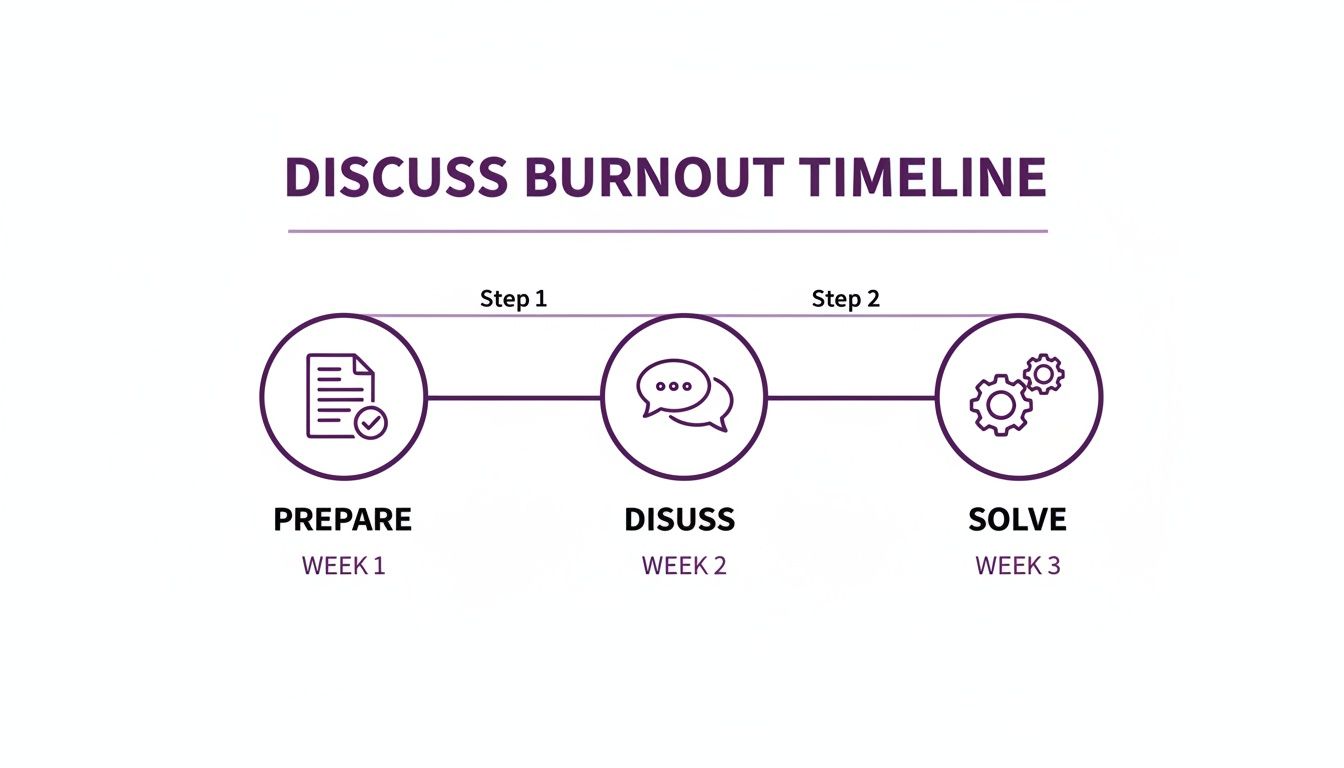
As you can see, this isn't about a single, dramatic conversation. It’s a thoughtful process requiring preparation, clear communication, and a commitment to collaborative problem-solving.
Nurture Your Social Connections
Burnout can be incredibly isolating. It often makes you pull away from the very people who can lift you up. That’s why consciously nurturing your connections outside of work is so important for recovery—it’s a powerful reminder that your identity is so much bigger than your job.
Make a real effort to reconnect with friends and family. It doesn't have to be some grand event. A simple phone call, a quick coffee, or a shared meal can make a huge impact. The whole point is to spend time in relationships where you're valued for who you are, not for what you do.
These relationships give you perspective, a shoulder to lean on, and a sense of belonging that work simply can't provide. As you start putting your long-term plan together, digging into more resources on how to recover from burnout and reclaim your energy can offer even more specific strategies. By rebuilding these connections, you create a support system that acts as a buffer against workplace stress, helping you feel more grounded and whole again.
When It’s Time to Ask for Professional Help
Sometimes, no matter how hard you try, self-care routines and workplace adjustments just don't cut it. You can set all the boundaries in the world, but if you're still feeling trapped, emotionally numb, or completely hopeless, it's a clear signal that burnout has dug its heels in deep.
Reaching out for professional support isn't a sign of failure. It's actually a brave, proactive step toward reclaiming your life. When burnout starts to look and feel a lot like depression or anxiety—pulling away from friends, losing interest in things you used to enjoy, or major shifts in your appetite and sleep—it's time to bring in a professional.
Finding Compassionate, Expert Care in Arizona
At reVIBE Mental Health, we know that taking that first step can be the hardest part. Our entire approach is built around creating a supportive, judgment-free space where you can feel safe to heal. We bring together therapists and psychiatric professionals who work as a team to create a plan that fits you.
We have specific services designed to help you navigate the complexities of burnout and any related mental health challenges:
- Talk Therapy: This is where you can dig deep with a therapist to understand the roots of your burnout, learn practical coping skills, and build lasting resilience.
- EMDR (Eye Movement Desensitization and Reprocessing): For some, past trauma can make burnout feel even more intense. EMDR is a highly effective therapy designed to help process those underlying experiences.
- Psychiatry and Medication Management: Our psychiatric team can help determine if medication might be a helpful tool for managing severe symptoms of anxiety or depression, making it easier for you to do the meaningful work in therapy.
Acknowledging you can’t carry it all alone is a profound sign of strength. Professional support gives you the dedicated space, expert perspective, and proven tools you need to truly recover.
We've made getting started as easy as possible. We offer appointments seven days a week, both in-person and online, and we work with most major insurance plans. If you're feeling a little nervous about what to expect, our guide on how to prepare for your first therapy session can help put your mind at ease.
Find a reVIBE Location Near You!
We currently have five locations for your convenience. (480) 674-9220
reVIBE Mental Health – Chandler
3377 S Price Rd, Suite 105, Chandler, AZ
reVIBE Mental Health – Phoenix Deer Valley
2222 W Pinnacle Peak Rd, Suite 220, Phoenix, AZ
reVIBE Mental Health – Phoenix PV
4646 E Greenway Road, Suite 100, Phoenix, AZ
reVIBE Mental Health – Scottsdale
8700 E Via de Ventura, Suite 280, Scottsdale, AZ
reVIBE Mental Health – Tempe
3920 S Rural Rd, Suite 112, Tempe, AZ
Your Questions About Workplace Burnout, Answered
When you're trying to figure out how to handle burnout, it’s natural to have a lot of questions. Let's tackle some of the most common ones I hear from clients.
Can I Really Beat Burnout Without Quitting My Job?
Yes, you absolutely can. For most people, leaving a job is the nuclear option, not the first step.
Recovery is often about reclaiming your power within your current role. This means getting serious about setting boundaries, learning how to talk to your manager about your workload, and making your well-being non-negotiable. It’s a process, but it's entirely possible. A good therapist can be a game-changer here, helping you build the skills to make your job work for you again.
So, How Long Does It Take to Feel Better?
This is the million-dollar question, and there's no one-size-fits-all answer. Honestly, it depends on how deep in it you are, what’s going on in the rest of your life, and how committed you are to making changes. It could be a few months; for some, it might be closer to a year.
The key is to stop looking for a quick fix and start focusing on small, sustainable shifts. Progress isn't a straight line. You'll have good days and bad days. The goal is consistent effort, not perfection. Be kind to yourself through the ups and downs.
Is Burnout an Official Medical Diagnosis?
This is a great, and important, question. The World Health Organization (WHO) classifies burnout as an "occupational phenomenon"—a syndrome caused by chronic stress at work that hasn't been managed well. It’s not technically a standalone medical condition.
However, the symptoms of burnout—deep exhaustion, feeling detached and cynical, a sense of ineffectiveness—can look and feel a lot like depression and anxiety. More importantly, burnout can absolutely lead to these clinically diagnosed conditions. If your symptoms are severe or just won't let up, getting a professional evaluation is the right call.
If you’ve tried to fix things on your own but still feel like you're running on empty, you don't have to walk this path alone. The compassionate team at reVIBE Mental Health is here to give you the expert support you need to heal.
Ready to take the next step? Visit revibementalhealth.com to get started.