

An anxiety therapy session typically lasts 45 to 60 minutes, follows a structured agenda, and focuses on teaching practical skills while exploring worry patterns, not just talking about feelings. A high-intensity CBT course for generalized anxiety disorder commonly uses 12 to 15 weekly one-hour sessions, although the schedule can be shorter or longer when clinically appropriate (NICE guidance).
You may be reading this while postponing an appointment, rehearsing what you'll say, or wondering whether your anxiety is serious enough to justify help. Feeling nervous about therapy for anxiety is common. The first session doesn't require a perfectly organized history or a dramatic explanation. You can arrive with uncertainty, describe what has been difficult lately, and let the therapist help organize the conversation.
Understanding What Happens in an Anxiety Therapy Session
You sit in your car outside the office, rereading the appointment details and thinking, “What am I supposed to say?” A useful answer is simple: start with what made you seek help now. You might mention constant worry, panic sensations, avoidance, disrupted sleep, or difficulty concentrating. Your therapist will ask questions that turn that opening statement into a clearer picture.
Most sessions begin with a brief check-in. You may review your mood, anxiety symptoms, sleep, daily functioning, and anything that happened since the previous appointment. If you practiced a skill or tried an agreed behavioral experiment, the therapist will ask what you noticed. This isn't a test you can fail. It helps both of you decide what deserves attention today.
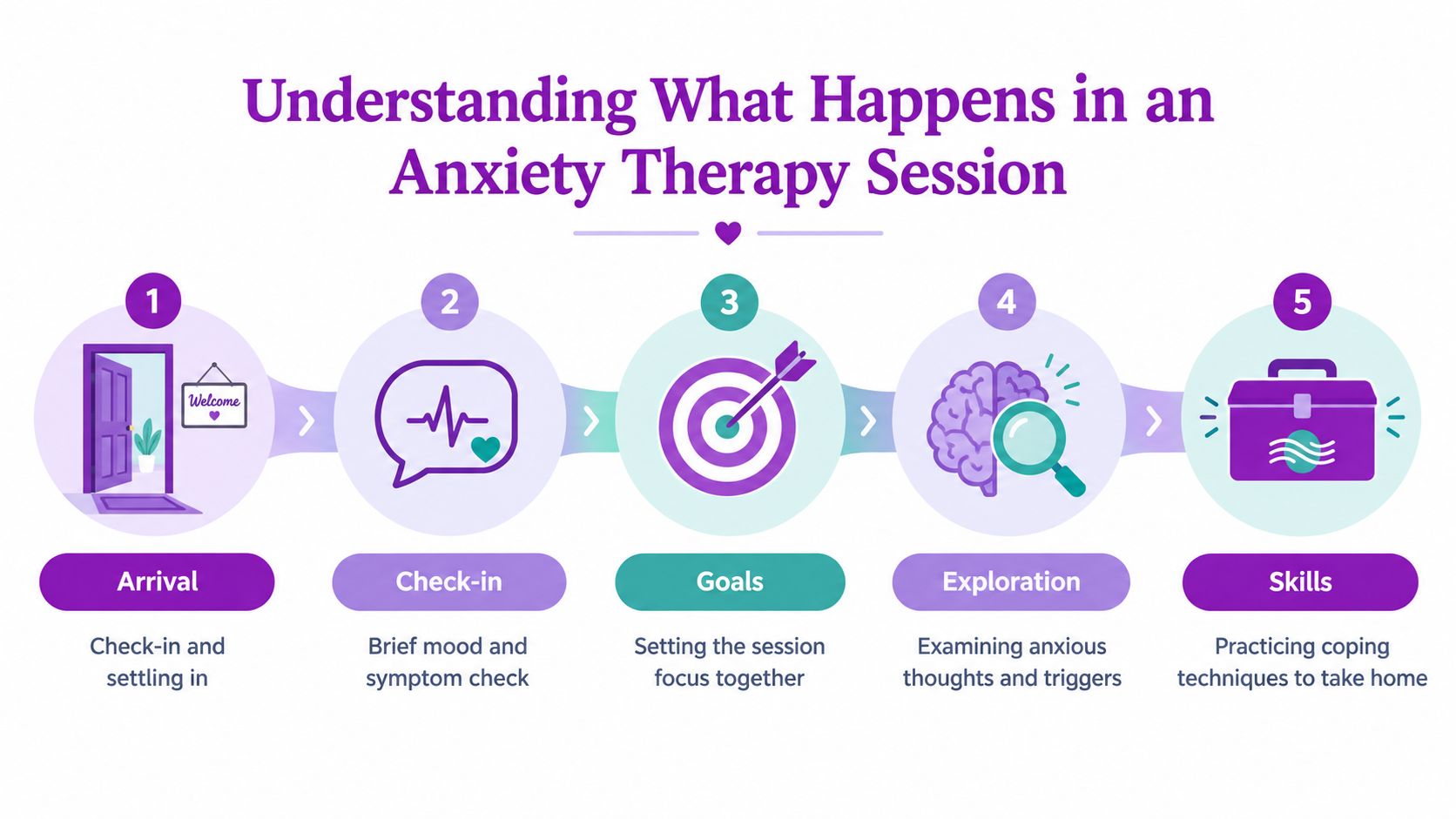
A practical session flow
A structured anxiety therapy session often includes:
- Settling in and checking progress. You describe what has changed, stayed the same, or become harder.
- Setting an agenda together. You and the therapist choose a specific focus instead of trying to solve everything at once.
- Examining patterns. You may map a trigger, anxious prediction, physical response, behavior, and short-term consequence.
- Practicing an intervention. This might involve cognitive restructuring, breathing practice, exposure planning, or another targeted exercise.
- Choosing between-session practice. You leave with a small, clear experiment that helps transfer the skill into daily life.
The work may feel uncomfortable when you examine a feared prediction or approach something you've been avoiding. That discomfort has a purpose. Behavioral testing gives you new information, while reducing avoidance can show you that anxiety doesn't have to dictate every decision.
Practical rule: You don't need to perform wellness in therapy. Accurate information, including “I didn't complete the exercise” or “I felt worse,” gives your therapist something useful to work with.
A collaborative approach matters. You can ask why an exercise is being used, request a slower pace, or explain that a technique doesn't fit. If you'd like a broader explanation of the conversation-based process, you can read what talk therapy involves. Gentle routines outside appointments can also support a sense of calm, such as a shower routine paired with mental wellness with shower steamers, but a comfort ritual isn't a substitute for clinical care.
Common Therapy Modalities for Anxiety Treatment
Choosing a therapy modality can feel like choosing a route before you know the terrain. Your symptoms, goals, preferences, and response to treatment all help determine which route fits. A clinician may also adjust the approach as new information emerges.
Cognitive behavioral therapy, or CBT, is one of the best-supported approaches used in anxiety therapy sessions. It treats anxiety as a pattern involving thoughts, feelings, physical sensations, and behavior. You might examine an overestimated threat, review the evidence, and plan a behavioral test instead of treating the anxious prediction as fact.
A 2024 systematic review and network meta-analysis examined 65 studies involving 5,048 adults with generalized anxiety disorder. During acute treatment, CBT, third-wave CBT approaches, and relaxation therapy performed better than treatment as usual. At 3 to 12 months after treatment ended, CBT was the only therapy category that remained significantly more effective than treatment as usual, with a standardized mean difference of −0.60 and a 95% confidence interval from −0.99 to −0.21 (JAMA Psychiatry).
How the approaches differ
| Approach | What may happen in a session | Useful question to ask |
|---|---|---|
| CBT | You identify anxious thoughts, test beliefs, reduce avoidance, and practice skills. | “How will we measure whether the patterns are changing?” |
| Third-wave CBT | You may practice acceptance, mindfulness, values-based action, or a different relationship to anxious thoughts. | “Will we focus on changing thoughts, responding differently to them, or both?” |
| Relaxation therapy | You learn techniques intended to reduce physical arousal and manage short-term distress. | “How should I use relaxation without making it another safety behavior?” |
A 2022 meta-analysis of psychologically delivered interventions analyzed 84 anxiety-outcome comparisons involving 26,689 participants. It found a significant reduction in symptom severity, with an effect size of d = 0.80 and a 95% confidence interval of 0.71 to 0.90 (2022 meta-analysis of psychological anxiety interventions). The finding supports structured psychological treatment, while leaving room for individual differences in fit and response.
You can review types of therapy for anxiety before an appointment, then ask how the clinician matches an approach to your symptoms, preferences, risk factors, and goals. A plan can change if your progress, comfort, or priorities indicate that another pace or method would work better.
Why People Delay Starting Anxiety Therapy Despite Recognizing It
You may recognize months of worry, avoidance, or physical tension and still hesitate to book an appointment. The hesitation often comes from uncertainty: Do these symptoms “count”? Will therapy help? What happens after searching for a provider? Comparing yourself with people who seem to be coping worse can make your own distress feel unqualified.
A 2025 analysis of 56,927 people across 21 countries found that 46% of people meeting criteria for a mental disorder recognized a need for treatment. Of those who recognized that need, 34% contacted services, and 6.9% ultimately received effective treatment (British Psychological Society Research Digest). The gap between recognizing a problem and receiving care shows why deciding to start can be difficult.
The uncertainty behind the delay
A separate analysis of 102,812 adults across 19 countries found that untreated people commonly reported low perceived severity at 52.9%, doubts about treatment effectiveness at 44.8%, nonfinancial barriers at 40.2%, financial barriers at 32.9%, and stigma at 20.6%. These findings come from a cross-national analysis of treatment barriers. Together, the barriers describe a decision problem as well as an access problem.
Your first concern after starting therapy may be discomfort. Noticing avoidance or trying a different behavior can feel difficult, even when the therapist explains the purpose and adjusts the pace. That discomfort can be workable. Feeling dismissed, unable to ask questions, or unclear about how treatment relates to your goals calls for a direct conversation about fit or a change in provider.
Progress does not require instant relief. Use these questions to judge whether treatment has a clear direction:
- Clarity: Can you explain what you are working on and why?
- Participation: Can you raise concerns without feeling judged?
- Direction: Do sessions connect with goals that matter in daily life?
- Review: Does the therapist use your experience to adjust the plan?
Therapy can begin before anxiety becomes a crisis. Waiting until it controls work, relationships, sleep, or daily choices may make starting harder. You do not need certainty that therapy will solve everything. You need enough information to make an appointment and assess, with the therapist, whether the care fits.
How to Prepare for Your First Anxiety Therapy Session
The first appointment becomes more useful when you bring observations, not a polished story. Write down the main symptoms, when you notice them, what tends to trigger them, and what anxiety stops you from doing. Include physical experiences such as muscle tension, racing sensations, stomach discomfort, or difficulty sleeping if they matter to you.
Set goals that can be observed. “Feel normal” is understandable but difficult to measure. “Spend less time avoiding a specific situation,” “sleep with fewer worry spirals,” or “return to an activity I've stopped” gives you and the therapist something concrete to review.
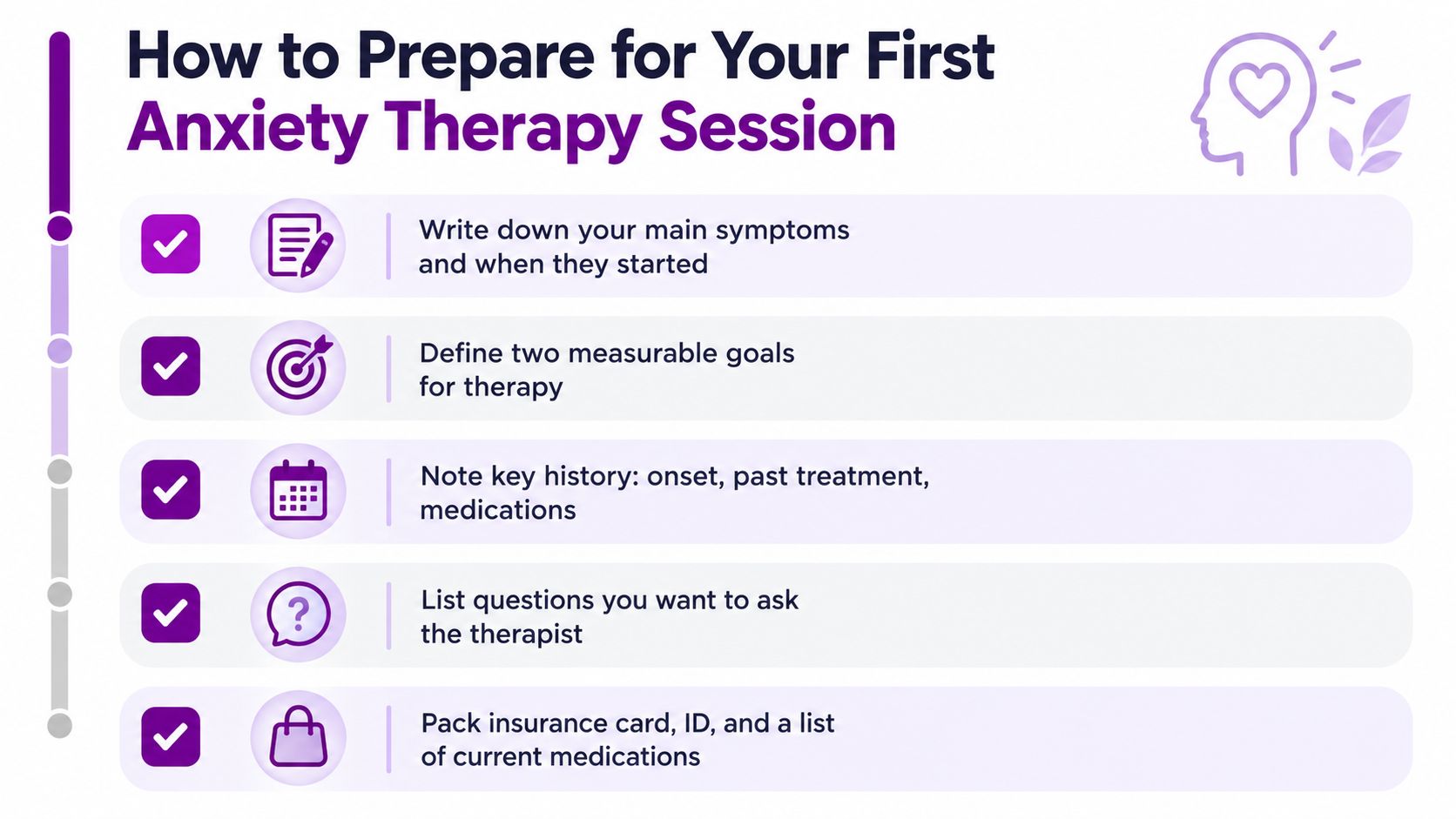
A simple preparation checklist
- Record the pattern: Note when symptoms started or became more disruptive, along with common triggers.
- Choose measurable goals: Bring two outcomes you want therapy to influence.
- Gather background details: List previous therapy, relevant health history, current medications, and major stressors.
- Write questions: Ask about the treatment approach, session structure, between-session practice, confidentiality, and progress reviews.
- Pack essentials: Bring your identification, insurance card, and medication list if requested by the provider.
Arrive with enough time to handle forms and settle your breathing, but don't spend the evening trying to create a complete biography. Your therapist can ask follow-up questions. Saying “I don't know where to start” is a valid start.
You can also use therapy intake questions to organize what you want to ask. The first appointment may focus on assessment and rapport rather than producing immediate change. That doesn't make it unproductive. It gives the clinician information needed to decide whether CBT, another psychological approach, medication evaluation, or a coordinated plan makes sense.
A useful expectation: Improvement isn't automatic simply because you attended. Therapy works through collaboration, repeated practice, honest feedback, and adjustments when the plan isn't helping enough.
Telehealth Versus In-Person Anxiety Therapy Sessions
Choose a format based on clinical fit, privacy, access, and your ability to participate, not convenience alone. Telehealth can remove transportation barriers and make scheduling easier, while in-person care may offer a consistent setting and more visible nonverbal information. Neither format eliminates the need for a clear treatment plan.
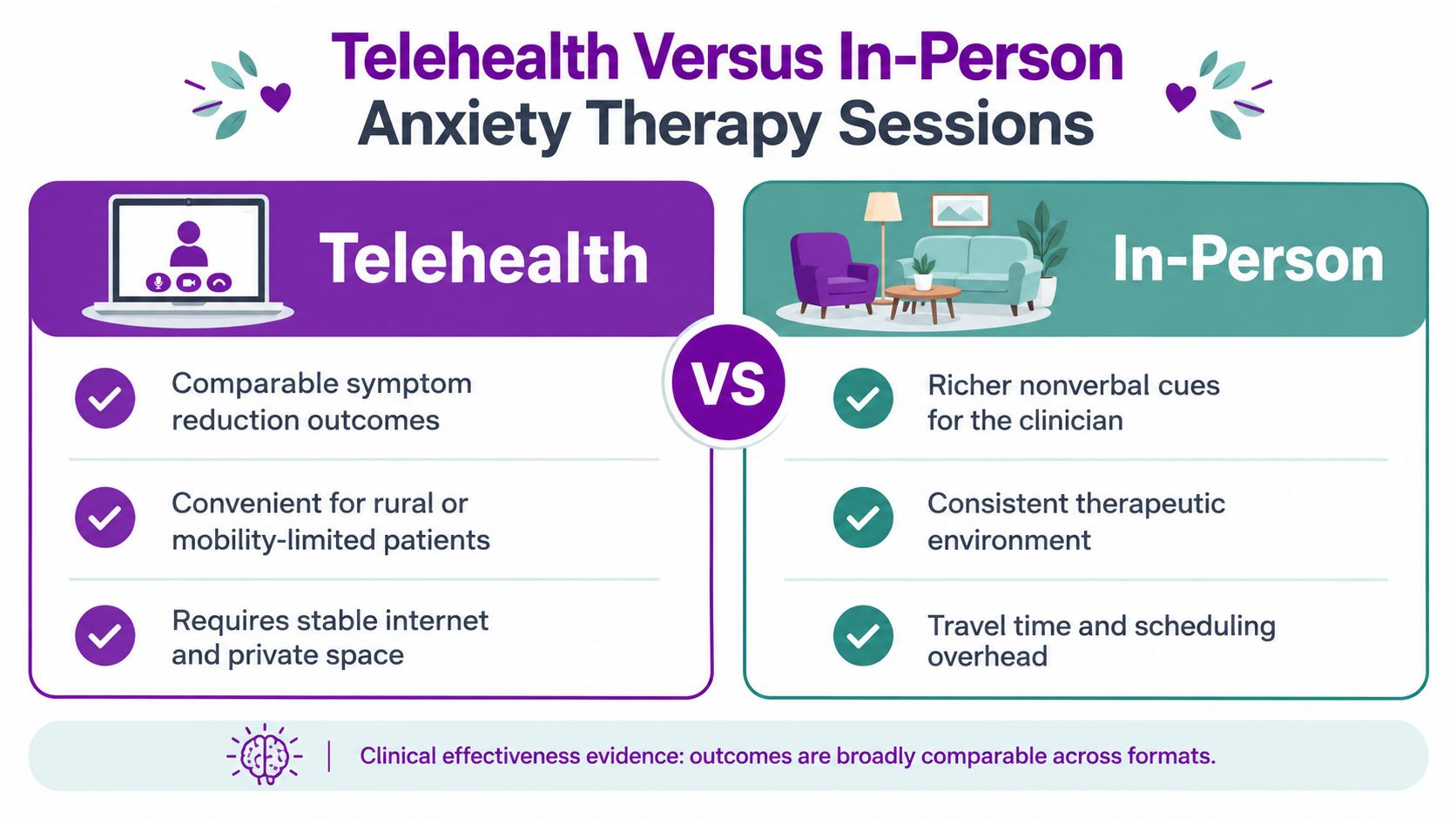
Before choosing online care, check whether you have a private space, reliable internet, and a plan for interruptions. Ask what happens if your anxiety escalates, you can't complete an exercise independently, or the therapist believes you need a higher level of support. If trauma symptoms, safety concerns, or medication evaluation are part of the picture, clarify how the provider coordinates additional care.
Questions that prevent format surprises
- How will we practice skills online? The answer should describe more than video conversation. It may include shared worksheets, guided exercises, or planned behavioral experiments.
- How do we handle technical problems? Agree on a backup communication method and what happens if the connection fails.
- What happens outside the program's scope? Ask how the provider responds when symptoms require individualized assessment or another service.
- Can I switch formats? A hybrid option may help if privacy, transportation, or symptom intensity changes.
- How is urgent support handled? Understand the provider's crisis and escalation procedures before you need them.
A separate analysis of therapist-assisted internet CBT found that 22.62% of client questions involved clarifying the therapeutic process, 18.25% involved technical problems, and 12.41% sought help for issues outside the program's scope (JMIR Mental Health). Those questions are practical, not inconvenient. Ask them early so the format supports treatment instead of creating a second source of uncertainty.
Signs of Progress and When to Adjust Your Treatment Plan
You may leave a session still feeling anxious, then notice later that recovery takes less time. Progress can look like entering a situation you once avoided, recognizing an anxious prediction before acting on it, or returning to your routine after a difficult moment. Track outcomes that matter in daily life, such as sleep disruption, worry intensity, safety behaviors, concentration, work participation, and availability in relationships.
Research supports looking for meaningful change while keeping expectations realistic. Broad findings show that psychological treatments can reduce anxiety symptoms, and CBT has shown meaningful improvement for generalized anxiety disorder. These are group-level results, not a promise about how quickly your symptoms will change. Use them as a reason to monitor your response, not as a deadline.
Compare the signal with the obstacle
A treatment review should examine two questions: are your symptoms changing, and is the process workable for you?
| If you notice | Discuss with your therapist |
|---|---|
| You understand your patterns but still avoid key situations | Whether behavioral practice should become more specific or gradual |
| Exercises cause temporary discomfort | Whether the pace and coping support fit your current capacity |
| You see no meaningful change | Whether the formulation, modality, goals, or session frequency should change |
| You feel unsafe, dismissed, or unable to speak honestly | Whether the therapeutic relationship is a poor fit |
| Anxiety remains severe or affects several areas of life | Whether psychiatric assessment or coordinated care belongs in the plan |
Bring brief tracking notes to your sessions. You might record the situation, your anxiety level, what you did, and how long recovery took. Then ask, “What would tell us that this approach is working?” A clinician should be able to answer without treating questions as resistance.
Treatment may help quickly at first, while longer-term results remain less predictable. Ask how you will rehearse skills between sessions, prepare for setbacks, and recognize early warning signs. A written follow-up plan can function like a map: it shows which skills to use, when to contact the therapist, and when the plan needs review. If improvement stalls, adjusting treatment is information about the approach, not proof that you have failed.
Finding the Right Anxiety Therapy Provider Near You
A practical search starts with three filters: clinical approach, workable access, and a relationship that allows honesty. Ask whether the provider treats anxiety with structured psychological methods, how progress is monitored, whether online and in-person options are available, and how therapy connects with psychiatric medication management when needed. Confirm insurance participation and ask about appointment availability before investing energy in a long intake process.
For adults in the Phoenix metro area, reVIBE Mental Health offers talk therapy, EMDR, and psychiatry with medication management through an integrated practice model. The practice provides in-person and secure online appointments, accepts major insurance plans, and lists appointment availability seven days a week. Details can change, so verify current scheduling, insurance, and services directly with the provider.
Arizona locations and contact details
reVIBE lists five Arizona locations and one central phone number, (480) 674-9220 (location information):
reVIBE Mental Health, Chandler
3377 S Price Rd, Suite 105, Chandler, AZreVIBE Mental Health, Phoenix Deer Valley
2222 W Pinnacle Peak Rd, Suite 220, Phoenix, AZreVIBE Mental Health, Phoenix PV
4646 E Greenway Road, Suite 100, Phoenix, AZreVIBE Mental Health, Scottsdale
8700 E Via de Ventura, Suite 280, Scottsdale, AZreVIBE Mental Health, Tempe
3920 S Rural Rd, Suite 112, Tempe, AZ
When you call, describe the anxiety symptoms you want help with, whether you prefer in-person or online care, your insurance, and any scheduling constraints. Ask how you'll be matched with a therapist, what the first anxiety therapy session includes, and how you can request a different provider if the fit isn't right.
The first appointment doesn't require confidence that you'll never feel anxious again. It requires a willingness to describe what's happening and evaluate whether the care plan helps you move toward the life you want.
reVIBE Mental Health provides anxiety therapy through talk therapy, EMDR, and psychiatry with medication management, with both secure online and in-person appointments across Arizona. Visit reVIBE Mental Health to review care options, check insurance and scheduling details, and take the next step toward an anxiety therapy session that matches your needs.