

You may be functioning at work, answering messages, and caring for your family, yet one moment keeps pulling you backward. It might be the phone call announcing the death, a hospital room, the sight of your loved one after they died, or the last conversation you can't stop replaying. Each time the memory returns, your body reacts as though the loss is happening again.
EMDR therapy for grief can help some people process that trauma-shaped part of bereavement. It isn't designed to erase love, remove sadness, or hurry someone through mourning. It's one evidence-informed approach among several, and it tends to make the most sense when grief feels stuck around vivid memories, guilt, fear, avoidance, nightmares, or other trauma symptoms.
What Grieving People Often Want to Know About EMDR
Grief and bereavement aren't interchangeable. Bereavement describes the experience of losing someone, while grief describes the emotional, physical, relational, and spiritual response that follows. A useful explanation of the distinction appears in this guide to grief versus bereavement, but the practical point is simple: not every painful loss requires trauma-focused therapy.
Some people need time, trusted relationships, a faith community, or a bereavement support group. Others benefit from cognitive behavioral therapy, which can help with guilt, avoidance, unhelpful beliefs, sleep disruption, and changes in daily behavior. Complicated Grief Treatment, often called CGT, focuses directly on persistent yearning, difficulty accepting the death, life disruption, and the work of reconnecting with meaningful activities.
EMDR takes a different route. It focuses on distressing memories and the thoughts, emotions, and body sensations attached to them. A person might still miss their parent after EMDR, but the memory of the final hours may no longer produce the same panic, mental replay, or physical overwhelm.
A useful first question
Ask yourself, “What exactly feels stuck?”
If the answer is ordinary waves of sadness, longing, anger, or disorientation that move and change over time, supportive grief counseling may be a better starting point. If the answer is “I keep seeing the death,” “I can't enter the hospital,” “I feel responsible,” or “my body goes into alarm whenever someone mentions it,” a trauma-informed assessment may be appropriate.
EMDR isn't a quick fix, and grief doesn't follow a schedule. Research supports it as a potentially useful option when bereavement includes intrusive or traumatic memories, but it doesn't show that EMDR is universally superior to CBT or other grief treatments. The sections below will help you think through fit, understand what sessions involve, weigh the evidence, and identify practical questions for a local therapist.
A grounded expectation: EMDR may soften the traumatic charge around a loss. It won't make the relationship less important or turn grief into a problem that never returns.
How EMDR Works for Grief and Bereavement
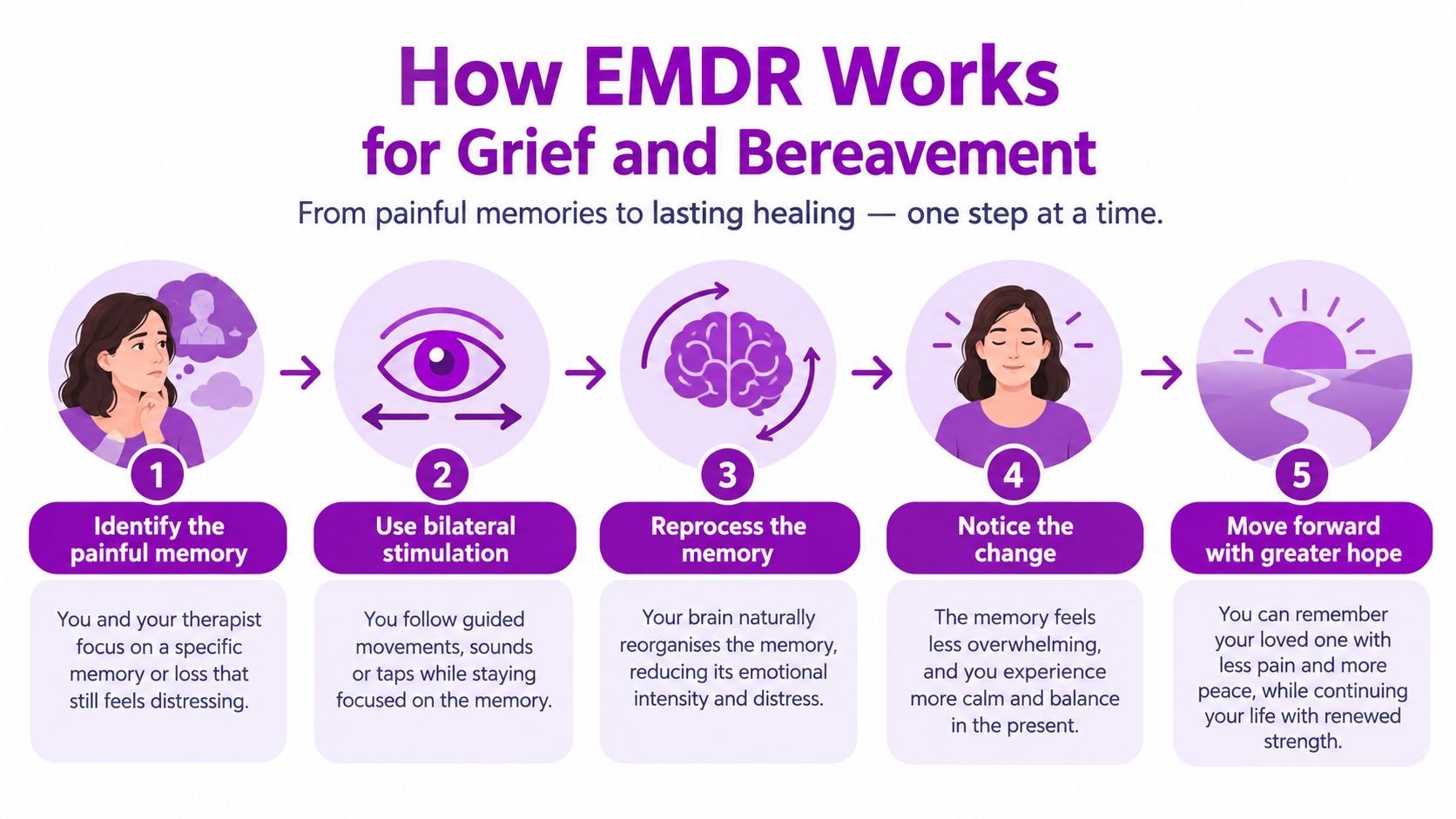
EMDR follows an eight-phase protocol, not a technique limited to moving the eyes from side to side. The therapist first learns your history, assesses safety, and helps you develop ways to stay present when emotions rise. Preparation can include breathing, grounding, imagery, and a “safe place” or other calming resource.
Suppose the selected target is the memory of a parent's final hours. During assessment, you and the therapist identify the most disturbing image, the negative belief it triggers, the emotions involved, and where you feel the distress in your body. You might notice a thought such as “I failed them,” along with fear, guilt, tightness in your chest, or a vivid image of the hospital room.
During desensitization, you briefly hold the target memory in mind while following bilateral stimulation. This may involve guided eye movements, alternating taps, or alternating tones. The therapist pauses regularly so you can notice what changes. The aim isn't to force a particular story or erase the memory. Bilateral or dual-attention stimulation is one part of a broader protocol, and researchers propose that it may help reduce the vividness and emotional intensity of a distressing memory while you remain aware of the present.
The remaining phases
Once the distress connected to the target has reduced, the therapist helps you strengthen a more useful belief, such as “I did what I could” or “I can remember and remain safe.” That is the installation phase. A body scan follows, checking for lingering tension or discomfort that may need attention.
The therapist then uses closure to help you return to steadiness before the appointment ends. At the next meeting, reevaluation checks what changed, what remains active, and whether another target should be addressed.
Standard EMDR can be adapted for grief. A more specialized approach, known as EMDR-IG, was developed by Shutts and colleagues for complicated grief and adds grief-specific targets and cognitions. It still requires careful assessment and preparation rather than treating every loss memory in the same way.
The underlying Adaptive Information Processing model proposes that distressing experiences can remain linked to the emotions, beliefs, and sensations present when they occurred. A trauma-informed framework, such as the one described in this resource on the HELP Now AZ trauma-informed approach, also emphasizes safety, collaboration, choice, and attention to the whole person. For a more general explanation of the therapy, you can review how EMDR therapy works.
What the Research Actually Shows About EMDR for Grief
The most important conclusion is measured rather than dramatic. EMDR has promising evidence for trauma-related grief, but the research base remains smaller and less definitive than many online articles suggest.
A foundational randomized controlled trial examined 19 adults, 12 women and 7 men, who reported significant difficulties after losing someone close. Participants spent 7 weeks on a waiting list and then received 7 weekly sessions of either EMDR or CBT. Researchers found no significant improvement on any outcome during the waiting period. After treatment, both groups showed significant reductions in grief symptoms, trauma symptoms, and general psychological distress. The reported effect sizes were .47 for grief, .60 for trauma symptoms, and .34 for distress, while the quality-of-life effect was smaller and not statistically significant at .11 (study background).
Among participants whose initial scores were in the clinical range, 72% achieved clinically meaningful and reliable improvement on the grief measure, and 82% did so on the trauma measure (reported trial findings). Those figures are encouraging, but they come from a small sample. The trial also lacked a direct no-treatment comparison after therapy, and it did not establish that EMDR was better than CBT.
What newer reviews add
A controlled experiment with 60 participants examined immediate responses to a negative loss-related memory. The eye-movement condition produced greater reductions in the memory's emotionality and the person's ability to focus on it than relaxation music or recall-only conditions (mechanism study). That supports a possible short-term memory-processing mechanism, not proof that EMDR prevents or resolves prolonged grief.
A 2025 systematic review examined 30 randomized controlled trials of psychotherapy for prolonged grief disorder published from 2011 through 2024. It found promise in approaches involving CBT, mindfulness, exposure, and EMDR, particularly for trauma-related grief. A separate 2025 network meta-analysis examined 40 primary studies and 5 follow-up studies. Several approaches showed stronger short-term associations, while narrative therapy, CGT, and social-support interventions performed well at follow-up. No intervention produced large effects in long-term follow-up (systematic review and meta-analysis summary).
| Treatment | Key trials | Approx. effect size | Follow-up | Evidence strength |
|---|---|---|---|---|
| EMDR | Small randomized grief trial | Grief .47, trauma .60, distress .34 | Significant reductions remained at follow-up in the EMDR group | Promising, preliminary |
| Complicated Grief Treatment | Larger established grief-treatment literature | Not provided in the verified evidence summarized here | Follow-up evidence is comparatively stronger | More established for prolonged grief |
| CBT and integrated approaches | Randomized comparisons with EMDR and other therapies | Not established as superior to EMDR in the cited trial | Varies by study | Supported option, with a broader grief-treatment role |
EMDR hasn't been shown to prevent normal grief, replace bereavement support, or outperform the best-supported CGT protocols. Reviews also report that direct comparisons between EMDR and CGT remain inadequate, especially for people meeting formal criteria for prolonged grief disorder (review of EMDR and prolonged grief evidence).
What an EMDR Grief Session Looks Like Step by Step
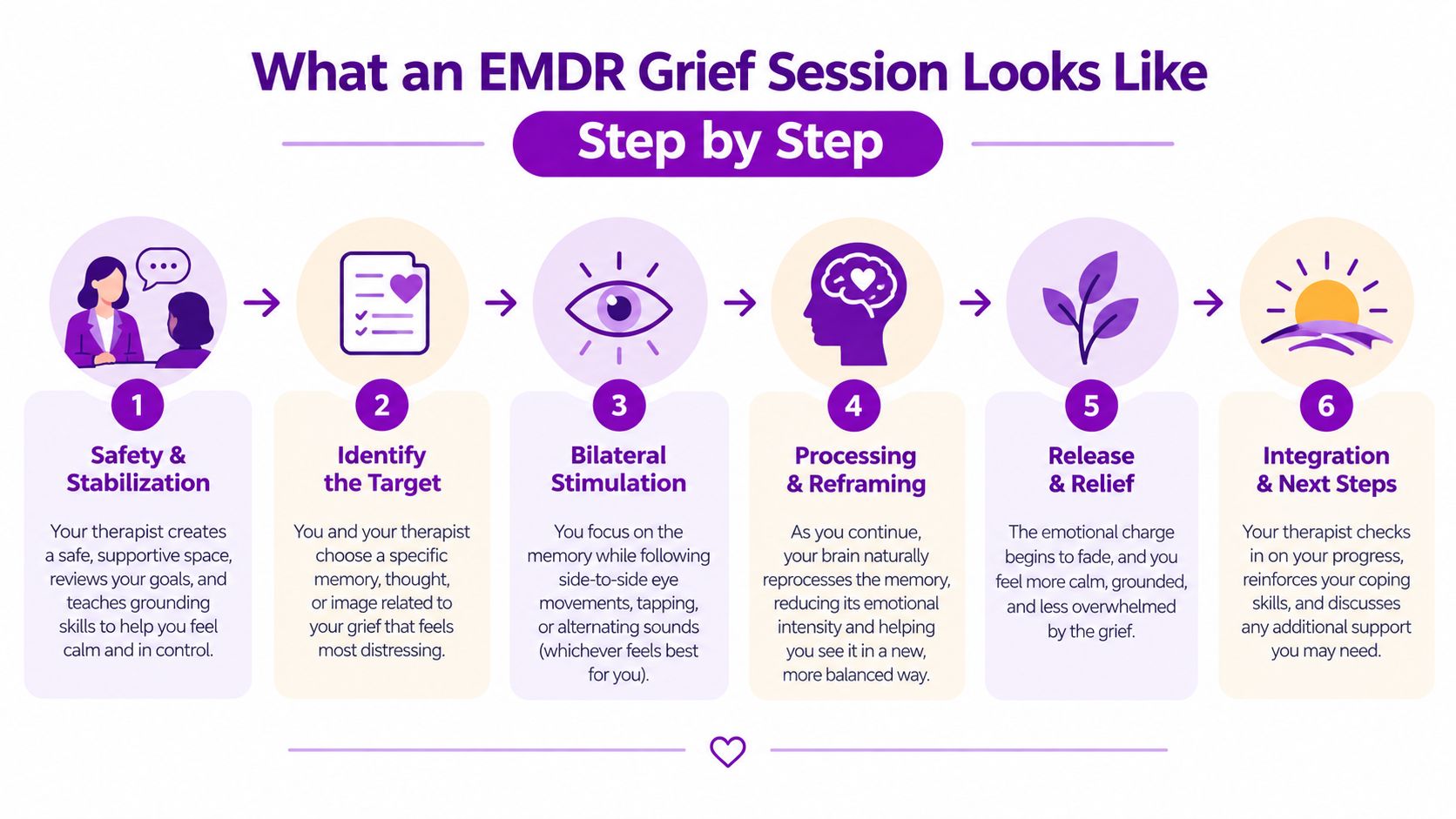
A grief-focused EMDR appointment usually begins with a 5 to 10 minute check-in, although the exact timing varies. The therapist may ask about sleep, emotional regulation, recent triggers, medication changes, and whether anything has made you feel less safe since the previous session.
The early appointments often focus on history and preparation rather than memory processing. Together, you identify possible targets such as the moment of the death, the last conversation, a disturbing image, or a guilt-laden decision. You may also practice a resource exercise, such as imagining a safe figure, using a container for intrusive thoughts, or noticing physical contact with the chair and floor.
Processing one memory at a time
Consider someone processing the memory of a sibling's hospital room. The therapist might ask for the image that represents the worst part, the belief attached to it, the emotion, and the body location of the distress. The client then holds the memory lightly while tracking guided eye movements, alternating taps, or tones.
After each set, the therapist asks what the client notices. The image might become less vivid, a previously frozen detail might change, or a belief such as “I abandoned my sibling” might shift toward “I stayed as long as I could.” The therapist doesn't tell the client what the memory should mean. The client notices the associations, and the therapist helps maintain dual attention between the past event and the present room.
Ending safely
Processing is done in small doses. You can ask to pause, open your eyes, change the target, or stop for the day. A competent therapist watches your level of activation and won't treat emotional intensity as proof that the session is working.
The closure phase returns attention to the present and may include grounding, breathing, or the calming resource practiced earlier. You and the therapist debrief without needing to solve every aspect of the loss. At the next session, reevaluation identifies what has settled and what still needs care.
You remain an active participant. EMDR isn't something a therapist does to you while you surrender control.
Who Is a Good Candidate and Who Should Pause
EMDR, CBT for grief, CGT, and general bereavement counseling serve different needs. A person who wants help rebuilding routines may benefit from CBT. Someone experiencing persistent yearning and major life disruption may need CGT. Someone needing companionship, validation, and practical support may prefer grief counseling or a group.
EMDR may fit adults who experience:
- Intrusive memories: The death scene, notification, hospital experience, or funeral repeatedly enters awareness with overwhelming force.
- Trauma responses: Nightmares, hyperarousal, avoidance, fear, or physical alarm accompany the grief.
- Persistent impairment: Grief symptoms continue beyond 6 to 12 months and interfere with work, relationships, sleep, or basic routines.
- A defined target: The person can identify a memory, belief, sensation, or anticipated situation they want to process.
Losses involving suicide, homicide, the death of a child, or violent circumstances often combine bereavement with trauma. That doesn't automatically make EMDR the right first intervention. Stabilization may need to come before memory processing.
When to pause
A therapist may recommend postponing trauma processing during active substance use, untreated dissociative disorders, recent suicidal ideation, an acute medical crisis, or psychosis. These situations call for safety planning, medical coordination, stabilization, or a different level of care first.
Standard EMDR protocols are validated for adults. Adolescent grief adaptations exist, but young people need a clinician experienced with both developmental needs and trauma treatment. Candidacy is a clinical judgment, not a self-diagnosis.
| Approach | Best fit for | Session count | Focus | Evidence strength |
|---|---|---|---|---|
| EMDR | Trauma-shaped grief with specific distressing memories | Individualized | Memory reprocessing, beliefs, body responses | Promising but preliminary |
| CBT for grief | Avoidance, guilt, sleep disruption, and daily functioning | Individualized | Thoughts, behaviors, coping, meaning | Established treatment option |
| Complicated Grief Treatment | Persistent yearning and impairment linked to prolonged grief | Individualized | Grief symptoms, restoration, and engagement with life | More extensively studied for prolonged grief |
| Bereavement counseling or support | Normal mourning and need for connection | Flexible | Validation, support, education, and adjustment | Appropriate supportive care, not a trauma-processing protocol |
For a closer look at a grief-specific treatment option, read about Complicated Grief Therapy. The right choice depends on the symptom pattern, safety, preferences, culture, and treatment goals.
How to Prepare for Your First EMDR Appointment
You don't need to arrive with a perfectly organized story. A short, honest record can help the clinician understand what happened and what is affecting you now.
Gather before the appointment
- A loss timeline: Note the date and circumstances of the death, major changes afterward, and memories that feel especially distressing.
- Previous therapy records: Include relevant diagnoses, treatment summaries, and information about what helped or made symptoms worse.
- Your medication list: Write down current medications, supplements, and recent changes.
- A symptom snapshot: Note intrusive images, sleep changes, avoidance, panic, guilt, numbness, and effects on work or relationships.
When you call, ask whether the clinician completed EMDR training through an EMDRIA-accredited course, how many grief cases they've completed, what license they hold, and whether they coordinate with your primary care physician when needed. Ask how they decide whether preparation should continue before processing starts.
Disclose active suicidality, recent substance use, dissociative episodes, unmanaged medical conditions, and medications that affect arousal. These details aren't admissions of failure. They help the therapist plan safely and determine whether another clinician or medical provider should be involved.
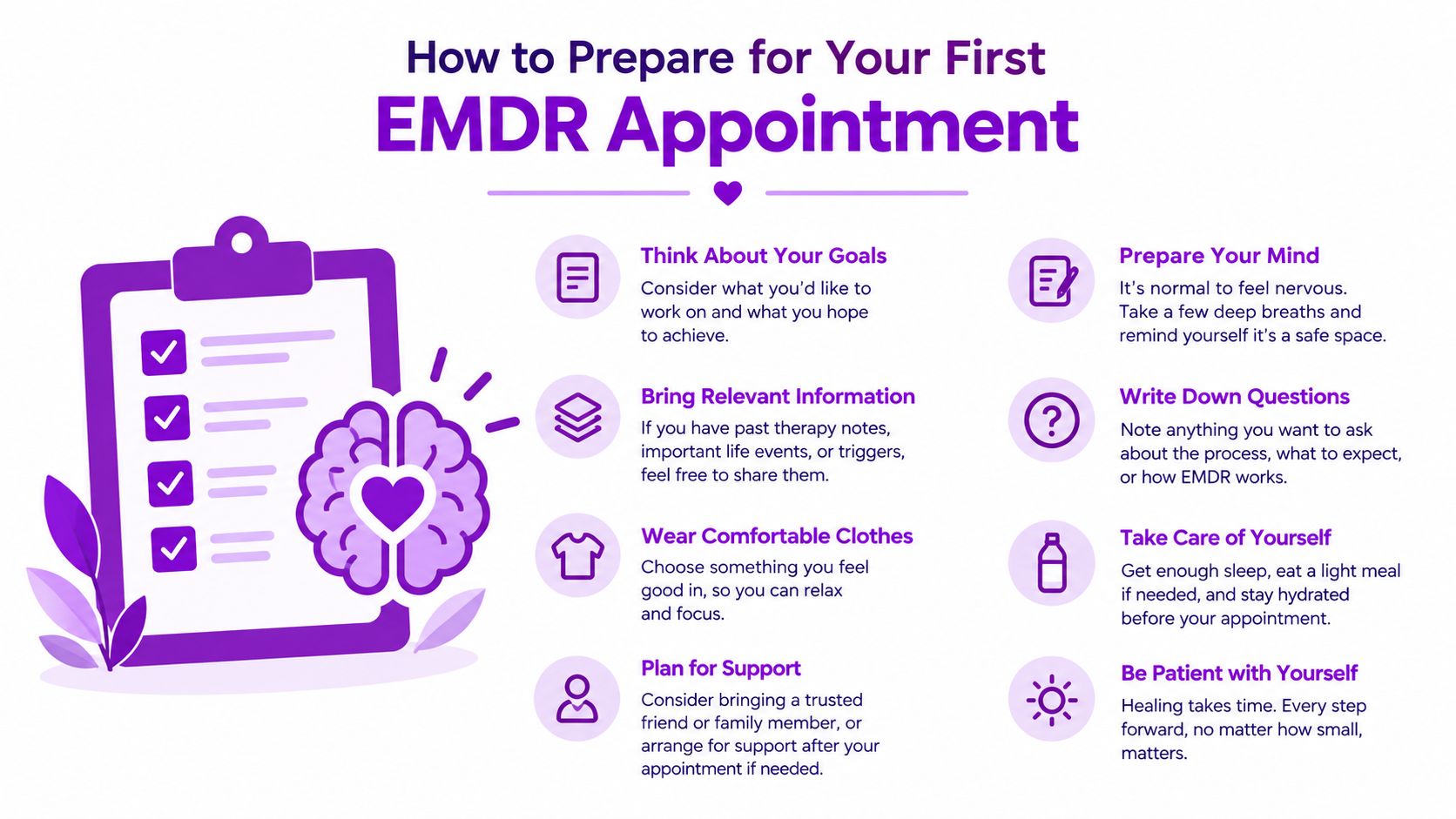
Bring water, a small snack, and sunglasses if your eyes water during sets. If you expect to process a memory during your first processing appointment, consider arranging for a trusted person to drive you home.
Be cautious if a therapist guarantees a cure, pressures you to begin memory work during the first appointment, or won't explain their training. A good consultation should leave room for questions, pacing, and a different starting point if EMDR isn't appropriate yet.
Finding Local EMDR Support in the Phoenix Metro
If you live in the Phoenix metro area, start by asking a prospective therapist three practical questions: Do you treat traumatic grief? Are you accepting new clients? Do you offer in-person sessions, telehealth, or both? Telehealth can be useful if you live farther out or want to begin with assessment and stabilization before deciding on processing.
reVIBE Mental Health currently has five locations for convenience. The practice offers in-person sessions, with telehealth available for people who live farther away or prefer secure online care. The scheduling line is (480) 674-9220.
| Logistics | Detail |
|---|---|
| Chandler | 3377 S Price Rd, Suite 105, Chandler, AZ |
| Phoenix Deer Valley | 2222 W Pinnacle Peak Rd, Suite 220, Phoenix, AZ |
| Phoenix PV | 4646 E Greenway Road, Suite 100, Phoenix, AZ |
| Scottsdale | 8700 E Via de Ventura, Suite 280, Scottsdale, AZ |
| Tempe | 3920 S Rural Rd, Suite 112, Tempe, AZ |
| Appointment formats | In-person sessions and telehealth availability |
| First conversation | Ask about fit, location, timing, training, and insurance |
Coverage deserves a direct conversation rather than an assumption. Ask your insurer whether EMDR is covered under psychotherapy and whether your plan applies CPT code 90834 versus 90837. If the therapist is out of network, ask the insurer how to request out-of-network benefits, whether prior authorization is required, and what documentation they need.
Staff can verify benefits before the first appointment when that service is available. Ask the practice for its current general email address and intake form link, since contact details and onboarding procedures can change. For additional non-clinical reading, these bereavement support resources may help you identify support between appointments.
A free consultation call can be a low-pressure first step. You can use it to confirm the clinician's experience, location, availability, insurance process, and whether your current needs call for EMDR or another form of grief support.
Your Next Step and When EMDR Is Worth Trying
EMDR may be worth exploring when your grief feels stuck, intrusive, or fused with trauma. That could mean witnessing a sudden death, replaying a disturbing discovery, avoiding reminders, experiencing nightmares, or carrying an intense belief that you caused the loss. It's also more workable when you have a stable living situation, adequate support, and enough emotional capacity to commit to approximately 8 to 12 sessions, if your clinician recommends that course.
Starting elsewhere may be wiser during an active suicidal crisis, unmanaged substance use, or a period when a complicated grief presentation hasn't received medical and psychological evaluation. Supportive counseling, CBT, CGT, medication evaluation, or practical crisis care may need to come first. Choosing another entry point isn't giving up on EMDR. It's matching the treatment to your safety and current needs.
Try one concrete action this week. Write a single sentence describing what you want to feel or do differently, such as “I want to remember the hospital without feeling trapped there.” Call (480) 674-9220, ask for a consultation, and bring that sentence with you.
Grief isn't linear. A difficult day doesn't cancel progress, and a calmer memory doesn't mean you loved the person less. EMDR is one well-supported tool for a particular kind of grief-related distress, not a guarantee and not a replacement for the relationships, rituals, meaning, and time that also shape mourning.
reVIBE Mental Health offers individual EMDR, talk therapy, and psychiatric support for people processing grief, trauma, and related concerns through in-person and secure online appointments. Visit reVIBE Mental Health to review care options and request a consultation about fit, location, timing, and insurance.