When you start searching for a therapist, the alphabet soup of credentials like LPC and LCSW can feel a bit overwhelming. While both are highly trained and qualified mental health professionals, the real difference between an LPC and an LCSW comes down to their core training and the lens through which they view mental health.
An LPC (Licensed Professional Counselor) comes from a background laser-focused on counseling theory and the art of clinical talk therapy. Think of them as specialists in the therapeutic process itself.
An LCSW (Licensed Clinical Social Worker), on the other hand, combines that same clinical therapy training with a unique "person-in-environment" perspective. Their social work foundation means they are always considering how larger social systems—like your community, family, and economic situation—affect your individual well-being.
At a Glance Comparing LPC and LCSW Credentials
To make this even clearer, let's break down the key professional differences between these two highly respected credentials. This table gives a quick snapshot of their distinct paths and practice philosophies.
| Credential | Licensed Professional Counselor (LPC) | Licensed Clinical Social Worker (LCSW) |
|---|---|---|
| Primary Focus | Individual and group counseling through therapeutic techniques. | A holistic "person-in-environment" view, linking individual therapy with social and community factors. |
| Education | Master's in Counseling (M.A. or M.S.). | Master of Social Work (MSW). |
| Training Philosophy | Deep dive into counseling theories, human development, and clinical application. | Integrates clinical psychotherapy with social justice, advocacy, and community resource navigation. |
| Typical Approach | Often centers on resolving internal conflicts, developing coping skills, and improving emotional regulation. | May include traditional therapy plus case management, connecting clients to housing, healthcare, or employment support. |
Ultimately, both paths lead to becoming skilled therapists capable of providing effective care. The key is understanding which approach resonates most with your own needs and worldview.
This visual summary really drives home the core distinction—the LPC's intensive focus on the individual’s internal experience versus the LCSW’s wider lens that includes the individual's place within their community and society.
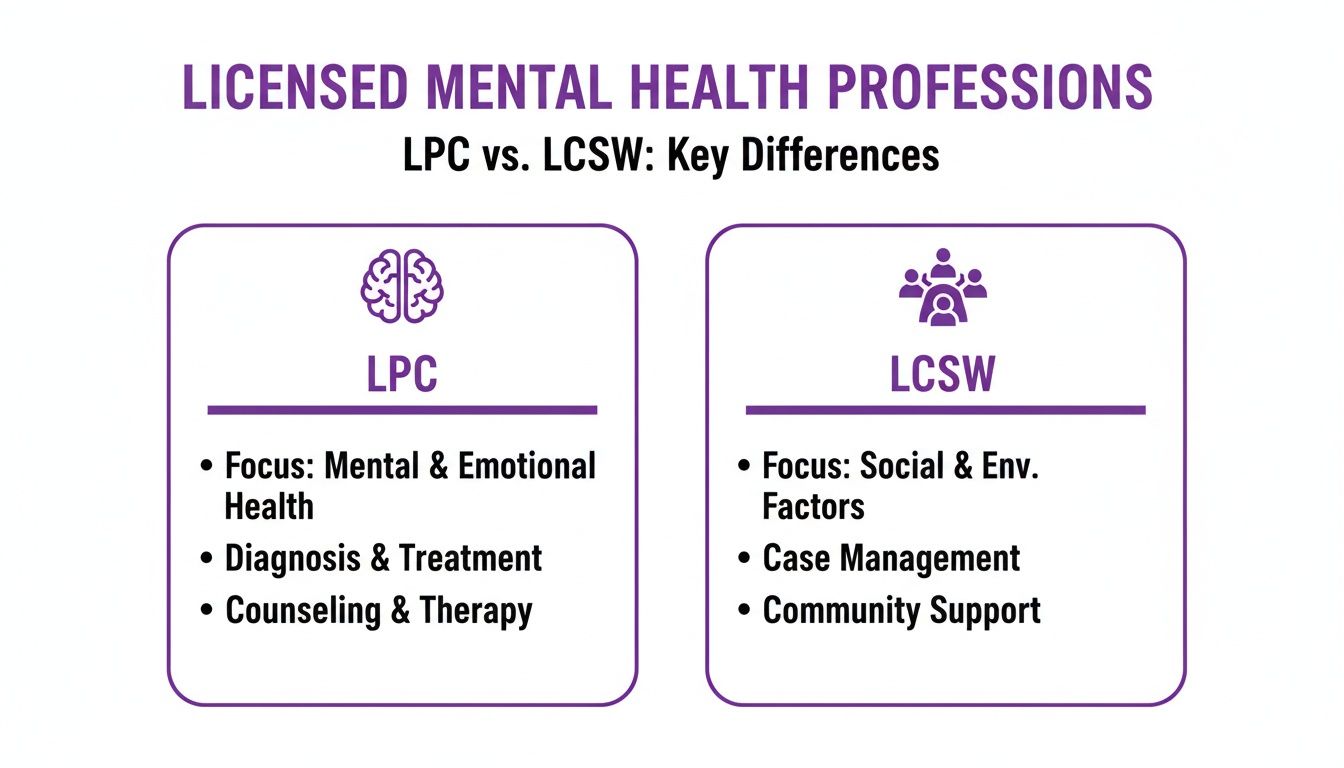
As the infographic shows, while their goals are often the same, their foundational philosophies give them different toolkits. In a similar vein, understanding the distinction between psychologists and psychiatrists can also help clarify the mental health landscape.
Getting a handle on these nuances empowers you to make a more informed choice when seeking care at one of reVIBE's locations across Scottsdale, Tempe, Chandler, or Phoenix. For a broader comparison, you can also explore the differences between a therapist vs. psychologist vs. counselor.
Comparing the Paths to Licensure in Arizona

When you sit down with a therapist, you’re trusting years of their dedicated training. Understanding the path each professional takes to get licensed can tell you a lot about the expertise and perspective they bring to the room.
While both LPCs and LCSWs go through a demanding process, their core educational philosophies are what really set them apart.
An aspiring LPC typically starts with a Master’s in Counseling. This degree is laser-focused on the art and science of therapy itself—think deep dives into therapeutic techniques, human development, and clinical assessment. They are truly specialists in talk therapy.
An LCSW, on the other hand, earns a Master of Social Work (MSW). Their training is a blend of intense clinical work and a broader look at social policy, community resources, and advocacy. This gives them a unique "systems" lens, helping them see how things like your job, family, or community affect your personal well-being.
A key takeaway here is that both credentials demand a massive commitment to real-world practice. In Arizona, both LPC and LCSW candidates must clock around 3,200 hours of supervised clinical work after they’ve already earned their master's degree.
A Closer Look at Education and Exams
This highly structured journey ensures that by the time you meet your therapist, they have a solid foundation of academic knowledge and proven, hands-on skills.
- Licensed Professional Counselor (LPC): After their Master's in Counseling, an LPC candidate must pass the National Counselor Examination (NCE). Their training really hones in on a person-centered, strength-based approach to therapy.
- Licensed Clinical Social Worker (LCSW): An LCSW candidate, post-MSW, must pass the Association of Social Work Boards (ASWB) Clinical Exam. Their entire education is built on the "person-in-environment" perspective, always connecting individual struggles to the larger world.
These different educational paths and exams directly shape how each professional approaches therapy. Regardless of the letters after their name, both are fully qualified to assess and diagnose mental health conditions. If you've ever wondered about that, our guide on whether a therapist can diagnose you is a great resource.
How Their Therapeutic Styles and Specialties Differ
The different educational paths an LPC and an LCSW take really color how they approach therapy and the specialties they’re drawn to. While both are excellent talk therapists, their foundational training gives them unique perspectives on how to help you.
An LPC’s education is grounded in counseling theory. This means they often start from a person-centered model, putting your internal world—your thoughts, feelings, and personal experiences—at the forefront. They are masters at helping you explore the internal patterns behind things like anxiety, depression, and trauma.
Because their training is so focused on therapeutic techniques, many LPCs go on to get advanced certifications in very specific, powerful treatment methods. They really geek out on becoming experts in a particular kind of therapy.
Common LPC Specialties
- EMDR (Eye Movement Desensitization and Reprocessing): A highly structured and effective therapy designed to help the brain process and heal from trauma.
- Gottman Method: A popular, science-backed approach for couples therapy that gives partners real tools to manage conflict, communicate better, and reconnect.
- Play Therapy: A specialized approach for kids, using their natural language of play to help them work through tough emotions and life events.
An LCSW, on the other hand, is trained to see things through a "person-in-environment" lens. This is a game-changer. It means they're not just looking at your individual symptoms; they're trained to see how your entire world—your family, your job, your community, and even societal issues—impacts your mental health.
This systemic view is probably the biggest practical difference you'll feel in the therapy room. An LCSW might weave in case management or connect you with community resources in Tempe or Phoenix, looking at the whole picture of your life, not just what happens during your session.
This dual focus on both clinical therapy and navigating real-world systems gives them a very practical, action-oriented toolkit. They’re equipped to support you both emotionally and by helping you tackle the external stressors that are weighing you down.
Where You'll Find LPCs and LCSWs

One of the easiest ways to understand the core training of a mental health professional is to look at where they practice. The difference between an LPC and LCSW really comes to life when you see the environments where they tend to build their careers.
LPCs are most often found in settings that are laser-focused on providing direct counseling and psychotherapy. These environments let them dive deep into their specialties, whether that's helping clients with relationship issues, trauma, or specific mood disorders.
This therapy-centric approach is really the signature of the LPC role. They focus on delivering direct clinical counseling for mental health, addiction, and family challenges, often preferring private practices or outpatient clinics over roles that involve case management. You can learn more about how their roles are defined in this detailed comparison on georgefox.edu.
Common Settings for LPCs
- Private Practice: This is the classic therapy setting—offering one-on-one, couples, or family counseling in a dedicated office.
- Outpatient Mental Health Clinics: Working as part of a clinical team, like our therapists here at reVIBE Mental Health.
- Specialized Treatment Centers: Focusing on specific issues like addiction recovery, eating disorders, or grief counseling.
Where You Might Find an LCSW
LCSWs are also fantastic therapists who run successful private practices. However, their broader "person-in-environment" training prepares them for a much wider range of roles. They are uniquely skilled at working within larger systems where mental health is just one piece of the puzzle.
Because they blend therapy with advocacy and system navigation, LCSWs are essential in settings where clients need both emotional support and practical help connecting with resources.
This dual skill set makes them a natural fit in places where a client might need more than just talk therapy. You’ll often find them in:
- Hospitals and Healthcare Systems
- Public and Private Schools
- Government Agencies (e.g., Child Protective Services)
- Nonprofit and Community Outreach Organizations
In these settings, an LCSW might provide a clinical therapy session in one hour and then spend the next hour advocating for that same client's housing or healthcare needs. This really highlights their unique ability to bridge individual counseling with systemic support, a key difference when you’re weighing an LPC vs LCSW.
How to Choose the Right Therapist for You
Trying to decide between an LPC and an LCSW can feel overwhelming, but it doesn't have to be. Honestly, the letters after a therapist's name are often less important than your specific goals and what you're hoping to get out of your sessions.
For most of the reasons people seek therapy—like navigating anxiety, coping with grief, working through depression, or just focusing on personal growth—both LPCs and LCSWs are absolutely qualified to help. The real key in these situations isn't the license, but the therapist's individual experience and, most importantly, the connection you feel with them.
Matching Your Needs to a Professional's Strengths
The distinction between the two really starts to matter when your situation calls for a particular kind of expertise. Think of it like this: you wouldn't see a heart surgeon for a broken bone. Both are doctors, but their specializations are different.
You might find a great fit with an LPC if your focus is more internal:
- Learning Practical Skills: You want to learn concrete tools, like using Cognitive Behavioral Therapy (CBT) techniques to challenge anxious thoughts.
- Specific Therapy Models: You’re looking for a specific approach like EMDR for trauma or the Gottman Method for couples counseling. LPCs often dive deep into these specialized modalities.
- Personal Growth: Your main goal is self-discovery, understanding your emotional landscape, and working on your inner world.
The single biggest predictor of success in therapy isn't the therapist's degree. It's the "therapeutic alliance"—that feeling of trust, rapport, and partnership you build with your provider. Decades of research back this up.
When an LCSW's Perspective Makes a Difference
So, where does an LCSW's unique training really shine? It's in their "person-in-environment" approach. They are masters at seeing how outside forces—your job, your family, your community—impact your mental health.
An LCSW could be the better choice if your struggles are tangled up with external systems:
- System Navigation: You're hitting roadblocks with a school system (maybe for your child's IEP), social services, or even the medical system. LCSWs are trained advocates who know how to connect you with the right resources.
- Environmental Stressors: Your mental well-being is heavily affected by things like housing instability, a toxic work environment, or systemic discrimination. An LCSW is equipped to help you manage both the emotional fallout and the practical, real-world problems.
At the end of the day, the "best" therapist is the one whose expertise aligns with your needs and who makes you feel safe, heard, and understood. The most important thing you can do is take that first step. At reVIBE Mental Health, we have a wonderful team of both LPCs and LCSWs at our Chandler, Phoenix, Scottsdale, and Tempe locations, ready to find the right fit for you.
Find a reVIBE Location Near You!

We hope this guide has made the difference between an LPC and an LCSW a lot clearer. But knowing the difference is just the first step—the next is finding the right person for you. That’s where we come in.
At reVIBE Mental Health, our integrated team includes both highly skilled LPCs and LCSWs. This means we can match you with a professional whose specific training and approach are perfectly aligned with what you're going through, all within a supportive, non-judgmental environment.
We make exceptional mental healthcare accessible across the valley, with appointments available seven days a week, both in-person and online.
Our team handles everything from insurance verification to scheduling so you can focus on your well-being. And for any therapists reading this, we know that building an online presence is a huge part of connecting with clients. A good first step is exploring the best website builders for therapists to create a space that reflects your practice.
With a diverse group of professionals on our staff, you can feel confident you’re getting the right kind of care. Take a moment to meet our team of therapists and see who might be a good match for you.
We currently have five locations for your convenience. (480) 674-9220
reVIBE Mental Health – Chandler
3377 S Price Rd, Suite 105, Chandler, AZreVIBE Mental Health – Phoenix Deer Valley
2222 W Pinnacle Peak Rd, Suite 220, Phoenix, AZreVIBE Mental Health – Phoenix PV
4646 E Greenway Road, Suite 100, Phoenix, AZreVIBE Mental Health – Scottsdale
8700 E Via de Ventura, Suite 280, Scottsdale, AZreVIBE Mental Health – Tempe
3920 S Rural Rd, Suite 112, Tempe, AZ
Your Questions About LPCs and LCSWs, Answered
When you're looking for a therapist, a lot of questions can come up. It's totally normal. While understanding the core differences between an LPC and an LCSW is a huge step, let's clear up a few more specific questions we often hear from clients at our Phoenix-area clinics.
Can an LPC or LCSW Prescribe Medication in Arizona?
That’s a definite no. Neither LPCs nor LCSWs can prescribe medication in Arizona. Their training is deeply rooted in psychotherapy and talk-based approaches.
However, they are experts at collaborating. In an integrated practice like reVIBE Mental Health, our therapists work hand-in-hand with our psychiatric team. This means your LPC or LCSW can easily connect you with one of our Psychiatrists or PMHNPs who can manage medication as part of your overall care plan.
Does Insurance Cover Both LPC and LCSW Therapists?
Yes, absolutely. The good news is that nearly all major insurance plans recognize both LPCs and LCSWs as licensed mental health providers, so their services are typically covered. This makes finding an in-network therapist much easier, regardless of their specific license.
At reVIBE, we accept most major insurance carriers and can help you verify your benefits to make sure you know exactly what to expect.
Is One Better for Couples Counseling?
This is a great question, but the answer isn't about the license. Both LPCs and LCSWs can be fantastic couples counselors.
What truly matters is their specialized training. You'll want to look for a therapist who is skilled in a specific modality for couples, like the Gottman Method or Emotionally Focused Therapy (EFT). The best fit will be a therapist—LPC or LCSW—who has the right expertise and with whom both you and your partner feel safe and understood.
Ready to find the right therapist for you? The team at reVIBE Mental Health is here to help. With five convenient locations in Chandler, Phoenix Deer Valley, Phoenix PV, Scottsdale, and Tempe, we make it easy to start your journey. Call us at (480) 674-9220 or get matched with a provider today.