
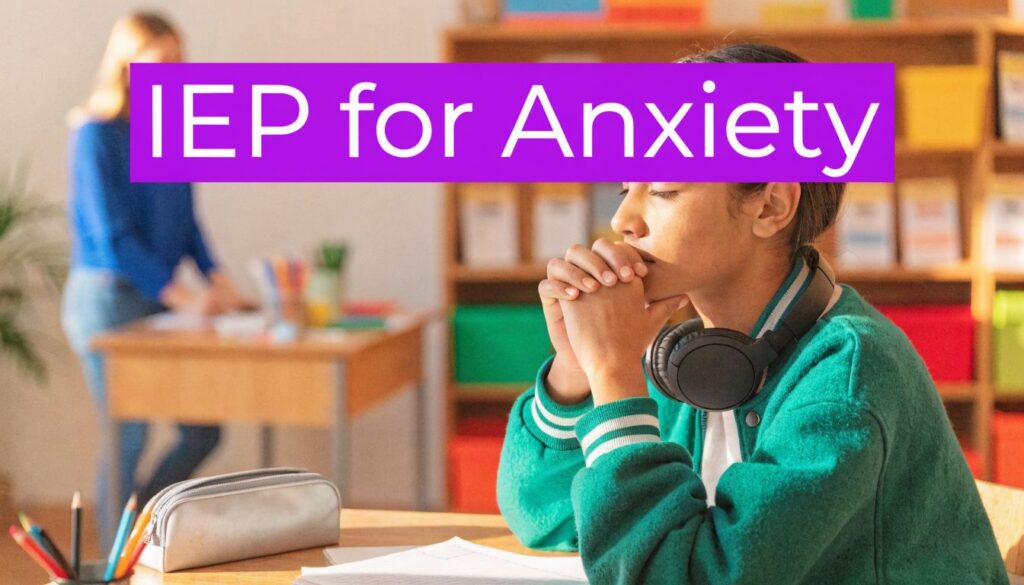
Your child says they’re fine at school, then melts down over homework. They complain of stomachaches on Sunday night. They ask to stay home on presentation days. They spend an hour erasing one paragraph because it has to be perfect. You can see they’re smart. You can also see school is getting harder, not easier.
Many parents sit in that exact space for a long time. They wonder whether this is ordinary stress, a phase, or something the school should be helping with. If that's where you are, an iep for anxiety disorder may be part of the answer.
An IEP is not a punishment, and it isn't a label that defines your child. Think of it more like a customized instruction manual for school. It tells the team what anxiety looks like for your child, how it affects learning, and what supports need to be in place so your child can access education.
Is Your Child's Anxiety More Than Just Worry
Anxiety at school often hides in plain sight. It doesn't always look like a child saying, "I feel anxious." More often, it shows up as avoidance, tears, shutdowns, irritability, perfectionism, or constant physical complaints.
A child might beg to stay home on test days. Another might go to school every day but miss half the lesson because they’re too worried to start the work. Another may look compliant, quiet, and "well behaved" while internally feeling overwhelmed all day.
Common signs parents notice first
You may be seeing patterns like these:
- School refusal: Your child becomes distressed before school, especially on certain days or around certain classes.
- Physical symptoms: Headaches, stomachaches, nausea, or repeated trips to the nurse happen most often on school days.
- Homework gridlock: Assignments that should take a short time stretch into long, exhausting evenings.
- Perfectionism: Your child freezes if they can't do something exactly right.
- Avoidance: They skip class participation, presentations, group work, or asking for help.
- Emotional fallout after school: They hold it together all day, then unravel at home.
Anxiety isn't measured by how dramatic it looks. It's measured by how much it interferes with your child's ability to learn, attend, participate, and function at school.
That distinction matters. Schools don't create IEPs just because a child has a diagnosis. They create them when a disability affects educational performance and the child needs specially designed instruction or related services.
If you've been told, "They're doing okay academically, so they must be fine," trust your observations. Academic grades are only part of the picture. Attendance, participation, stamina, emotional regulation, and the ability to access the school day all matter.
How Anxiety Affects Learning at School
Anxiety changes how a child experiences the entire school day. It can affect attention, memory, work completion, attendance, peer relationships, and behavior. A child may know the material and still be unable to show it consistently.
According to recent information summarized with National Institute of Mental Health data, 31.9% of adolescents ages 13 to 19 have an identified anxiety disorder. That helps explain why schools regularly see students whose anxiety interferes with attendance, concentration, and participation.

What anxiety can look like in a classroom
Some students show obvious distress. Others look oppositional, distracted, or withdrawn. Here are a few school-based examples parents often recognize once someone names them:
- The child who never starts work: They stare at the page, not because they don't know what to do, but because they're afraid of doing it wrong.
- The student who asks for constant reassurance: "Is this right?" becomes a coping strategy for anxiety.
- The child who misses instruction: Frequent nurse visits, bathroom trips, or time outside the room add up.
- The quiet student in group work: Social anxiety can make collaboration feel impossible.
- The child who melts down over changes: A substitute teacher, changed seating chart, or surprise quiz can throw off the whole day.
Educational impact is broader than grades
Parents often find this confusing. A child can have average or even strong grades and still have a disability-related school impact. If they are spending extreme energy just to get through the day, avoiding important tasks, or relying on unsustainable coping habits, that matters.
Think of school performance like a three-legged stool. One leg is academics. Another is behavior and emotional regulation. The third is access, meaning attendance, participation, and engagement. Anxiety can destabilize any of those legs.
For some families, anxiety overlaps with learning differences or twice-exceptional profiles. If that sounds familiar, this guide on children with learning challenges can help you think through how strong abilities and hidden struggles can coexist.
School behaviors that may actually be anxiety
Parents are often told a child is unmotivated, defiant, or careless. Sometimes that's not the full story. Anxiety can drive behaviors such as:
- Incomplete work because the child gets stuck in perfectionism
- Refusal to present because speaking in front of peers feels threatening
- Late arrivals or absences because getting into the building triggers panic
- Shutting down during tests even after studying
- Irritability or escape behaviors when demands feel overwhelming
If your child is a teenager, this practical article on how to help a teenager with anxiety can help you connect what you're seeing at home with what may be happening at school.
A useful phrase in school meetings is: "My child isn't just worried. Anxiety is interfering with access to instruction, completion of work, and participation in the school day."
That language helps shift the conversation from personality to educational impact.
Understanding Your Options IEP vs 504 Plan
Parents often hear both terms in the same meeting and leave more confused than when they arrived. That's understandable. An IEP and a 504 Plan can both support a child with anxiety, but they do different jobs.
A simple analogy helps. A 504 Plan is like a ramp into the building. It improves access to the same general environment. An IEP is more like a specialized route with instruction, support, and services built around your child's needs.

What a 504 Plan does
Under Section 504, a student with anxiety can qualify if the condition substantially limits a major life activity such as concentrating, learning, or school participation. A 504 plan usually provides accommodations in general education, such as extended time, breaks, or a quiet testing location. One verified source also notes that these environmental supports can show up to 20 to 30% improvement in task completion rates in implementation benchmarks, as described by Mission Prep's overview of school supports.
A 504 Plan is often appropriate when the child can learn the curriculum but needs barriers reduced.
What an IEP does
An IEP falls under IDEA, special education law. It is for students whose disability requires specially designed instruction, not just accommodations. For anxiety, that may mean direct teaching in coping strategies, counseling, behavior supports, or explicit instruction in self-regulation and school participation skills.
With an IEP, the school isn't only changing the environment. The school is also teaching missing skills and delivering services.
IEP vs. 504 Plan for Anxiety at a Glance
| Feature | IEP (Individuals with Disabilities Education Act) | 504 Plan (Section 504 of the Rehabilitation Act) |
|---|---|---|
| Primary purpose | Special education and related services | Equal access through accommodations |
| Who qualifies | Student has a disability and needs specially designed instruction | Student has a disability that substantially limits a major life activity |
| What it includes | Goals, services, accommodations, progress monitoring | Accommodations and access supports |
| Examples for anxiety | Counseling, self-regulation instruction, attendance goals, coping-skill teaching | Extended time, breaks, quiet space, seating changes |
| Progress tracking | Formal progress on annual goals | Usually less formal, based on accommodation effectiveness |
| Legal structure | IDEA | Section 504 |
When parents often need to push for clarity
Sometimes schools say, "Let's just do a 504," when the child may need an IEP. That's not automatically wrong, but it's worth slowing down and asking one key question:
Is my child only needing access supports, or do they also need direct instruction and services to learn how to manage anxiety in the school setting?
If the child needs skill-building, not just flexibility, an IEP may be the better fit.
A good school team should be able to explain why they recommend one path over the other. If they can't explain it clearly, ask them to describe what support your child would receive under each option.
Qualifying for an IEP for Anxiety
A diagnosis can open the door to a conversation, but it doesn't automatically qualify a child for special education. This is one of the hardest parts for parents, because it can feel like the school is minimizing what your child is going through.
What the school is supposed to ask is different: How does the anxiety affect educational performance, and does the student need special education because of it?
The legal categories that may apply
Under IDEA, anxiety is often considered under the category of Emotional Disturbance, defined in federal regulations as a condition over time that adversely affects educational performance, including difficulty with relationships, inappropriate feelings under normal circumstances, or pervasive unhappiness. That plain-language description is summarized in The REACH Institute's explanation of IEP and 504 accommodations.
Sometimes anxiety may also be discussed under Other Health Impairment, especially when it significantly affects alertness, stamina, or functioning. Schools use categories for eligibility. They should not use them to avoid addressing actual need.
What schools need to see
Think of the evaluation process as a fact-finding mission. The team is gathering evidence that answers two questions:
- Is there a disability-related concern?
- Is that concern affecting school enough that specially designed instruction is needed?
Helpful evidence may include:
- Attendance patterns: absences, tardiness, early pickups
- Behavior patterns: shutdowns, avoidance, panic, repeated nurse visits
- Teacher observations: participation, task initiation, response to feedback
- Parent input: what happens before school, after school, and during homework
- Outside records: therapy notes, psychiatric evaluation summaries, pediatrician documentation
If you're preparing outside documentation, this overview of what happens during a psychiatric evaluation can help you understand what information may be useful.
What to put in a written evaluation request
You don't need legal language. You do need clarity. A written request should include:
- Your concern: "My child has significant anxiety that is affecting school."
- What you are seeing: missed school, panic before presentations, inability to complete work, avoidance, physical complaints
- What you are requesting: a full special education evaluation, including mental health and functional school impact
- Any outside information: diagnoses, therapy records, medication history if relevant
Here is a plain example:
"I am requesting a comprehensive special education evaluation for my child due to anxiety that is affecting attendance, class participation, and work completion. I would like the school to assess all areas of suspected disability, including social, emotional, behavioral, and academic impact."
Assessments that may be part of the process
The school may use several tools, depending on your child's needs:
- Psychological evaluation
- Classroom observations
- Interviews with parents and teachers
- Rating scales
- Attendance and work completion review
- Functional Behavioral Assessment (FBA) if avoidance or behavior is a major concern
An FBA can be especially useful when anxiety shows up as escape behavior. In simple terms, it asks, "What is this behavior doing for the child?" If the answer is "getting out of a stressful demand," the plan needs to address anxiety directly, not just punish the behavior.
Building an Effective IEP for Anxiety
A weak IEP for anxiety often looks polished on paper but misses the core issue. It might list a few accommodations, add generic counseling, and never teach the child what to do when anxiety hits.
A strong iep for anxiety disorder is different. It identifies how anxiety shows up, names the school impact, and builds supports around skill development.

Start with present levels that tell the truth
The PLAAFP section should describe what anxiety looks like during the school day. Not just "struggles with emotions." Not just "has difficulty focusing."
It should name patterns such as:
- avoids entering class after transitions
- shuts down when asked to read aloud
- misses instruction due to repeated bathroom use
- becomes tearful when corrected
- needs repeated adult reassurance to begin work
If the present levels are vague, the rest of the IEP usually will be too.
Accommodations that reduce barriers
Accommodations matter. They don't replace instruction, but they make the day more manageable while the child learns new skills.
Helpful anxiety-related accommodations may include:
- Predictability supports: visual schedules, advance notice of changes, test previews
- Environmental supports: preferential seating, quiet testing area, access to a calm space
- Task supports: chunked assignments, extra processing time, reduced pressure for public performance
- Regulation supports: break card, trusted adult check-in, movement breaks
If you want a broader framework for thinking through options, this IEP accommodations and modifications list is a useful planning resource before meetings.
Services that teach, not just soothe
Many plans fall short for children with anxiety. A child with anxiety often needs more than "someone to talk to." They may need direct instruction in recognizing triggers, using coping strategies, tolerating mistakes, asking for help, or returning to class after distress.
School-based services might include counseling, social skills instruction, or behavior support. In many cases, strategies grounded in cognitive behavioral therapy principles are especially relevant because they teach students how thoughts, feelings, and actions connect.
Practical rule: If a support can't be described, taught, practiced, and measured, it's probably too vague to protect your child.
What measurable goals look like
Goals are where the IEP becomes real. A vague goal such as "Student will manage anxiety better" is almost impossible to monitor.
A stronger goal names the behavior, the skill, and the expected progress. Verified examples from federal guidance include a student progressing from 0 to 4 independent uses of relaxation strategies weekly during panic attacks over 36 weeks, or responding to criticism appropriately in 4 out of 5 instances using self-regulation techniques, as outlined in the U.S. Department of Education anxiety disorders fact sheet.
Here is the difference in plain language:
| Weak goal | Stronger goal |
|---|---|
| "Will reduce anxiety." | "When overwhelmed, student will independently use a taught coping strategy during 4 out of 5 observed opportunities." |
| "Will improve attendance." | "Student will attend school consistently with reduced avoidance behaviors, as measured by attendance data." |
| "Will accept feedback." | "Student will respond to correction using a self-regulation strategy in 4 out of 5 instances." |
Before and after example
Before:
"Student will feel less anxious at school."
After:
"During non-preferred or high-stress academic tasks, student will use a pre-taught coping strategy and remain engaged with adult support fading over time, as measured by staff data collection."
The second version gives the team something to teach and track.
The root cause has to stay visible
Administrative decisions and court rulings have emphasized an important principle: schools must address anxiety as the cause, not just the behavior that comes out of it. If a child is missing class because they panic in crowded hallways, the plan shouldn't only target tardiness. It should target the anxiety and the skills needed to manage that moment.
That's the heart of a useful IEP. It doesn't punish the smoke while ignoring the fire.
Your Step-by-Step Guide to the IEP Process
Parents often tell me the process feels like a maze. It helps to treat it less like one giant event and more like a sequence of smaller moves. You're not trying to master special education law in a weekend. You're trying to keep putting one foot in front of the other.

Step 1 Document what you're seeing
Start with a simple record. Keep notes on attendance problems, homework struggles, school avoidance, panic symptoms, emails from teachers, and patterns around specific classes or triggers.
You don't need a fancy binder to begin. A notes app, folder, or dated document works fine if you keep it organized.
Step 2 Make the request in writing
Send a clear written request for evaluation to the school. Email is often easiest because it creates a paper trail.
Include:
- Your concern
- Examples of educational impact
- Your request for a full evaluation
- Any outside documentation you have
Short and direct is better than emotional and long.
Step 3 Gather outside information
If your child has a therapist, psychiatrist, pediatrician, or previous evaluator, gather records that help describe the anxiety and its impact. You aren't trying to overwhelm the school with paperwork. You're trying to give the team a fuller picture.
This is especially important when anxiety is hidden at school but intense at home.
Step 4 Review the evaluation carefully
Before the eligibility meeting, read the reports. Highlight anything that matches what you've been seeing. Circle anything confusing or incomplete.
Make a list with three columns:
| What the report confirms | What seems missing | Questions to ask |
|---|---|---|
| panic around school attendance | little mention of homework gridlock | how was class avoidance measured? |
| social withdrawal | no observation during high-stress class | was presentation anxiety assessed? |
| physical complaints | limited parent input | can we add more home data? |
That format keeps meetings grounded and focused.
Step 5 Prepare for the meeting like a conversation, not a showdown
Many parents brace for battle. Sometimes conflict happens, but preparation usually helps more than armor.
Bring:
- A short parent statement
- Your list of concerns and priorities
- Questions about eligibility, goals, and services
- A support person if needed
Bring a one-page summary if you're overwhelmed. It helps you stay grounded and helps the team hear you clearly.
You can also ask for draft goals or proposed documents before the meeting. That gives you time to think instead of reacting in real time.
Step 6 Ask the right questions in the meeting
You don't need to know everything. You do need to ask clear questions such as:
- How is anxiety affecting educational performance?
- Why are you recommending a 504 instead of an IEP, or vice versa?
- What skill will my child be explicitly taught?
- How will progress be measured?
- Who is responsible for each support?
These questions shift the meeting from vague reassurance to concrete planning.
Step 7 Review the final IEP after the meeting
Read the document once emotions settle. Check whether the written plan matches what was discussed.
Look for these basics:
- Present levels are specific
- Goals are measurable
- Accommodations are clear
- Services include frequency and setting
- Progress monitoring is defined
If something is missing or inaccurate, respond in writing and ask for correction.
Step 8 Monitor and revisit
An IEP is not set-and-forget paperwork. Watch how it works in real life. Is attendance improving? Is your child using the strategies? Are teachers implementing the accommodations consistently?
If not, you can request another meeting. You do not have to wait for the annual review if the plan isn't working.
Partnering for Success with reVIBE Mental Health
One of the biggest gaps parents run into is the disconnect between school support and private treatment. The school may be focused on attendance, behavior, or class participation. Your child's therapist may be working on panic, trauma, or emotional regulation. If those two worlds never connect, the child ends up carrying the burden alone.
That gap matters because guidance on anxiety IEPs rarely explains how to integrate outside care. One verified source notes that parents often need help aligning private therapy, EMDR, or medication management with school planning, and that using outside progress reports in IEP meetings can support more coordinated care, as discussed in A Day in Our Shoes on IEP goals for anxiety.
A strong private provider can help by documenting symptoms clearly, describing how anxiety affects functioning, and identifying strategies that are already helping. That information can strengthen school evaluations, shape realistic goals, and help the IEP team understand what the child needs during the school day.
Ongoing care can also reinforce what the school is trying to build. If a student is learning coping skills, emotional regulation, or ways to respond to triggers in therapy, those same skills can be carried into the classroom more consistently when adults are working from the same playbook.
For families in the Phoenix area, reVIBE Mental Health offers therapy, EMDR, psychiatry, and medication management that can support children and teens with anxiety while families manage school planning.
Find a reVIBE Location Near You!
We currently have five locations for your convenience. (480) 674-9220
- reVIBE Mental Health – Chandler: 3377 S Price Rd, Suite 105, Chandler, AZ
- reVIBE Mental Health – Phoenix Deer Valley: 2222 W Pinnacle Peak Rd, Suite 220, Phoenix, AZ
- reVIBE Mental Health – Phoenix PV: 4646 E Greenway Road, Suite 100, Phoenix, AZ
- reVIBE Mental Health – Scottsdale: 8700 E Via de Ventura, Suite 280, Scottsdale, AZ
- reVIBE Mental Health – Tempe: 3920 S Rural Rd, Suite 112, Tempe, AZ
If you're trying to help your child with anxiety at school and want support that connects what happens in the therapy office with what happens in the classroom, reVIBE Mental Health can help you take the next step. Their team works with children, teens, and families across the Phoenix area through therapy, EMDR, psychiatry, and medication management, with in-person and online options available.